

What to Pair With Tricep Workout for Maximum Muscle Gains
Pairing the right exercises with your tricep workout can make a big difference in your results. Many people just focus on triceps, but smart pairing helps you build stronger arms, better muscle balance, and even boosts your overall fitness. If you’re not sure what to do with your triceps, you might end up wasting effort or even risking injury. This guide will help you pick the best exercises, explain why certain combinations work, and show you how to structure your routine for maximum effect.
You’ll learn which muscle groups to target alongside your triceps, how to choose exercises based on your goals, and practical tips to avoid common mistakes. With simple explanations, examples, and useful tables, you’ll be ready to create a workout that fits your needs and keeps your training safe and effective.
Why Pairing Matters In Tricep Workouts
Pairing exercises is more than just mixing things up. When you train triceps, you’re often working other muscles too. If you don’t pair wisely, you might overload your joints or miss chances to build full arm strength. For example, after a heavy tricep session, your elbows can be tired, so adding certain exercises can help you recover or activate supporting muscles.
Studies show that combining muscle groups in workouts can improve gains. A research review found that pairing opposing muscles (like triceps and biceps) can help boost overall strength and prevent injury. It also helps your body recover faster, as different muscles support each other.
Beginners often forget that triceps are involved in many pushing movements. If you just repeat tricep-only exercises, you can miss out on bigger improvements. Smart pairings help you work the triceps from new angles, build supporting muscles, and keep your workouts interesting.
Best Muscle Groups To Pair With Triceps
Not every muscle group works well with triceps. Some pairings are natural, while others can cause fatigue or imbalance. Here are the most effective groups:
Chest
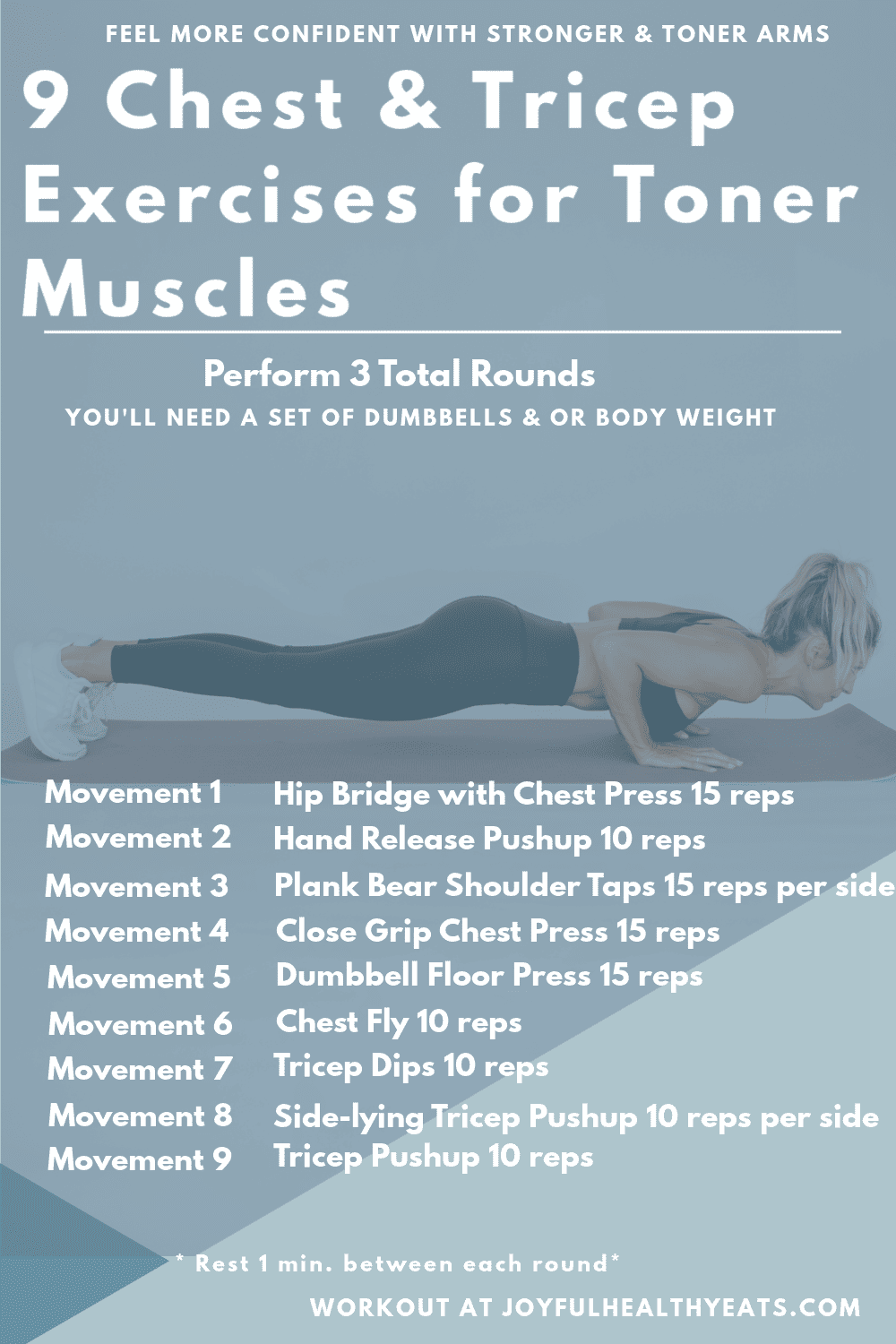
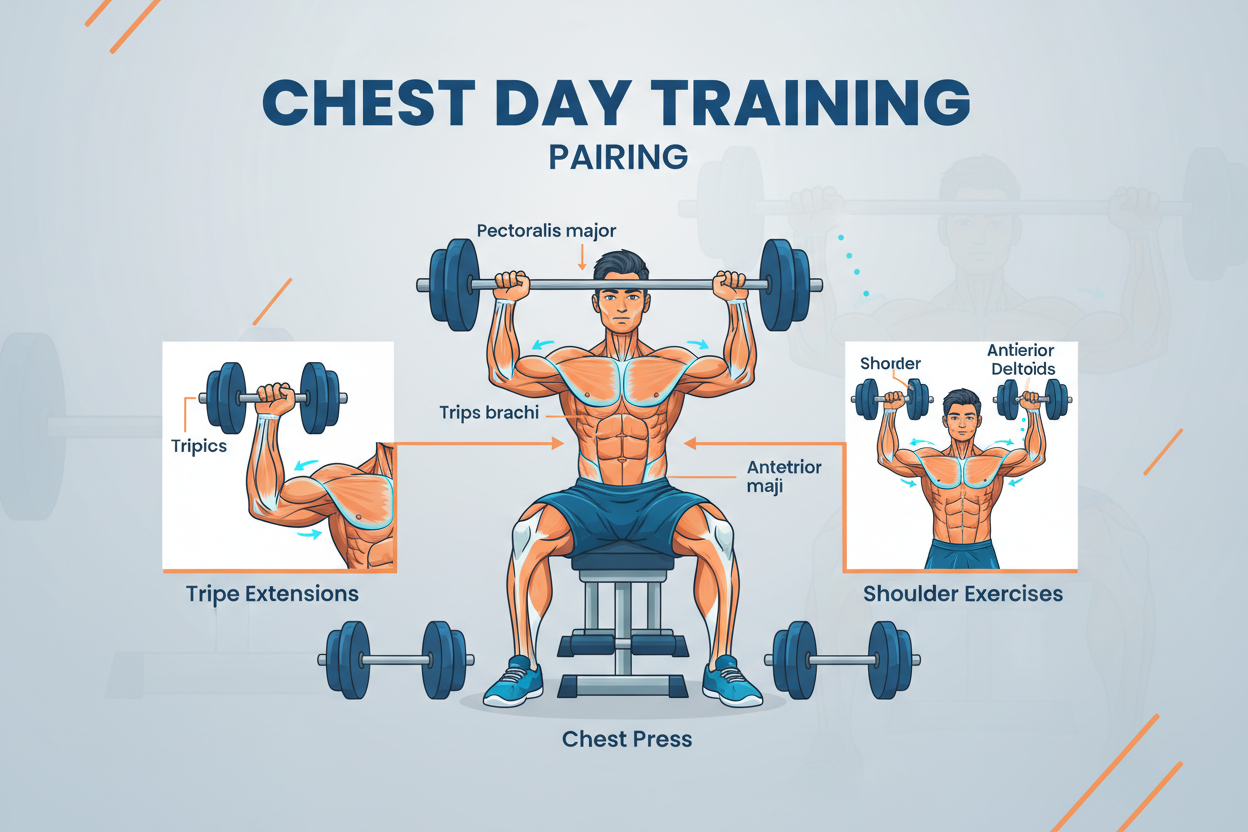
The chest and triceps often work together in pushing movements. Exercises like push-ups, bench presses, and dips use both muscles. Pairing them helps you train efficiently and save time. It also increases the load on your triceps, leading to greater growth.
Shoulders
Shoulders support many tricep exercises, especially overhead movements. When you train triceps and shoulders together, you improve stability and reduce injury risk. This pairing is common in routines for athletes and those who want stronger, more balanced arms.
Biceps
While biceps are the opposite of triceps, pairing them in the same session can help balance muscle growth. Some people do “arm day” routines, hitting both muscles. This keeps your arms looking even and prevents strength gaps.
Back
The back is less directly involved with triceps, but pairing them can work if you’re using compound movements. For example, close-grip pull-ups use both triceps and some back muscles. This combo can be good for full upper-body routines.
Core
Adding core exercises to a tricep workout isn’t common, but it helps stabilize your body and improves posture. If you want to boost overall strength, pairing triceps with planks or other core moves can make your workout more complete.
Credit: www.joyfulhealthyeats.com
Common Exercise Pairings For Tricep Workouts
Let’s look at some popular pairings and why they work.
Push-pull Routine
This classic method pairs pushing (triceps, chest, shoulders) and pulling (back, biceps) exercises. It helps balance muscle use and prevents overworking one group.
Upper Body Split
Many people use an upper-body split, training triceps with chest and shoulders one day, then back and biceps another. This allows for focused training and better recovery.
Arm Day
Some routines group biceps and triceps together. This works well for people who want bigger arms or are short on time. It also lets you use supersets, where you switch quickly between the two muscles.
Full Body
If you’re busy or want overall fitness, pairing triceps with lower body or core exercises can be efficient. You get a complete workout in less time.
Sample Tricep Workout Pairings
Here are sample routines that use the best pairings. Each includes practical examples and tips.
Triceps + Chest
- Bench Press: 4 sets x 8 reps
- Tricep Dips: 3 sets x 10 reps
- Push-Ups: 3 sets x 12 reps
- Dumbbell Flyes: 3 sets x 10 reps
This combo works the pushing muscles. Start with a heavy compound exercise (bench press), then isolate the triceps with dips. Push-ups and flyes add volume and help with muscle endurance.
Triceps + Shoulders
- Overhead Press: 4 sets x 8 reps
- Skull Crushers: 3 sets x 10 reps
- Lateral Raises: 3 sets x 12 reps
- Tricep Rope Pushdown: 3 sets x 10 reps
Overhead presses work both shoulders and triceps. Skull crushers focus on the triceps, while lateral raises target the shoulders. Rope pushdowns finish the routine.
Triceps + Biceps
- Barbell Curl: 4 sets x 8 reps
- Tricep Kickbacks: 3 sets x 10 reps
- Hammer Curl: 3 sets x 12 reps
- Close-Grip Push-Up: 3 sets x 12 reps
Pairing curls with tricep exercises keeps your arms balanced. You can alternate between biceps and triceps for better pump and recovery.
Triceps + Core
- Plank: 3 sets x 1 minute
- Tricep Extension: 4 sets x 8 reps
- Russian Twist: 3 sets x 20 reps
- Diamond Push-Up: 3 sets x 10 reps
Adding core moves like planks and Russian twists gives stability and helps posture. Diamond push-ups are a great tricep finisher.
How To Structure Your Tricep Pairing Routine
Building a routine is more than picking exercises. You need to think about order, sets, reps, and rest.
Order Of Exercises
Always start with compound exercises—these use multiple muscles and require the most energy. For example, bench press or overhead press. After compounds, move to isolation exercises like tricep extensions or kickbacks.
Sets And Reps
For Strength: 4-5 Sets X 6-8 Reps
For Muscle Size: 3-4 Sets X 8-12 Reps
For Endurance: 2-3 Sets X 15+ Reps
Most people mix these, starting heavy and finishing with lighter, higher reps.
Rest Periods
Rest for 1-2 minutes between heavy sets, and 30-60 seconds for lighter exercises. If you’re using supersets (switching between triceps and another muscle), keep rests short to boost intensity.
Frequency
Train triceps and paired muscles 1-2 times per week. More than this can cause overuse or injury, especially if you’re doing heavy lifts.
Common Mistakes In Tricep Pairings
Pairing exercises seems easy, but there are traps. Here’s what to watch out for:
- Overlapping Muscle Fatigue: Training chest and triceps on back-to-back days can leave your arms too tired to perform well.
- Ignoring Recovery: Not enough rest between sessions leads to poor results and risk of injury.
- Using Only Isolation Exercises: Focusing just on tricep extensions misses the benefits of compound moves.
- Poor Exercise Order: Doing isolation before compound exercises can make your big lifts weaker.
- Skipping Warm-Up: Start every session with a warm-up to protect joints and boost performance.
Advanced Pairing Strategies
If you’re experienced, you can try some advanced methods to boost your tricep gains.
Supersets
Supersets involve doing two exercises back-to-back, usually for opposing muscles. For triceps, you can pair with biceps:
- Tricep Pushdown + Barbell Curl
This method increases intensity and saves time.
Drop Sets
Drop sets mean doing an exercise, then reducing the weight and continuing without rest. For triceps:
- Tricep Rope Pushdown: Start heavy, then drop weight and keep going.
It’s great for building endurance and muscle size.
Pre-exhaustion
Start with an isolation exercise to tire the triceps, then do a compound move:
- Tricep Extension (isolation)
- Bench Press (compound)
This technique can help you target the triceps more in big lifts.
Circuit Training
Circuits combine several exercises with little rest. For triceps pairings:
- Bench Press
- Tricep Extension
- Push-Up
- Plank
Do each for 30 seconds, rest 1 minute, repeat. This boosts heart rate and muscle endurance.
Comparison: Triceps Pairing Options
To help you choose, here’s a comparison of common pairings.
| Pairing | Main Benefit | Best For | Drawback |
|---|---|---|---|
| Chest | Max strength & muscle growth | Bodybuilders, athletes | Risk of fatigue in elbows |
| Shoulders | Improved stability | Functional strength | Shoulder overuse |
| Biceps | Balanced arm size | Beginners, arm-focused | May miss compound benefits |
| Back | Upper body endurance | Advanced routines | Complex to program |
| Core | Better posture | Full body fitness | Less direct tricep growth |
Credit: www.gxmmat.us
How To Choose Exercises For Your Goals
Your goals decide which pairings are best.
Muscle Growth
Focus on compound lifts and heavy weights. Pair triceps with chest or shoulders for maximum muscle size.
Strength
Use heavy, low-rep sets. Pair with other pushing muscles for full force.
Endurance
Use lighter weights, more reps, and circuits. Pair with core or full-body moves.
Balanced Arms
Pair triceps with biceps. Alternate sets for both muscles to keep growth even.
Time Efficiency
If you’re busy, use supersets or circuits. Pair triceps with chest or biceps, and keep rest short.
Practical Tips For Safe Pairing
Pairing exercises can be tricky. Here’s how to stay safe:
- Warm up with light cardio and dynamic stretches.
- Use proper form to protect elbows and shoulders.
- Start with lower weights until you’re confident.
- Change pairings every few weeks to prevent plateau.
- Listen to your body—if you feel pain, stop and rest.
Real-life Example: Effective Tricep Pairing
Let’s see how pairing works for a busy person.
Maria is a beginner with little time. She wants stronger arms and better fitness. Her routine:
- Bench Press: 3 sets x 8 reps
- Tricep Extension: 3 sets x 10 reps
- Plank: 3 sets x 30 seconds
- Barbell Curl: 3 sets x 10 reps
Maria pairs triceps with chest, adds a core move for stability, and balances arms with curls. She trains twice per week, rests 48 hours between sessions.
Key insight: Beginners often miss the benefit of mixing compound and isolation exercises. Maria’s routine helps her build strength, avoid injury, and stay motivated.
Data: Effects Of Pairing On Muscle Growth
Research shows pairing triceps with other muscle groups boosts results. A study found that compound exercises (bench press, push-ups) increase tricep activation by up to 30% compared to isolation only.
Here’s a data table on muscle activation:
| Exercise | Tricep Activation (%) | Other Muscle Activation (%) |
|---|---|---|
| Bench Press | 60 | Chest: 75 |
| Tricep Extension | 90 | Minimal |
| Push-Up | 65 | Chest: 70 |
| Overhead Press | 55 | Shoulders: 80 |
| Skull Crusher | 85 | Minimal |
Non-obvious insight: Many think isolation exercises are best for triceps, but compound moves offer almost as much activation—plus extra benefits.
Tricep Pairing For Different Fitness Levels
Beginner
- Focus on form and simple pairings (triceps + chest or biceps).
- Use moderate weights.
- Limit total exercises to 4-5 per session.
Intermediate
- Try advanced pairings (shoulders, circuits).
- Add more sets and reps.
- Use supersets for intensity.
Advanced
- Mix all pairings.
- Use drop sets, pre-exhaustion, and circuits.
- Change routines every few weeks for continued growth.
Tricep Pairing For Home Workouts
You don’t need a gym to pair tricep exercises. Here are home-friendly combos:
- Triceps + Chest: Push-ups, diamond push-ups, dips on a chair.
- Triceps + Biceps: Resistance band curls, tricep extensions.
- Triceps + Core: Planks, mountain climbers, close-grip push-ups.
Home routines can be just as effective. Use household items for resistance, and focus on form.
Credit: braingain.fit
Timing: When To Pair Triceps
When you train triceps depends on your routine. Here’s a guide:
| Routine Type | Tricep Training Frequency | Pairing Suggestion |
|---|---|---|
| Full Body | 2-3 times/week | Chest, shoulders, core |
| Upper Body Split | 1-2 times/week | Chest, shoulders |
| Arm Day | 1 time/week | Biceps, forearms |
Tip: Don’t train triceps on back-to-back days. Give 48 hours rest for best recovery.
Importance Of Stretching And Cool Down
Pairing exercises isn’t just about what you do during the workout. Stretching and cooling down matter too.
- Stretch triceps, chest, and shoulders after your session.
- Hold each stretch for 20-30 seconds.
- Use foam rolling to release tight spots.
This reduces soreness, improves flexibility, and helps you recover faster.
Nutrition For Tricep Pairing
You need the right fuel for muscle growth.
- Eat protein after your workout (chicken, eggs, beans).
- Include healthy carbs (rice, potatoes) for energy.
- Stay hydrated.
Try to eat within 1 hour after training. This helps muscles repair and grow.
Tracking Progress With Paired Workouts
To get the most from pairings, track your workouts.
- Write down exercises, sets, reps, and weights.
- Note how you feel after each session.
- Adjust pairings every 4-6 weeks based on progress.
Tracking helps you spot plateaus and keeps you motivated.
Frequently Asked Questions
What Muscles Should I Pair With Triceps For Best Results?
The chest and shoulders are the most common pairings. They work together in pushing movements, helping you build strength and muscle. Pairing with biceps also helps balance arm growth.
Can I Pair Triceps With Back Exercises?
Yes, but it’s less common. Some compound moves, like close-grip pull-ups, use both triceps and back muscles. It works best in full-body or advanced routines.
How Often Should I Pair Triceps With Other Muscles?
Most people pair triceps once or twice per week. This gives enough recovery time. Avoid training triceps with the same group on back-to-back days to prevent overuse.
Is It Safe To Use Supersets When Pairing Triceps?
Supersets are safe if you use proper form and don’t overdo it. Start with lighter weights and increase as you get stronger. Rest between sets to avoid fatigue.
What Are The Signs I’m Pairing Tricep Exercises Incorrectly?
Watch for joint pain, extreme fatigue, or slow progress. If you feel sore for days or lose strength, adjust your pairings, rest more, or change exercise order.
Pairing the right exercises with your tricep workout makes your training more effective and enjoyable. Smart combinations help you build muscle, prevent injury, and stay motivated. Remember to start with compound lifts, mix in isolation moves, and adjust your pairings to fit your goals. Tracking your progress, eating well, and stretching will keep you on the path to stronger, healthier arms. For more detailed exercise science, visit NCBI. Take these tips, customize your routine, and see the difference for yourself.
