

How to Workout Tricep at Home: Simple Moves for Big Results
How To Workout Tricep At Home
Strong arms do not come only from the gym. You can build impressive triceps right at home, without fancy equipment or heavy weights. The triceps muscle makes up most of your upper arm, so training it well leads to bigger, stronger arms and better overall strength. Many people focus on the biceps, but the triceps are even more important for pushing movements and real-life activities. Whether your goal is to gain muscle, improve tone, or simply get healthier, understanding how to train your triceps at home will help you see results.
This guide explains home-friendly tricep exercises, practical routines, and important mistakes to avoid. You will learn how to use your bodyweight, simple household items, and smart techniques to get the most out of each workout. Even if you are a beginner, you can follow these steps and start building stronger triceps today.
Why Triceps Matter
The triceps are often forgotten in home workouts. But these muscles are critical for:
- Arm strength: They support every pushing movement, from lifting to throwing.
- Muscle balance: Strong triceps prevent injuries and help biceps grow.
- Daily activities: Triceps help with movements like pushing open doors, lifting bags, or getting up from a chair.
Your triceps are made up of three parts, called “heads. ” Training each part leads to fuller, more balanced arms. Many people make the mistake of doing only one exercise, but mixing different movements is key.
Understanding The Triceps Muscle
The triceps brachii is located at the back of the upper arm. It has three heads:
- Long head: Runs along the back of the arm and is the largest section.
- Lateral head: Gives the arm its outer “horseshoe” shape.
- Medial head: Lies deep in the arm, under the other two.
Each head activates differently depending on the exercise. For example, overhead movements target the long head, while pushing exercises focus on the lateral and medial heads. Knowing which exercises work which part helps you train smarter.
How Triceps Work
The main job of the triceps is elbow extension. This means straightening your arm from a bent position. Whenever you push, press, or extend your arm, the triceps are working hard. This is why they are so important for strength and everyday tasks.
Benefits Of Home Tricep Workouts
Training your triceps at home offers several advantages:
- Convenience: No travel time or gym membership required.
- Flexibility: Workout anytime, with minimal space.
- Cost-saving: Use household items instead of expensive equipment.
- Privacy: Exercise comfortably without feeling watched.
Home workouts can be just as effective as gym sessions if you follow the right methods. You control the pace, rest, and exercise choices, making it easier to stick to a routine.
Essential Equipment For Home Tricep Training
You do not need much to train your triceps at home. Some exercises require only your bodyweight. Others use simple items you already have.
Bodyweight
Most exercises use your own weight for resistance. This makes them accessible and safe for beginners.
Household Items
- Backpack: Fill it with books or water bottles for extra resistance.
- Chair or bench: Use for dips or step-ups.
- Towel: Helps with grip and resistance.
- Water bottles: Substitute for dumbbells.
Resistance Bands
If you want more variety, buy a set of resistance bands. They are affordable, easy to store, and can make exercises harder as you improve.
Optional: Dumbbells
If you own dumbbells, you can do more advanced movements. But they are not required for effective tricep training.
Key Principles For Effective Tricep Workouts
Before you start, it is important to understand some basic rules:
- Progressive overload: Increase difficulty over time by adding reps, resistance, or new exercises.
- Proper form: Focus on technique to avoid injury and get maximum results.
- Full range of motion: Straighten your arms fully for best muscle activation.
- Rest and recovery: Give your muscles time to grow by resting between workouts.
Ignoring these principles leads to slow progress or injuries. Always check your form in a mirror or ask a friend to help.
Best Home Tricep Exercises
There are many ways to train your triceps at home. Below are the most effective exercises, grouped by difficulty and equipment needs.
Bodyweight Exercises
These movements use your own weight. They are ideal for beginners or anyone without equipment.
1. Tricep Dips (using Chair)
Sit on the edge of a sturdy chair. Place your hands beside your hips, fingers facing forward. Slide your body forward and lower yourself until your elbows are bent at 90 degrees. Push up to the starting position.
- Works: All three heads, especially the long head
- Tip: Keep your back close to the chair for better form
2. Diamond Push-ups
Get into a push-up position. Place your hands together under your chest, forming a diamond shape with your fingers and thumbs. Lower your body, keeping elbows close to your sides, then push back up.
- Works: Lateral and medial heads
- Tip: Go slow to prevent wrist pain
3. Close-grip Push-ups
Hands are placed shoulder-width apart. Lower yourself as in a normal push-up, but keep elbows tight to your sides.
- Works: All heads, with focus on medial and lateral
- Tip: Use knees for easier variation
4. Bench Or Table Push-ups
Place hands on a bench or table, feet on the floor. Perform push-ups from this elevated position.
- Works: Triceps and chest
- Tip: Good for beginners needing less resistance
5. Pike Push-ups
Start with hips high, feet and hands on the floor. Lower head toward the ground, elbows bending, then push up.
- Works: Triceps and shoulders
- Tip: Keep elbows close to target triceps
Exercises Using Household Items
6. Backpack Tricep Extensions
Fill a backpack with books. Hold it overhead with both hands. Lower it behind your head, keeping elbows close, then extend arms upward.
- Works: Long head
- Tip: Hold backpack tight to avoid swinging
7. Water Bottle Kickbacks
Hold a water bottle in each hand. Bend forward, keeping your back flat. Extend arms behind you, pause, then return to start.
- Works: All heads, especially lateral
- Tip: Use full range for best results
8. Chair Or Table Dips
Use two chairs or a sturdy table for a deeper dip. Place hands on one, feet on the other. Lower body between, then push up.
- Works: All heads
- Tip: Advanced variation for more resistance
9. Towel Pushdowns
Tie a towel to a door handle. Pull down with both hands, straightening arms.
- Works: Triceps, simulating cable pushdown
- Tip: Use slow, controlled movement
Resistance Band Exercises
Resistance bands add extra challenge and variation.
10. Band Overhead Extensions
Stand on the band. Hold handles overhead, lower behind head, then extend arms.
- Works: Long head
- Tip: Use thicker bands as you get stronger
11. Band Tricep Pushdowns
Attach band to a high point (door or hook). Pull down with both hands, straightening arms.
- Works: All heads
- Tip: Keep elbows close to sides
12. Band Kickbacks
Attach band to low point. Hold handle, extend arm behind you.
- Works: Lateral head
- Tip: Squeeze at the end of movement
Dumbbell Exercises (optional)
If you have dumbbells, try these:
13. Overhead Dumbbell Extension
Hold one or two dumbbells overhead. Lower behind head, then extend arms.
- Works: Long head
14. Dumbbell Kickbacks
Bend forward, hold dumbbells. Extend arms back, pause, return.
- Works: Lateral head
15. Dumbbell Floor Press
Lie on back, press dumbbells up, keeping elbows close.
- Works: Medial head
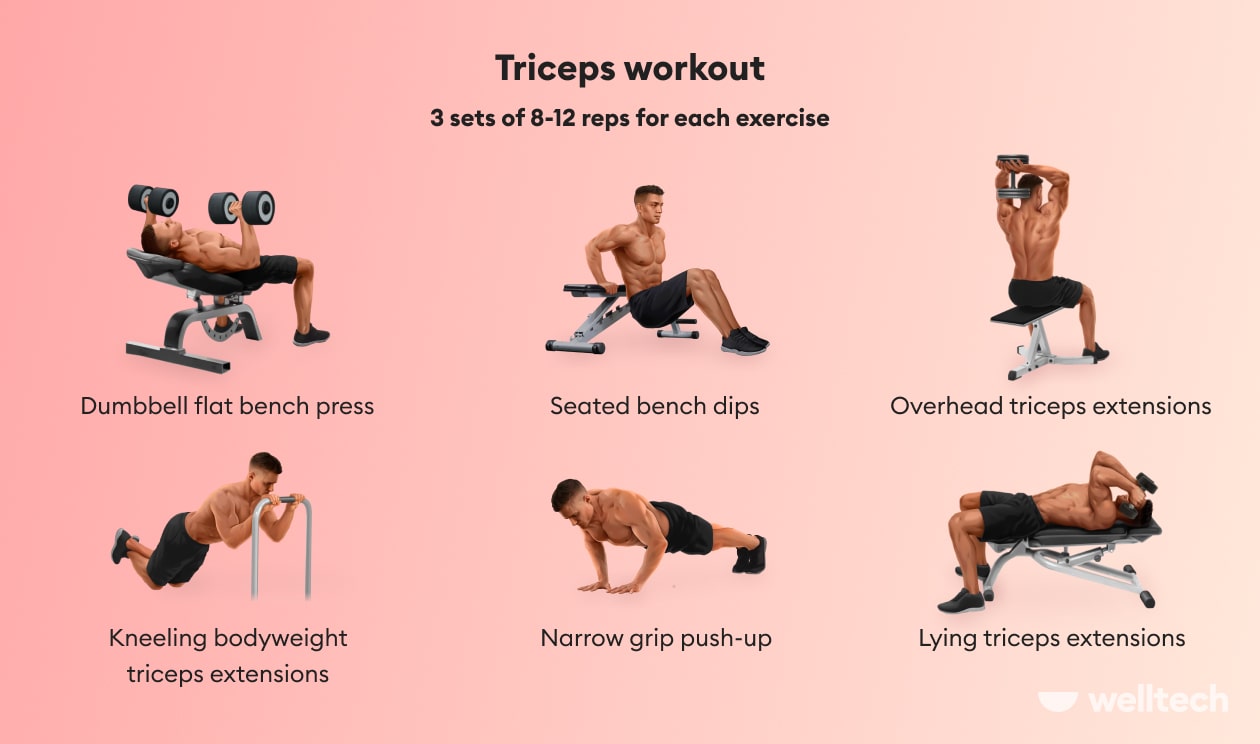
Credit: www.antillespr.edu
Sample Tricep Workout Routines At Home
Different routines fit different goals. Here are two sample plans:
Beginner Routine (no Equipment)
- Diamond Push-Ups: 3 sets x 8 reps
- Chair Dips: 3 sets x 10 reps
- Close-Grip Push-Ups: 3 sets x 8 reps
Rest 60 seconds between sets.
Intermediate Routine (with Household Items)
- Backpack Overhead Extension: 3 sets x 12 reps
- Water Bottle Kickbacks: 3 sets x 10 reps
- Chair Dips: 3 sets x 12 reps
Rest 45–60 seconds between sets.
Advanced Routine (with Bands/dumbbells)
- Band Overhead Extension: 4 sets x 10 reps
- Band Tricep Pushdowns: 4 sets x 10 reps
- Dumbbell Kickbacks: 4 sets x 10 reps
Rest 30–45 seconds between sets.
Adjust reps and sets based on your fitness level. If you cannot complete the reps, lower the number or use easier variations.
Comparing Tricep Exercises: Effectiveness And Difficulty
Below is a comparison of popular home tricep exercises. This helps you choose the right one based on your ability and available equipment.
| Exercise | Difficulty | Muscle Activation | Equipment Needed |
|---|---|---|---|
| Diamond Push-Up | Medium | High | None |
| Chair Dip | Medium | High | Chair |
| Water Bottle Kickback | Easy | Medium | Water Bottles |
| Band Pushdown | Medium | High | Band |
| Backpack Extension | Easy | Medium | Backpack |
| Dumbbell Kickback | Medium | High | Dumbbells |
How Often To Train Triceps At Home
Frequency depends on your goals and recovery:
- Beginner: 2–3 times per week
- Intermediate/Advanced: 3–4 times per week
Allow at least 48 hours of rest between tricep sessions. Overtraining can lead to soreness and slow progress.
Common Mistakes In Home Tricep Training
Many people do not see results because they make simple mistakes. Here are the most common ones and how to fix them:
1. Poor Form
Rushing through exercises or using bad form reduces muscle activation and increases injury risk. Always control the movement and focus on technique.
2. Not Using Full Range
If you do not fully straighten your arms, you miss out on tricep growth. Work through the complete range every time.
3. Skipping Progressive Overload
Doing the same exercises every week leads to plateaus. Increase reps, resistance, or try harder variations as you improve.
4. Neglecting Recovery
Muscles grow during rest, not during exercise. Skipping rest days or not sleeping enough slows progress.
5. Focusing Only On One Exercise
Triceps have three heads. Doing only dips or push-ups misses parts of the muscle. Use a mix of exercises to get full development.
Nutrition For Tricep Growth
Training is only part of the equation. Muscles need nutrients to grow and recover.
Protein
Protein is essential for muscle repair. Aim for 0.8–1 gram of protein per pound of bodyweight. Good sources include eggs, chicken, beans, and dairy.
Carbohydrates
Carbs provide energy for workouts. Choose whole grains, fruits, and vegetables.
Healthy Fats
Fats support hormone balance and joint health. Use olive oil, nuts, and avocados.
Hydration
Drink plenty of water. Muscles need hydration for best performance.
A smart nutrition plan will make your workouts more effective and help your triceps grow faster.
Tracking Progress At Home
Measuring results keeps you motivated. Here’s how to track your tricep growth:
- Take photos every 2–4 weeks
- Measure arm size with a tape
- Record reps/sets in a notebook
- Note strength improvements (more reps or heavier backpack)
Do not worry if progress is slow at first. Triceps often take time to show visible changes.
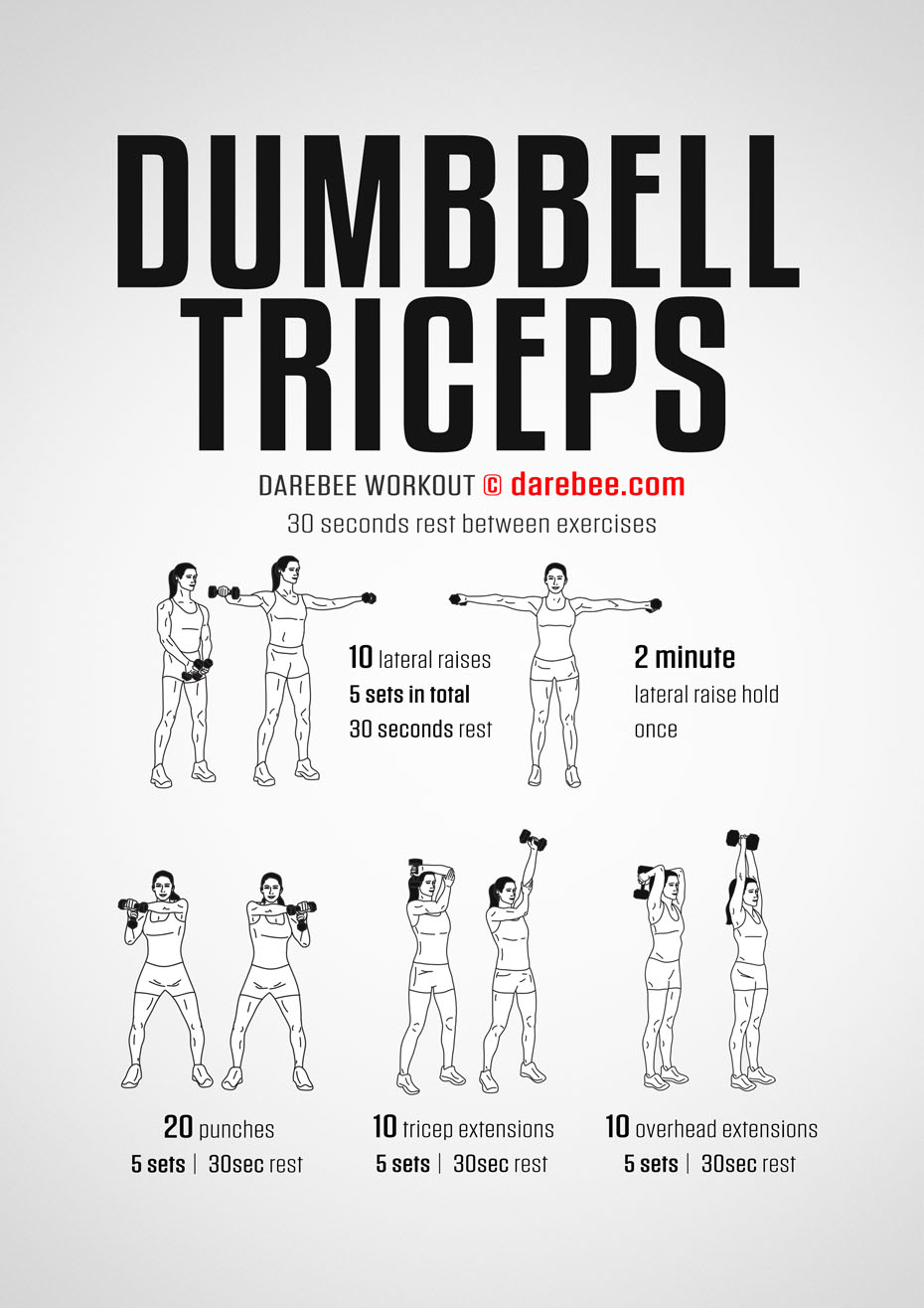
Credit: darebee.com
Advanced Tips For Home Tricep Training
Once you master the basics, try these advanced ideas:
1. Tempo Training
Slow down the lowering phase (eccentric), then explode upward. This increases muscle tension and growth.
2. Supersets
Combine two exercises back-to-back without rest. Example: diamond push-ups followed by chair dips.
3. Unilateral Movements
Train one arm at a time for better muscle balance. Try single-arm kickbacks or pushdowns.
4. Time Under Tension
Hold the extended position for 2–3 seconds at the end of each rep. This forces the muscle to work harder.
These techniques challenge your triceps and break through plateaus.
Comparing Home Vs Gym Tricep Training
Is training at home as effective as the gym? Here’s a direct comparison:
| Aspect | Home | Gym |
|---|---|---|
| Equipment Variety | Limited | Wide |
| Convenience | High | Medium |
| Cost | Low | High |
| Results | Good with consistency | Excellent if using machines and weights |
| Privacy | High | Low |
The main difference is equipment. But results depend more on your effort than location. With dedication, you can build strong triceps at home.
How To Stay Motivated For Home Tricep Workouts
Sticking to a home routine is harder for some people. Here are smart ways to stay on track:
- Set clear goals: Write down what you want to achieve.
- Schedule workouts: Pick specific days and times.
- Track progress: Use photos, measurements, or a journal.
- Find a workout partner: Challenge a friend or family member.
- Reward yourself: Celebrate milestones with small treats.
Motivation drops when you do not see results. Remember, triceps take time to change. Stay patient and consistent.
Real-life Examples: Success Stories
Many people have built strong triceps at home. For example, a college student used chair dips, diamond push-ups, and backpack extensions for six months. He gained two inches on his upper arm and improved his bench press strength. Another office worker, using water bottles and resistance bands, saw better definition and less arm fat after three months.
The secret is not equipment, but consistency. Simple exercises, done regularly, bring real results.

Credit: www.youtube.com
Safety Tips For Home Tricep Training
Home workouts are safe if you follow some basic rules:
- Check equipment: Make sure chairs and benches are stable.
- Warm up: Spend five minutes on arm circles, shoulder rotations, and light push-ups.
- Start slow: Begin with fewer reps and easier variations.
- Listen to your body: Stop if you feel pain (not muscle burn).
- Cool down: Stretch your triceps and shoulders after each session.
Avoid training on slippery floors or with broken equipment. Safety always comes first.
How To Combine Tricep Training With Other Workouts
Triceps work best as part of a balanced routine. Combine them with chest, shoulders, and back for total upper body strength.
A sample weekly plan:
- Day 1: Triceps + Chest
- Day 2: Back + Biceps
- Day 3: Triceps + Shoulders
- Day 4: Rest
Mixing muscle groups prevents overuse and gives better results.
How To Progress Over Time
Triceps respond well to gradual increases in challenge. Here’s how to keep improving:
- Add more reps or sets
- Use heavier household items (bigger backpack, larger water bottles)
- Try harder exercises (switch from chair dips to table dips)
- Reduce rest time between sets
- Use advanced techniques (supersets, tempo)
Growth happens when you push past your comfort zone. If you stop progressing, change your routine.
Why Form Matters More Than Weight
Many people think heavier weights lead to bigger muscles. But bad form ruins results and risks injury. Proper form activates the triceps fully, even with lighter resistance.
For example, diamond push-ups with perfect technique are harder than sloppy bench dips with a heavy backpack. Focus on quality over quantity.
How To Use Online Resources
YouTube and fitness sites offer video demonstrations. These help you learn proper form and new variations. Choose trusted sources and avoid “shortcut” advice.
For more information on exercise science, visit Healthline, a respected health resource.
Frequently Asked Questions
How Long Does It Take To See Tricep Results At Home?
Visible changes usually appear after 4–8 weeks of consistent training. Beginners may notice strength improvements sooner, but muscle definition takes time. Genetics, nutrition, and workout intensity all affect progress.
Can I Train Triceps Every Day?
It is not recommended. Muscles need rest to recover and grow. Overworking triceps can lead to soreness and slow results. Train them 2–4 times per week, with at least one day of rest between sessions.
What Is The Best Tricep Exercise For Beginners?
Chair dips and diamond push-ups are effective and easy to learn. They require no equipment and target all three heads of the triceps. Start with these and move to harder variations as you improve.
How Can I Increase Resistance At Home?
Use household items like a backpack filled with books, water bottles, or resistance bands. You can also slow down movements or increase reps. Changing angle and range of motion adds difficulty.
Why Are My Triceps Not Growing?
Possible reasons include poor form, lack of progressive overload, not eating enough protein, or overtraining. Review your routine and make sure you are increasing challenge and eating well. Tracking progress helps identify problems.
Building strong triceps at home is possible for everyone. With the right exercises, smart routines, and consistent effort, you can see real changes in your arm strength and size. Remember, patience and dedication are your best tools.
