

Glute Workout Routines: Sculpt Your Best Booty Fast
Glute Workout Routines: Build Stronger, Healthier Glutes
A strong lower body can change the way you move, feel, and even prevent injury. The glute muscles—your gluteus maximus, medius, and minimus—do more than just give shape to your backside. They are the powerhouse for walking, running, climbing stairs, and lifting heavy things. Strong glutes also stabilize your hips and spine, supporting your whole body. Yet, many people sit for hours each day, which can make glutes weak and tight.
If you want to build rounder, firmer, and more functional glutes, you need the right workout routine. But with so many exercises and programs out there, it's easy to feel lost. Should you use weights or bodyweight? How many times a week is best? What exercises actually make a difference?
This guide will answer all those questions, whether you’re a beginner or already experienced. You’ll learn why glute training matters, how to target each part of your glutes, and which routines get results. Plus, you’ll get practical tips, sample routines, comparison tables, and answers to the most common questions about glute workouts.
Why Glute Training Matters
Your glute muscles are among the largest and strongest in your body. They play a key role in:
- Hip extension and rotation (moving your leg behind or to the side)
- Stabilizing your pelvis when you walk or run
- Supporting your lower back and posture
- Power in sports like sprinting, jumping, and cycling
Weak glutes can cause problems such as back pain, knee pain, and poor balance. In fact, research shows that strong glutes can help prevent injuries in athletes and everyday people.
But there’s more. Well-developed glutes can:
- Improve your athletic performance
- Make daily tasks like lifting and climbing stairs easier
- Enhance your body’s appearance and confidence
Non-obvious insight: Many people think squats are enough for glutes, but research proves that different exercises hit glute muscles in different ways. For full development, you need a mix of movements.
Understanding The Glute Muscles
The “glutes” are made of three muscles:
- Gluteus Maximus: The largest, creates the main shape of your buttocks. Main job: hip extension (moving your thigh backward).
- Gluteus Medius: On the side of your hip. Controls hip abduction (moving your leg out to the side) and stabilizes your pelvis.
- Gluteus Minimus: The smallest, under the medius, helps with hip stability and rotation.
If you only train one movement (like squats), you’ll miss some of these muscles. For the best results, use exercises that target all three.
| Glute Muscle | Main Function | Best Exercise Example |
|---|---|---|
| Gluteus Maximus | Hip extension, outward rotation | Hip Thrust |
| Gluteus Medius | Hip abduction, pelvis stability | Lateral Band Walk |
| Gluteus Minimus | Hip internal rotation, support | Side-Lying Leg Raise |
Key Principles For Effective Glute Workouts
A good glute workout routine is more than just doing random exercises. Here are essential principles to follow for the best results:
1. Train Glutes Multiple Times Per Week
For most people, training glutes 2–3 times a week works best. This gives enough stimulus for growth and recovery. Beginners can start with 2 sessions per week. If you’re more advanced, three sessions may give extra benefits. Avoid training glutes hard two days in a row—muscles need time to recover.
2. Use A Mix Of Compound And Isolation Movements
Compound exercises work several muscles at once (like squats, lunges, deadlifts). Isolation exercises focus mainly on the glutes (like glute bridges, kickbacks). Mixing both gives full development.
3. Vary Your Rep Ranges
Heavy weights with low reps (6–8) build strength. Moderate reps (8–15) build muscle size. Higher reps (15–25) create muscle endurance. Changing rep ranges keeps workouts interesting and hits different muscle fibers.
4. Focus On Mind-muscle Connection
Think about squeezing your glutes during each rep. Slowing down the movement and pausing at the top can help activate the right muscles. Many people feel their thighs working more than their glutes—this tip can make a big difference.
Non-obvious insight: Glutes are often “sleepy” after years of sitting. Warming up with activation drills (like banded clamshells) before your main workout helps wake up your glutes for better results.
5. Progressive Overload
To grow stronger and bigger glutes, you need to do a bit more over time. This can mean adding weight, doing more reps, or using harder exercises. Keep track of your progress and aim to improve each week.
Best Glute Exercises (with Tips)
Here are the most effective glute exercises, how they work, and some practical tips to get the most out of each one.
Hip Thrust
This is the king of glute exercises. Sit on the ground with your upper back against a bench, feet flat. Place a barbell or weight across your hips. Push through your heels and lift your hips up, squeezing your glutes at the top.
Lower and repeat.
Tips: Keep your chin tucked, feet shoulder-width apart, and pause at the top. Don’t arch your back.
Squat (barbell Or Bodyweight)
Squats work your glutes, quads, and hamstrings. Stand with feet slightly wider than hips. Lower down as if sitting in a chair, keeping your chest up and knees out. Return to standing.
Tips: Push through your heels, not your toes. Go as low as your hips and knees allow without pain.
Romanian Deadlift
Hold a barbell or dumbbells. Stand tall, knees slightly bent. Hinge at your hips (not your back) and lower the weights down your legs. You should feel a stretch in your hamstrings and glutes. Stand back up by pushing your hips forward.
Tips: Keep your back flat. Don’t round your shoulders.
Bulgarian Split Squat
Stand with one foot behind you on a bench or step. Lower your back knee toward the ground while keeping your front foot flat. Push through your front heel to stand up.
Tips: Keep your torso upright. Move slowly for balance.
Glute Bridge
Lie on your back, knees bent, feet flat. Push through your heels to lift your hips up, squeezing your glutes. Lower and repeat.
Tips: Add a band around your knees for extra glute work.
Cable Kickback
Attach an ankle strap to a low cable. Stand facing the machine, kick your leg back and up, squeezing your glute. Return slowly.
Tips: Keep your core tight. Don’t swing your leg—control the motion.
Lateral Band Walk
Put a resistance band above your knees. Stand with feet hip-width apart, bend knees slightly. Step side to side, keeping tension on the band.
Tips: Don’t let your knees cave in. Stay low for better glute activation.
Clamshell
Lie on your side, knees bent, band above knees. Open your top knee like a clamshell, keeping feet together. Lower and repeat.
Tips: Don’t roll your hips back. Focus on your glute, not your lower back.

Credit: spotebi.com
Sample Glute Workout Routines
Below you’ll find routines for different levels and goals. Each routine has a mix of compound and isolation exercises. Adjust weights and reps as needed.
Beginner Glute Workout (2 Days A Week)
This routine focuses on learning the right movements and building a base.
Day 1:
- Bodyweight Squat – 3 sets x 12 reps
- Glute Bridge – 3 sets x 15 reps
- Lateral Band Walk – 2 sets x 20 steps
- Clamshell – 2 sets x 15 reps per side
Day 2:
- Romanian Deadlift (light dumbbells) – 3 sets x 10 reps
- Step-Up – 3 sets x 10 reps per leg
- Standing Glute Kickback – 2 sets x 15 reps per leg
- Side-Lying Leg Raise – 2 sets x 15 reps per side
Tips: Focus on good form. Rest 60–90 seconds between sets. Warm up with 5–10 minutes of light cardio and some glute activation drills.
Intermediate Glute Workout (3 Days A Week)
For those who want more challenge and have basic strength.
Day 1:
- Barbell Hip Thrust – 4 sets x 10 reps
- Bulgarian Split Squat – 3 sets x 8 reps per leg
- Lateral Band Walk – 3 sets x 20 steps
- Cable Kickback – 3 sets x 12 reps per leg
Day 2:
- Romanian Deadlift (moderate weight) – 4 sets x 8 reps
- Step-Up (weighted) – 3 sets x 10 reps per leg
- Glute Bridge (with band) – 3 sets x 15 reps
- Clamshell – 2 sets x 20 reps per side
Day 3:
- Goblet Squat – 4 sets x 12 reps
- Curtsy Lunge – 3 sets x 10 reps per leg
- Single-Leg Hip Thrust – 3 sets x 8 reps per leg
- Fire Hydrant (with band) – 2 sets x 15 reps per leg
Tips: Increase weights if last reps are too easy. Rest 60–120 seconds between sets.
Advanced Glute Workout (3 Days A Week)
For experienced trainees who want maximum development.
Day 1: Strength Focus
- Barbell Hip Thrust – 5 sets x 6 reps (heavy)
- Back Squat – 4 sets x 8 reps
- Romanian Deadlift – 4 sets x 8 reps
- Lateral Band Walk – 3 sets x 20 steps
Day 2: Volume & Isolation
- Dumbbell Step-Up – 4 sets x 12 reps per leg
- Bulgarian Split Squat (light-moderate) – 3 sets x 12 reps per leg
- Glute Bridge (with pause at top) – 3 sets x 20 reps
- Cable Kickback – 3 sets x 15 reps per leg
- Clamshell (banded) – 3 sets x 20 reps per side
Day 3: Plyometric & Endurance
- Jump Squat – 3 sets x 12 reps
- Single-Leg Hip Thrust – 3 sets x 10 reps per leg
- Curtsy Lunge – 3 sets x 12 reps per leg
- Fire Hydrant (banded) – 3 sets x 20 reps per leg
Tips: Use heavier weights for strength day, lighter for volume and endurance. Focus on explosive movement for jump squats. Rest 90–150 seconds on heavy sets.
Comparing Glute Workouts: Bodyweight Vs. Weights
Many wonder if you need weights for results. Both bodyweight and weighted exercises can build glutes, but there are differences.
| Method | Pros | Cons | Best For |
|---|---|---|---|
| Bodyweight | Easy to start, low injury risk, can do anywhere | Progression is limited, hard to increase challenge | Beginners, travel, home workouts |
| Weights (barbell, dumbbell) | More muscle growth, easier progression, variety | Need equipment, higher injury risk if form is poor | Intermediate, advanced, gym users |
Practical tip: If you train at home, use resistance bands or fill a backpack with books for extra weight.
Mistakes To Avoid In Glute Training
Even with the right exercises, common mistakes can slow your progress or cause injury:
- Poor form: Letting your back round, knees cave in, or using momentum instead of muscle.
- Neglecting warm-up: Jumping into heavy lifts without activating your glutes first.
- Overtraining: Doing too many hard sets without enough rest can lead to soreness and injury.
- Not using full range of motion: Partial reps reduce muscle activation and growth.
- Ignoring the medius and minimus: Focusing only on hip extension misses the side and stabilizing glutes.
Non-obvious insight: If you feel your lower back or hamstrings more than your glutes, you may need to lower the weight and slow down each rep. Sometimes, lighter weights with better control give better results.
Glute Training For Different Goals
Your routine should match your goal. Here’s how to adjust for different outcomes:
For Size And Shape
- Use moderate to heavy weights
- Focus on hip thrusts, squats, and deadlifts
- Train glutes 2–3 times a week with 8–15 reps per set
For Strength
- Lift heavier weights for fewer reps (4–8)
- Rest longer between sets (2–3 minutes)
- Focus on compound lifts like hip thrust, squat, deadlift
For Endurance And Tone
- Use lighter weights or bodyweight
- Do higher reps (15–25)
- Add circuits, plyometrics (like jump squats), and short rest
For Sports Performance
- Combine strength and explosive power
- Use box jumps, sprints, and resisted runs with traditional strength moves
Example: Soccer players benefit from lateral band walks and single-leg hip thrusts, as strong glutes improve speed and stability.
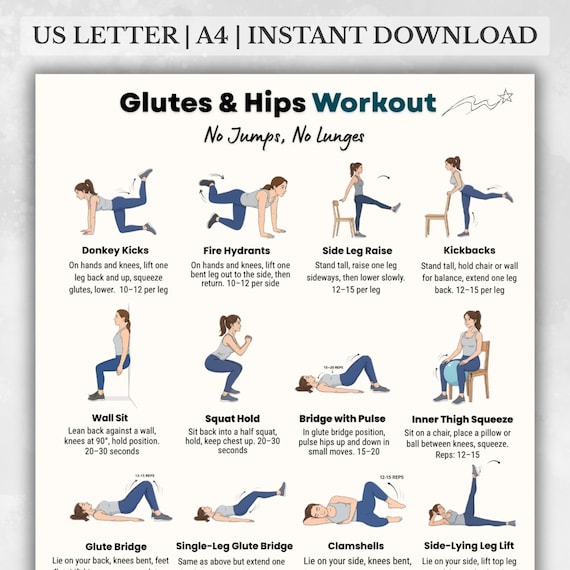
Credit: www.etsy.com
How To Warm Up And Activate Your Glutes
Warming up isn’t just about getting your heart rate up. You need to “wake up” your glutes, especially if you sit most of the day. Glute activation makes your workout more effective and reduces injury risk.
Sample Glute Activation Warm-Up:
- Glute Bridge – 2 sets x 15 reps
- Clamshell (with band) – 2 sets x 15 reps per side
- Lateral Band Walk – 2 sets x 15 steps per direction
- Bodyweight Squat – 2 sets x 10 reps
Spend 5–7 minutes on this before your main workout.
Tracking Progress And Adjusting Your Routine
To keep seeing results, you need to track your progress and make changes over time.
How To Track
- Write down weights, reps, and sets for each workout
- Take photos every 4–6 weeks to see changes
- Note how exercises feel: Is the muscle burning, or are you just going through the motions?
When To Change Routine
- If you stop seeing progress for 3–4 weeks
- If you get bored or lose motivation
- If your schedule changes (travel, busy periods)
Tip: Changing one or two exercises, reps, or order can keep things fresh. Avoid changing everything at once.
Nutrition Tips For Glute Growth
Training is only half the battle. Muscles need the right fuel to grow and recover.
- Protein: Aim for 0.7–1 gram per pound of body weight daily
- Carbohydrates: Give energy for hard workouts
- Healthy fats: Support hormone balance
Drink enough water, and don’t skip meals after training. If you want to build muscle, a slight calorie surplus (eating a bit more than you burn) helps.
Example: If you weigh 150 lbs, aim for at least 105–150 grams of protein per day.
Rest And Recovery
Your glutes grow when you rest, not during the workout. Overtraining can lead to soreness and slower progress.
How much rest? For most, 48–72 hours between hard glute sessions is enough. Sleep at least 7–8 hours per night for the best recovery.
Active recovery (like walking, stretching, or yoga) helps blood flow and reduces soreness.
Home Vs. Gym Glute Training
You can build strong glutes at home or in the gym. Each has advantages:
| Training Location | Pros | Cons | Best Equipment |
|---|---|---|---|
| Home | Convenient, private, flexible schedule | Limited equipment, harder to progress weight | Resistance bands, dumbbells, step/bench |
| Gym | More equipment, easier progression, motivation | Travel time, membership cost, crowded at times | Barbells, cable machines, squat rack |
Tip: Even with just bands and a bench, you can do most glute exercises at home.
Glute Workouts For Men Vs. Women
Both men and women benefit from glute training. The main differences are goals and exercise choices:
- Women often want rounder, fuller glutes. They may use more hip thrusts, bridges, and abduction moves.
- Men may focus more on strength and use heavier squats and deadlifts.
The science shows that both should use a mix of compound and isolation moves. Don’t be afraid to use weights or high reps, no matter your gender.
How To Avoid Plateaus
It’s normal to hit a plateau, where progress slows. Here’s how to break through:
- Increase weight: Even small jumps (2–5 lbs) help.
- Change reps/sets: Try higher reps for a few weeks, then go back to lower reps.
- Change exercise order: Start with a different movement.
- Add a new exercise: Try hip thrust variations, single-leg work, or plyometrics.
Non-obvious insight: Sometimes, less is more. Taking a deload week (with lighter weights and fewer sets) can refresh your body and mind.
Glute Workouts For Special Populations
For Older Adults
Focus on balance, flexibility, and low-impact glute exercises. Step-ups, bridges, and banded movements are safe and effective.
For People With Knee Or Back Pain
Start with glute bridges and side-lying moves. Avoid deep squats or heavy lunges until pain improves. Always check with a health professional if unsure.
For Athletes
Mix power moves (like sprints, jumps) with strength exercises. Single-leg work is key for injury prevention.

Credit: www.afvt.org
Glute Training Myths
There are many myths about glute training. Here are the top ones to ignore:
- “Squats alone build the best glutes.” In reality, hip thrusts activate glutes more than squats.
- “Women shouldn’t lift heavy.” Both men and women need resistance to grow muscle.
- “More is always better.” Quality beats quantity. Too many sets without recovery slows progress.
- “You need fancy machines.” Bands and bodyweight can still deliver great results.
If you want more details about muscle function, check out Wikipedia’s Gluteus Maximus article.
Frequently Asked Questions
How Often Should I Train My Glutes For Best Results?
For most people, 2–3 times per week is ideal. This gives enough stimulus for muscle growth and time to recover. Beginners can start with 2 days. If you’re advanced or want faster results, 3 days is fine—just avoid back-to-back heavy sessions.
What’s The Best Exercise For Glutes?
The barbell hip thrust is often called the top glute builder. Research shows it activates the gluteus maximus more than squats or lunges. But for full development, use a mix of hip thrusts, squats, deadlifts, and abduction moves.
Can I Build Glutes Without A Gym?
Yes. Bodyweight exercises like bridges, squats, and banded moves can build glutes at home. For faster results, add resistance bands, dumbbells, or a weighted backpack.
Why Don’t I Feel My Glutes Working?
This is common, especially for people who sit a lot. Try a longer warm-up with glute activation drills (like clamshells and band walks). Slow down each rep and focus on squeezing your glutes. If you still don’t feel them, lower the weight and work on form.
How Long Does It Take To See Results From Glute Training?
You may feel stronger and notice better muscle tone in 4–6 weeks if you train consistently. Visible changes like growth and shape usually take 8–12 weeks or longer, depending on your routine, diet, and genetics.
Building strong, healthy glutes is about more than looks—it’s about better movement, less pain, and more confidence. With the right exercises, smart programming, and good nutrition, anyone can achieve noticeable results. Whether you train at home or in the gym, start simple, stay consistent, and enjoy the benefits of your hard work.
