

Glute Toning Workout: Sculpt Stronger, Rounder Glutes Fast
Glute Toning Workout: A Complete Guide To Sculpted, Strong Glutes
A well-shaped, toned set of glutes is more than just an aesthetic goal. Your gluteal muscles—the gluteus maximus, medius, and minimus—are some of the largest and most powerful in your body. They help you walk, run, climb, and even stand tall. Strong glutes can improve your posture, protect your lower back, and boost your athletic performance. But for many, the journey to toned glutes can feel confusing. What exercises truly work? How often should you train? Is it possible to tone your glutes at home, or do you need a gym?
This guide will cut through the noise and give you practical advice, science-based routines, and real-world tips to help you build the glutes you want—whether your goal is to fill out your jeans, enhance sports performance, or simply feel stronger.
You'll learn which exercises matter most, how to structure your workouts, and how to avoid common mistakes. Let’s get started on the path to stronger, firmer glutes.
Why Glute Toning Matters
Your glutes are more than just a "backside" muscle. They play a key role in daily movement and support your whole body. Here’s why glute toning should be part of your fitness plan:
- Posture and Back Health: Weak glutes can lead to poor posture and back pain. Strong glutes stabilize your pelvis and spine, reducing risk of injury.
- Athletic Performance: Whether sprinting, jumping, or lifting, strong glutes generate power and speed.
- Injury Prevention: Toned glutes help take pressure off your knees and lower back, lowering your risk of strains.
- Metabolic Boost: Large muscles like the glutes burn more calories at rest, helping with fat loss.
Many people sit for hours each day, which can weaken glutes and tighten hip flexors. This is called gluteal amnesia or "sleepy glutes." The right workout can wake these muscles up, improve their strength, and give you a firmer shape.
Understanding Your Glute Muscles
To train smart, you need to know what you’re working. The glutes are made up of three main muscles:
- Gluteus Maximus: The biggest muscle in your glutes, responsible for hip extension (moving your thigh backward), outward rotation, and giving your butt its shape.
- Gluteus Medius: Located on the outer side of your hip, it helps with side movement (abduction) and stabilizes your pelvis when you walk or run.
- Gluteus Minimus: The smallest, under the medius, also helps with side movement and stabilization.
Each muscle plays a different role. A complete glute toning workout targets all three for best results.
Key Principles For Glute Toning
Before you jump into exercises, understand these core principles. They make a big difference in how fast and safely you see results.
Progressive Overload
Your muscles adapt to the stress you put on them. To keep growing stronger and more toned, you need to progressively overload your glutes—by increasing resistance, reps, sets, or time under tension. If you always do the same workout, your muscles stop changing.
Mind-muscle Connection
Many people "cheat" glute exercises by letting other muscles (like the quads or lower back) do the work. To truly tone your glutes, focus on feeling them contract during each rep. Slow down, pause at the top, and squeeze the muscle.
Frequency And Recovery
You need to train your glutes often enough to see change but not so much you don’t recover. Most people get good results with 2–3 focused glute sessions per week, with at least one rest day in between.
Variety And Plan
Use a mix of compound movements (multi-joint, heavy lifts) and isolation moves (targeted, high-rep exercises). Change up your program every 4–8 weeks to avoid plateaus.
Glute Toning Workout: Essential Exercises
Not all glute exercises are created equal. Some moves are far more effective for building and shaping your glutes. Below are the most important exercises, broken into categories. Aim to include a mix of these in your weekly routine.
Compound Exercises (big Lifts)
These moves use multiple joints and muscle groups. They build strength and size quickly.
- Barbell Hip Thrust
- Sit on the ground with your upper back against a bench, roll a barbell over your hips, and thrust upward by driving through your heels. Squeeze your glutes at the top.
- Proven to activate the gluteus maximus more than almost any other exercise.
- Squat Variations
- Regular squats, goblet squats, sumo squats, and Bulgarian split squats all work the glutes.
- Focus on sitting back and keeping your knees over your toes.
- Deadlift Variations
- Romanian deadlifts, sumo deadlifts, and conventional deadlifts all target the glutes and hamstrings.
- Push your hips back and keep your back flat.
Isolation Exercises
These moves target the glutes specifically, with less help from other muscles.
- Glute Bridge
- Similar to the hip thrust but performed on the floor, sometimes with weight.
- Great for beginners or as a burnout at the end of your session.
- Cable Kickback
- Attach an ankle strap to a low cable, kick your leg back and up, squeezing your glutes.
- Focus on slow, controlled movement.
- Clamshells
- Lie on your side with knees bent, open and close your knees like a clamshell.
- Targets the gluteus medius and minimus.
- Fire Hydrant
- On all fours, lift your leg out to the side without shifting your hips.
- Good for hip stability and outer glute development.
Bodyweight And Resistance Band Moves
These exercises are perfect for home workouts or as "finishers" after heavier lifts.
- Donkey Kicks
- On hands and knees, kick your heel up to the ceiling, keeping your knee bent.
- Add a resistance band for more difficulty.
- Lateral Band Walk
- With a band around your knees or ankles, step side-to-side, keeping tension on the band.
- Burns the outer glutes and hips.
- Single-Leg Glute Bridge
- Like the regular glute bridge, but with one leg raised.
- Doubles the challenge on each glute.
Sample Glute Toning Workout Routines
Below are sample routines for different fitness levels. Adjust the weight, reps, and sets to match your ability. Always warm up with dynamic stretches and light activity for 5–10 minutes.
Beginner Routine (home Or Gym, 2 Days/week)
- Bodyweight Squats: 3 sets of 15 reps
- Glute Bridges: 3 sets of 12 reps
- Donkey Kicks: 3 sets of 10 reps per side
- Clamshells: 3 sets of 12 reps per side
- Lateral Band Walks: 2 sets of 20 steps
Rest 30–60 seconds between sets. Focus on slow, controlled movement and squeezing your glutes.
Intermediate Routine (gym Or Well-equipped Home, 3 Days/week)
- Barbell Hip Thrusts: 4 sets of 8–12 reps
- Bulgarian Split Squats: 3 sets of 10 reps per leg
- Romanian Deadlifts: 3 sets of 10–12 reps
- Cable Kickbacks: 3 sets of 12 reps per side
- Fire Hydrants: 3 sets of 15 reps per side
Rest 60–90 seconds between sets. Increase weight gradually as you get stronger.
Advanced Routine (gym, 3 Days/week)
- Barbell Hip Thrusts: 5 sets of 6–8 reps (heavy)
- Sumo Deadlifts: 4 sets of 8 reps
- Walking Lunges: 4 sets of 12 reps per leg
- Single-Leg Glute Bridges: 3 sets of 10 reps per side
- Banded Lateral Walks: 3 sets of 25 steps
- Cable Kickbacks: 3 sets of 15 reps per side (slow, controlled)
Rest 1–2 minutes between sets. Push yourself on the big lifts, but use perfect form.
Weekly Glute Training Schedule Ideas
How often should you train your glutes? Most people see best results with 2–3 focused sessions per week. Here are two sample schedules:
| Day | Beginner | Intermediate/Advanced |
|---|---|---|
| Monday | Glute Workout | Glute Workout (Heavy) |
| Tuesday | Rest or Cardio | Upper Body |
| Wednesday | Rest or Cardio | Glute Workout (Accessory) |
| Thursday | Rest | Rest or Cardio |
| Friday | Glute Workout | Glute Workout (Heavy) |
| Saturday | Rest or Cardio | Upper Body or Cardio |
| Sunday | Rest | Rest |
If you’re doing full-body workouts, include at least 2–3 glute exercises per session.
How To Progress Over Time
Seeing results is about more than just picking the right exercises. You need to push your body to adapt. Here’s how to keep your glutes growing and toning:
- Increase Weight: As you get stronger, add weight to your exercises. Small increases (2.5–5 lbs) can make a big difference.
- Add Reps/Sets: If you’re not ready for more weight, add extra repetitions or another set.
- Slow Down: Increase the time your glutes are under tension by slowing the lowering part of each rep.
- Change Angles: Switch up your stance, foot position, or type of resistance (e.g., bands vs. weights) to hit the muscles differently.
- Deload Weeks: Every 6–8 weeks, take a lighter week to let your body recover and prevent injury.
Mistakes That Sabotage Glute Toning
Many people work hard but don’t see the results they want. Here are common mistakes and how to fix them:
- Not Using Enough Resistance
- Bodyweight moves are great for beginners, but as you get stronger, you need more challenge. Add weights or bands.
- Poor Form
- Letting your knees cave in, rounding your back, or not going deep enough can shift the work away from your glutes.
- Not Squeezing at the Top
- The peak contraction is where much of the muscle-building happens. Pause and squeeze at the top of each rep.
- Neglecting Recovery
- Muscles grow when you rest. Overtraining can lead to fatigue and injuries.
- Focusing Only on Squats
- Squats are great, but other movements like hip thrusts, bridges, and lunges often activate the glutes more.
- Ignoring Nutrition
- Muscles need protein and calories to grow and tone. Not eating enough can slow your progress.
Glute Toning At Home Vs. Gym
You don’t need a fancy gym to get strong, toned glutes. Both home and gym workouts can deliver results, but each has pros and cons.
| Home Workout | Gym Workout |
|---|---|
|
|
If you’re training at home, invest in a set of resistance bands and adjustable dumbbells. They’re affordable and make a big difference.
The Role Of Cardio And Other Activities
Cardio alone won’t tone your glutes, but it can help with overall fat loss, which lets muscle definition show. Activities like hill sprints, stair climbing, cycling, and hiking also work the glutes.
Try to include at least 150 minutes of moderate cardio per week, plus 2–3 strength-based glute sessions. This balance helps you lose fat and reveal the toned muscles underneath.

Credit: www.youtube.com
Nutrition For Glute Toning
Exercise is only half the picture. What you eat shapes your results.
Protein
Muscles need protein to repair and grow. Aim for about 0. 7–1 gram of protein per pound of body weight daily if you’re training hard. Good sources are chicken, fish, lean beef, eggs, dairy, beans, and tofu.
Calories
To build muscle and tone, you usually need a slight calorie surplus (eat more than you burn) or at least maintenance calories. If you want to lose fat, use a small calorie deficit, but don’t cut too much or you’ll lose muscle.
Carbs And Fats
Carbs fuel your workouts, and healthy fats support hormones. Don’t skip them—just focus on whole foods like oats, rice, fruits, nuts, olive oil, and avocados.
Hydration
Dehydrated muscles work less efficiently. Drink water before, during, and after your workouts.
Real-world Results: What To Expect
How long does it take to see toned glutes? It depends on your starting point, workout quality, and diet. Most people notice changes in 4–8 weeks with consistent effort. Visible tone and shape often take 3–6 months.
Here’s a sample timeline for a dedicated beginner:
| Weeks | Expected Changes |
|---|---|
| 1–4 | Increased muscle activation, better posture, slight firmness |
| 5–8 | Noticeable firmness, jeans fit differently, strength increases |
| 9–16 | Visible shape change, improved athletic performance, less body fat if nutrition is on point |
Two things many beginners miss:
- Genetics play a role. Some people build glutes more easily, while others need more work and patience.
- Consistency is key. Skipping workouts or changing programs too often slows progress.

Credit: www.youtube.com
Tips For Faster, Safer Progress
To make your glute toning journey smoother, keep these tips in mind:
- Warm Up Well: Use dynamic stretches and light cardio to activate your glutes and prevent injury.
- Use Mirrors or Record Yourself: Watching your form helps catch mistakes you might not feel.
- Prioritize Glutes Early in Workouts: Do glute work when you’re fresh, not at the end of a long session.
- Don’t Neglect Other Muscles: Balanced training for your core, hamstrings, and quads supports strong, healthy glutes.
- Track Your Workouts: Write down weights, reps, and sets to see progress and stay motivated.
Glute Toning Workout: At-home Circuit Example
If you want a quick, effective glute circuit at home, try this:
Repeat the circuit 3–4 times, resting 60 seconds between rounds.
- Bodyweight Squat – 15 reps
- Single-Leg Glute Bridge – 10 reps per side
- Donkey Kick – 12 reps per side
- Clamshell – 15 reps per side
- Lateral Band Walk – 20 steps
Add a resistance band above your knees for more challenge. Focus on slow, quality reps and really squeezing your glutes.
Glute Toning For Men Vs. Women
While the basic principles are the same for everyone, some differences exist:
- Women often have a higher proportion of slow-twitch muscle fibers in the glutes, which respond well to higher reps and more volume.
- Men may build muscle faster with heavy weights and lower reps, but also benefit from higher-rep finishers.
Both genders should train all parts of the glutes, use a mix of rep ranges, and focus on progressive overload.
Equipment For Glute Toning
While bodyweight training works, adding simple equipment can speed up results:
- Resistance Bands: Great for warm-ups, activation, and adding resistance to bodyweight moves.
- Dumbbells/Kettlebells: Useful for squats, lunges, deadlifts, and bridges.
- Barbells: Best for hip thrusts and heavy squats.
- Bench or Step: For Bulgarian split squats and hip thrusts.
- Ankle Weights: Boost the challenge of kickbacks and fire hydrants.
If you’re on a budget, start with a set of resistance bands—they’re affordable and versatile.
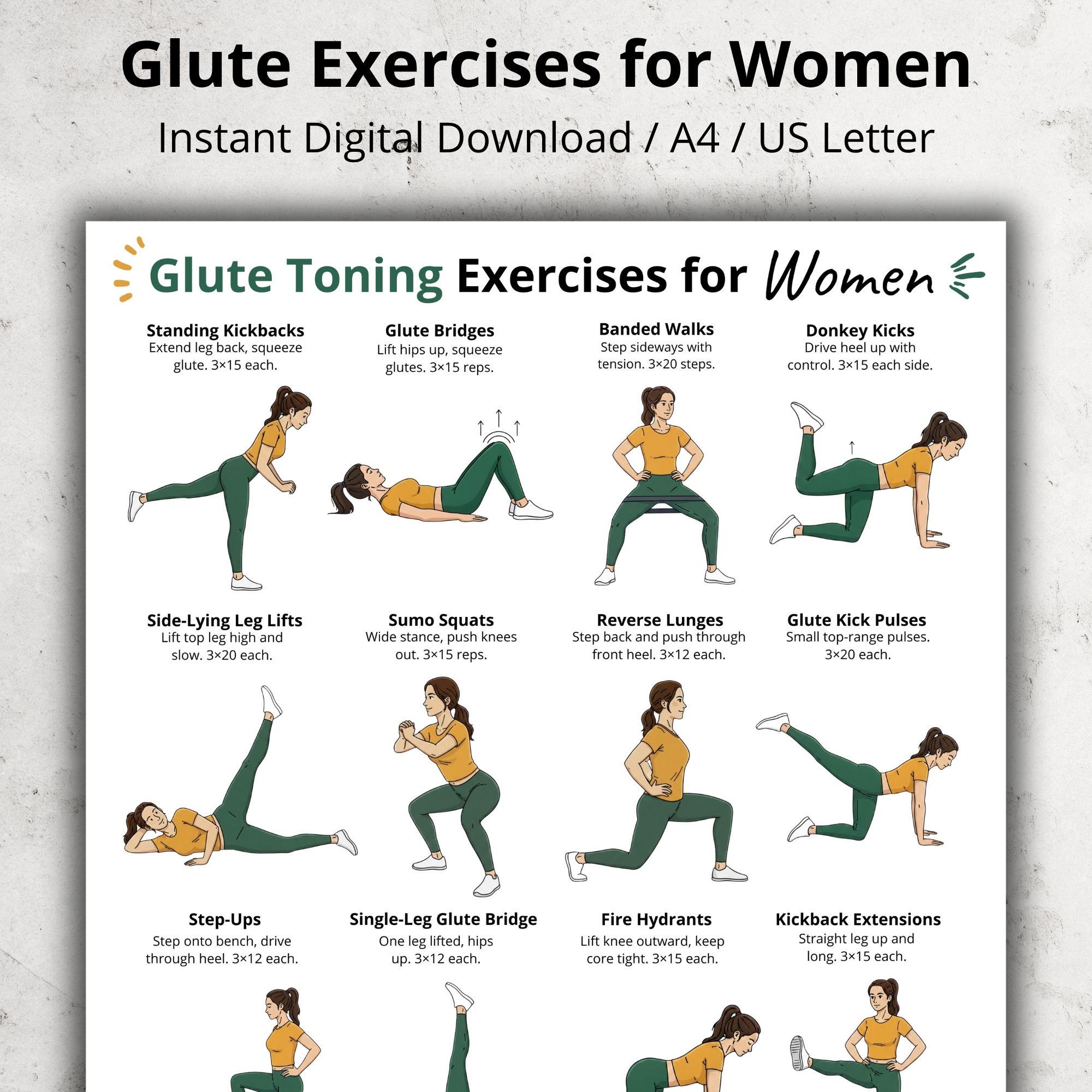
Credit: www.etsy.com
The Science Behind Glute Training
Research shows glutes respond best to a mix of heavy compound lifts and targeted isolation moves. In a study published in the Journal of Strength and Conditioning Research, barbell hip thrusts produced higher glute activation than squats or lunges.
Muscles grow through:
- Mechanical tension (lifting heavy)
- Metabolic stress (burning, high reps)
- Muscle damage (tiny tears that repair stronger)
A good program uses all three for best results. Variety in rep ranges and exercise selection is key.
For more on the science behind glute training, check out this research summary.
Frequently Asked Questions
How Often Should I Train My Glutes For Best Results?
Most people see good progress with 2–3 glute-focused workouts per week. More isn’t always better—your muscles need time to recover. If you feel sore or tired, take an extra rest day.
Can I Tone My Glutes Without Weights?
Yes, you can tone your glutes with bodyweight and resistance band exercises. Moves like bridges, squats, donkey kicks, and lateral walks are effective, especially for beginners. For advanced results, adding some weight is helpful.
Why Don’t I Feel My Glutes Working During Exercises?
Often this means you’re using other muscles more than your glutes. Slow down your reps, focus on squeezing at the top, and try glute activation drills (like clamshells or bridges) before your main workout.
How Long Does It Take To See Results From Glute Workouts?
Most people notice firmer, stronger glutes within 4–8 weeks if they train consistently and eat well. Visible shape changes may take 3–6 months. Genetics and nutrition also play a role.
Is It Possible To Overtrain My Glutes?
Yes. Training your glutes hard every day can lead to overtraining, soreness, and even injury. Stick to 2–3 focused sessions per week, and always listen to your body.
A toned, strong set of glutes is a realistic goal for anyone—no matter your starting point. With the right exercises, smart programming, good nutrition, and patience, you can build glutes that look and feel amazing. Stay consistent, challenge yourself, and celebrate every bit of progress along the way.
