

Glute Home Workout: Sculpt Stronger Glutes Fast
Glute Home Workout: Build Stronger, Firmer Glutes Without A Gym
A strong, well-shaped glute is more than just about looks. Your glute muscles power every step, jump, and squat you do each day. They help you walk upright, protect your lower back, and even improve your posture. But many people believe you need a gym or fancy machines to build these muscles.
The truth is, with the right glute home workout, you can get impressive results using bodyweight or simple items at home.
This article is your complete guide to working out your glutes at home. Whether you’re a beginner or already active, you’ll find practical routines, simple explanations, and expert tips to help you reach your goals. You’ll discover exercises that fit small spaces, how to progress as you get stronger, and real strategies to see and feel results.
If you want a firmer backside, better athletic performance, or just want to move pain-free, this is for you.
Why Train Your Glutes At Home?
Many people spend hours sitting each day. This weakens the glute muscles over time, leading to back pain, poor balance, and less power in your legs. Training your glutes at home can fix these issues. You don’t need a gym membership or expensive equipment. Home workouts save time, fit any schedule, and let you train in comfort.
Some benefits of regular glute training:
- Better posture and less lower back pain
- Stronger hips for running, walking, or sports
- More calorie burn from larger muscles
- Improved balance and injury prevention
Many people notice their pants fit better, and they move more easily in daily life after a few weeks of focused glute workouts.
Glute Muscle Anatomy Simplified
Understanding your glute muscles helps you train smarter. The glutes are not just one muscle, but a group:
- Gluteus maximus: The largest muscle, gives your backside its shape and helps you stand up or climb stairs.
- Gluteus medius: Sits on the side, controls leg movement outwards, and supports balance.
- Gluteus minimus: Works with the medius to stabilize your hips.
Most people underwork the medius and minimus, which can cause weak hips and a flat appearance. The best glute home workout includes moves for all three muscles.
Key Principles For Effective Glute Home Workouts
Before you start, understand these important principles. They help you avoid mistakes and get faster results.
- Muscle Activation: Many people’s glutes “sleep” from sitting too much. Warming up with simple activation exercises wakes them up so they work during your main workout.
- Progressive Overload: Muscles only change if you challenge them. This means adding more reps, sets, or resistance over time.
- Full Range of Motion: Move through the whole range in each exercise. Partial squats or rushed reps don’t work the muscle fully.
- Mind-Muscle Connection: Focus on feeling your glutes squeeze. Rushing through reps with no focus often works your thighs or back instead.
- Rest and Recovery: Muscles grow when you rest. Train glutes 2–3 times per week, not every day.
What You Need For A Glute Home Workout
You can start with just your bodyweight. But adding a few simple tools can speed up progress:
- Resistance bands (loop or long): Cheap and add extra challenge.
- A sturdy chair or bench: For hip thrusts and step-ups.
- A mat: For comfort on the floor.
- A backpack with books: Adds weight for squats or lunges.
If you don’t have bands or weights, focus on more reps, slower movements, or single-leg exercises to make it harder.
Credit: www.etsy.com
The Best Glute Home Exercises (no Equipment Required)
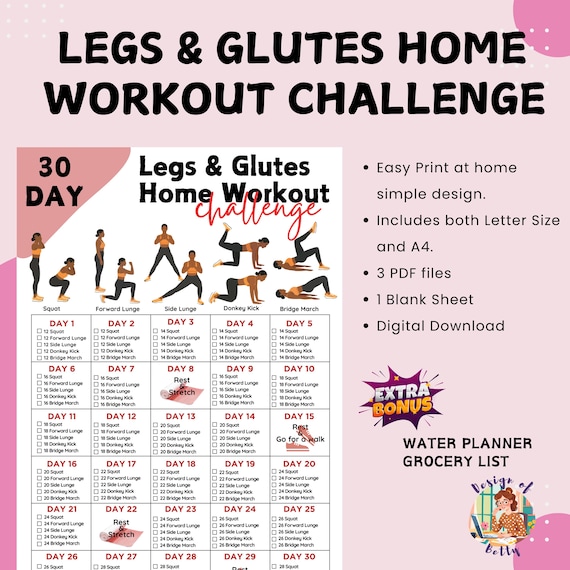
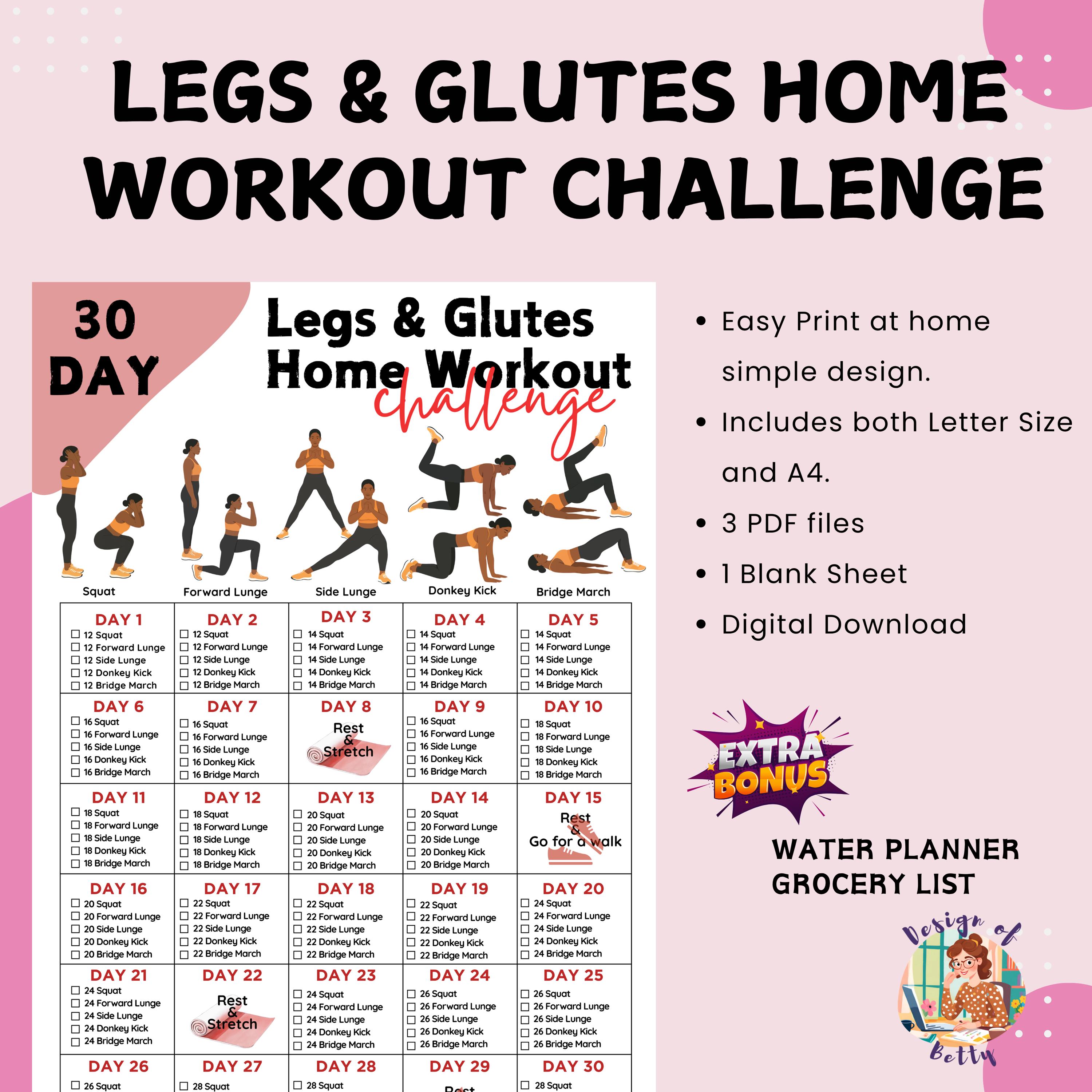
These exercises need little space and zero equipment. They target your glutes from all angles.
1. Glute Bridge
Lie on your back, knees bent, feet flat. Push through your heels, lift your hips up, and squeeze your glutes at the top. Lower slowly. Works all three glute muscles.
2. Hip Thrust (using A Chair Or Couch)
Sit in front of a chair, shoulders resting on it, feet flat. Push your hips up until your body forms a straight line from shoulders to knees. Squeeze glutes hard, then lower. This is one of the best moves for glute growth.
3. Bodyweight Squat
Stand with feet hip-width apart. Lower your body as if sitting back into a chair. Go as low as you can with control. Push up through your heels. Focus on glute squeeze at the top.
4. Reverse Lunge
Stand tall. Step one foot back, lower your back knee toward the floor, then return to start. Alternate sides. Keep most of your weight on the front heel.
5. Donkey Kick
Start on hands and knees. Kick one heel up toward the ceiling, keeping your knee bent. Lower slowly. Do all reps on one side before switching.
6. Clamshell
Lie on your side, knees bent, feet together. Open your top knee like a clam, keeping feet touching. Works the glute medius and minimus.
7. Fire Hydrant
On hands and knees, lift one knee out to the side, keeping your hip bent. Pause and lower. This targets side glutes and hip muscles.
8. Single-leg Glute Bridge
Like the basic bridge, but lift one leg in the air. Push through the other foot. This doubles the challenge and corrects muscle imbalances.
Adding Resistance For Faster Results
Once bodyweight feels easy, add resistance for better progress. The simplest way is using resistance bands around your thighs or above your knees. You can also hold a backpack, water jugs, or any heavy object.
Here’s a comparison of how resistance changes the challenge:
| Exercise | Bodyweight Only | With Resistance Band | With Extra Weight |
|---|---|---|---|
| Glute Bridge | Easy | Medium | Hard |
| Hip Thrust | Medium | Hard | Very Hard |
| Squat | Medium | Hard | Very Hard |
| Donkey Kick | Easy | Medium | Hard |
Tip: If you don’t have bands or weights, slow your reps (4 seconds up, 4 seconds down) or add a pause at the hardest point to make it more difficult.
Sample Glute Home Workout Routines
Whether you are new or advanced, you can follow these routines. Each takes 20–35 minutes and needs no special gear.
Beginner Routine
- Glute Bridge – 3 sets x 15 reps
- Bodyweight Squat – 3 x 12 reps
- Clamshell – 2 x 15 per side
- Fire Hydrant – 2 x 12 per side
Rest 45 seconds between sets. Focus on slow, controlled movements.
Intermediate Routine
- Hip Thrust (with chair) – 3 x 15 reps
- Reverse Lunge – 3 x 12 per leg
- Donkey Kick – 3 x 15 per side
- Single-Leg Glute Bridge – 2 x 10 per side
Rest 30–45 seconds. Add a band or backpack for extra challenge.
Advanced Routine
- Banded Hip Thrust – 4 x 15 reps
- Banded Squat – 4 x 12 reps (hold backpack for more)
- Bulgarian Split Squat (foot on chair) – 3 x 10 per leg
- Banded Clamshell – 3 x 20 per side
- Single-Leg Romanian Deadlift (holding weight) – 3 x 12 per side
Rest 30 Seconds. These Moves Are Tough—focus On Good Form!
Note: “x” means “times” (e.g., 3 x 15 reps means 3 sets of 15 repetitions).
Glute Activation: The Secret To Better Results
Many people feel squats and lunges mostly in their quads (front thighs). The secret to “waking up” your glutes is using activation exercises before your main workout. This helps you get more out of every rep.
Try this 5-minute glute activation before any glute home workout:
- Clamshells – 15 per side
- Donkey Kicks – 15 per side
- Bodyweight Glute Bridge – 15 reps
- Fire Hydrants – 12 per side
Move slowly and focus on squeezing your glutes. You should feel a “burn” in the glute area, not your thighs.
Common Mistakes That Hurt Progress
It’s easy to do glute exercises wrong, especially at home. Watch for these common errors:
- Using your lower back or hamstrings instead of glutes (especially in bridges)
- Letting your knees cave in during squats or bridges
- Rushing reps without control
- Not going low enough in squats or lunges
- Neglecting single-leg moves, which help fix muscle imbalances
Non-obvious insight: Many people fail to progress because they never adjust the difficulty. If you can do 20 reps easily, it’s time to add resistance, slow down, or try harder moves.
How To Progress Your Glute Home Workouts
Your body adapts quickly, so you need to make your workouts harder over time. Here’s how:
- Increase reps or sets: Start with 10–12 reps, work up to 20.
- Add resistance: Use bands, weights, or even a heavy bookbag.
- Try harder versions: Move from double-leg to single-leg exercises.
- Slow down: Count 3–4 seconds up and down for each rep.
- Shorten rest: Less rest makes your muscles work harder.
Here’s a simple way to track your progress:
| Week | Exercise | Reps/Set | Resistance | Notes |
|---|---|---|---|---|
| 1 | Glute Bridge | 12 | Bodyweight | Focus on form |
| 2 | Glute Bridge | 15 | Bodyweight | Slower reps |
| 3 | Glute Bridge | 15 | Band added | Stronger squeeze |
| 4 | Single-Leg Bridge | 12 | Bodyweight | Harder version |
You should feel your workouts getting harder but still “doable. ” If you feel pain (not muscle burn), stop and check your form.

Credit: us.humankinetics.com
How Often Should You Train Glutes At Home?
Most people get great results with 2–3 glute workouts per week. Muscles grow during rest, so avoid training the same muscle hard two days in a row. For best results:
- Beginners: 2 times per week
- Intermediate/Advanced: 3 times per week
On other days, do light cardio, stretching, or work other body parts.
Nutrition Tips For Glute Growth
Training is only half the battle. To build muscle, your body needs fuel. Here are simple, practical tips:
- Eat enough protein: Muscles need it to grow. Good sources include chicken, eggs, beans, and Greek yogurt.
- Don’t fear healthy carbs: Oats, rice, and potatoes give you energy for tough workouts.
- Add healthy fats: Avocado, nuts, and olive oil support muscle repair.
- Stay hydrated: Muscles work better when you drink enough water.
- Eat after workouts: A meal or snack with protein and carbs within 2 hours helps recovery.
Many people try to build muscle while dieting very hard. This rarely works. You need to eat enough calories or your body won’t have the resources to build new muscle.
Credit: www.etsy.com
How Long Does It Take To See Results?
Everyone’s body is different, but most people notice:
- Better muscle tone in 3–4 weeks
- Clothes fit differently in 6–8 weeks
- Visible muscle growth in 2–3 months
You may feel your glutes working better and have less back or knee pain even sooner. Results come faster if you are consistent and make your workouts harder over time.
Real-life Example: Glute Transformation At Home
Consider “Maya,” a busy office worker who started a glute home workout. She trained 3 times a week, using just a mat and resistance bands. After two months, she could do single-leg glute bridges with a backpack for extra weight. She reported:
- Climbing stairs became easier
- Lower back pain reduced
- Her pants fit better around the hips
The key to Maya’s success was consistency and tracking her progress. She didn’t rely on motivation—she made it part of her routine, just like brushing her teeth.
Non-obvious insight: Tracking your reps and sets each week helps you stay motivated and see progress, even when the mirror changes slowly.
How To Stay Consistent With Glute Home Workouts
Many people start strong, but lose motivation after a few weeks. Here’s how to stay on track:
- Set a schedule: Pick exact days and times. Write them in your calendar.
- Make it easy: Lay out your mat and bands the night before.
- Track progress: Write down each workout in a notebook or phone.
- Join a community: Online groups or friends help you stay accountable.
- Celebrate small wins: Did you add reps or resistance? That’s progress!
If you miss a day, don’t quit. Just get back on track next workout.
Advanced Glute Home Workout Techniques
Once you master the basics, try these advanced methods to keep making gains:
1. Paused Reps
Pause for 2–3 seconds at the hardest part (top of bridge or bottom of squat). This increases time under tension.
2. Eccentric Focus
Lower yourself very slowly (3–4 seconds) on each rep. This makes your muscles work harder.
3. Supersets
Do two exercises back to back with no rest. For example, glute bridges then clamshells. This saves time and boosts results.
4. Single-leg Variations
Single-leg hip thrusts, split squats, and single-leg bridges force each glute to work alone, preventing one side from “cheating. ”
5. Mini-circuits
Do 3–4 exercises in a row, rest, then repeat. This keeps your heart rate up and burns more calories.
Glute Home Workout For Small Spaces
You don’t need a big room or yard. Here’s a sample workout for a tiny space:
- Glute Bridge – 3 x 15 reps
- Clamshell – 3 x 15 per side
- Donkey Kick – 3 x 12 per side
- Standing Kickback (hold wall) – 3 x 15 per leg
All can be done on a mat or towel. Just make sure you have enough space to lie down.
Glute Home Workouts For Different Goals
Different people want different results. Here’s how to adjust your routine:
| Goal | Best Exercises | Reps/Sets | Rest |
|---|---|---|---|
| Build muscle size | Hip Thrust, Squat, Split Squat | 8–15 reps, 3–5 sets | 60–90 sec |
| Firm and tone | Bridge, Clamshell, Donkey Kick | 15–20 reps, 3–4 sets | 30–45 sec |
| Increase strength | Single-Leg Bridge, Weighted Squat | 6–10 reps, 3–5 sets | 60–90 sec |
| Burn fat | Mini-circuits, Supersets | 15–20 reps, 3–4 sets | 15–30 sec |
Choose your focus and adjust your workout plan. For best results, switch your routine every 4–6 weeks.
Stretching And Mobility For Glute Health
Strong muscles need to stay flexible. Tight hip flexors and quads can block your glutes from working well. Here are simple stretches to do after your workout:
- Kneeling Hip Flexor Stretch: Kneel, push your hips forward gently, hold 30 seconds per side.
- Figure-Four Stretch: Lie on back, cross one ankle over opposite knee, pull toward chest, hold 30 seconds.
- Standing Quad Stretch: Grab your ankle behind, keep knees together, hold 30 seconds per side.
Spend 5–10 minutes after each workout stretching. This helps prevent soreness and improves movement.
When To Change Or Upgrade Your Glute Home Workout
If you feel bored or stop seeing progress, it’s time to change things up:
- Add new exercises (like frog pumps or curtsy lunges)
- Use heavier bands or objects
- Change your rep range (try more or fewer reps)
- Try advanced techniques (see above)
- Add short cardio (like jump squats) for more calorie burn
Most people benefit from updating their routine every 4–6 weeks.
Staying Safe: Injury Prevention Tips
Working out at home is usually safe, but always:
- Warm up before starting (see glute activation above)
- Use good form (watch yourself in a mirror or record a short video)
- Don’t push through sharp pain—muscle “burn” is okay, joint pain is not
- Progress slowly, especially with new exercises
- If unsure, ask a fitness coach online or check resources like ACE Fitness
Frequently Asked Questions
How Often Should I Do Glute Home Workouts For Best Results?
2–3 times per week is ideal for most people. This gives your muscles time to recover and grow. More is not always better—rest is just as important as training.
Can I Grow My Glutes At Home Without Weights?
Yes, you can build and shape your glutes using bodyweight, resistance bands, and common household items. The key is making the exercises harder over time by increasing reps, using single-leg moves, or slowing your tempo.
Why Don’t I Feel My Glutes During Squats Or Lunges?
This is very common. Often, your quads (front thighs) take over. Try glute activation exercises before your workout, focus on pushing through your heels, and slow down each rep. Mind-muscle connection is important.
How Long Until I See Changes In My Glutes?
Most people notice a firmer feel in 3–4 weeks and visible changes in 2–3 months. Progress depends on your consistency, nutrition, and how you make your workouts harder over time.
What Should I Do If I Feel Pain In My Knees Or Back During Glute Exercises?
Stop and check your form. Often, poor technique or weak supporting muscles cause pain. Strengthen your core, try easier variations, and avoid exercises that hurt. If pain continues, see a professional.
Building strong, shapely glutes at home is within your reach. Start simple, stay consistent, and keep challenging yourself. In a few months, you’ll feel stronger, move better, and see the results you want.
