

Glute Hamstring Workout: Build Strength and Sculpt Your Lower Body
Glute Hamstring Workout: Build Strength, Power, And Shape
The glutes and hamstrings are some of the most powerful muscles in your body. When strong and well-trained, they help you run faster, jump higher, lift heavier, and move with more confidence. But for many people, these muscles are weak or underdeveloped.
This can lead to poor posture, lower back pain, slow progress in sports, and a lack of shape in the lower body.
A smart glute hamstring workout does much more than just make your legs look good. It can improve your athletic performance, protect your joints, and even help prevent injuries. But not all exercises or routines are created equal. Some focus too much on one muscle, leaving the other behind. Others use poor form or skip important steps, leading to frustration or even injury.
This guide will show you how to build a complete glute hamstring workout for all fitness levels. You’ll learn the best exercises, how to plan your routine, and the science behind building strong, healthy muscles. Whether you’re a beginner or a seasoned lifter, you’ll find practical tips and techniques that get results.
Why Train Glutes And Hamstrings Together?
Your glutes and hamstrings work as a team. Both muscles help you extend your hips, which is needed for walking, running, jumping, and lifting. When these muscles are weak or unbalanced, other parts of your body—like your lower back—take on extra work.
This can lead to pain and injuries.
Training these muscles together helps you:
- Build functional strength for sports and daily life.
- Improve your athletic speed and power.
- Reduce your risk of injury.
- Shape your lower body for a more balanced look.
But there’s more to it. The glutes are made of three parts: gluteus maximus, gluteus medius, and gluteus minimus. The hamstrings have three main muscles at the back of your thigh. Both groups are involved in hip extension, but the glutes are stronger in this movement, while the hamstrings also help bend the knee.
A good workout hits all these muscles from different angles. It uses both compound lifts (that work many muscles at once) and isolation exercises (that target a specific muscle).
Anatomy Of The Glutes And Hamstrings
Understanding the muscles you’re training helps you get better results. Here’s a quick look at each group:
Glute Muscles
- Gluteus Maximus: The largest muscle in your buttocks. It’s the main muscle used in hip extension and gives your glutes their shape.
- Gluteus Medius: Located on the side of your hip. Important for hip stability and side-to-side movements.
- Gluteus Minimus: The smallest glute muscle. It supports the medius and helps with hip rotation.
Hamstring Muscles
- Biceps Femoris: Runs along the outside of the back of your thigh.
- Semitendinosus: Sits in the middle, under the gluteus maximus.
- Semimembranosus: Closer to the inside of your thigh.
These muscles work together for movements like standing up from a chair, climbing stairs, sprinting, and more.
Benefits Of A Strong Glute Hamstring Connection
Many people focus on “toning” or “shaping” their glutes without realizing the importance of the hamstrings. Training these muscles together is not just about looks—it has real benefits for your health and performance.
- Injury prevention: Strong glutes and hamstrings protect your knees and lower back by absorbing force and helping with balance.
- Better posture: These muscles support your pelvis and spine, reducing back pain and improving the way you stand and move.
- Powerful movements: Sprinters, jumpers, and lifters all rely on a strong glute-hamstring connection for explosive power.
- Everyday strength: Simple tasks like walking up stairs or lifting a box become easier.
Research shows that weak glutes and hamstrings are linked to higher risk of knee injuries, especially in athletes. Building these muscles helps you stay active and healthy.
How To Structure A Glute Hamstring Workout
The right structure makes a huge difference. You want to train both muscle groups evenly and safely. Here’s how to plan your workout:
- Warm-up (5-10 minutes): Start with dynamic stretches and light cardio to increase blood flow and prepare your muscles.
- Compound lifts: Begin with big, multi-joint exercises when you’re fresh.
- Isolation movements: Add exercises that focus on one muscle at a time.
- Finisher or burn-out sets: Use lighter movements to increase muscle pump and fatigue.
- Cool-down: Stretch and relax your muscles to prevent soreness.
Aim for 2-3 glute hamstring workouts per week, with at least one day of rest between sessions.
Sample Weekly Workout Split
| Day | Workout Focus |
|---|---|
| Monday | Glute Hamstring Workout |
| Wednesday | Upper Body |
| Friday | Glute Hamstring Workout |
| Saturday/Sunday | Active Recovery or Rest |
You can adjust the days based on your schedule. The key is to avoid training the same muscles on back-to-back days.
Top Glute Hamstring Exercises
Choosing the right exercises is crucial. Some moves focus more on the glutes, while others target the hamstrings. The best routine uses a mix.
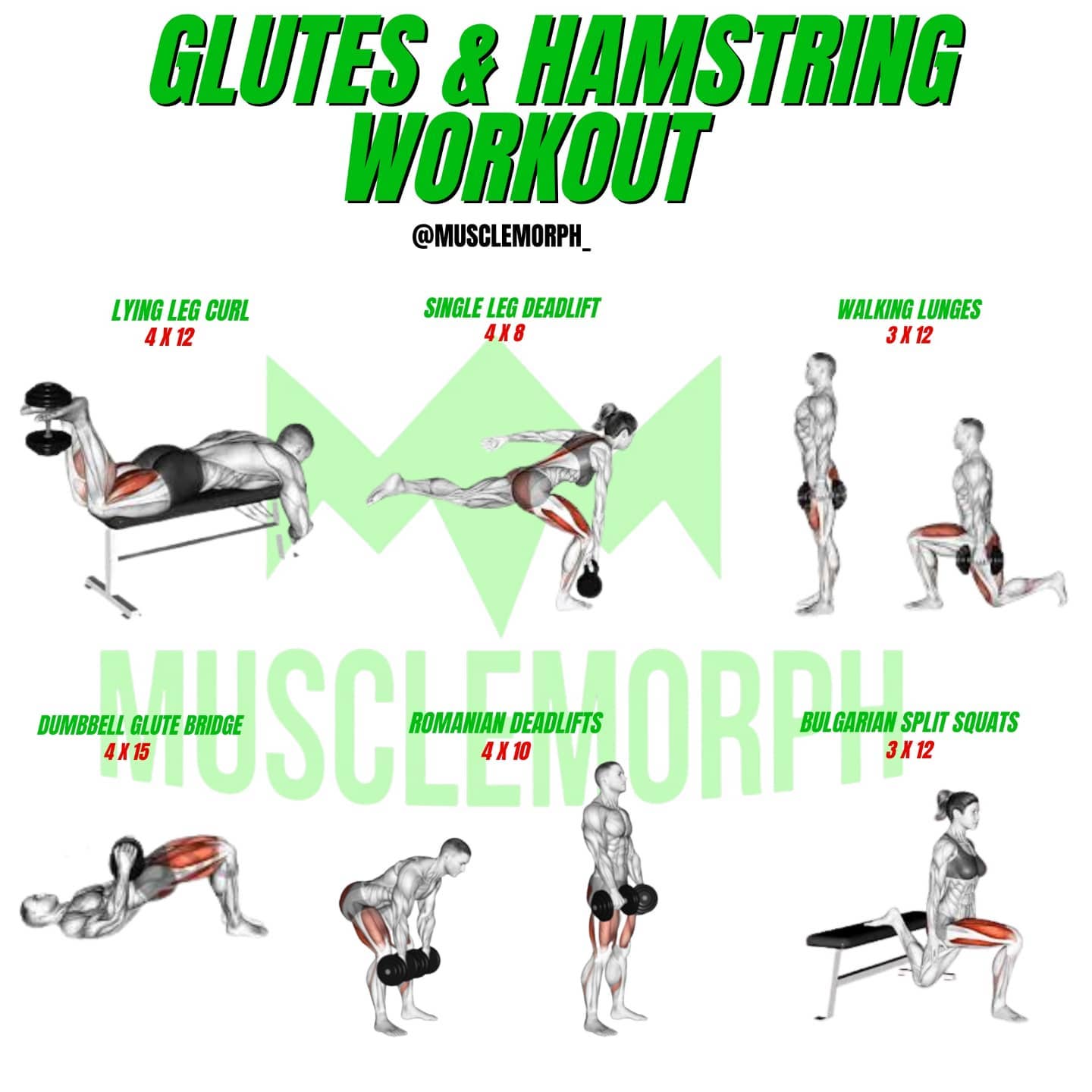
1. Hip Thrust
The hip thrust is one of the best exercises for glute growth. You sit on the ground with your upper back against a bench, feet flat on the floor, and a barbell over your hips. Push your hips up, squeeze your glutes at the top, then lower back down.
- Main focus: Gluteus maximus
- Secondary: Hamstrings, core
Tip: Pause for 1-2 seconds at the top for maximum muscle activation.
2. Romanian Deadlift
The Romanian deadlift (RDL) is a classic hamstring and glute builder. Stand with feet hip-width apart, holding a barbell in front of your thighs. Hinge at your hips, keep your back flat, and lower the bar until you feel a stretch in your hamstrings. Return to standing.
- Main focus: Hamstrings, glutes
- Secondary: Lower back
Tip: Keep the bar close to your legs and avoid rounding your back.
3. Glute Bridge
Similar to hip thrusts but with your shoulders on the ground. Push through your heels and lift your hips, squeezing your glutes.
- Main focus: Glutes
- Secondary: Hamstrings
Tip: For more challenge, try single-leg glute bridges.
4. Bulgarian Split Squat
Stand with one foot on a bench behind you. Lower your back knee toward the floor, keeping your front knee over your ankle.
- Main focus: Glutes, quads
- Secondary: Hamstrings
Tip: Lean slightly forward to increase glute activation.
5. Hamstring Curl
Use a machine or a stability ball. Lie face down (machine) or on your back (ball), and bend your knees to bring your heels toward your glutes.
- Main focus: Hamstrings
Tip: Control the movement—don’t swing.
6. Deadlift
A classic lift that works many muscles. Stand with feet hip-width, grip the bar, and lift by driving through your heels and extending your hips.
- Main focus: Glutes, hamstrings, lower back
Tip: Start light if you’re new to deadlifting.
7. Step-up
Step onto a box or bench, driving through your heel to stand up, then step down.
- Main focus: Glutes, hamstrings
- Secondary: Quads
Tip: Keep your chest up and don’t push off the back foot.
8. Cable Pull-through
Stand facing away from a low cable. Grab the handle between your legs, hinge at your hips, and pull the cable forward by thrusting your hips.
- Main focus: Glutes, hamstrings
Tip: Focus on squeezing your glutes, not using your back.
9. Single-leg Romanian Deadlift
Stand on one leg, hinge at your hip, and lower a dumbbell toward the ground. Keep your back flat.
- Main focus: Hamstrings, glutes (one side at a time)
Tip: This also improves balance and core strength.
10. Back Extension
On a back extension bench, lower your upper body, then lift back up by squeezing your glutes and hamstrings.
- Main focus: Hamstrings, glutes
- Secondary: Lower back
Tip: Avoid hyperextending (arching) your back at the top.
Example Glute Hamstring Workouts
Here are two sample routines: one for beginners and one for advanced lifters. Adjust the weights and sets to match your level.
Beginner Glute Hamstring Workout
- Bodyweight Glute Bridge – 3 sets x 12 reps
- Romanian Deadlift (light dumbbells) – 3 sets x 10 reps
- Step-Ups – 3 sets x 10 reps each leg
- Hamstring Curl (machine or ball) – 3 sets x 12 reps
Rest 1-2 minutes between sets. Focus on form.
Advanced Glute Hamstring Workout
- Barbell Hip Thrust – 4 sets x 8 reps
- Romanian Deadlift (barbell) – 4 sets x 8 reps
- Bulgarian Split Squat – 3 sets x 10 reps each leg
- Cable Pull-Through – 3 sets x 12 reps
- Single-Leg Glute Bridge – 2 sets x 12 reps each leg
- Back Extension – 3 sets x 12 reps
Rest 1-2 minutes between sets. Increase weight as you get stronger.

Credit: us.humankinetics.com
Common Mistakes To Avoid
Many people make small errors that limit their progress or increase injury risk. Here are some common mistakes and how to avoid them:
- Not using full range of motion: Short, quick reps don’t activate the muscles fully. Lower the weight slowly and lift with control.
- Overusing quads: If your knees go far past your toes during squats or lunges, you may be using your quads more than your glutes or hamstrings.
- Neglecting single-leg work: Unilateral exercises, like single-leg RDLs, help fix muscle imbalances.
- Poor hip hinge form: Many people round their lower back in deadlifts or RDLs. Practice the hip hinge with no weight first.
- Skipping warm-up and cool-down: This can increase injury risk and slow recovery.
Tips For Faster Progress
Building strong glutes and hamstrings takes time, but these tips can speed up your progress:
- Prioritize compound lifts: Exercises like hip thrusts and RDLs give you the most bang for your buck.
- Progressive overload: Gradually increase the weight or reps each week.
- Add resistance bands: Bands can add extra tension to glute bridges or hip thrusts.
- Mind-muscle connection: Focus on squeezing your glutes and hamstrings during each rep.
- Recovery: Get enough sleep, eat enough protein, and stretch after workouts.

Credit: canada.humankinetics.com
Glute Hamstring Workout For Different Goals
Not every workout is the same. Here’s how to adjust your routine based on your main goal.
For Muscle Growth (hypertrophy)
- Use moderate to heavy weights (70-85% of your max).
- Do 3-4 sets of 8-12 reps.
- Rest 60-90 seconds between sets.
- Focus on slow, controlled movements.
For Strength
- Use heavier weights (80-90% of your max).
- Do 4-6 sets of 4-6 reps.
- Rest 2-3 minutes between sets.
- Include deadlifts, hip thrusts, and back extensions.
For Fat Loss And Endurance
- Use lighter weights and higher reps (15-20).
- Rest 30-60 seconds between sets.
- Add supersets (two exercises back-to-back) or circuits.
Home Vs Gym: Equipment Options
You don’t need a gym to build strong glutes and hamstrings, but some equipment helps. Here’s a quick comparison.
| Exercise | Gym Equipment | Home Alternative |
|---|---|---|
| Hip Thrust | Barbell, Bench | Backpack with books, Couch |
| Romanian Deadlift | Barbell, Dumbbells | Backpack, Water jugs |
| Hamstring Curl | Machine | Stability ball, Towel on floor |
| Step-Up | Box or Bench | Stairs, Sturdy chair |
Resistance bands are a cheap and effective tool for both home and gym workouts.
How Long Does It Take To See Results?
Most people notice changes in strength and muscle tone within 4-8 weeks if they train consistently and eat well. Visible changes depend on your starting point, genetics, and how hard you work.
- Strength: You may feel stronger in 2-4 weeks.
- Muscle size: Most see changes after 6-12 weeks.
- Fat loss: Results vary, but you’ll see more muscle definition as your body fat drops.
Non-obvious insight: Some people feel their glutes working less as they add weight. This usually means their form is slipping. Drop the weight, focus on perfect form, and progress will return.
Nutrition For Glute And Hamstring Growth
You can’t out-train a poor diet. Muscles need fuel to grow and recover.
- Protein: Aim for 0.7-1 gram per pound of body weight.
- Carbs: Help fuel your workouts and recovery.
- Healthy fats: Support hormone balance.
- Hydration: Water is essential for muscle function and recovery.
Try to eat a balanced meal or snack within 1-2 hours after your workout. This helps your muscles repair and grow.
Credit: www.fondation-enovos.lu
How To Stay Motivated
Staying motivated is key for long-term results. Here are some tips:
- Track your progress: Write down weights, reps, or take photos every few weeks.
- Set specific goals: Like “I want to do 10 hip thrusts with 100 lbs.”
- Find a workout buddy: Training with a friend can keep you accountable.
- Reward yourself: Celebrate milestones—new personal bests, consistency, or visible changes.
- Change things up: Try new exercises or routines to keep things interesting.
Mobility And Flexibility For Better Results
Strong muscles are great, but flexible, mobile muscles work even better. Tight hamstrings or hip flexors can limit your progress.
- Stretch after every workout: Focus on the hamstrings, glutes, and hip flexors.
- Foam rolling: Helps reduce soreness and improve muscle recovery.
- Dynamic warm-ups: Like leg swings or bodyweight lunges, prepare your muscles for hard work.
Extra tip: If you can’t feel your glutes during exercises, try “activation” drills like clamshells or band walks before your main workout.
Advanced Glute Hamstring Techniques
Once you’ve mastered the basics, these techniques can help break through plateaus:
- Paused reps: Pause for 2-3 seconds at the hardest part of the exercise (e.g., top of a hip thrust).
- Slow negatives: Lower the weight slowly (3-4 seconds) to increase muscle tension.
- Supersets: Pair a glute exercise with a hamstring exercise for more intensity.
- Drop sets: Do a set to failure, reduce the weight, and keep going.
Non-obvious insight: Advanced lifters sometimes forget about stability. Adding single-leg work and core exercises keeps your body balanced and strong.
Sample Progression Plan (12 Weeks)
If you’re ready to commit, here’s a sample plan for steady improvement. Adjust the weights as you get stronger.
| Weeks | Focus | Key Exercises | Sets x Reps |
|---|---|---|---|
| 1-4 | Form & Foundation | Bodyweight Glute Bridge, Step-Up, Romanian Deadlift | 3 x 12-15 |
| 5-8 | Strength & Volume | Hip Thrust, Bulgarian Split Squat, Hamstring Curl | 4 x 8-12 |
| 9-12 | Advanced Techniques | Barbell Hip Thrust, Single-Leg RDL, Supersets | 4 x 8-10 |
Check your form often and increase weight only when you can do every rep with good technique.
Frequently Asked Questions
How Often Should I Train Glutes And Hamstrings?
Most people get good results with 2-3 focused workouts per week. Give yourself at least one day of rest between lower body sessions to allow your muscles to recover and grow.
Can I Build Glutes And Hamstrings At Home Without Weights?
Yes. Bodyweight exercises like glute bridges, single-leg Romanian deadlifts, and step-ups are effective. Adding resistance bands or household items (like a backpack with books) can make the exercises harder as you get stronger.
Why Don’t I Feel My Glutes Working During Exercises?
This is a common problem. It usually means your form needs work or your glutes are weak compared to other muscles. Try glute activation drills before your main workout, focus on squeezing your glutes during each rep, and slow down your movement.
What’s Better: High Reps Or Heavy Weights For Glute Hamstring Growth?
Both can work, but for muscle growth, moderate to heavy weights (8-12 reps per set) usually give the best results. Beginners should start with lighter weights and perfect their form before increasing the load.
Are Glute Hamstring Workouts Good For Athletes?
Absolutely. Strong glutes and hamstrings are essential for running, jumping, and almost every sport. They help you move faster, jump higher, and reduce your risk of injury. Many top athletes include these exercises in their regular training.
If you want to dive deeper into the science behind these exercises, visit the Gluteus Maximus Wikipedia page for more details.
A well-designed glute hamstring workout can transform your lower body, boost your athletic performance, and protect your joints for life. Start simple, focus on good form, and stay consistent—you’ll be amazed at the results you can achieve.
