

Why are Positive Affirmations Important for Kids
Children are like sponges. They absorb everything around them—words, actions, and feelings. This is why the messages they hear every day shape their self-image, confidence, and emotional health. Positive affirmations are simple, powerful statements that encourage kids to believe in themselves. When used regularly, these phrases can change the way children think, act, and feel. Many parents and teachers wonder: do positive affirmations really matter for kids, or are they just nice words? Let’s explore how these statements can influence a child’s life, and why they are much more than just feel-good quotes.
What Are Positive Affirmations?
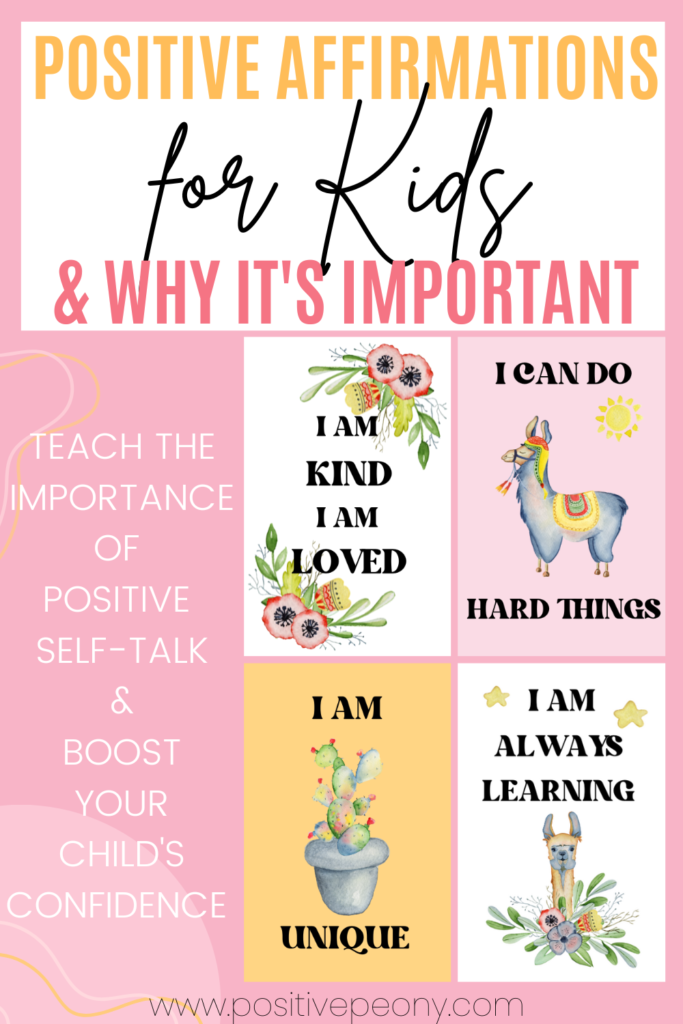
Positive affirmations are encouraging phrases or statements that people repeat to themselves. Examples include “I am smart,” “I am loved,” and “I can do hard things.” For kids, affirmations are usually short, easy to remember, and focused on building confidence, kindness, and resilience.
These statements work by replacing negative thoughts with positive ones. When kids hear or say affirmations often, their brains start to believe them. This process is called neuroplasticity—the brain’s ability to change and adapt. For children, whose brains are still developing, this effect is even stronger.
How Affirmations Influence Children’s Minds
Children’s minds are open and flexible. They learn quickly from their surroundings, and their inner voice is shaped by what they hear and experience. Positive affirmations work by strengthening a child’s self-talk—the inner dialogue that guides thoughts and actions.
When kids repeat affirmations, several things happen:
- Self-belief grows: Kids start to see themselves as capable and worthy.
- Negative thinking decreases: Regular positive statements help quiet doubts and fears.
- Emotional resilience improves: Children learn to handle setbacks with courage.
- Motivation increases: Kids feel encouraged to try new things and face challenges.
Brain research shows that positive self-talk can increase activity in areas linked to motivation and reward. In other words, affirmations can help kids feel good about themselves and push through difficulties.
Why Do Kids Need Positive Affirmations?
Children face many challenges—schoolwork, friendships, family changes, and new experiences. Sometimes, they hear negative messages or compare themselves to others. These moments can hurt their confidence and make them feel unsure.
Positive affirmations are important because they:
- Build self-esteem: Kids who believe in themselves are more likely to try new things and bounce back from failure.
- Reduce anxiety: Encouraging words calm fears and help kids feel safe.
- Encourage positive behavior: When children feel good about themselves, they act kindly and responsibly.
- Support mental health: Affirmations are a tool for coping with stress and difficult feelings.
Many kids struggle with self-doubt or worry, especially during transitions like starting school or moving to a new place. Affirmations give them a simple way to feel stronger and more confident.
Examples Of Positive Affirmations For Kids
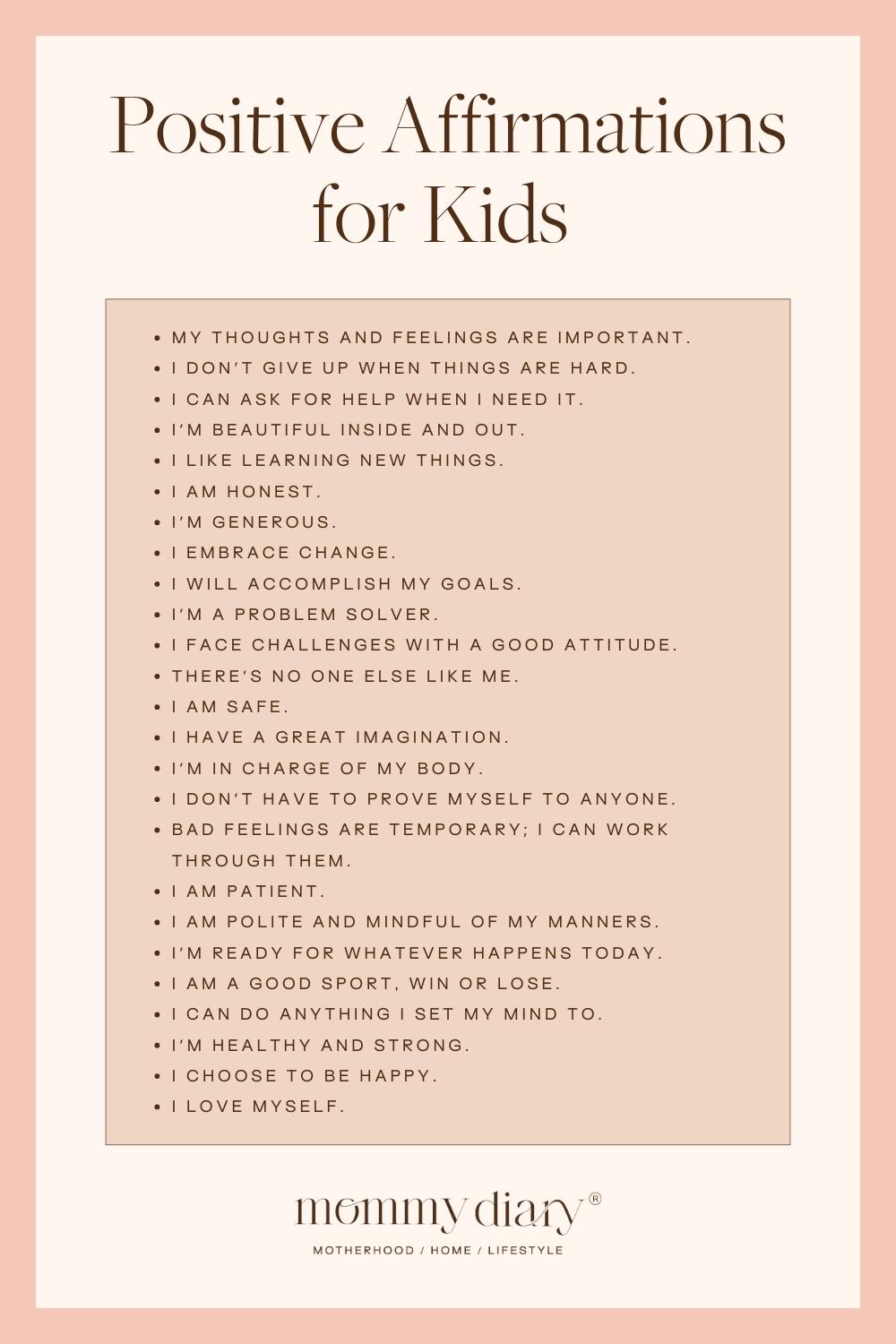
To make affirmations effective, they should be clear, simple, and age-appropriate. Here are some common examples:
- I am brave
- I am loved
- I can learn anything
- I am important
- I am kind
- I can make good choices
- I am creative
- I am a good friend
- I am strong
- I can ask for help
These statements can be repeated daily, written in journals, or used in classroom activities. The key is to find affirmations that match the child’s needs and personality.
Scientific Evidence Supporting Affirmations
Research shows that positive self-talk and affirmations can help children in many ways. For example, studies found that children who use positive affirmations:
- Have higher self-esteem
- Show better academic performance
- Are more resilient after setbacks
- Experience less anxiety
One study showed that children who repeated affirmations before a test performed better than those who did not. Another study found that affirmations helped children with social anxiety feel more comfortable in group settings.
The science is clear: positive affirmations are not just empty words. They have real effects on the brain and behavior.
How Affirmations Shape Self-esteem And Confidence
Self-esteem is how much a child values themselves. Confidence is the belief that they can succeed. Both start forming early and are influenced by family, friends, and school.
Positive affirmations help build these qualities by:
- Replacing negative messages: Kids often hear “You can’t” or “You’re not good enough.” Affirmations counter these with “You can” and “You are enough.”
- Encouraging effort: Affirmations focus on trying, not just winning. Statements like “I can learn” or “I can improve” help kids see progress as success.
- Supporting emotional growth: When children feel good about themselves, they are less afraid of making mistakes.
Let’s compare self-esteem in kids who use affirmations versus those who don’t:
| Factor | With Affirmations | Without Affirmations |
|---|---|---|
| Self-esteem | Higher | Lower |
| Confidence | Strong | Weak |
| Willingness to try new things | More likely | Less likely |
| Response to failure | Resilient | Discouraged |
Kids with regular positive affirmations tend to be more willing to take risks, ask questions, and learn from mistakes.
Credit: mommy-diary.com
Role Of Affirmations In Managing Anxiety And Stress
Anxiety and stress are common in children, especially when facing new or difficult situations. Positive affirmations act as a mental tool to calm fears and build courage.
When a child feels nervous, repeating affirmations like “I am safe” or “I can handle this” can:
- Lower stress levels
- Reduce physical symptoms like stomachaches or headaches
- Help kids focus on solutions instead of worries
In fact, therapists often use affirmations as part of cognitive-behavioral therapy for anxious children. This approach teaches kids to challenge negative thoughts and replace them with positive ones.
Here is a comparison between children who use affirmations and those who don’t when dealing with anxiety:
| Scenario | With Affirmations | Without Affirmations |
|---|---|---|
| First day at school | Calmer, more confident | More anxious, withdrawn |
| After a mistake | Accepts, tries again | Feels shame, avoids |
| Meeting new friends | Open, friendly | Shy, nervous |
This shows how positive affirmations make a real difference in handling stress and anxiety.
The Impact Of Affirmations On Academic Performance
Academic success is not just about intelligence. It’s also about confidence, motivation, and attitude. Positive affirmations encourage kids to believe in their abilities, which can lead to better grades and learning experiences.
When children repeat statements like “I can solve this problem” or “I am a good learner,” they are more likely to:
- Stay focused in class
- Try harder on homework
- Ask for help when needed
- Overcome fear of failure
Teachers often use affirmations to motivate students before tests or big projects. This helps reduce test anxiety and improves performance.
A survey showed that students who practiced positive self-talk scored higher on math and reading tests compared to those who did not. The difference was most noticeable in students who previously felt insecure about their abilities.
Affirmations And Social Skills
Social skills—like making friends, sharing, and resolving conflicts—are important for every child. Affirmations help kids feel confident in social settings and encourage positive behavior.
When children repeat affirmations such as “I am a good friend” or “I can listen,” they learn to value themselves and others. This can lead to:
- Better communication
- More cooperation
- Stronger friendships
Teachers sometimes use group affirmations in class to build a sense of community. This helps shy or nervous kids feel included and valued.
Here is a data table showing the effect of affirmations on social skills:
| Skill | With Affirmations | Without Affirmations |
|---|---|---|
| Making friends | Easier | Harder |
| Handling conflicts | More peaceful | More aggressive |
| Sharing | Frequent | Rare |
| Empathy | Higher | Lower |
Kids who use affirmations are more likely to show kindness and understanding in their relationships.
How Parents And Teachers Can Introduce Affirmations
Positive affirmations work best when they are part of daily life. Parents and teachers can help children use affirmations in simple ways:
- Model the language: Adults can use affirmations themselves. For example, “I am proud of you,” or “I believe in you.”
- Make it a routine: Repeat affirmations each morning or before bedtime.
- Use visual reminders: Write affirmations on sticky notes, mirrors, or classroom walls.
- Personalize statements: Choose affirmations that fit the child’s needs and personality.
- Encourage repetition: The more often kids repeat affirmations, the stronger the effect.
Some parents worry that affirmations feel forced. The key is to use genuine words and make them meaningful. Over time, children start to believe the statements and use them naturally.
Common Mistakes When Using Affirmations
While affirmations are powerful, there are some mistakes to avoid:
- Using unrealistic statements: Saying “I am perfect” or “I never fail” can cause frustration when reality does not match.
- Ignoring feelings: Affirmations should not hide negative emotions. It’s important to talk about feelings and use affirmations to support, not replace, real conversations.
- Being inconsistent: Affirmations work best with regular practice. Infrequent use may have little effect.
- Choosing complex language: Simple, clear phrases are more effective for children.
Avoiding these mistakes helps affirmations become a helpful tool, not just empty words.
Practical Tips For Making Affirmations Effective
To make affirmations truly work for kids, try these practical tips:
- Start with one or two statements: Focus on what matters most to the child.
- Use positive, action-based language: “I am learning,” “I can try,” “I am growing.”
- Combine with actions: Pair affirmations with positive behaviors. For example, “I am helpful” followed by sharing toys.
- Encourage creativity: Let kids create their own affirmations. This builds ownership and meaning.
- Celebrate progress: Notice when affirmations lead to positive changes.
Some children respond better to visual reminders, while others like speaking or writing affirmations. Find what works best for the child’s style.
Real-life Examples Of Affirmations Changing Kids’ Lives
It’s easy to wonder if affirmations really make a difference. Here are a few real-life stories:
- A shy child who used the statement “I am brave” learned to speak up in class, leading to improved grades and friendships.
- A child struggling with math repeated “I can learn anything.” Over time, their attitude changed, and they started to enjoy math.
- In a classroom, daily group affirmations like “We are a team” led to fewer conflicts and more cooperation.
These examples show how small changes in language can lead to big changes in behavior and feelings.
Affirmations For Different Age Groups
Affirmations should match a child’s age and understanding. Here are examples for different groups:
Preschoolers
- “I am loved”
- “I am safe”
- “I can share”
Elementary School
- “I can solve problems”
- “I am a good friend”
- “I am creative”
Teens
- “I am confident”
- “I can set goals”
- “I am responsible”
As children grow, their needs change. Affirmations should grow with them, focusing on challenges and strengths at each stage.
Non-obvious Insights About Affirmations For Kids
Many people think affirmations are only for confidence. But there are deeper benefits:
- Affirmations teach emotional vocabulary: Kids learn words to describe feelings, making it easier to express themselves.
- They build mental habits: Regular affirmations create a routine of positive thinking, which can last a lifetime.
- They support group identity: In classrooms or families, group affirmations foster unity and belonging.
One insight often missed: affirmations can help children with learning differences or special needs feel included and valued. Simple phrases can encourage all kids, regardless of ability.
How Affirmations Fit With Other Parenting Strategies
Affirmations work best when combined with other positive parenting tools. For example:
- Praise: Recognize effort, not just achievement.
- Active listening: Let kids share their thoughts and feelings.
- Encouragement: Support children when they try new things.
Affirmations are not a magic fix. They are part of a larger toolkit for raising confident, resilient kids.
Credit: positivepeony.com
Using Affirmations In Schools
Many schools now include affirmations in daily routines. Teachers may start the day with a group affirmation, or encourage students to create their own. This approach:
- Builds a positive classroom culture
- Helps students feel safe and valued
- Reduces bullying and conflict
Some schools use affirmation boards or journals to help kids practice positive self-talk. Over time, this creates a climate where children feel empowered and respected.
The Link Between Affirmations And Mental Health
Mental health is a growing concern for children. Stress, anxiety, and depression can affect even young kids. Affirmations offer a simple, accessible tool for building mental strength.
Research shows that positive self-talk can:
- Lower risk of depression
- Reduce symptoms of anxiety
- Improve coping skills
Affirmations are not a replacement for therapy or medical care. But they are a helpful supplement, especially when children need daily reminders that they are strong and capable.
For more on the science behind affirmations and mental health, see Psychology Today.
Frequently Asked Questions
What Are Positive Affirmations For Kids?
Positive affirmations are short, encouraging statements that help children build self-esteem, confidence, and resilience. Examples include “I am smart,” “I am loved,” and “I can do hard things.”
How Often Should Children Use Affirmations?
Daily repetition works best. Kids can say affirmations in the morning, before bed, or during stressful moments. Regular practice helps the brain believe the positive messages.
Are Affirmations Helpful For Children With Learning Differences?
Yes. Affirmations can help all kids, including those with learning disabilities or special needs, feel valued and capable. Simple, clear phrases are most effective.
Can Affirmations Replace Therapy Or Counseling?
No. Affirmations are a helpful tool, but they do not replace professional support. For serious mental health issues, children should see a counselor or therapist.
How Can Parents Make Affirmations More Meaningful?
Personalize statements for each child, use genuine words, and combine affirmations with actions. Let children create their own affirmations and celebrate their progress.
Final Thoughts
Positive affirmations are more than simple words. They are a powerful tool for shaping a child’s mind, building confidence, and supporting mental health. When used regularly and thoughtfully, affirmations help kids become resilient, motivated, and kind. Parents and teachers play a key role in making affirmations a part of daily life.
Whether spoken, written, or shared in groups, these statements can change the way children see themselves and the world. The effects last far beyond childhood, creating strong, healthy adults who believe in their abilities. If you want to help a child grow and thrive, start with positive affirmations—and watch the difference unfold.

Credit: www.amazon.com
