

What is the Difference between Affirmation and Confirmation?
What Is The Difference Between Affirmation And Confirmation
Words can look similar, sound similar, and still mean very different things. The difference between affirmation and confirmation is a classic example. Many people use these words as if they are interchangeable. But in reality, their meanings and uses are quite distinct. If you want to communicate clearly in English—whether for work, study, or personal growth—knowing when to use each term is important.
Let’s explore what makes affirmation and confirmation unique. We’ll look at their definitions, uses in daily life, practical examples, differences in tone and intent, and even how they appear in law, psychology, business, and religion. By the end, you’ll not only see the difference—you’ll feel confident choosing the right word for any situation.
Understanding Affirmation
Affirmation is a word you’ll find in many places: from motivational talks to daily routines. But what does it really mean?
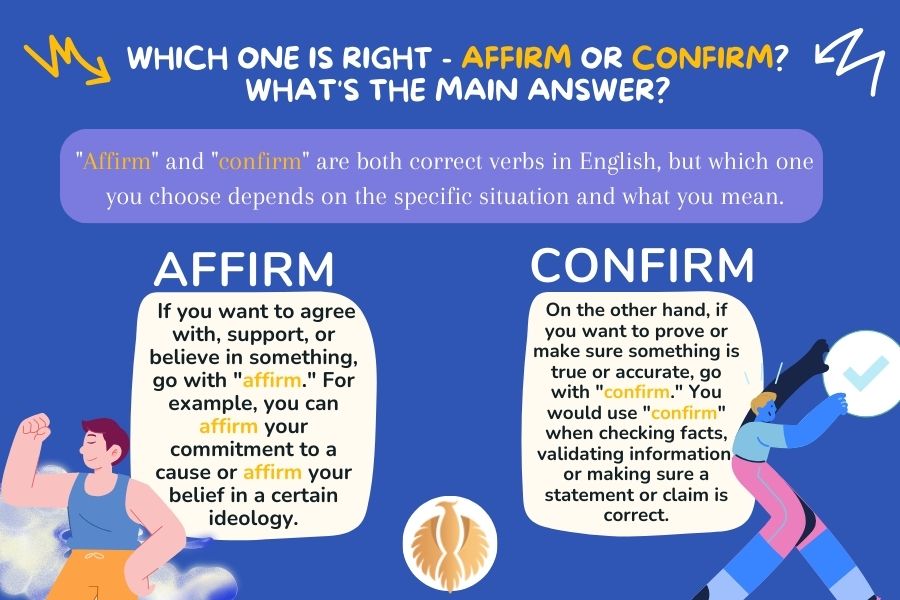
Affirmation is a statement that declares something to be true. It’s about expressing support, agreement, or belief. Often, affirmations are positive statements people repeat to themselves to boost confidence or change their mindset. For example, someone might say, “I am capable,” as a daily affirmation.
But affirmation is not just about self-help. It can also mean agreeing with an idea or showing support for a statement made by someone else.
Examples Of Affirmation
- Saying “You did a great job!” to encourage a friend.
- Repeating “I will succeed” to build personal confidence.
- Publicly supporting a cause by stating, “I believe in equal rights.”
- In law, a witness affirms to tell the truth instead of swearing an oath.
How Affirmations Work In Self-development
Many people use affirmations as a tool for personal growth. By repeating positive statements, they try to shift their beliefs and attitudes. Research shows that affirmations can reduce stress, help people face challenges, and improve overall well-being. However, for affirmations to work, they must be believable and repeated consistently.
Affirmation In Communication
In conversation, giving an affirmation means agreeing with or validating what someone says. For example, if a colleague shares an idea in a meeting, you might say, “That’s a strong proposal,” as an affirmation of their contribution.
Key Features Of Affirmation
- Expresses agreement, belief, or support.
- Often positive and encouraging.
- Used in self-talk, communication, and public statements.
- Focuses on belief or personal acceptance.
Understanding Confirmation
Confirmation is about proving or verifying that something is true, correct, or has happened. When you confirm, you are not just stating your belief—you are providing evidence or checking the facts.
For example, when you book a flight, you receive a confirmation email. This message proves your booking is complete. In science, a confirmation is when an experiment supports a theory. In daily life, confirmation happens when you double-check details or make sure of something.
Examples Of Confirmation
- Receiving an email after registering for an event.
- Doctor confirming a diagnosis with test results.
- Scientist repeating an experiment to confirm findings.
- Teacher checking homework to confirm it is complete.
Confirmation In Everyday Life
Confirmation is everywhere. You confirm reservations, appointments, and deliveries. In these cases, confirmation gives you assurance that things are correct or set. This is different from affirmation, which is more about feelings and beliefs.
Confirmation In Communication
When you confirm something in a conversation, you are verifying information. For example, “Can you confirm your address?” asks for proof or validation.
Key Features Of Confirmation
- Provides proof or evidence.
- Verifies facts or details.
- Used in official, formal, and practical situations.
- Focuses on certainty and accuracy.
Core Differences: Affirmation Vs. Confirmation
To really understand these two words, let’s compare them side by side.
| Feature | Affirmation | Confirmation |
|---|---|---|
| Definition | Statement of belief or support | Proof that something is true |
| Purpose | Encourage, support, agree | Verify, validate, check |
| Common Contexts | Self-help, communication, law, religion | Business, science, daily life, law |
| Evidence Needed? | No | Yes |
| Emotional Tone | Positive, supportive | Neutral, factual |
This table highlights the main differences. Affirmation is about what you believe or support. Confirmation is about checking or proving something.
Origins And Etymology
Words often carry history in their roots. The origins of affirmation and confirmation help clarify why they feel so different in use.
- Affirmation comes from the Latin word “affirmare,” meaning “to make steady, strengthen, confirm.” It has always carried a sense of declaring positively.
- Confirmation comes from the Latin “confirmare,” meaning “to strengthen, establish, make firm.” Over time, it evolved to focus more on making something certain or proven.
Both words share a similar root, but affirmation emphasizes positive declaration, while confirmation centers on making things sure through evidence.
Affirmation In Different Fields
The meaning of affirmation can change slightly depending on the context. Here’s how it is used in various areas:
In Psychology
Psychologists often talk about affirmation as a tool for self-improvement. Self-affirmation theory suggests that people can handle stress better if they regularly remind themselves of their values and strengths. For example, writing down “I am resilient” can help someone stay positive during difficult times.
In Law
In a legal setting, affirmation is an alternative to an oath. Some people do not want to swear oaths for personal or religious reasons. Instead, they make a solemn affirmation to tell the truth. This is legally binding, just like an oath.
In Religion
Some religious traditions use affirmation as a public statement of faith or belief. In many ceremonies, people affirm their beliefs or support for community values.
In Everyday Life
We use affirmations all the time, often without thinking. Supporting a friend, encouraging a child, or stating your goals aloud—all these are forms of affirmation.
Confirmation In Different Fields
Confirmation also appears in many areas, each with its own meaning and importance.
In Business
When you buy a product online, you get a confirmation email. This is proof that your order is received and being processed. Businesses use confirmation to reduce errors and build trust with customers.
In Science
Scientists always seek confirmation. An idea is just a theory until experiments produce results that confirm it. Without confirmation, scientific claims remain uncertain.
In Law
Confirmation can mean verifying facts or approving a decision. For example, a judge might need confirmation from another source before finalizing a verdict.
In Religion
In some religions, confirmation is a special ceremony that marks a person’s commitment to their faith. This is different from affirmation, which is more about stating belief.
Practical Examples: When To Use Each Word
Choosing between affirmation and confirmation depends on what you want to express. Here are some practical cases.
- Sending a Motivational Message
- “You are strong and capable.” (Affirmation)
- Not: “You are confirmed as strong and capable.” (This sounds odd and formal.)
- Booking a Hotel Room
- “Can you confirm my reservation?” (Confirmation)
- Not: “Can you affirm my reservation?” (This is not standard English.)
- Supporting a Friend
- “I affirm your decision to study abroad.” (Affirmation)
- “Can you confirm your travel dates?” (Confirmation)
- Workplace Communication
- Affirming: “I support your idea for the new project.”
- Confirming: “Can you confirm the meeting time?”
- Legal Proceedings
- Affirmation: “Do you affirm to tell the truth?”
- Confirmation: “The court seeks confirmation of the evidence.”
How Context Changes Meaning
Sometimes, a sentence could use either word, but the meaning changes.
- “I affirm this information.”
Means: I believe or support this information.
- “I confirm this information.”
Means: I have checked and can prove this information is correct.
Understanding this subtle difference is key to clear communication. Even advanced English speakers sometimes mix them up, especially in writing.
Common Mistakes And How To Avoid Them
Mixing up affirmation and confirmation can lead to confusion. Here are mistakes people often make:
- Using “affirmation” when asking for proof (“Can you give me an affirmation of your address?” instead of “confirmation”).
- Using “confirmation” in self-help or motivational contexts (“Daily confirmations” instead of “affirmations”).
- Assuming affirmation always means positivity; it can also mean agreement, not just encouragement.
To avoid mistakes, think:
If you want proof or verification, use confirmation.
If you want to show support or belief, use affirmation.
Why This Difference Matters
Some may think the difference is small, but it can change the meaning of a message. Imagine a manager saying, “I confirm your hard work. ” This sounds cold and technical. If the manager says, “I affirm your hard work,” it feels encouraging and personal.
Misusing these words can also cause problems in professional emails, legal documents, and important speeches. Choosing the right word builds trust, clarity, and respect.
Emotional Impact: Affirmation Vs. Confirmation
Words carry emotional weight. Affirmation feels warm, uplifting, and supportive. It helps build relationships, encourage growth, and boost morale.
Confirmation is neutral, objective, and factual. It creates a sense of security, certainty, and order. Both are important, but they serve different emotional needs.
Real-world Scenarios
Let’s look at how affirmation and confirmation appear in real life.
Scenario 1: Workplace
- Manager to employee: “I affirm your commitment to the team.” (Shows support)
- HR to employee: “Can you confirm your start date?” (Checks a detail)
Scenario 2: Education
- Teacher to student: “I affirm your effort on this project.” (Encourages)
- School to parent: “Please confirm your child’s attendance.” (Seeks verification)
Scenario 3: Daily Life
- Friend to friend: “I affirm your decision to try something new.” (Supports choice)
- Customer service: “Your booking is confirmed.” (Proof of action)
These examples show how choosing the right word changes the tone and outcome of a message.
Credit: phoenixenglishlang.com
The Role Of Evidence
One of the clearest differences is the role of evidence.
- Affirmation: No evidence required. It’s about belief or support.
- Confirmation: Requires evidence. It’s about proof or checking.
For instance, if a scientist claims a discovery, peers need confirmation through experiments. If a parent says, “I believe in you,” that’s affirmation.
Linguistic Nuances
English is full of subtle differences. Affirmation and confirmation are both nouns, but their related verbs—affirm and confirm—also show the contrast.
- To affirm is to declare or support something.
- To confirm is to check, prove, or verify.
These verbs appear in many professional and personal contexts. Learning their proper use can help you write and speak more precisely.
Affirmation And Confirmation In Digital Communication
In the digital age, these words are more visible than ever.
- Apps send confirmation codes for security.
- Websites display order confirmations after you buy something.
- Social media often encourages users to share affirmations to spread positivity.
Understanding the correct term is essential, especially in emails, online forms, and customer support.
Differences In Formality
Affirmation is usually less formal. It’s common in conversation, motivation, and personal development.
Confirmation is more formal. It appears in business, law, science, and official communication.
However, both can be used in formal and informal settings. The key is to match the word to the purpose.

Credit: www.oreilly.com
Affirmation And Confirmation In Different Cultures
In some cultures, public affirmation is highly valued. For example, giving positive feedback openly is common in the United States, but less so in some Asian cultures where modesty is important.
Confirmation, however, is universal. Every culture values checking facts, especially in important matters like health, travel, or finance.
Cultural awareness can help you use affirmation and confirmation wisely, respecting local expectations.
How To Practice Using Both Words Correctly
Improving your English means using new words in real situations. Here are tips to practice:
- When you want to encourage someone, use affirmation: “I affirm your effort.”
- When you need to check details, use confirmation: “Can you confirm the address?”
- Write sample sentences with both words and compare the tone.
- Pay attention to how professionals use these terms in emails, meetings, and news.
- If unsure, ask yourself: Am I giving support (affirmation) or checking facts (confirmation)?
Table: Affirmation Vs. Confirmation In Common Situations
Here is a quick reference for using affirmation and confirmation in real life:
| Situation | Use Affirmation | Use Confirmation |
|---|---|---|
| Job Interview | “I affirm my interest in this job.” | “Can you confirm your interview time?” |
| Medical Appointment | Doctor affirms support for your health plan. | Clinic confirms your appointment date. |
| Online Purchase | Affirm your choice of product to a friend. | Receive confirmation of your order. |
| Education | Teacher affirms student’s progress. | School confirms exam schedule. |
How Affirmation And Confirmation Affect Behavior
Language shapes behavior. When you receive affirmation, you often feel more confident and motivated. Teams perform better when leaders affirm their efforts. Children grow stronger when parents affirm their strengths.
When you receive confirmation, you feel safe and certain. Confirming facts reduces mistakes, avoids misunderstandings, and builds trust in business and personal life.
Insights Beginners Often Miss
Many English learners overlook two important points:
- Affirmation can be negative: While affirmation is often positive, it can also be neutral or even negative. For example, affirming a rule means stating it clearly, not necessarily praising it.
- Confirmation can involve repeated checking: In science and business, confirmation often requires checking something more than once. A single confirmation may not be enough; repeated confirmations build stronger trust.
Recognizing these insights will help you use the words more accurately and confidently.
Psychological Impact
Affirmation taps into self-esteem and social connection. People who receive regular affirmation from friends, family, or colleagues report higher satisfaction and lower anxiety.
Confirmation provides peace of mind. When you know something is confirmed, you can relax and move forward without doubt.
Combining both in communication—affirming a person’s effort and confirming the facts—creates a positive and reliable environment.
Affirmation And Confirmation In Leadership
Leaders who master both skills are more effective. They affirm team members to build morale and confirm details to ensure projects run smoothly.
For example, a manager might say, “I affirm your creativity in this project. Please confirm the delivery timeline with the client. ” This approach motivates and organizes at the same time.
Table: Key Words Associated With Affirmation And Confirmation
To avoid confusion, notice the words that often appear with affirmation and confirmation.
| Affirmation | Confirmation |
|---|---|
| Support | Proof |
| Belief | Verification |
| Encouragement | Evidence |
| Agreement | Validation |
| Declaration | Approval |
These word associations can help you choose the right term quickly.
When Both Words Appear Together
Sometimes, you’ll see both words in the same context. For example:
- In a legal document, a person might affirm a statement, and then the court seeks confirmation through evidence.
- In business, a leader might affirm the company’s values and confirm the accuracy of financial reports.
Using both correctly shows language mastery and increases your credibility.
How To Remember The Difference
Here’s a simple way to remember:
- Affirmation = A for Agreement or Attitude
- Confirmation = C for Checking or Certainty
If you’re agreeing or supporting, choose affirmation. If you’re checking or proving, choose confirmation.
Trusted Sources For Further Reading
If you want to study more about the difference between affirmation and confirmation, reliable information can be found at Wikipedia: Affirmation and Negation.
Frequently Asked Questions
What Is The Main Difference Between Affirmation And Confirmation?
Affirmation is about stating or supporting a belief, idea, or value. It is often positive and encourages agreement. Confirmation is about verifying, checking, or proving that something is true or correct, usually with evidence.
Can Affirmation And Confirmation Be Used Together?
Yes, they can. For example, you can affirm your commitment to a project, and then confirm the project’s deadline with your team. Affirmation builds trust; confirmation ensures accuracy.

Credit: www.globalcustody.pro
Is Affirmation Always Positive?
No, affirmation is not always positive. While it is often used to encourage or support, it can also simply mean stating something clearly or agreeing with a fact, even if that fact is not pleasant.
Why Is Confirmation Important In Business?
Confirmation is critical in business to avoid mistakes, build trust, and ensure that all parties have the same understanding. For example, confirming an order or agreement prevents confusion and conflict.
How Can I Improve My Use Of Affirmation And Confirmation In English?
Practice by writing sentences using both words in different contexts. Listen and read carefully to notice how native speakers use them. When speaking or writing, ask yourself: “Am I supporting (affirmation) or checking (confirmation)?”
Learning the difference between affirmation and confirmation will help you communicate more clearly, avoid misunderstandings, and show confidence in any situation. The more you practice, the more natural these words will become in your English conversations.
