

What are Positive Affirmations for Kids: Boosting Confidence Daily
What Are Positive Affirmations For Kids
Every child faces moments of self-doubt, worry, and frustration. Sometimes, small words can make a big difference in how they feel. Positive affirmations are simple phrases that help kids build a strong mindset. When children repeat affirmations, they start believing in themselves, feeling calmer, and becoming more confident.
This article explores what positive affirmations for kids are, why they matter, and how parents and teachers can use them to support children's growth.
Understanding Positive Affirmations
Positive affirmations are short, uplifting statements. Kids say these phrases to themselves, often aloud, to encourage positive thinking. For example, a child might say, "I am brave" or "I can do hard things." The goal is to help them replace negative thoughts with positive ones.
Affirmations are not magic. They do not solve every problem instantly. But when used regularly, they can change how a child sees themselves and the world. Research shows that positive self-talk can improve mood, reduce stress, and boost self-esteem.
How Affirmations Work
When children repeat positive phrases, their brains start to believe them. This process is known as neuroplasticity. The brain creates new pathways, making positive thoughts easier to access. Over time, these pathways become stronger, and negative thinking becomes weaker.
A non-obvious insight is that affirmations work best when they match a child's real experiences. If a child struggles with math, saying "I am good at math" may feel false. But "I am learning new math skills every day" feels honest and encourages growth.
Why Kids Need Positive Affirmations
Kids face many challenges. School, friendships, family changes, and even social media can cause stress. Affirmations help children:
- Build confidence
- Manage anxiety
- Handle mistakes
- Improve relationships
Children who use affirmations often show better emotional control and resilience. They learn to focus on their strengths, not just their weaknesses.
Benefits Of Positive Affirmations For Kids
Positive affirmations offer many advantages for children's mental and emotional health. Below are key benefits, supported by examples and data.
1. Boosting Self-esteem
Kids often compare themselves to others. They may feel “not good enough” or “less talented.” Affirmations like "I am unique" or "I am proud of myself" help them value their own qualities.
A study from the American Psychological Association found that children who practiced self-affirmation had higher self-esteem scores compared to those who did not.
2. Reducing Anxiety
Anxiety is common among kids. Positive affirmations can calm their nerves. For example, "I am safe" or "I can handle tough feelings" gives comfort during stressful times.
Children who use affirmations regularly report fewer anxious thoughts and better coping strategies.
3. Encouraging Growth Mindset
A growth mindset means believing that skills and intelligence can improve with effort. Affirmations like "I learn from my mistakes" help kids see challenges as opportunities.
According to research, children with a growth mindset are more motivated and less afraid of failure. Affirmations support this thinking.
4. Improving Social Skills
Kids sometimes struggle with friendships and social situations. Affirmations such as "I am a good friend" or "I listen to others" guide positive behavior.
Social affirmations help children feel confident in groups, reducing shyness and loneliness.
5. Supporting Academic Success
Positive self-talk is linked to better school performance. When kids say "I can solve problems" or "I am getting better at reading," they approach learning with optimism.
Teachers report that students who use affirmations are more willing to try difficult tasks and ask for help.

Credit: www.thepathway2success.com
Common Positive Affirmations For Kids
There are many types of affirmations children can use. Here are examples that suit different situations:
- I am loved
- I am important
- I am brave
- I can try my best
- I am learning every day
- I can ask for help
- I am kind
- I believe in myself
- I can make good choices
- I am strong
- I am creative
- I am proud of myself
- I can handle anything
- I am grateful
- I am helpful
- I am patient
- I am enough
- I respect others
- I can solve problems
- I forgive myself
These affirmations are easy for kids to remember and repeat. They cover self-worth, effort, kindness, and resilience.
How To Introduce Positive Affirmations To Kids
It is important to make affirmations part of a child’s daily routine. Here are practical steps for parents, teachers, and caregivers:
1. Start Simple
Begin with one or two affirmations that match the child’s needs. For example, if a child is shy, start with "I am confident."
2. Make It Fun
Children learn best through play. Turn affirmations into games, songs, or art. Let kids decorate affirmation cards or posters.
3. Lead By Example
Adults should use affirmations themselves. When parents say, "I am calm" during stressful moments, kids see the value of positive self-talk.
4. Use Daily Reminders
Set a regular time, such as before school or bedtime, for repeating affirmations. Consistency is key.
5. Personalize Affirmations
Encourage kids to create their own phrases. Affirmations are more powerful when they feel personal.
6. Avoid Pressure
Never force a child to use affirmations. Let them choose what feels right.
Examples Of Positive Affirmations In Different Situations
Children face unique challenges. Here are examples of affirmations for common situations:
When Facing A Test
- I am prepared
- I can focus
- I will do my best
After Making A Mistake
- Mistakes help me learn
- I can try again
- I forgive myself
During Conflict With Friends
- I can listen
- I can solve problems
- I am a good friend
When Feeling Sad Or Worried
- It’s okay to feel sad
- I am safe
- I can ask for help
When Trying Something New
- I am brave
- I can learn
- I am curious
Each situation needs the right affirmation. Matching the phrase to the moment helps kids feel supported.
Comparing Positive Affirmations And Negative Self-talk
Children often use self-talk, but not all self-talk is helpful. Positive affirmations replace negative phrases with supportive ones. Here is a comparison:
| Negative Self-Talk | Positive Affirmation |
|---|---|
| I can't do this | I can try my best |
| I'm not smart | I am learning every day |
| No one likes me | I am a good friend |
| I always fail | Mistakes help me grow |
| I'm scared | I am brave |
Switching from negative to positive takes practice. But the new phrases can change how children feel and act.
Scientific Evidence For Positive Affirmations
Research supports the use of positive affirmations in childhood. Studies show that regular affirmation practice leads to:
- Higher self-esteem scores
- Lower rates of anxiety and depression
- Better academic performance
- Improved social skills
One study found that children who practiced affirmations had a 23% increase in self-confidence after four weeks. Another showed that kids with positive self-talk were more likely to try new activities and face challenges.
A non-obvious insight is that affirmation effectiveness depends on repetition and sincerity. Saying affirmations once is not enough; children should repeat them often and believe in their meaning.
Making Affirmations Age-appropriate
Affirmations should match a child’s developmental level. Younger kids need simple words and clear ideas. Older children can use more complex phrases.
Here’s a helpful comparison:
| Age Group | Sample Affirmations |
|---|---|
| 3-6 years | I am kind. I am loved. I can share. |
| 7-10 years | I can solve problems. I am a good friend. I am brave. |
| 11-14 years | I learn from mistakes. I am confident. I can handle anything. |
Adjusting affirmations to a child’s age helps them understand and accept the phrases.
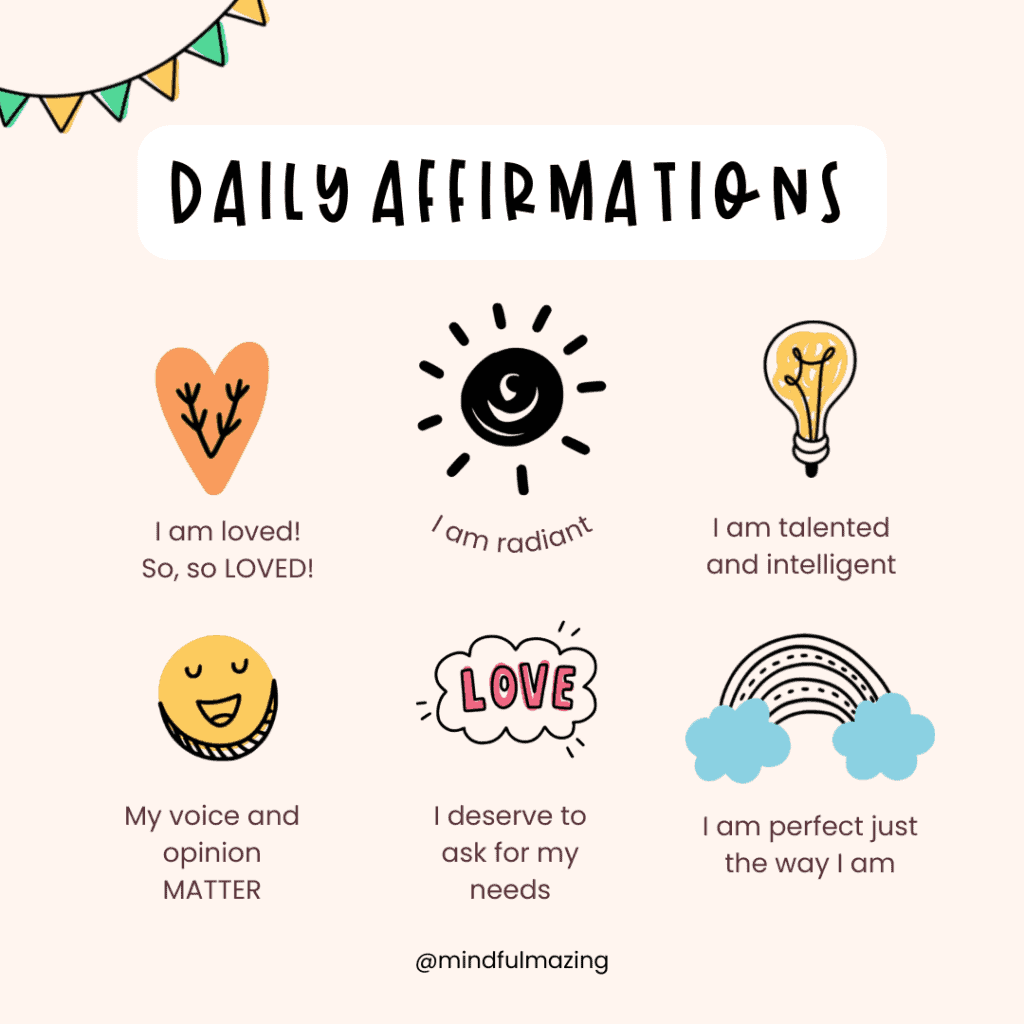
Credit: www.mindfulmazing.com
Mistakes To Avoid When Using Affirmations
Affirmations are helpful, but common mistakes can limit their impact. Here are some to watch for:
1. Using Unrealistic Phrases
Affirmations should be believable. If a child says, "I am perfect," they may not trust the phrase. Instead, use "I am learning every day."
2. Ignoring Feelings
Affirmations do not erase difficult emotions. Children need space to feel sad or upset. Use affirmations to support, not hide, feelings.
3. Forcing Affirmations
Kids should choose affirmations that feel true. Forcing phrases may cause resistance.
4. Lack Of Consistency
Affirmations work best with daily practice. Forgetting or skipping days reduces their power.
5. Using Only Generic Statements
Personalized affirmations are more effective. Help children create phrases that fit their real experiences.
How Parents And Teachers Can Support Affirmations
Adults play a big role in helping kids use affirmations. Here are ways to support:
1. Model Positive Self-talk
Children learn by watching adults. When parents or teachers use affirmations, kids see that positive self-talk is normal.
2. Create A Supportive Environment
Display affirmation posters in classrooms or bedrooms. Use books, videos, or activities that encourage positive thinking.
3. Encourage Group Practice
Have children share affirmations in groups. This builds community and helps kids see that everyone faces challenges.
4. Celebrate Progress
Notice when a child uses an affirmation. Praise their effort, not just results.
5. Listen And Adapt
Ask kids how they feel about affirmations. Change phrases as needed to match their growth.
Using Affirmations At Home
Parents can create routines that include affirmations. Here are ideas:
- Morning affirmations before school
- Bedtime affirmations to calm worries
- Affirmation jars: Children pick a phrase each day
- Art projects: Decorate affirmation cards or posters
Making affirmations part of daily life encourages lasting change.
Affirmations In Schools
Teachers can use affirmations to build a positive classroom culture. Here are practical methods:
- Start each day with a group affirmation
- Use affirmations during stressful moments, like tests
- Encourage students to make their own affirmation posters
- Add affirmation activities to social-emotional lessons
Schools that use affirmations report better student engagement and fewer behavior problems.
Comparing Affirmations With Other Mindset Tools
Affirmations are one tool for building a strong mindset. Here’s a comparison with other popular methods:
| Mindset Tool | How It Works | Best For |
|---|---|---|
| Positive Affirmations | Repeating uplifting phrases | Daily confidence and resilience |
| Gratitude Journals | Writing what you’re thankful for | Improving mood and outlook |
| Mindful Breathing | Deep, slow breaths to calm | Managing stress and anxiety |
| Visualization | Imagining success or peace | Facing challenges or fears |
Combining affirmations with other tools makes a stronger impact. For example, a child might use affirmations after mindful breathing to boost calm and confidence.
Real-life Examples And Success Stories
Many parents and teachers share stories of how affirmations helped their children. Here are a few:
Emma’s Story
Emma, age 8, struggled with reading. She often said, “I’m bad at reading.” Her teacher introduced the affirmation, "I am improving every day." After a month, Emma felt less frustrated and started reading more books.
Jacob’s Experience
Jacob was nervous about making new friends. His mom helped him use the affirmation, "I am a good friend." Jacob began talking to classmates and felt more comfortable in social situations.
Classroom Success
A teacher used daily affirmations in her class. Students said, "I am ready to learn" each morning. The teacher noticed higher participation and fewer conflicts.
These stories show that affirmations are not just words—they can change attitudes and actions.
Tips For Making Affirmations More Effective
Some parents and teachers wonder how to make affirmations work faster. Here are practical tips:
- Encourage repetition: The more often kids say affirmations, the stronger their effect.
- Use visual aids: Posters, cards, or drawings help kids remember their phrases.
- Match affirmations to goals: If a child wants to improve in sports, use "I am strong" or "I can practice and get better."
- Involve senses: Let children sing, write, or act out affirmations.
- Celebrate small wins: Notice when affirmations help, and praise progress.
A non-obvious insight is that affirmations can be linked to daily routines, such as brushing teeth or packing a school bag. This makes practice effortless and consistent.
Cultural Differences In Affirmation Use
Affirmations are used worldwide, but cultural values shape their style. In some cultures, group affirmations are common, focusing on community and kindness. In others, individual achievement is stressed.
It’s important to respect cultural differences and let kids choose affirmations that fit their beliefs.
Challenges And Solutions In Affirmation Practice
Some children resist affirmations, saying they feel silly or fake. Here’s how to address these challenges:
- Validate feelings: It’s okay to feel unsure about affirmations.
- Start slow: Use simple phrases or write them down instead of saying aloud.
- Make it a group activity: Kids feel less awkward when others join in.
- Share adult stories: Show how affirmations help grown-ups too.
Overcoming resistance takes patience. The key is gentle encouragement, not pressure.
Resources For Positive Affirmations
Many books, websites, and apps offer affirmation ideas for kids. One helpful resource is Psychology Today. These tools give parents and teachers more ways to support children’s growth.
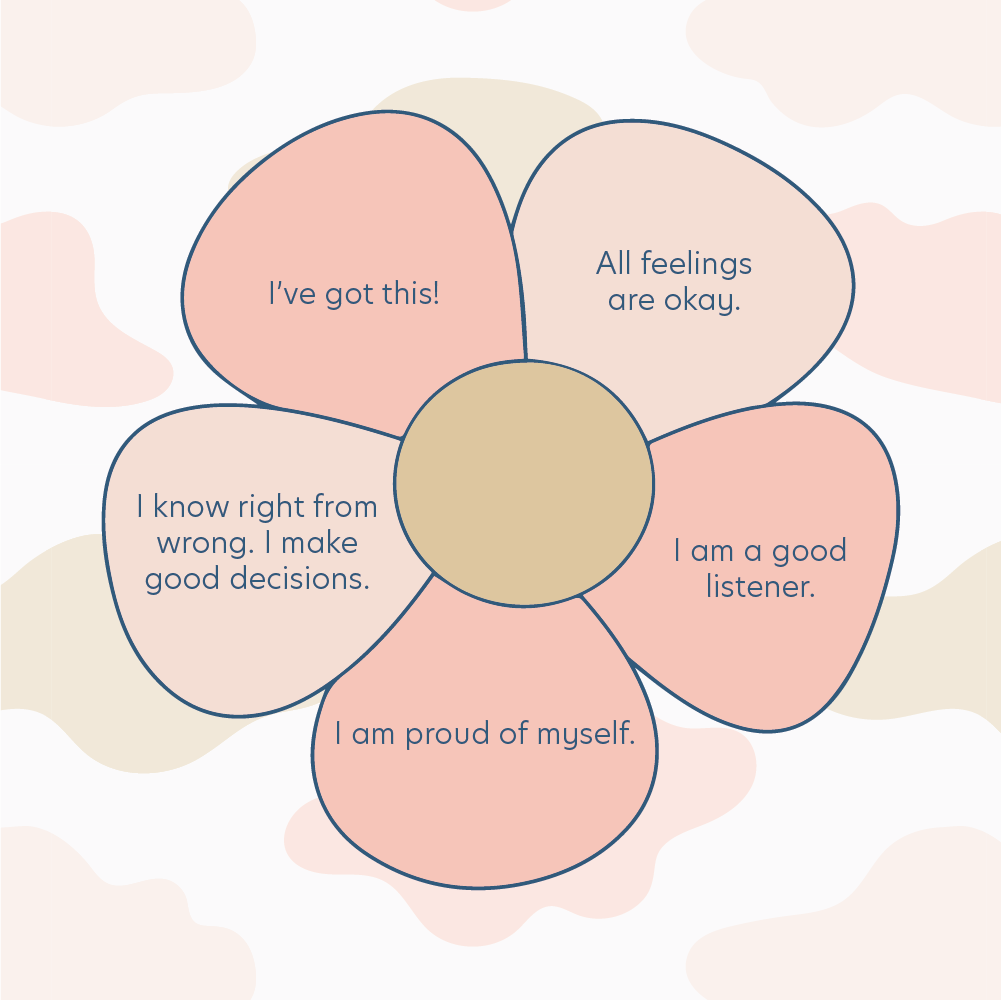
Credit: brightpathkids.com
Frequently Asked Questions
What Are Positive Affirmations For Kids?
Positive affirmations for kids are short, uplifting statements that children repeat to themselves. They help build confidence, manage emotions, and develop a positive mindset.
How Often Should Kids Use Affirmations?
Children should use affirmations daily for best results. Morning, bedtime, or before stressful events are good times. Consistent practice makes affirmations more effective.
Can Affirmations Help Children With Anxiety?
Yes, positive affirmations can reduce anxiety. Phrases like "I am safe" or "I can handle tough feelings" calm nerves and help children cope with stress.
Are There Age-appropriate Affirmations?
Affirmations should match a child's age and understanding. Younger children need simple phrases, while older kids can use more complex statements.
What If My Child Refuses To Use Affirmations?
It is normal for some kids to resist. Try making affirmations fun, using art or games. Let children choose or create their own phrases. Avoid forcing them.
Positive affirmations are simple but powerful tools. They help children face challenges, build confidence, and feel good about themselves. When used with care and consistency, affirmations can support kids in every part of life—from school to friendships, and beyond. Parents, teachers, and caregivers have the power to guide children in using affirmations wisely.
The journey starts with a single phrase, repeated with hope and belief.
