

Is Affirmation a Noun? Understanding Its Grammar and Usage
Is Affirmation A Noun
When you hear the word affirmation, you might think about positive phrases people repeat to themselves. But if you’re learning English, you may wonder about its grammar: Is “affirmation” a noun? How do you use it? Why does this matter for writing and speaking?
Understanding the role of affirmation helps not only with English grammar but also with using the word in the right way. In this article, you’ll get a full explanation, with real examples, comparisons, practical tips, and answers to common questions. If you want to master English vocabulary, get comfortable with the word “affirmation”—from its definition to its use in daily life and writing.
What Is A Noun?
Before looking at “affirmation,” it’s important to understand what a noun is. A noun is a word that names something. It could be a person, place, thing, idea, or feeling. For example:
- Person: Teacher, doctor, friend
- Place: School, city, park
- Thing: Book, phone, chair
- Idea or feeling: Happiness, freedom, love
Nouns answer the questions “what? ” or “who? ” in a sentence. They can be the subject or object. Most sentences in English need at least one noun to make sense.
Some nouns are countable (you can count them: apple, apples) and some are uncountable (you can’t count them: water, information).
Understanding nouns is basic but critical for making your English clear and correct.
Is “affirmation” A Noun?
The answer is clear: affirmation is a noun. It belongs to the group of words that express an idea or concept. But it’s not enough to say “yes”—you need to know why and how.
“Affirmation” is the name of something. Specifically, it is the name of:
- The act of affirming
- A statement that confirms something is true
- A positive declaration or encouragement
Because it is the name of an action or idea, it fits perfectly into the noun category.
Here is how you can see that “affirmation” is a noun:
- It can follow “the,” “an,” or “my” (the affirmation, an affirmation, my affirmation)
- It can be counted (one affirmation, two affirmations)
- It can be the subject or object in a sentence
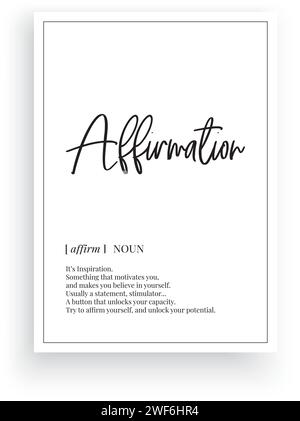
Credit: www.alamy.com
The Definition Of Affirmation
The definition of affirmation is important. According to the Oxford English Dictionary, “affirmation” means:
- The action of affirming something or being affirmed.
- Emotional support or encouragement.
This shows that “affirmation” is an idea, not an action or description. That is what makes it a noun.
Usage In Sentences
To see “affirmation” in action, look at these examples:
- “She gave me an affirmation of her support.”
- “Positive affirmations help many people feel more confident.”
- “His affirmation inspired the whole team.”
In each case, “affirmation” names a thing (an idea or statement).
Singular And Plural
The word can be singular (affirmation) or plural (affirmations):
- “One affirmation can make a big difference.”
- “Daily affirmations are part of her routine.”
This is typical for countable nouns.
How “affirmation” Is Formed
Understanding the parts of the word gives even more clarity. “Affirmation” comes from the verb affirm, which means to state something strongly or positively. The suffix -ation turns the verb into a noun. This pattern happens in many English words:
- Inform → information
- Confirm → confirmation
- Demonstrate → demonstration
So “affirmation” Is The Noun Form Of “affirm.”
Is “affirmation” Ever Used As A Verb Or Adjective?
Some words in English can be both nouns and verbs (like “play” or “dream”). But “affirmation” is only a noun. You do not use “affirmation” as a verb or an adjective.
- Incorrect: I will affirmation you.
- Correct: I will affirm you. / I will give you an affirmation.
The verb form is affirm. The adjective is affirmative (e.g., “She gave an affirmative answer”).
So, “affirmation” is always a noun. Recognizing this prevents common grammar mistakes.
Types Of Nouns: Where Does Affirmation Fit?
Nouns are not all the same. Here’s how “affirmation” fits into English grammar.
Concrete Vs. Abstract Nouns
- Concrete noun: Names something you can touch or see (book, apple)
- Abstract noun: Names an idea, quality, or feeling (love, courage, freedom)
“Affirmation” is an abstract noun. It names an idea, not a physical object.
Countable Vs. Uncountable Nouns
- Countable noun: You can count them (one, two, three)
- Uncountable noun: Cannot be counted (water, advice)
“Affirmation” is usually countable:
- “Several affirmations were written on the wall.”
But in some cases, it can also be used in a more general, uncountable sense:
- “Affirmation is important for mental health.”
Most often, you’ll see it as a countable noun.
Common Vs. Proper Nouns
- Common noun: General name (city, car, teacher)
- Proper noun: Specific name (London, Toyota, Mr. Lee)
“Affirmation” is a common noun. It is not a name of a person or place.
Comparison: Affirmation Vs. Related Words
Some words are similar to “affirmation” but have different meanings or functions.
| Word | Part of Speech | Meaning |
|---|---|---|
| Affirm | Verb | To state something as true; to confirm |
| Affirmation | Noun | The act of affirming; a positive statement |
| Affirmative | Adjective | Agreeing with or consenting to a statement |
| Confirmation | Noun | Proof or verification of something |
Notice that only “affirmation” is a noun referring to a positive statement or the act of affirming.
How To Use “affirmation” Correctly
Using “affirmation” properly in writing and speech shows your command of English. Here’s how you can use it:
- As a Subject: “Affirmation helps people believe in themselves.”
- As an Object: “He received affirmation from his family.”
- With Adjectives: “A simple affirmation can change your mood.”
- In Plural Form: “Many affirmations are about self-worth.”
Non-obvious Tips
- Avoid confusing “affirmation” with “confirmation.” “Affirmation” is about support or positive statements. “Confirmation” is about checking something is true.
- Affirmation is not always positive. In law or formal writing, it can mean a statement that something is true, not just encouraging words.
Examples In Different Contexts
“Affirmation” is not just for personal growth or self-help. Here are several situations where you might see or use the word.
Everyday Conversation
- “Thanks for your affirmation. It really helped me today.”
- “She wrote affirmations on her mirror.”
Education
- “Teachers give affirmation to students to encourage learning.”
Law
- “The witness gave an affirmation that her statement was true.”
Workplace
- “Employee affirmation programs increase motivation.”
Mental Health
- “Daily affirmation improves self-esteem.”
Each context uses “affirmation” as a noun, but the meaning can shift a little based on the situation.
Common Mistakes With “affirmation”
Even advanced English learners sometimes make errors with this word. Here are mistakes to watch for:
- Using “affirmation” as a verb.
- Wrong: “I affirmation my feelings.”
- Right: “I affirm my feelings.”
- Mixing up “affirmation” and “confirmation.”
- Wrong: “I need your affirmation that the order is correct.”
- Right: “I need your confirmation that the order is correct.”
- Forgetting plural form when needed.
- Wrong: “I wrote many affirmation.”
- Right: “I wrote many affirmations.”
- Adding unnecessary articles.
- Wrong: “She needs the affirmation everyday.”
- Right: “She needs affirmation every day.” (if talking about affirmation in general)
Paying attention to these details helps you sound more natural.

Credit: www.etsy.com
Origins And Etymology Of “affirmation”
Knowing where a word comes from can help you remember its use. “Affirmation” comes from the Latin affirmatio, which means a declaration or confirmation. It entered English through Old French.
This is useful because many English nouns end in -ation and have similar meanings:
- Information (from inform)
- Confirmation (from confirm)
- Participation (from participate)
Recognizing this pattern helps you guess meanings of new words.
“affirmation” In Different English Varieties
The use of “affirmation” is generally the same in American, British, Canadian, and Australian English. However, there are some small differences in frequency or context.
- In American English, “affirmation” often appears in self-help or psychology.
- In British English, you might see “affirmation” in legal or formal documents.
Pronunciation is also similar, but stress may shift slightly in different accents.
Affirmation In Other Languages
If you’re a non-native English speaker, knowing the equivalent word in your language can help. Here are some translations:
| Language | Translation | Literal Meaning |
|---|---|---|
| Spanish | afirmación | Statement or confirmation |
| French | affirmation | Statement or assertion |
| German | Bestätigung | Confirmation or affirmation |
| Chinese (Mandarin) | 肯定 (kěndìng) | Affirmation or confirmation |
| Hindi | स्वीकृति (sweekriti) | Acceptance or affirmation |
This shows that “affirmation” is an idea found in many languages, even if the exact word changes.
The Role Of Affirmation In Communication
Why does it matter that “affirmation” is a noun? The answer is about clear communication.
- Nouns give structure to sentences. Knowing “affirmation” is a noun helps you place it correctly in a sentence.
- Abstract nouns express ideas. You use “affirmation” to talk about feelings, support, or statements.
- Precise use builds trust. If you use words correctly, people understand you better.
If you’re writing an essay, email, or speech, using “affirmation” in its right form boosts your credibility.

Credit: www.etsy.com
How To Build Vocabulary Around “affirmation”
Once you know “affirmation” is a noun, you can build related vocabulary:
- Affirm (verb): “I affirm my decision.”
- Affirmative (adjective): “She gave an affirmative response.”
- Affirmatively (adverb): “He nodded affirmatively.”
Learning the word family helps you write and speak with more variety.
Affirmation In Positive Psychology
You may see “affirmation” often in topics about mental health and well-being. In this context, an affirmation is a positive statement that people say to themselves to change negative thinking.
Example affirmations:
- “I am worthy of respect.”
- “I can overcome challenges.”
- “Every day brings new opportunities.”
Research suggests that repeating affirmations can help reduce stress and improve confidence. According to Wikipedia, positive affirmations are used in therapy and self-help programs around the world.
But remember, even in this context, “affirmation” is still a noun: it is the name of a statement, not the action itself.
Real-world Examples And Data
To see how common the word “affirmation” is, let’s look at some data.
- In English books and articles, “affirmation” appears thousands of times every year.
- Google Ngram Viewer shows a steady rise in the use of “affirmation” in self-help literature.
- In online forums and blogs, “affirmation” is among the top 100 words in discussions about motivation.
It’s more common in writing about psychology, education, and personal growth than in business or science.
Practical Ways To Practice Using “affirmation”
Improving your use of “affirmation” (and other nouns) takes practice. Here are some strategies:
- Write sentences using “affirmation” in different positions (subject, object, etc. ).
- Read articles or books that use “affirmation.” Notice how it is used in context.
- Make a list of affirmations for yourself, using the word correctly.
- Explain the meaning of affirmation to a friend, using examples.
- Test yourself: Change verbs into nouns using “-ation” (affirm → affirmation).
This active practice will help you remember and use the word naturally.
Why Understanding Parts Of Speech Matters
Knowing that “affirmation” is a noun is not just a grammar point. It helps with:
- Sentence building: You know where the word fits.
- Vocabulary growth: You can use related words correctly.
- Clear writing: You avoid confusion and mistakes.
Many learners make errors by using words in the wrong part of speech. Taking time to learn the role of “affirmation” will improve your English overall.
Quick Reference: Key Facts About “affirmation”
- Affirmation is a noun.
- It refers to the act of affirming, or a positive statement.
- It is an abstract, usually countable, common noun.
- The verb form is “affirm,” the adjective is “affirmative.”
- Used in daily conversation, legal language, education, and psychology.
- Never use “affirmation” as a verb or adjective.
- Plural: “affirmations.”
- Found in many languages with similar meanings.
Frequently Asked Questions
What Is The Difference Between “affirmation” And “confirmation”?
Affirmation means making a positive statement or showing support. Confirmation means checking or proving that something is true. For example, “I received affirmation from my friend,” but “I received confirmation of my hotel booking.”
Can You Use “affirmation” In The Plural Form?
Yes, you can use “affirmation” as a plural noun: “affirmations.” This is common, especially when talking about several different positive statements. Example: “She repeats her affirmations every morning.”
Is “affirmation” Always Positive?
No, not always. While many people use “affirmation” to mean a positive statement, in legal or formal contexts, it can simply mean a declaration that something is true, without emotional value.
What Are Some Synonyms For “affirmation”?
Some common synonyms include declaration, assertion, statement, and assurance. However, these words might not always mean exactly the same thing. “Affirmation” often has a special meaning in self-help and psychology.
How Can I Remember That “affirmation” Is A Noun?
Remember that -ation at the end of a word often changes a verb into a noun (affirm → affirmation). Also, try making sentences: “An affirmation is important,” or “I wrote three affirmations.” If you can count it or use “a/an/the” before it, it’s a noun.
Mastering words like affirmation can boost your confidence in English. By knowing that “affirmation” is a noun, and seeing how to use it in real situations, you make your communication clearer and more powerful. Practice, notice the details, and you will soon use “affirmation” naturally and correctly every time.
