

How to Get Started With Affirmations: A Simple Guide for Beginners
How To Get Started With Affirmations
Imagine waking up every morning, feeling sure about your goals and confident about yourself. For many people, this sounds like a dream. But what if there was a simple tool to help you move closer to this reality? That tool is called affirmations. These are positive statements you repeat to yourself to help change your mindset and improve your life. While some people think affirmations are just wishful thinking, research shows they can actually rewire the brain and help you achieve more.
Getting started with affirmations can feel confusing. Maybe you have heard about them on social media or from friends, but you are not sure how to use them correctly. You might wonder if you need special words or if you have to believe them right away.
The truth is, anyone can use affirmations, and you do not need to be a spiritual guru or a motivational speaker. You just need a little guidance.
This article will give you a clear, practical guide to starting with affirmations. You will learn what affirmations are, why they work, how to write your own, and how to make them part of your daily routine. You will also discover common mistakes to avoid, and see examples for different goals.
By the end, you will have all the tools you need to use affirmations with confidence.
What Are Affirmations?
Affirmations are short, positive statements that help you focus on your strengths, goals, or desired outcomes. They are designed to encourage a positive mindset and reduce negative thinking. For example, saying "I am confident in my abilities" is an affirmation. People use affirmations to support change in areas such as self-esteem, health, relationships, and work.
Affirmations are not magic. They do not instantly change your life. Instead, they help you shift your thoughts over time. By repeating positive statements, you can start to believe in your own power and open your mind to new possibilities.
Many successful people use affirmations to stay motivated and focused.
How Affirmations Work
Some people think that affirmations are just repeating nice words. But science shows that they can actually influence your mind. This process is known as self-affirmation theory. Here’s how it works:
- Your brain hears the words you say.
- If you repeat positive statements, your brain starts to accept them as true.
- Over time, this reduces negative thinking and builds confidence.
Research from the University of Pennsylvania shows that positive self-talk can lower stress and improve problem-solving. When you change your inner dialogue, you react better to challenges. This does not mean that affirmations solve all problems, but they give you a stronger foundation to face them.
Benefits Of Using Affirmations
Affirmations offer several advantages. Here are a few key benefits:
- Boost self-confidence: When you tell yourself positive things, you feel more secure.
- Reduce stress: Positive thinking helps you stay calm in difficult situations.
- Change negative habits: Affirmations help you focus on what you want to change.
- Improve motivation: Reminding yourself of your strengths helps you take action.
- Support mental health: Studies show affirmations can lower anxiety and depression.
Many people notice small improvements after a few weeks of regular practice. However, the real power of affirmations comes with long-term use.
Common Myths About Affirmations
Before you start, it’s important to clear up some misunderstandings. Here are a few common myths:
- Myth 1: You must believe your affirmations right away.
In truth, it’s normal to feel strange at first. Belief grows over time with practice.
- Myth 2: Affirmations work instantly.
Like exercise, results take time. Consistency is key.
- Myth 3: Affirmations are only for positive people.
Anyone can use affirmations, even if you feel doubtful or negative.
- Myth 4: Affirmations are just wishful thinking.
Science shows they can change your mindset when used correctly.
Understanding these myths helps you set realistic expectations.
How To Write Powerful Affirmations
Writing your own affirmations is simple, but there are a few guidelines to make them effective. Here’s how to create affirmations that work:
1. Use Present Tense
State your affirmation as if it is already true. For example, say "I am healthy" instead of "I will be healthy". This tells your mind that change is happening now.
2. Keep It Positive
Focus on what you want, not what you want to avoid. For example, say "I am calm and relaxed" instead of "I am not stressed".
3. Make It Personal
Use words like "I" or "my". This helps you connect with the statement.
4. Be Specific
General statements are less effective. Instead of "I am successful", try "I am confident when I speak in meetings".
5. Keep It Short
Simple affirmations are easier to remember and repeat.
6. Use Emotional Words
Add feelings to make the affirmation stronger. For example, "I am excited about my progress".
Here are some examples:
- "I am strong and capable."
- "I am worthy of love and respect."
- "I am focused and productive every day."
A common mistake is writing affirmations that are too long or complicated. Start with short, clear statements for the best results.
Step-by-step: How To Get Started With Affirmations
Many people try affirmations but give up quickly because they do not see results. To avoid this, follow these steps for a strong start:
Step 1: Choose Your Focus
Decide what area of life you want to improve. It could be confidence, health, money, or relationships. Choosing one area helps you stay focused.
Step 2: Write Your Affirmations
Use the tips above to write 2-3 clear statements. Make them positive, present-tense, and personal.
Step 3: Set A Routine
Pick a time each day to repeat your affirmations. Many people do this in the morning or before bed. Consistency is more important than timing.
Step 4: Say Them Out Loud
Speak your affirmations clearly and with feeling. Saying them out loud makes them more powerful than just thinking them.
Step 5: Repeat Regularly
Repeat your affirmations at least twice a day. Some people write them on sticky notes or in a journal. The more you repeat, the more your mind accepts them.
Step 6: Visualize Success
As you say your affirmations, imagine how your life will look when they are true. Visualization makes the process stronger.
Step 7: Track Progress
Notice changes in your thoughts and feelings. You can write in a journal or simply reflect on your growth.
Following these steps gives you a strong foundation for using affirmations.
Examples Of Affirmations For Different Goals
Affirmations can be used for almost any goal. Here are some examples for popular areas:
For Confidence
- "I am confident in my skills."
- "I trust myself to make good decisions."
- "I believe in my unique strengths."
For Stress Relief
- "I am calm and in control."
- "I handle challenges with ease."
- "I let go of things I cannot change."
For Health
- "I take good care of my body."
- "I enjoy eating healthy foods."
- "I am strong and full of energy."
For Relationships
- "I am a loving and caring friend."
- "I communicate clearly and kindly."
- "I attract positive people into my life."
For Money And Success
- "I am open to new opportunities."
- "I manage my money wisely."
- "I am successful in my work."
These are starting points. You can personalize affirmations to fit your own needs.
Mistakes To Avoid When Starting With Affirmations
Beginners often make a few simple mistakes. Avoiding these can make your affirmations much more effective.
- Being too general: "I am happy" is less powerful than "I am grateful for the good things in my life."
- Using negative words: Avoid words like "not" or "never". Focus on what you want.
- Being inconsistent: Skipping days makes it harder to see results.
- Giving up too soon: Change takes time. Stick with your routine for several weeks.
- Choosing unrealistic statements: If your affirmation feels impossible, change it to something you can believe. For example, "I am becoming more confident every day."
A helpful tip is to adjust your affirmations if they do not feel right. Make them believable and meaningful for you.
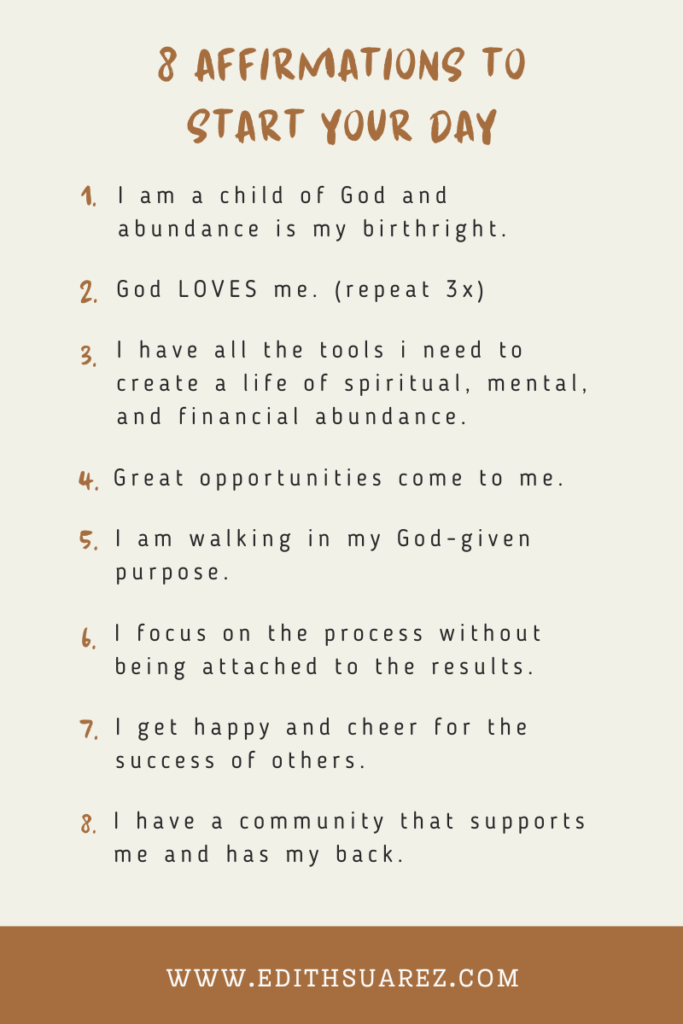
Credit: edithsuarez.com
How Affirmations Compare To Other Mindset Tools
You might wonder how affirmations stack up against other tools like visualization, meditation, or journaling. Here’s a quick comparison:
| Tool | Main Focus | How It Works | Best For |
|---|---|---|---|
| Affirmations | Positive Self-Talk | Repeat positive statements | Building confidence, changing thoughts |
| Visualization | Imagining Success | Picture goals as real | Motivation, goal setting |
| Meditation | Calm Mind | Focus on breath or silence | Reducing stress, mindfulness |
| Journaling | Self-Reflection | Write thoughts and feelings | Understanding emotions, planning |
Affirmations work best when combined with these tools. For example, you can repeat affirmations during meditation or write them in your journal.
Scientific Evidence Supporting Affirmations
Affirmations are not just a trend. They have real support from science. Studies show that self-affirmation changes how the brain responds to stress and challenges.
In one study, researchers used brain scans to see what happens when people use affirmations. They found that repeating positive statements increased activity in the parts of the brain linked to self-worth and reward. This can help you stay motivated and less affected by criticism or failure.
Another study found that people who practiced affirmations felt less stressed before big events, such as public speaking. They performed better and recovered faster from setbacks.
Here’s a summary of what the research says:
| Study Focus | Key Finding | Result |
|---|---|---|
| Self-worth | Affirmations activate reward centers | Increased motivation |
| Stress response | Positive self-talk lowers stress | Better performance |
| Resilience | Affirmations help recovery from failure | Stronger self-esteem |
You can read more about this research from the Wikipedia Self-affirmation page.

Credit: www.womenshealthnetwork.com
How To Make Affirmations Part Of Your Daily Life
Many people struggle to stick with affirmations. The secret is to build them into your daily routine. Here are practical tips:
Start Small
You do not need to spend hours each day. Even five minutes in the morning can help. Begin with one or two affirmations, then add more as you get comfortable.
Use Reminders
Write your affirmations on sticky notes and place them where you will see them—like your bathroom mirror, fridge, or computer. Some people set reminders on their phone.
Pair With Habits
Link affirmations to something you already do. For example, say them while brushing your teeth or before you start work. This makes it easier to remember.
Involve Your Senses
Say your affirmations out loud, write them, and even listen to recordings of yourself. The more senses you use, the stronger the effect.
Track Your Growth
Keep a simple journal. Write down your affirmations and note any changes in your thoughts or actions. This helps you see progress and stay motivated.
Stay Flexible
If your goals or feelings change, adjust your affirmations. There is no “one right way”—make them work for you.
These small steps can help you build a routine that lasts.
Practical Examples: Morning And Night Affirmation Routines
Having a set routine can make affirmations more effective. Here’s how you might use affirmations in the morning and at night:
Morning Routine Example
- Wake up and sit quietly for a minute.
- Take a few deep breaths.
- Repeat 2-3 affirmations out loud, such as:
- "I am ready for a successful day."
- "I am grateful for this new start."
- "I am strong and focused."
- Visualize yourself handling the day with confidence.
This routine sets a positive tone for your whole day.
Night Routine Example
- Before bed, find a quiet space.
- Reflect on your day. Notice any small wins.
- Repeat your affirmations, such as:
- "I am proud of my efforts today."
- "I am calm and at peace."
- "I am thankful for the good in my life."
- Let go of any stress as you breathe deeply.
Doing this helps you end your day with gratitude and calm.
Adapting Affirmations For Different Learning Styles
Not everyone learns in the same way. Some people learn by hearing, others by seeing, and some by doing. You can adapt affirmations to fit your learning style:
- Auditory learners: Say affirmations out loud or listen to recordings.
- Visual learners: Write affirmations in bright colors or use images.
- Kinesthetic learners: Write affirmations by hand or act them out with movement.
For example, a visual learner might create a vision board with their affirmations. An auditory learner could record themselves and listen during their commute.
Here is a quick comparison:
| Learning Style | Best Method | Tip |
|---|---|---|
| Auditory | Say or listen | Record on your phone |
| Visual | Write or draw | Use colors or images |
| Kinesthetic | Write or move | Repeat while walking |
This makes affirmations more personal and effective.
Two Insights Most Beginners Miss
- Emotion is key: Many people repeat affirmations without feeling. The real power comes when you connect emotionally. Smile, stand tall, and really feel the words. Your brain responds more to feelings than just words.
- Combine affirmations with action: Affirmations are not a replacement for effort. For example, saying "I am healthy" is more powerful if you also choose healthy foods and exercise. Use affirmations to support real actions.

Credit: us.amazon.com
How Long Does It Take To See Results?
This is a common question. Results depend on your starting point, your belief, and your consistency. Some people notice small changes in mood after a week. Bigger changes in confidence or behavior can take a month or more.
Most experts recommend using affirmations daily for at least 21 days. Remember, this is not a race. The goal is steady growth, not instant transformation.
When Affirmations Might Not Work
Affirmations are a helpful tool, but they are not a cure-all. If you are struggling with serious mental health problems, affirmations alone may not be enough. In these cases, it’s important to seek help from a professional.
Also, if you choose affirmations that feel completely untrue, your mind may resist them. In this case, use “bridge” statements, such as "I am open to learning to love myself. " This feels more believable and helps you grow step by step.
Making Affirmations Fun And Creative
You do not have to repeat the same words every day. Here are some ways to keep your practice fresh:
- Write your affirmations in a song or poem.
- Draw a picture to go with each affirmation.
- Share affirmations with a friend and encourage each other.
- Change your affirmations each month based on your goals.
Creativity helps you stay interested and makes affirmations more memorable.
Final Thoughts
Starting with affirmations can seem simple, but it is a powerful way to change your mindset and grow. The most important thing is to be patient and consistent. Choose affirmations that fit your goals, repeat them daily, and connect with the words emotionally.
Use reminders and routines to make affirmations a natural part of your life. Combine affirmations with real actions for even better results.
Remember, affirmations are just one tool. Use them along with other methods like journaling, visualization, and healthy habits. Over time, you will notice positive changes in your thoughts, feelings, and actions.
Frequently Asked Questions
What Are Affirmations?
Affirmations are positive statements you repeat to yourself to encourage a better mindset, boost confidence, and support your goals. They help you focus on your strengths and what you want to achieve.
How Often Should I Repeat My Affirmations?
For best results, repeat your affirmations at least twice a day—once in the morning and once at night. The key is consistency. The more you repeat them, the stronger the effect.
Do I Need To Believe My Affirmations For Them To Work?
No, you do not need to believe them fully at first. It is normal to feel unsure. Over time, as you repeat your affirmations, your belief will grow.
Can I Write My Own Affirmations?
Yes, writing your own affirmations is recommended. Personal affirmations are more powerful because they fit your specific needs and goals.
What If Affirmations Do Not Seem To Work For Me?
If you do not see results, check if your affirmations are too general, negative, or unrealistic. Adjust them to make them more believable. Also, combine affirmations with positive actions in your daily life for better results. If you struggle with serious problems, consider seeking help from a professional.
