

Affirmations to Start the New Year: Boost Your Mindset Fast
Starting a new year is more than just changing the calendar—it’s about fresh energy, hope, and new goals. Many people want to improve their lives, but they often feel lost or overwhelmed. That’s where affirmations can help. Affirmations are positive statements you repeat to yourself.
They shape your mindset, encourage new habits, and help you believe in your own power. When you use affirmations as a daily practice, you set the tone for the months ahead. They are like seeds you plant for a stronger, happier, and more successful version of yourself.
People sometimes think affirmations are just “feel-good” words. In reality, research shows that positive self-talk can actually rewire your brain. When you say and believe uplifting statements, your mood improves, your stress goes down, and your actions change for the better.
Many athletes, leaders, and high achievers use affirmations to push through challenges and reach their goals.
In this guide, you’ll discover what affirmations really are, why they work, and how to use them to create a brighter start to the new year. You’ll find practical tips, example affirmations, and deeper insights to help you move forward with confidence and clarity.
What Are Affirmations?
Affirmations are short, positive sentences that help you focus on your strengths and what you want to achieve. You repeat them often, especially in the morning or before important moments. The idea is simple: if you tell yourself something positive enough times, you start to believe it.
For example, saying “I am strong and capable” every day can help you actually feel stronger and more able to handle tough situations. Affirmations are not magic. They don’t instantly change your life. Instead, they guide your thoughts and feelings, helping you become the person you want to be.
Here’s what makes an effective affirmation:
- Positive language: Use words like “can,” “will,” or “am.”
- Present tense: Say “I am successful,” not “I will be successful.”
- Personal: Start with “I” or “My.”
- Specific: Focus on clear goals or feelings.
Why Use Affirmations To Start The New Year?
The start of a new year is full of possibilities. You might have new goals or want to leave old habits behind. Affirmations help you:
- Set your intentions
- Build self-belief
- Reduce anxiety about change
- Stay focused when you feel lost
Most people set resolutions, but by February, many have already stopped. Affirmations are different. They don’t rely on willpower alone. They change your thinking from the inside out.
Non-obvious insight: People often forget that affirmations are not just about positive thinking. They actually train your brain. Each time you repeat an affirmation, your mind becomes more open to new opportunities and less afraid of failure.
Another key point: Affirmations work best when you combine them with action. For example, saying “I am healthy” is powerful, but it’s even better when you also eat well and exercise.

Credit: www.sumeetaseeks.com
How Affirmations Affect Your Mind
Your brain is like a garden. If you plant good seeds (positive thoughts), you grow confidence and hope. If you let weeds grow (negative thoughts), you get doubt and fear. Affirmations are tools to plant more good seeds.
Science shows that positive self-talk can:
- Lower stress
- Improve mental health
- Increase motivation
- Boost performance
A study published in the journal Social Cognitive and Affective Neuroscience found that self-affirmation lights up parts of the brain related to reward and self-worth. This means your brain actually responds to the positive things you say.
Example: If you repeat “I am calm and in control” before a big meeting, your stress levels drop. You feel more prepared and act more confidently.
Building Your Own Affirmations
You don’t need to use someone else’s words. In fact, affirmations work best when they feel personal. Here’s how you can create your own:
- Think about your goals: What do you want to change or improve?
- Turn them into positive statements: Focus on what you want, not what you fear.
- Use present tense: Imagine you already have what you want.
- Keep it short and simple: One or two sentences is enough.
- Make it believable: If it feels too far from your reality, start with “I am learning to…” or “I am becoming…”
Example transformation:
- Goal: I want to be more confident at work.
- Affirmation: “I am confident and speak clearly in meetings.”
30 Powerful Affirmations To Start The New Year
Here are 30 carefully chosen affirmations you can use or adapt for your own journey. Each one is designed to spark new hope and energy for the coming months.
- I am open to new opportunities.
- I let go of the past and welcome new beginnings.
- I am worthy of success and happiness.
- I trust myself to make good decisions.
- I am growing stronger every day.
- My goals are within my reach.
- I am grateful for all I have and all I will receive.
- I choose positivity in every situation.
- I am in control of my thoughts and actions.
- I believe in my ability to change my life.
- I am surrounded by love and support.
- I attract abundance and prosperity.
- I am proud of how far I have come.
- I am becoming the best version of myself.
- I am patient with myself and my progress.
- I forgive myself for past mistakes.
- I am motivated and full of energy.
- I embrace new challenges with courage.
- I focus on what I can control and let go of the rest.
- I deserve to feel good about myself.
- I am resilient and can handle whatever comes my way.
- I make choices that support my health and happiness.
- I celebrate my achievements, big and small.
- I am learning and growing every day.
- I am calm, centered, and at peace.
- I bring value to my work and my relationships.
- I am attracting positive people into my life.
- I am focused and determined to reach my goals.
- I am worthy of love and kindness.
- I am excited for all that is coming my way.
You can repeat these in the morning, write them in a journal, or say them before important events.
How To Use Affirmations Daily
Knowing affirmations is not enough. You need a regular practice to see results. Here’s how you can make affirmations a part of your life:
- Morning routine: Start your day with 2-3 affirmations. Stand in front of a mirror and say them out loud.
- Write them down: Keep a journal where you write your affirmations every day.
- Use reminders: Set your phone or computer to show your favorite affirmation at certain times.
- Combine with action: After saying your affirmation, take one small step toward your goal.
- Stay consistent: Repeat the same affirmation for at least 21 days to make it a habit.
Non-obvious tip: Speak your affirmations with emotion. Don’t just repeat words. Feel the meaning behind each phrase.
Another insight: If you struggle to believe your affirmation, add “I am learning to…” or “I am becoming more…” to make it feel real.
Common Mistakes When Using Affirmations
Many people try affirmations but give up quickly. Here are common mistakes and how to avoid them:
- Being too vague: “I want to be happy” is not clear. Use specific words: “I am finding joy in everyday moments.”
- Using negative words: Don’t say “I am not afraid.” Instead, say “I am brave and confident.”
- Expecting quick results: Affirmations need time and repetition to work.
- Saying things you don’t believe: If “I am rich” feels like a lie, try “I am open to new ways of earning money.”
- Not connecting with emotion: The power of affirmations comes from feeling, not just words.
Affirmations For Different Life Areas
Affirmations can target any part of your life. Here are examples for the most common goals people have at the start of the year.
Affirmations For Health
- I honor my body and take care of my health.
- I make healthy choices easily.
- I enjoy moving my body every day.
- I am grateful for my strong, healthy body.
Affirmations For Career
- I am focused and productive at work.
- I welcome new challenges as chances to grow.
- I add value to my team and my company.
- I am ready for new opportunities in my career.
Affirmations For Relationships
- I communicate with kindness and respect.
- I deserve love and give love freely.
- I attract positive and supportive people.
- I am building strong, healthy relationships.
Affirmations For Money
- I am open to receiving abundance.
- Money flows to me easily and often.
- I manage my finances wisely.
- I am creating wealth and security.
Affirmations For Confidence
- I trust in my abilities.
- I am proud of who I am.
- I face challenges with confidence.
- I believe in myself.
Real-life Stories: How Affirmations Changed Lives
Affirmations are not just theory. Many people have transformed their lives with this simple tool.
Maria’s story: Maria felt anxious every time she started a new project at work. She began using the affirmation “I am capable and creative.” After two months, her boss noticed she was taking more initiative. Maria says, “Affirmations didn’t just make me feel better—they helped me act braver.”
Rahul’s experience: Rahul wanted to lose weight but kept quitting his diet. He started saying, “I make healthy choices every day.” He also wrote down one healthy thing he did each night. Over six months, he lost 10 kg and felt more in control of his habits.
Non-obvious insight: Many people forget to celebrate small wins. Affirmations help you notice little steps, not just big changes. This keeps you motivated and less likely to give up.
Data: Do Affirmations Really Work?
To understand how affirmations impact people, let’s look at some research data.
| Study | Participants | Results |
|---|---|---|
| Self-Affirmation and Problem-Solving | 80 adults | Those using affirmations solved 50% more problems under stress. |
| Affirmations and Health Behavior | 120 patients | Patients using daily affirmations were 35% more likely to follow health advice. |
| Affirmations and Academic Performance | 200 students | Students with affirmation practice improved grades by 10% over a semester. |
This shows affirmations are more than just words—they can lead to real change.
Comparing Affirmations To Resolutions
Affirmations are often compared to resolutions. Both are popular ways to start a new year, but they are not the same.
| Aspect | Affirmations | Resolutions |
|---|---|---|
| Focus | Mindset and beliefs | Specific behaviors or goals |
| Approach | Positive statements | Rules or promises |
| Common Results | Gradual mindset shift | Often dropped after a few weeks |
| Emotional Support | Builds self-esteem | Can cause guilt if broken |
A key insight: Combining both can work well. For example, set a resolution to exercise three times a week, and use the affirmation “I love taking care of my body” to reinforce it.
When Affirmations Don’t Work
It’s important to know that affirmations are not a cure-all. If you say something you truly don’t believe, it can make you feel worse, not better. Here’s what to do if affirmations don’t seem to help:
- Adjust your wording: Make your statements more believable. Instead of “I am always confident,” try “I am learning to feel more confident.”
- Look for deeper issues: Sometimes, negative beliefs come from past experiences. Talking to a counselor or coach can help.
- Pair affirmations with action: Words alone are not enough. Use affirmations to encourage real steps, no matter how small.
Making Affirmations Part Of Your Life
The real power of affirmations comes from regular practice. Here’s how to make them a natural part of your day:
- Choose 2-3 key affirmations: Focus on what matters most to you right now.
- Say them out loud: Speaking reinforces belief.
- Write them where you’ll see them: Post notes on your mirror, fridge, or computer.
- Use them during stress: Repeat your affirmations when you feel anxious or unsure.
- Share with others: Teach your friends or family. Group support makes affirmations stronger.
Non-obvious tip: Record your affirmations in your own voice and listen to them during your commute or before sleep. Hearing your own voice can make the message more powerful.
The Science Behind Affirmations
Affirmations are rooted in psychology. The concept of “self-affirmation theory” was developed by psychologist Claude Steele. It says that people want to see themselves as good, capable, and worthy. When you repeat positive statements, you protect your self-worth, especially during difficult times.
Brain imaging studies show that affirmations activate the reward centers in your brain. This creates a sense of pleasure and motivation. Over time, your brain starts to expect good things and looks for ways to make them real.
For more about the science, you can visit the Wikipedia page on Affirmations.
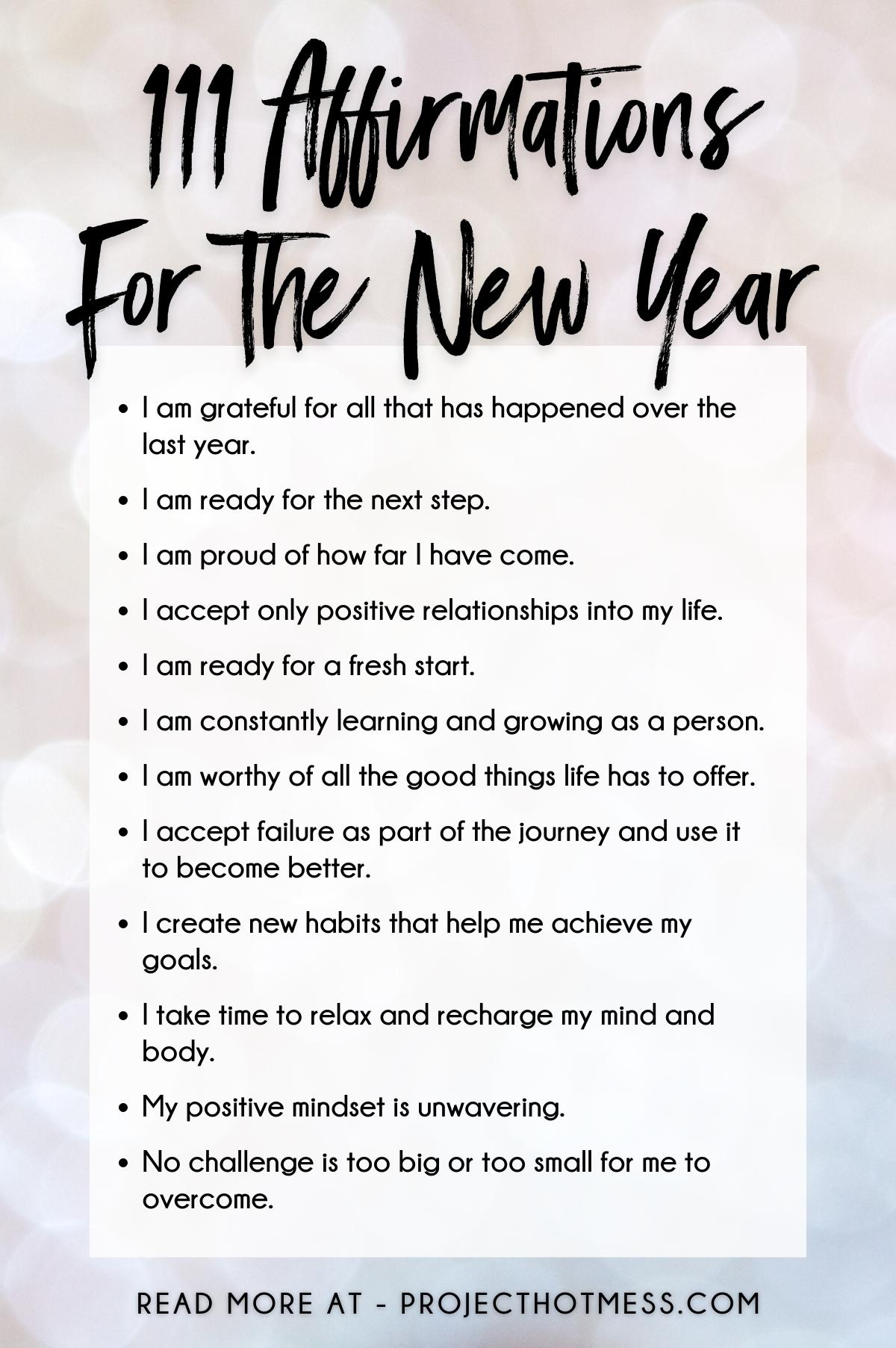
Credit: projecthotmess.com
Customizing Affirmations For Your Needs
Everyone’s journey is different. Here’s how to adapt affirmations for your unique life:
- If you’re facing a big change: “I am ready for new adventures.”
- If you want more balance: “I make time for rest and joy every day.”
- If you struggle with self-doubt: “I am enough, just as I am.”
- If you want to save money: “I am careful and wise with my spending.”
Insight: It’s okay to change your affirmations as your life changes. Review them each month and update based on what you need most.
The Best Times To Use Affirmations
Timing can help make affirmations more effective. Here are some good moments to practice:
| Time | Why It Works |
|---|---|
| Morning | Sets a positive tone for your day |
| Before important events | Boosts confidence and calm |
| During stress or doubt | Helps shift your mindset |
| Before sleep | Encourages peaceful rest and positive dreams |
You don’t have to limit yourself. Use affirmations whenever you need a boost.

Credit: www.affirmations.online
Tips For Lasting Success With Affirmations
To get the most from your affirmation practice, keep these tips in mind:
- Be patient: Change takes time. Trust the process.
- Stay flexible: If an affirmation stops working, change it.
- Celebrate progress: Notice small improvements in your mood or habits.
- Ask for support: Share your affirmations with friends or a group for encouragement.
- Mix with other tools: Combine affirmations with meditation, journaling, or exercise for even better results.
Frequently Asked Questions
What Is The Best Way To Use Affirmations?
The best way is to repeat your affirmations daily, out loud and with feeling. Write them down, post them where you’ll see them, and use them during stressful times. Consistency is key.
How Long Does It Take For Affirmations To Work?
It depends on the person and the affirmation. Some people notice changes in a few days, while others may need weeks. Most experts recommend using the same affirmation for at least 21 days.
Can Affirmations Help With Anxiety Or Stress?
Yes, affirmations can reduce anxiety and stress by shifting your focus to positive thoughts. They are not a replacement for medical help, but they can be a helpful tool for managing emotions.
Should I Use Someone Else’s Affirmations Or Write My Own?
You can start with common affirmations, but writing your own makes them more personal and powerful. Use words and phrases that truly matter to you.
What If I Don’t Believe My Affirmations At First?
That’s normal. Start with softer statements like “I am learning to…” or “I am becoming…” As you repeat them and take small actions, your belief will grow.
Starting a new year with affirmations is a simple but powerful way to shape your life. These short, positive statements can help you move past fear, build new habits, and create the future you want. Remember, the journey starts with a single word—and the belief that you can change.
