

Examples of Good Affirmations to Boost Confidence Daily
Examples Of Good Affirmations
Many people talk about affirmations, but not everyone knows how to use them well. You might see short phrases on social media or hear about them from friends. But what makes an affirmation truly good? Is there a special way to write or say them?
Let’s explore what good affirmations are, why they matter, and see clear examples you can use. This article will guide you through the best practices, give you practical examples, and help you understand how to make affirmations work for you.
What Are Affirmations?
Affirmations are simple, positive statements. They help you change your thoughts and beliefs. When you repeat them often, you start to believe what you say. This can lead to real changes in your mood, your actions, and even your life.
The main purpose is to shift your mindset from negative to positive.
For example, if you often think, “I can’t do this,” an affirmation might be, “I am capable. ” By repeating the positive phrase, you challenge your old belief and build a new one.
Why Good Affirmations Matter
Not every affirmation is effective. Some are too general, some are not believable, and some are not personal. Good affirmations follow a few simple rules:
- They are positive.
- They are present tense.
- They feel personal.
- They are believable.
When these rules are followed, affirmations can help:
- Boost confidence
- Reduce stress
- Improve focus
- Encourage healthy habits
A recent study from the University of Pennsylvania found that people who used positive affirmations daily felt less anxious and more motivated. The science behind affirmations is strong, but the real results come from using them well.
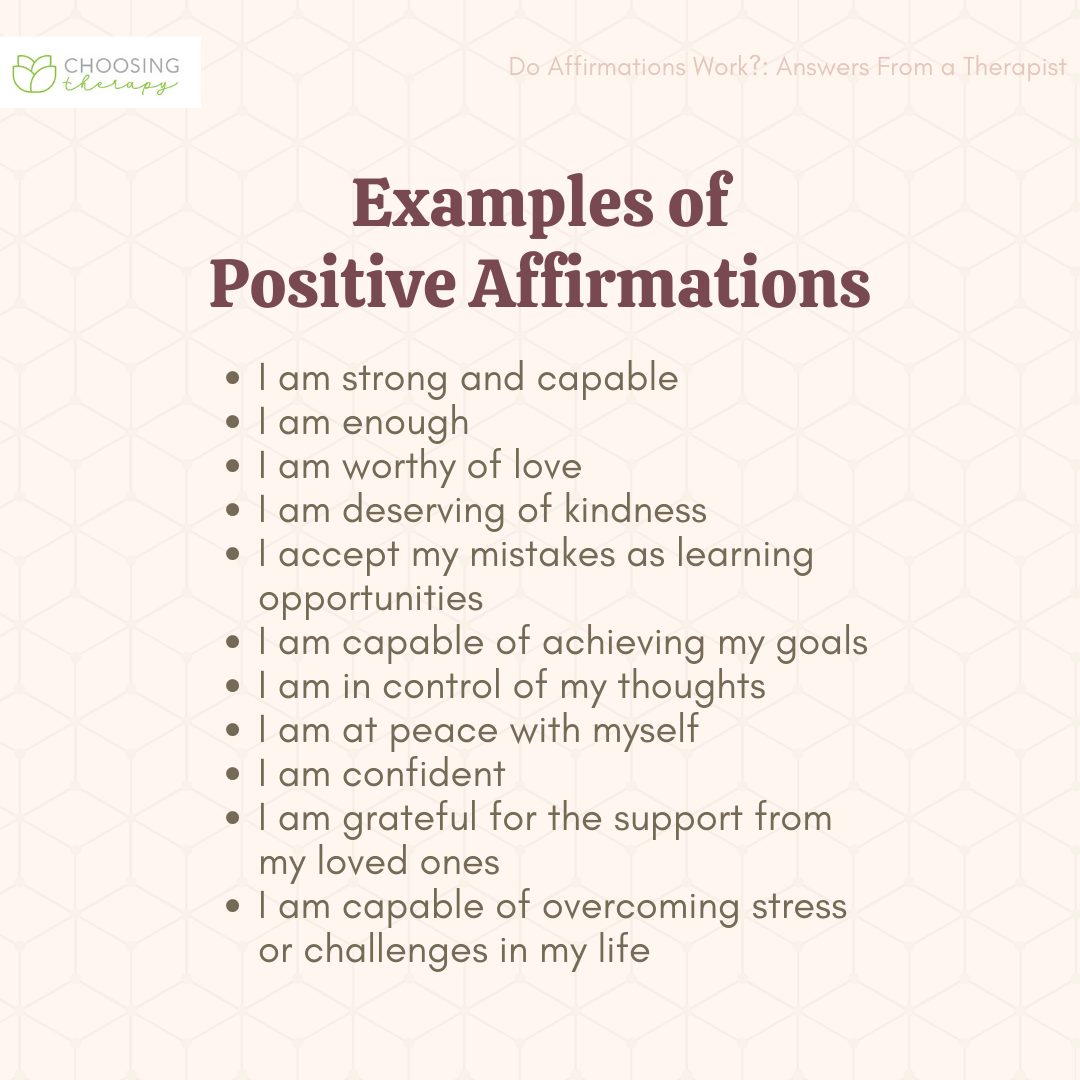
Credit: www.choosingtherapy.com
Key Elements Of Effective Affirmations
To create or identify a good affirmation, look for these elements:
- Positive wording: Avoid words like “not” or “never.”
- Present tense: Speak as if it is already true.
- Personal statement: Use “I” or “my.”
- Specific focus: Address a clear goal or feeling.
- Believable content: Choose words you can accept.
Here’s a comparison of weak vs. strong affirmations:
| Weak Affirmation | Strong Affirmation |
|---|---|
| I will not fail. | I am successful in what I do. |
| I wish I was confident. | I am confident in myself. |
| I hope to be healthy. | My body is strong and healthy. |
Notice how the strong affirmations use positive, present language and feel more personal.
Examples Of Good Affirmations
Let’s look at clear examples. These are grouped by purpose. You can choose ones that fit your needs or goals.
Self-confidence
- I am confident in my abilities.
- I trust myself to make good decisions.
- I am proud of who I am.
- I am worthy of respect and love.
- My confidence grows every day.
Success And Achievement
- I am capable of achieving my goals.
- Success comes naturally to me.
- I am focused and determined.
- I learn from every experience.
- My actions create positive results.
Health And Wellness
- My body is strong and healthy.
- I make choices that support my well-being.
- I feel energized and active.
- I care for myself every day.
- My mind and body are in harmony.
Stress Relief
- I am calm and relaxed.
- I release tension with each breath.
- I handle challenges with ease.
- Peace fills my mind and heart.
- I am in control of my thoughts.
Relationships
- I communicate clearly and kindly.
- I am surrounded by love and support.
- I respect and value others.
- My relationships are positive and healthy.
- I attract caring people into my life.
Financial Abundance
- I am open to new opportunities.
- Money flows easily to me.
- I manage my finances wisely.
- I am grateful for what I have.
- Abundance is part of my life.
Motivation And Focus
- I am motivated to reach my goals.
- I stay focused on what matters.
- I finish what I start.
- I am driven and persistent.
- My efforts lead to success.
Personal Growth
- I am always learning and growing.
- I welcome change and new ideas.
- I become stronger each day.
- I embrace challenges as chances to grow.
- My life improves with every step.
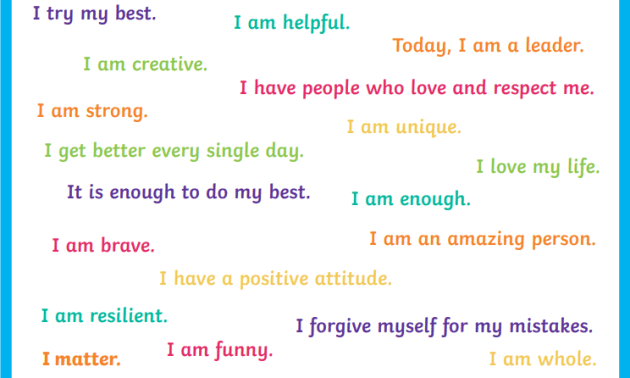
Credit: www.twinkl.es
How To Use Affirmations In Daily Life
Many people wonder how to use affirmations correctly. Here are some practical tips:
- Repeat daily: Say your affirmations in the morning or before bed.
- Write them down: Keep a journal of your favorite phrases.
- Say them aloud: Speaking with emotion makes them stronger.
- Post them: Place notes on your mirror, computer, or desk.
- Visualize: Picture yourself living the affirmation.
Some people use affirmations during meditation or while exercising. Others repeat them in stressful moments to calm their mind.
A good tip is to personalize your affirmations. Change the words to fit your life. For example, instead of “I am successful,” you might say, “I am successful in my studies,” if you are a student.
Common Mistakes When Using Affirmations
Even with good examples, mistakes can happen. Here are common ones to avoid:
- Using negative words: “I am not afraid” is less powerful than “I am brave.”
- Making statements too big: If you don’t believe “I am rich,” try “I am improving my finances.”
- Skipping repetition: Saying an affirmation once is not enough. Consistency matters.
- Forgetting emotion: Monotone or emotionless repetition has less impact.
- Using future tense: “I will be happy” is less effective than “I am happy.”
If you notice an affirmation feels wrong or forced, adjust it. Make it smaller or more believable. Start with “I am learning to…” or “I am open to…” if needed.
Affirmations For Different Life Areas
Good affirmations can fit any area of life. Here are examples for specific needs:
Work And Career
- I am skilled in my work.
- I handle tasks efficiently.
- I am respected by my team.
- I grow in my career every day.
- My work makes a positive impact.
Parenting
- I am a patient and loving parent.
- I listen to my children with care.
- I help my family grow and learn.
- My home is filled with love.
- I support my children’s dreams.
Creativity
- I am creative and inspired.
- New ideas come easily to me.
- I express myself freely.
- My creativity adds value to my life.
- I trust my imagination.
Learning And Education
- I learn quickly and easily.
- I enjoy discovering new things.
- I remember information well.
- I am curious and open-minded.
- My studies are rewarding.
Emotional Balance
- I accept my feelings without judgment.
- I manage my emotions wisely.
- I choose calm in difficult times.
- My inner peace grows daily.
- I forgive myself and others.
How Affirmations Change The Brain
You might wonder if affirmations are just words, or if they make real changes. Research shows that affirmations can change the way the brain works. When you repeat positive statements, your brain starts to create new connections.
A study in the journal Social Cognitive and Affective Neuroscience used MRI scans to show that self-affirmation activates reward centers in the brain. This can help you feel better, make better choices, and even cope with stress.
Here’s a quick comparison of brain activity:
| Type of Thought | Brain Area Activated | Effect |
|---|---|---|
| Negative self-talk | Threat centers (amygdala) | Stress, anxiety |
| Positive affirmation | Reward centers (ventromedial prefrontal cortex) | Calm, motivation |
This shows why good affirmations are not just feel-good statements—they help your mind change over time.
Tips To Make Affirmations More Powerful
A simple sentence can have a big impact if used well. Here are two non-obvious ways to make affirmations stronger:
- Connect with feeling: Don’t just say the words. Feel them. Imagine how life would be if the affirmation was true. This makes the brain believe the statement faster.
- Pair with action: After saying an affirmation, take a small action that matches it. For example, if you say, “I am healthy,” choose a healthy meal next.
Other helpful tips:
- Use “mirror work”: Look at yourself in the mirror while saying affirmations.
- Record your voice: Listen to your affirmations during the day.
- Use visual cues: Attach affirmations to images or vision boards.
Advanced Examples Of Affirmations
Sometimes simple sentences are not enough. Advanced affirmations combine two or more ideas, or use “anchoring” words for extra power. Here are examples:
- I am calm, confident, and ready for anything.
- Every day, I grow stronger and wiser.
- I attract kindness, success, and abundance into my life.
- I am grateful for my health, my family, and my achievements.
- I trust myself and embrace change with courage.
These advanced phrases can help when you want to cover more than one area, or deepen your practice.
Customizing Affirmations For Personal Growth
No two people are the same. Personalizing your affirmations makes them more effective. Here’s how:
- Identify your main goal: What do you want to change or improve?
- Choose positive words: Find words that feel right for you.
- Add your name: Saying “I, Maria, am confident” can feel stronger.
- Include details: “I am confident speaking in meetings” is more powerful than “I am confident.”
- Use your own voice: Adjust the sentence until it feels natural.
Personalized affirmations help you connect better and believe faster.
Real-life Stories: Affirmations In Action
Many people use affirmations every day. Here are two real-life stories:
- Maria’s Confidence Boost: Maria was shy at work. She started saying, “I am confident speaking in meetings.” After a month, she noticed she spoke up more often and felt less nervous.
- James’ Health Journey: James wanted to improve his fitness. He repeated, “My body is strong and healthy,” and paired it with daily exercise. Over time, his energy improved and he felt proud of his progress.
These stories show that affirmations can lead to real changes. The key is consistency and belief.
Comparison Of Common Affirmation Methods
There are many ways to practice affirmations. Here’s a comparison:
| Method | How It Works | Best For |
|---|---|---|
| Journaling | Write affirmations daily in a notebook. | People who like writing. |
| Speaking aloud | Say affirmations with emotion. | People who want to build confidence. |
| Mirror work | Look at yourself in the mirror while repeating. | Self-esteem improvement. |
| Listening (audio) | Record and play back your affirmations. | Busy schedules. |
| Visualization | Picture yourself living the affirmation. | Goal setting. |
Try different methods to see which fits you best. Some people mix two or three for best results.
Affirmations For Children And Teens
Kids and teens can benefit from affirmations too. Here are examples for young people:
- I am smart and capable.
- I am a good friend.
- I try my best every day.
- I am important and valued.
- I am brave when facing challenges.
For parents, encouraging children to use these phrases can help build self-esteem and resilience.
Incorporating Affirmations Into Routine
Making affirmations a habit is key. Here’s how to do it:
- Pick a time: Morning, evening, or during breaks.
- Keep it simple: Start with 2–3 affirmations.
- Repeat daily: Consistency creates change.
- Use reminders: Set phone alerts or leave notes.
- Celebrate progress: Notice small wins and adjust as needed.
By including affirmations in your routine, they become a natural part of your day.
Measuring The Impact Of Affirmations
You might wonder how to know if affirmations are working. Here are signs:
- Improved mood: Feeling happier or calmer.
- Better choices: Acting in line with your affirmations.
- New habits: Starting positive routines.
- Changed beliefs: Thinking more positively about yourself.
Some people keep a journal to track changes. If you notice progress after a few weeks, your affirmations are working.
A survey from the American Psychological Association found that people who used affirmations for one month reported a 22% increase in self-confidence and a 16% drop in stress.
Scientific Evidence Supporting Affirmations
There is real science behind affirmations. Research from Harvard University shows that daily affirmations can lower stress, improve performance, and boost well-being. The key is repetition and belief.
One study found that students who used affirmations before exams performed better. Another showed that people with chronic illness felt less anxiety after using affirmations daily.
For more scientific details, see Wikipedia: Affirmations (psychology).
Frequently Asked Questions
What Is The Best Way To Use Affirmations?
The best way is to repeat them daily, say them with emotion, and believe in the words. Writing them down or saying them aloud makes them stronger. Combine affirmations with action whenever possible.
Can Affirmations Really Change My Life?
Yes, they can help shift your mindset, build confidence, and change habits. The key is consistency and belief. Results may take time, but many people see positive changes in mood, behavior, and goals.
How Many Affirmations Should I Use At Once?
Start with 2–3 affirmations focused on your main goal. Too many can be overwhelming. As you get comfortable, add more or change them to fit your needs.
What If I Don’t Believe My Affirmation?
If an affirmation feels too big or false, make it smaller and more believable. Try “I am learning to…” or “I am open to…” instead of “I am…” until you feel ready.
Are Affirmations Helpful For Children?
Yes, children and teens can use simple, positive affirmations to build self-esteem and resilience. Parents can help by encouraging regular practice and making it fun.
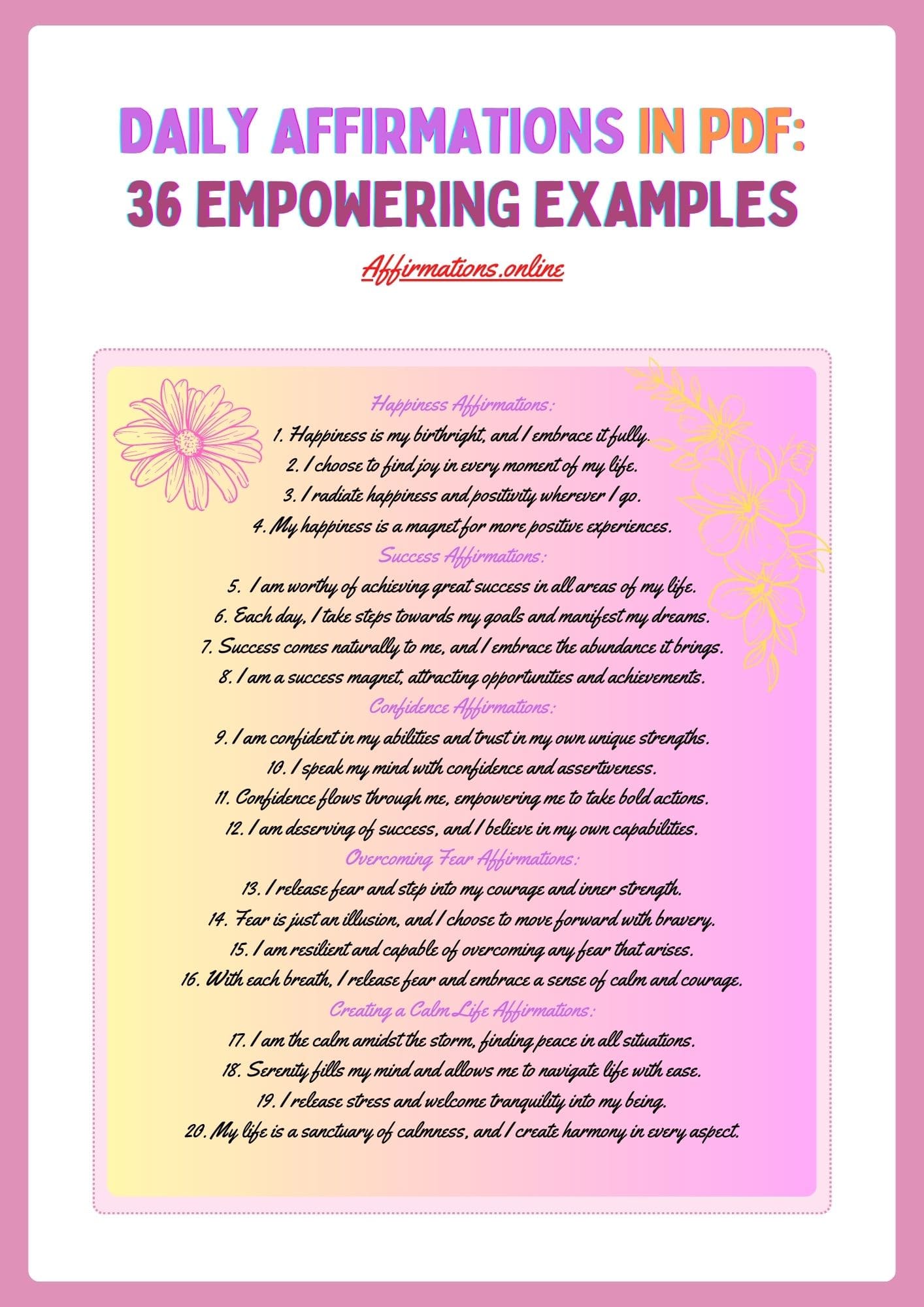
Credit: www.affirmations.online
Final Thoughts
Good affirmations are more than just positive words. When used well, they help you change your thoughts, your habits, and your life. Remember to keep your affirmations positive, personal, and believable. Try different methods, personalize your phrases, and make them a daily habit.
With patience and consistency, affirmations can support your growth, confidence, and well-being. Whether you’re new to affirmations or looking to improve your practice, these examples and tips can guide you to better results.
