

Affirmations on Self-Love
Self-love is more than a trend. It’s a foundation for a happier, healthier life. Many people struggle to accept themselves. Doubt, fear, and negative thoughts can fill the mind. Affirmations are simple tools that help shift these thoughts. They build confidence and help you see your worth.
But learning how to use affirmations correctly can be confusing. Let’s discover how affirmations on self-love work, why they matter, and how you can use them to change your mindset and your life.
What Are Affirmations?
Affirmations are positive statements you repeat to yourself. They are designed to change your thinking. When you say affirmations, you train your mind to focus on positive beliefs. For example: “I am worthy of love.” Over time, these words help you believe in yourself.
Affirmations are not just random positive sentences. They are carefully chosen words that connect with your goals and feelings. The idea is not just to repeat them, but to really mean them and feel them as true. The more you practice, the more your brain starts to accept these new ideas as reality.
How Affirmations Work
The brain is powerful. It listens to what you say and think. If you repeat negative phrases (“I’m not good enough”), your brain starts to believe them. But when you use positive affirmations, you challenge these negative beliefs. You create new, healthy patterns.
This process is similar to forming a habit. At first, your brain may resist, especially if you have a long history of negative self-talk. But as you keep repeating affirmations, you build new neural pathways. This is called neuroplasticity—the brain’s ability to change and adapt. It means the more you practice positive self-talk, the easier it gets.
Studies show that affirmations can improve self-esteem, reduce stress, and boost motivation. In psychology, this is called self-affirmation theory. It explains that positive statements help you protect your self-image. This is important for self-love.
It’s important to know that affirmations are not about ignoring problems or pretending everything is perfect. Instead, they help you focus on your strengths and open your mind to new possibilities. You are training yourself to notice what’s good, not just what’s wrong.
Why Self-love Matters
Self-love means respecting and accepting yourself. It’s about being kind to your mind and body. Without self-love, you may feel anxious, depressed, or lonely. Many people struggle with negative self-talk. This can come from childhood experiences, social media, or pressure to be perfect.
You might think self-love is selfish. Actually, it’s the opposite. When you care for yourself, you have more energy and kindness to give to others. You make better choices and protect your well-being.
Key Benefits
- Better Mental Health: Self-love reduces anxiety and depression. When you treat yourself with kindness, you feel safer and happier inside. It also helps you bounce back from setbacks more quickly.
- Healthy Relationships: When you love yourself, you set boundaries and attract positive people. You are less likely to accept poor treatment or stay in unhealthy situations.
- Greater Confidence: Self-love helps you trust your abilities. You stop doubting your value, which makes it easier to take on challenges.
- Resilience: You handle challenges better when you believe in yourself. Self-love acts like a cushion against life’s difficulties. When you make mistakes, you can recover and learn instead of blaming yourself.
When you lack self-love, you may find it hard to say no, feel guilt for taking breaks, or constantly seek approval from others. Building self-love helps you break these habits and start living for yourself.
Data And Statistics
A survey by the American Psychological Association found that people with high self-esteem are 50% less likely to experience depressive symptoms. Another study showed that positive self-talk can improve performance in stressful situations by up to 20%.
In addition, research from the University of Waterloo found that self-affirmation can lower physiological stress responses. This means your body actually feels calmer when you practice self-love, not just your mind. With regular use, affirmations can slowly change your emotional “set point,” so you react with more self-compassion when things go wrong.
Types Of Self-love Affirmations
Affirmations come in many forms. Some focus on body image. Others help with emotional healing. Choosing the right affirmation depends on your needs.
Affirmations can be broad or very specific. For example, someone who struggles with self-doubt might use, “I trust myself to make wise choices,” while someone healing from a breakup might say, “I am whole on my own. ”
Common Categories
- Body positivity: “I appreciate my body.”
- Self-worth: “I am enough.”
- Forgiveness: “I forgive myself.”
- Confidence: “I trust myself.”
- Gratitude: “I am grateful for who I am.”
You can also create affirmations for courage (“I face challenges with strength”), acceptance (“I accept myself fully”), or growth (“I am always learning and improving”). The more personal your affirmation, the more powerful it becomes.
Here’s a comparison of affirmation categories and their main benefits:
| Affirmation Type | Main Benefit | Example |
|---|---|---|
| Body positivity | Improved self-image | I love my body as it is |
| Self-worth | Greater confidence | I am worthy of respect |
| Forgiveness | Emotional healing | I forgive myself for past mistakes |
| Confidence | Increased motivation | I believe in my abilities |
| Gratitude | Positive outlook | I am thankful for my life |
You can even blend categories. For example, “I forgive myself and appreciate my unique journey” combines forgiveness and gratitude.
How To Create Effective Self-love Affirmations
Affirmations work best when they are personal, positive, and present tense. Here are practical steps to create affirmations that fit your needs.
Step-by-step Guide
- Identify your struggle: What negative thoughts do you have? For example, “I feel unworthy.” Be honest about what’s hard for you. This helps you target the right area.
- Turn it positive: Change the negative thought into a positive statement. “I am worthy of love.” If your negative thought is, “I always fail,” your affirmation could be, “I am capable of success.”
- Use present tense: Affirmations are most powerful when spoken as if they are true now. “I am confident.” Avoid future tense (“I will be confident”), which makes it feel far away.
- Keep it simple: Short, clear statements are easier to remember. For example, “I am strong” instead of “I am a person who is strong in many ways.”
- Be specific: If you want to improve body image, say, “I appreciate my strong legs,” not just “I love myself.” The more detailed, the more real it feels.
- Repeat often: Practice your affirmations daily. The more you repeat, the more your mind adapts.
It helps to write your affirmation down, say it out loud, and even visualize it. The more senses you use, the deeper the message goes.
Common Mistakes To Avoid
- Using negative words: “I am not weak” is less effective than “I am strong.” The brain focuses on the main idea, so avoid “not” or “never.”
- Making affirmations too long: Keep them short and clear. Long statements are hard to remember and lose their impact.
- Forgetting to personalize: Generic affirmations may not feel real. Make your statement unique to your situation.
- Lacking emotion: If your affirmation doesn’t spark any feeling, try changing the words until it feels right.
Also, avoid making statements that are too far from what you believe. If “I love everything about myself” feels false, start with “I am learning to accept myself. ” You can adjust your affirmation as your confidence grows.
40 Powerful Self-love Affirmations
Here are 40 strong affirmations you can use. Repeat them daily, or choose the ones that fit you best.
- I am worthy of love and respect.
- I accept myself completely.
- My mistakes do not define me.
- I am proud of who I am.
- I forgive myself for past errors.
- I trust myself to make good decisions.
- I am enough just as I am.
- I am grateful for my body.
- I believe in my abilities.
- I am strong and resilient.
- I choose happiness every day.
- My life is valuable.
- I am comfortable with who I am.
- I am more than my flaws.
- I deserve kindness.
- I celebrate my achievements.
- I honor my feelings.
- I am unique and special.
- My worth is not dependent on others.
- I love the person I am becoming.
- I am patient with myself.
- I am growing every day.
- I trust my intuition.
- My body deserves care and respect.
- I release self-judgment.
- I am peaceful and centered.
- I choose to focus on the good.
- I am proud of my progress.
- I attract positive energy.
- I am safe to express myself.
- I am gentle with myself.
- I am open to love.
- I am grateful for my strengths.
- I am free from self-doubt.
- I honor my boundaries.
- I am worthy of success.
- I am enough, always.
- I respect my needs.
- I am deserving of joy.
- I love myself deeply.
You don’t need to use all 40. Start with one or two that feel most important. As you grow, add more or change them to fit your new goals.
How To Practice Affirmations Daily
Repeating affirmations once is not enough. You need to make them part of your routine. Here are practical ways to add affirmations to your day.
Morning Routine
Start your day with positive energy. Stand in front of a mirror, look at yourself, and say your affirmations out loud. This helps set a good mood for the day.
It may feel strange at first, but looking into your own eyes while saying affirmations can make them feel more real. Try smiling at yourself as you speak.
Journaling
Write your affirmations in a notebook every morning or evening. The act of writing makes the words stronger in your mind.
Some people like to write the same affirmation several times, like a mantra. You can also combine journaling with gratitude lists for extra power.
Meditation
Close your eyes, breathe deeply, and repeat your affirmations. Meditation helps you focus and connect with your inner self.
Try repeating your affirmation with each breath. For example, breathe in and think, “I am enough,” breathe out and think, “I am at peace. ” This creates a calming rhythm.
Phone Reminders
Set reminders on your phone. Every hour, get a notification with your affirmation. This keeps you on track.
You can also use phone wallpapers or lock screens with your favorite affirmation so you see it many times each day.
Using Post-it Notes
Stick notes with your favorite affirmations around your home—on the bathroom mirror, fridge, or workspace. Seeing them often helps reinforce the message.
Change the notes every week so they feel fresh. Add colors or drawings to make them more personal and fun.
Adding Affirmations To Activities
Say your affirmation while walking, brushing your teeth, or doing simple tasks. Linking affirmations to daily activities helps make them a habit.
If you like music, sing your affirmation or create a simple chant. The rhythm can make it more memorable.

Credit: www.amazon.com
Scientific Evidence Behind Affirmations
Affirmations are not just positive thinking. Research shows they can change brain activity and behavior.
A study by Carnegie Mellon University found that people who practiced self-affirmation before stressful tasks had lower cortisol levels (a stress hormone). Another research from UCLA showed that daily affirmations improved self-worth and reduced negative feelings.
MRI scans have shown that when people use affirmations, the areas of the brain linked to self-processing and reward become more active. This means affirmations can actually change the way your brain responds to challenges and stress.
Here’s a data table showing how affirmations impact well-being:
| Group | Stress Level Reduction (%) | Self-Esteem Increase (%) |
|---|---|---|
| Affirmation Users | 30 | 25 |
| Non-Users | 10 | 5 |
Some studies also suggest that affirmations are more effective when they match your values. For example, if you value kindness, an affirmation like, “I am kind and compassionate,” will have a stronger impact.
Real-life Examples Of Self-love Affirmations
Many people use affirmations to heal and grow. Here are two stories showing how affirmations changed lives.
Example 1: Overcoming Body Shame
Sarah struggled with body image for years. She started repeating, “I appreciate my body as it is. ” Over months, she began to feel better. She made healthier choices and stopped criticizing herself.
Her journey was not instant. At first, she felt silly and even angry saying the affirmation. But she kept going, and over time, her inner dialogue changed. She started to focus on what her body could do, not just how it looked.
Example 2: Building Confidence After Failure
Raj lost his job and felt worthless. He began each day with, “I am enough and capable. ” Slowly, his confidence returned. He applied for new jobs and found work that made him happy.
Raj also noticed he was less afraid to ask for help and could handle rejection with more ease. Affirmations helped him see that his value was not tied to his job, but to who he was as a person.
Stories like these show that affirmations are more than just words—they can be the start of real change.
When Affirmations Don’t Work
Affirmations are powerful, but not magic. Sometimes, they may not produce results. Here’s why:
- You don’t believe the words: If you feel the affirmation is a lie, it won’t help.
- Lack of repetition: Saying it once is not enough.
- No emotional connection: If you don’t feel the statement, it won’t stick.
- Ignoring deeper issues: Affirmations can’t solve trauma or mental health issues alone.
Another common issue is expecting instant results. Real change takes time and patience. If you notice little progress, try adjusting your affirmation, or pair it with other self-care practices.
If you struggle with serious self-esteem or mental health problems, consider talking to a professional. Affirmations can be a helpful tool, but sometimes deeper support is needed.
Combining Affirmations With Other Self-love Practices
Affirmations work best when combined with other healthy habits. Here are some ways to boost your self-love journey.
Gratitude Practice
Write down three things you like about yourself each day. This builds self-appreciation.
You can also share your gratitude with a friend or family member. Speaking your gratitude out loud makes it more real.
Mindfulness
Stay aware of your thoughts and feelings. Mindfulness helps you notice negative self-talk and replace it with affirmations.
Try simple breathing exercises or a short daily meditation to help you stay present. When you catch a negative thought, pause and gently replace it with your chosen affirmation.
Physical Self-care
Exercise, eat well, and get enough sleep. Taking care of your body shows self-respect.
Even small acts, like stretching or drinking water, can be a way to practice self-love. When you do these things, say your affirmation to yourself: “I care for my body because I am worth it.”
Setting Boundaries
Learn to say no. Protect your time and energy.
Affirmations like, “My needs matter,” or “I have the right to rest,” can help you build and maintain boundaries without guilt.
Common Barriers To Self-love
Many people find it hard to love themselves. Here are reasons why:
- Past trauma: Old wounds can make self-love difficult. Memories from childhood or past relationships can leave deep marks.
- Social comparison: Comparing yourself to others lowers self-worth. Social media often shows only the best moments, making you feel less.
- Perfectionism: Trying to be perfect leads to disappointment. No one is perfect, and chasing perfection causes stress.
- Cultural beliefs: Some cultures teach self-sacrifice over self-love. You may have learned that putting yourself first is wrong.
Recognizing these barriers is the first step to overcoming them.
Another barrier is fear—fear of being seen as arrogant or selfish. But healthy self-love is about balance, not ego. Self-love means understanding your value, not thinking you are better than others.
How To Overcome Negative Self-talk
Negative thoughts are common, but you can change them. Here’s a practical plan:
- Notice negative thoughts: “I’m not good enough.”
- Challenge the thought: Is it true? What evidence supports it?
- Replace with affirmation: “I am enough.”
- Practice daily: Repeat your affirmation when negative thoughts appear.
Example
If you think, “I always fail,” pause and ask, “Is that true? ” Maybe you succeeded before. Then say, “I am capable of success. ”
Over time, you can train your mind to catch negative thoughts early. This is a skill, and like any skill, it improves with practice. You might even keep a “thought journal” to track your progress and spot patterns.

Credit: mblwrites.com
Using Affirmations In Relationships
Self-love affects your relationships. When you love yourself, you attract healthy connections. Here’s how affirmations help:
- Set boundaries: “I respect my needs.”
- Attract positive people: “I deserve loving relationships.”
- Heal from past hurt: “I am open to love.”
Affirmations can improve trust and communication.
If you often give too much in relationships, try affirmations like, “My feelings are important,” or “It’s safe to ask for what I need. ” These help you value yourself while connecting with others.
Affirmations For Different Life Stages
Affirmations are useful for everyone, but needs change over time.
Teens
Young people often struggle with self-image. Affirmations like “I am unique and valuable” help build confidence.
For teens facing peer pressure, “I am true to myself” is helpful. Remind them to focus on their own journey, not just fitting in.
Adults
Adults face stress and pressure. “I am strong and resilient” supports self-esteem.
During career changes or parenting, affirmations like “I handle challenges with grace” or “I am doing my best” can be powerful.
Seniors
Older adults may feel lonely. “My life is valuable” helps maintain self-worth.
Affirmations like “I have wisdom to share” or “I am grateful for my experiences” can bring comfort and pride.
Here’s a summary table of affirmations for different life stages:
| Life Stage | Common Challenge | Suggested Affirmation |
|---|---|---|
| Teens | Low self-image | I am unique and valuable |
| Adults | Stress | I am strong and resilient |
| Seniors | Loneliness | My life is valuable |
How To Measure Progress With Affirmations
Tracking progress helps you stay motivated. Here’s how to know if affirmations are working:
- Mood improvement: Do you feel happier?
- Confidence boost: Are you more willing to try new things?
- Less negative self-talk: Are critical thoughts less frequent?
- Better relationships: Do you set healthy boundaries?
Practical Tips
- Keep a journal: Write your feelings and notice changes over weeks.
- Rate your mood: Use a scale (1–10) and track improvement.
- Ask trusted friends: Do they notice positive changes?
If you feel stuck, try changing your affirmation or adding a new one. Progress is not always a straight line—some days are harder than others, but over time you’ll notice a shift.
Advanced Tips For Using Affirmations
Once you master basic affirmations, you can try these advanced techniques:
- Visualization: Imagine yourself living the affirmation (“I see myself confident at work”). Picture the details—your feelings, actions, and results.
- Record yourself: Listen to your affirmations during the day. Hearing your own voice can deepen the belief.
- Group practice: Join a group or community where you share affirmations.
Some people find singing or chanting affirmations helps them connect more deeply.
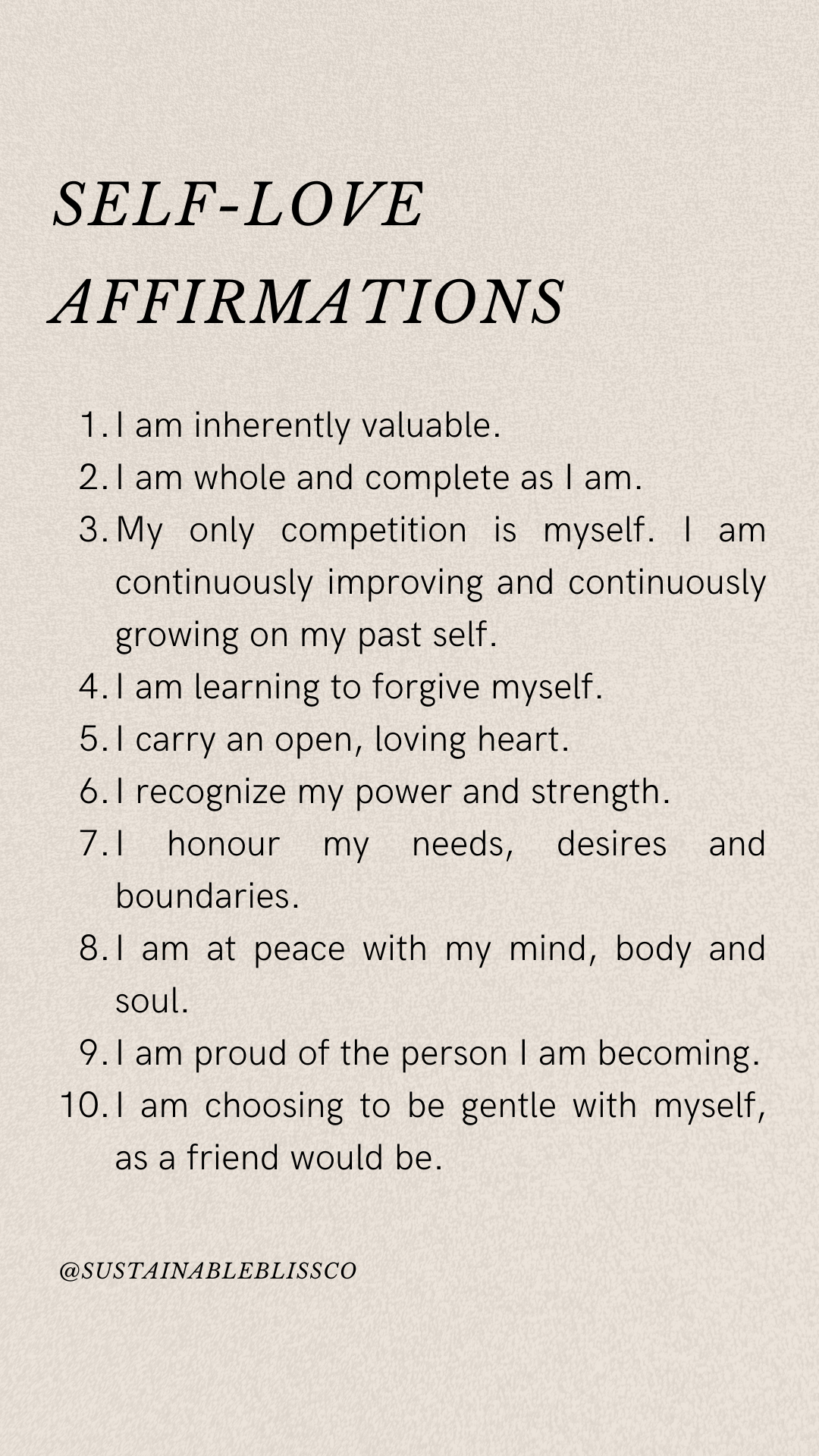
Try combining affirmations with physical movement—say your affirmation while walking, stretching, or even dancing. This links the positive words with positive feelings in your body.
Credit: www.sustainableblissco.com
Non-obvious Insights For Beginners
Most beginners miss these points:
- Feeling is more important than words. If you don’t connect emotionally, your affirmation loses power.
- Affirmations can be flexible. Change your affirmation as your needs change.
- Timing matters. Affirmations are strongest when used during stressful moments, not just when you feel good.
Also, it’s normal to feel resistance at first. Don’t judge yourself for feeling awkward. See it as a sign that you’re challenging old beliefs.
Another insight: combine affirmations with action. If your affirmation is, “I take care of my body,” then follow up with a small healthy habit, even just drinking water.
Frequently Asked Questions
Can Affirmations Really Change How I Feel About Myself?
Yes, affirmations can help change your mindset over time. They are not instant solutions, but regular practice can shift negative thinking and build self-love. The key is consistency and emotional connection.
How Long Does It Take For Self-love Affirmations To Work?
Results vary for each person. Some notice changes in a few weeks, while others take longer. Practice daily and track your progress. Most people see improvement in mood and self-esteem within one or two months.
Do I Have To Say Affirmations Out Loud?
No, but saying them out loud can make them stronger. Writing, thinking, or listening to affirmations also works. Choose the method that feels best for you.
What If I Feel Silly Saying Affirmations?
Many people feel awkward at first. This is normal. Try starting with simple statements and repeat them in private. Over time, it will feel more natural.
Can Affirmations Help With Anxiety And Depression?
Affirmations can support mental health, but they are not a cure. If you have severe anxiety or depression, combine affirmations with other support, such as therapy. For more guidance, see this Psychology Today article.
Self-love affirmations are simple but powerful tools. They help change your mindset, build confidence, and improve your life. The journey takes time, but each step makes you stronger. Begin today, and discover the joy of loving yourself.
