

Leg And Glute Workout at Home: Sculpt Your Lower Body Fast
Leg And Glute Workout At Home
Building strong legs and glutes can change not only how you look but also how you move and feel every day. Many people think you need expensive gym equipment to get results, but you can achieve impressive strength and shape with home workouts.
Training your lower body helps you walk, run, climb stairs, and even sit with better comfort and posture. It also burns a lot of calories, which is great for fat loss and overall health.
Home workouts offer flexibility. There’s no need to wait for machines or travel to a gym. You can work out early in the morning, during a lunch break, or at night. All you need is a small space and your own body weight.
If you want a challenge, simple items like a backpack or water bottles can add extra resistance.
This article is your complete guide to a powerful leg and glute workout at home. You’ll learn which exercises work best, how to structure your routine, and ways to keep progressing even without fancy equipment. We’ll share tips that beginners often miss, explain how to avoid common mistakes, and answer important questions at the end. Whether you are just starting or want to take your results further, this guide will help you get strong, toned legs and glutes—right from your living room.
Why Train Legs And Glutes At Home?
Focusing on your legs and glutes isn’t just about looks. These muscles are some of the largest in the body. Training them offers benefits that reach far beyond appearance.
1. Functional Strength: Strong legs and glutes help with daily activities like lifting, walking, and even standing up from a chair. They make you more stable and less likely to fall or get injured.
2. Increased Metabolism: Because these muscles are so large, working them burns a lot of calories—even after your workout is finished. This helps with weight management and fat loss.
3. Improved Posture: Many people spend long hours sitting. This can weaken the glutes and hip muscles. Strengthening them supports your lower back and improves posture, reducing the risk of pain and injury.
4. Accessibility: You don’t need much space or equipment. With the right exercises, you can get a full workout using just your body weight. If you want extra resistance, common household items work well.
5. Convenience: Home workouts save time. There’s no need for a gym membership or waiting in line for machines. You can fit a session into almost any schedule.
Beginners often overlook how much leg and glute strength affects their whole body. For example, stronger glutes can protect your knees and lower back during everyday movements. Also, building these muscles can help prevent future joint pain and mobility issues as you age.
Anatomy Of Legs And Glutes: What You’re Training
To get the most from your workout, it helps to know which muscles you’re targeting:
- Quadriceps (front of thigh): Used for straightening the knee and powerful movements like jumping.
- Hamstrings (back of thigh): Help bend the knee and extend the hip, important for running and climbing.
- Gluteus maximus, medius, and minimus (buttocks): These muscles help you stand, walk, climb, and keep your pelvis stable.
- Calves (lower back leg): Help you push off the ground when walking or running and stabilize the ankle.
A balanced workout should hit all these areas. This supports both strength and appearance, and prevents muscle imbalances that can lead to injury.

Credit: samarthyaclasses.com
Essential Bodyweight Leg And Glute Exercises
Some of the best exercises use only your body weight. These moves are simple but effective, and you can adjust them to your fitness level.
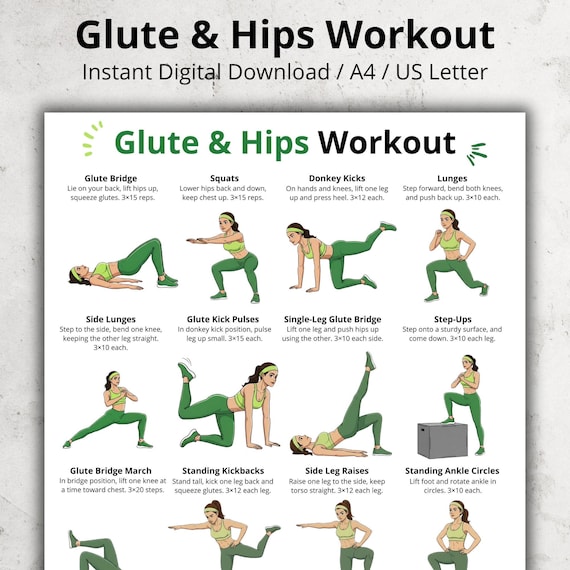
1. Squats
Squats are the “king” of lower body exercises. They work your quads, glutes, hamstrings, and even your core.
How to do it:
- Stand with feet shoulder-width apart.
- Push your hips back and bend your knees, as if sitting in a chair.
- Keep your chest up and your back straight.
- Lower until your thighs are parallel to the floor, then stand back up.
Tip: Beginners often let their knees cave inward—focus on keeping them in line with your toes.
2. Lunges
Lunges target each leg separately, helping fix strength differences between sides.
How to do it:
- Stand tall, step forward with one foot.
- Lower until both knees are at 90-degree angles.
- Push through your front heel to return to standing.
Tip: Don’t let your front knee go past your toes. This keeps your knee safe.
3. Glute Bridges
This move isolates your glute muscles and works your hamstrings.
How to do it:
- Lie on your back, knees bent, feet flat on the floor.
- Push through your heels to lift your hips as high as possible.
- Squeeze your glutes at the top, then lower slowly.
Tip: To make it harder, try single-leg glute bridges.
4. Bulgarian Split Squats
A powerful exercise for quads and glutes.
How to do it:
- Stand a few feet in front of a chair or low table.
- Rest one foot behind you on the chair.
- Lower your body until your front thigh is nearly parallel to the floor.
- Push through your front heel to stand up.
Tip: Keep your torso upright and your front knee over your ankle.
5. Step-ups
Great for glutes, quads, and improving balance.
How to do it:
- Use a sturdy chair or step.
- Step up with one foot, bring the other foot up, then step down.
- Alternate legs.
Tip: Push through your heel, not your toes, for more glute activation.
6. Calf Raises
Don’t forget your calves—they help with stability and power.
How to do it:
- Stand with feet hip-width apart.
- Rise onto your toes, pause, then lower back down.
Tip: Try single-leg calf raises for extra challenge.
7. Side-lying Leg Lifts
Targets the gluteus medius, important for hip stability.
How to do it:
- Lie on your side, legs straight.
- Lift your top leg to about 45 degrees, then lower slowly.
Tip: Keep your toes pointed forward to work the right muscles.
8. Wall Sits
A simple but tough exercise for endurance.
How to do it:
- Stand with your back against a wall.
- Slide down until your thighs are parallel to the floor.
- Hold as long as you can.
Tip: Don’t let your knees go past your toes.
9. Reverse Lunges
A safer variation for people with knee discomfort.
How to do it:
- Step backward instead of forward, lower your knee toward the floor.
- Push through your front foot to return.
Tip: Keep your upper body straight—don’t lean forward.
10. Sumo Squats
Targets the inner thighs and glutes.
How to do it:
- Stand with feet wide, toes pointed out.
- Squat down, keeping your chest up.
Tip: Push your knees outward for better inner thigh activation.
Adding Resistance At Home: Simple Equipment Options
While bodyweight exercises are effective, adding resistance can help you build more muscle and strength. You don’t need to buy expensive equipment—many items at home work just as well.
Common Household Items For Resistance
- Backpack with books: Wear a loaded backpack for squats, lunges, or step-ups.
- Water bottles or milk jugs: Hold in your hands for extra weight during lunges or squats.
- Towels: Use for sliding hamstring curls on smooth floors.
- Resistance bands: These are cheap and take up almost no space. They add challenge to squats, glute bridges, and more.
Comparison Of Home Equipment Options
Here’s how some common resistance options compare for home leg and glute workouts:
| Equipment | Cost | Adjustability | Best For |
|---|---|---|---|
| Backpack with books | None (use what you have) | Easy (add/remove books) | Squats, step-ups, lunges |
| Water bottles/milk jugs | Low | Limited | Lunges, side steps |
| Resistance bands | Low | Varies (light to heavy) | Glute bridges, squats |
| Chairs/steps | None | Fixed | Step-ups, split squats |
Beginners often miss the value of adding small amounts of resistance. Even a backpack with a few books can make your muscles work much harder, helping you build strength more quickly.

Credit: nilds.gov.ng
Structuring Your At-home Leg And Glute Workout
To see progress, your workouts need structure. This means not just doing random exercises, but following a plan that balances intensity, variety, and rest.
Key Principles For Effective Workouts
- Frequency: Aim for 2-3 leg and glute sessions per week. This gives your muscles time to recover and grow.
- Volume: For each exercise, perform 3-4 sets of 8-15 repetitions. If you can do more than 15 easily, add resistance or choose a harder version.
- Rest: Rest 30-60 seconds between sets. This keeps your heart rate up but allows your muscles to recover.
Sample Workout Plan (no Equipment Needed)
Try this full lower body routine at home:
- Bodyweight Squats: 3 sets x 15 reps
- Reverse Lunges: 3 sets x 10 reps per leg
- Glute Bridges: 3 sets x 15 reps
- Step-Ups: 3 sets x 12 reps per leg
- Side-Lying Leg Lifts: 3 sets x 15 reps per side
- Calf Raises: 3 sets x 20 reps
Rest 30 seconds between sets. If you’re a beginner, start with 2 sets per exercise.
Progressing Your Workouts
Progress is key for results. Here are ways to keep challenging yourself:
- Increase reps or sets as you get stronger.
- Add resistance using household items.
- Slow down the lowering (eccentric) part of each exercise.
- Try harder variations (single-leg squats, plyometric lunges).
A common mistake is repeating the same workout for weeks without making it harder. Your muscles need new challenges to grow.
Comparison: Bodyweight Vs. Weighted Home Workouts
Let’s look at how bodyweight and weighted routines stack up:
| Workout Type | Strength Gains | Muscle Growth | Fat Loss | Convenience |
|---|---|---|---|---|
| Bodyweight | Moderate | Good for beginners | High (more reps) | Excellent |
| Weighted (home items) | High | Better for all levels | High | Very good |
Adding resistance helps you progress faster, but even bodyweight training—done right—can give impressive results.
Advanced Variations For More Challenge
Once you master basic moves, try these progressions. They build more muscle, burn more calories, and keep workouts interesting.
1. Single-leg Squats (pistol Squats)
A tough move that works the entire leg and glute.
- Stand on one leg, extend the other in front.
- Lower yourself as far as possible, then push back up.
- Hold onto a wall or chair for balance if needed.
2. Jump Squats
Add power and burn more calories.
- Perform a regular squat, but explode upward, jumping as high as you can.
- Land softly and go straight into the next rep.
3. Bulgarian Split Squats (weighted)
Use a backpack or dumbbells for extra resistance.
- Same as the basic version, but hold weight or wear a loaded backpack.
4. Glute Bridge March
Targets each glute separately.
- In bridge position, lift one foot off the ground, then the other, like marching.
5. Banded Lateral Walks
Use a resistance band around your thighs.
- Take small steps to the side, keeping tension on the band.
6. Curtsy Lunges
A variation that targets glute medius and inner thighs.
- Step one leg behind and across, lower into a lunge, then return.
Proper Warm-up And Cool-down
Warming up prepares your body and helps prevent injury. Cooling down aids recovery and reduces soreness.
Warm-up Routine (5-7 Minutes)
- March or jog in place: 1 minute
- Bodyweight squats: 1 set x 15 reps
- Leg swings: 10 per leg, forward and side-to-side
- Hip circles: 10 per direction
- Arm swings and shoulder circles: 30 seconds
This increases blood flow and warms up the muscles you’ll use.
Cool-down Routine (5 Minutes)
- Standing quad stretch: 30 seconds per leg
- Hamstring stretch: 30 seconds per leg
- Seated glute stretch: 30 seconds per side
- Calf stretch against a wall: 30 seconds per leg
- Deep breathing: 1 minute
Many skip warm-ups and cool-downs, but they are key for safety and flexibility.
Common Mistakes And How To Avoid Them
Getting results at home is easier when you dodge these frequent errors:
1. Poor Form: Rushing or using sloppy technique leads to poor results and injury. Focus on quality, not just quantity.
2. Not Progressing: Repeating the same workout with no changes slows results. Increase reps, sets, or resistance regularly.
3. Ignoring Weak Muscles: Most people have weaker glutes compared to their quads. Add isolation exercises like glute bridges and side-lying leg lifts.
4. Overtraining: Rest is as important as workouts. Muscles need time to recover. Two to three sessions per week are enough for most people.
5. Skipping Warm-Ups: Cold muscles get injured more easily. Always warm up before you begin.
Nutrition Tips For Leg And Glute Growth
Muscle growth needs the right food. No matter how hard you train, you need good fuel for the best results.
1. Protein: Essential for muscle repair. Try to get 0.6-1 gram per pound of body weight daily. Good sources include chicken, fish, eggs, beans, and Greek yogurt.
2. Carbohydrates: Provide energy for tough workouts. Whole grains, fruits, and vegetables are best.
3. Healthy Fats: Needed for hormone health. Avocado, nuts, seeds, and olive oil are smart choices.
4. Hydration: Muscles work better when you’re well-hydrated. Aim for at least 8 cups of water daily.
5. Timing: Eat a balanced meal with protein and carbs within two hours after working out to help your muscles recover.
Beginners often forget how much nutrition matters. Training without proper food is like building a house without bricks.
Tracking Progress And Staying Motivated
Measuring your progress helps you stay motivated and see real results.
Ways To Track Progress
- Take photos: Every 2-4 weeks, from the same angles.
- Record reps, sets, and resistance: Use a notebook or app.
- Measure your legs and glutes: Use a tape measure around the thickest part.
- Notice daily life changes: Climbing stairs, walking, or standing up should feel easier.
Staying Motivated
- Set small, clear goals: “Do 15 full squats” is more motivating than “get stronger.”
- Find a workout buddy: Family or friends can help keep you accountable.
- Change up your routine: Add new exercises or challenges to avoid boredom.
Many people quit because they don’t see fast results. Remember: building muscle takes time. Celebrate small wins along the way.
Sample 4-week Leg And Glute Home Workout Program
Here’s a sample plan to follow. Adjust sets, reps, or rest as needed for your level.
| Week | Workout 1 | Workout 2 | Workout 3 |
|---|---|---|---|
| 1 | Squats (3x12) Glute Bridges (3x15) Step-Ups (3x10 per leg) Calf Raises (3x20) |
Reverse Lunges (3x10 per leg) Wall Sits (3x30 sec) Side-Lying Leg Lifts (3x15 per side) Glute Bridge March (3x10 per leg) |
Sumo Squats (3x12) Bulgarian Split Squats (2x8 per leg) Calf Raises (3x20) Hamstring Slides (3x10) |
| 2 | Add one set to each exercise Increase reps by 2-3 if possible |
Add resistance (backpack, bands) Increase hold time for wall sits |
Try single-leg glute bridge Add a set to split squats |
| 3 | Add jump squats (2x10) Increase sets to 5 for calf raises |
Add curtsy lunges (3x10 per leg) Increase reps for all exercises |
Use heavier backpack/bottles Focus on slow lowering phase |
| 4 | Repeat favorite exercises Test max reps for squats and glute bridges |
Try advanced variations Focus on perfect form |
Take progress photos Celebrate your progress! |
This plan helps you progress safely, avoid boredom, and see steady improvements.
Frequently Asked Questions
How Often Should I Do Leg And Glute Workouts At Home?
Most people see good results with 2-3 sessions per week. This gives your muscles time to recover and grow. If you are new, start with two sessions, then add a third as your body adapts.
Can I Build Muscle Without Equipment?
Yes, you can build muscle using only your body weight. Exercises like squats, lunges, and glute bridges work very well. To keep making progress, add more reps, sets, or try harder variations. Adding resistance, even with home items, speeds up growth.
How Long Does It Take To See Results?
You may notice small changes in 2-4 weeks, like better strength and less soreness. Visible muscle growth and shape often take 8-12 weeks of regular training and good nutrition. Consistency is key.
What If I Have Knee Pain During Squats Or Lunges?
Try reverse lunges or wall sits, which are often easier on the knees. Focus on form—don’t let your knees go past your toes and keep your weight in your heels. If pain continues, see a doctor or physical therapist before continuing.
Do I Need Protein Shakes To Build Muscle?
No, protein shakes are not required. You can get enough protein from foods like chicken, eggs, beans, and yogurt. Shakes are just a convenient option if you struggle to meet your needs through meals.
Building strong legs and glutes at home is possible for anyone, no matter your starting point. Use the exercises, tips, and plans in this guide to shape a stronger, healthier lower body from the comfort of your home. If you want more science-backed fitness advice, check out the National Institutes of Health. Remember, progress comes from small, regular steps—so start today and enjoy the results that follow.
Credit: www.etsy.com
