

Glute Dumbbell Workout: Sculpt Stronger, Rounder Glutes Fast
Getting a strong, well-shaped backside is a goal for many people—whether you want to improve your posture, run faster, or just fill out your jeans better. The glute muscles are not just about looks; they play an important role in your daily movement and athletic performance. Good news: you don’t need a gym full of machines to grow and shape your glutes. A simple pair of dumbbells and some floor space are enough for a complete glute dumbbell workout. With the right exercises, smart technique, and a bit of consistency, you can target all parts of your glutes from home or in any gym.
Let’s explore how to train your glutes effectively using only dumbbells. This guide will show you the best exercises, how to structure your workout, form tips, common mistakes, and ways to adjust for every fitness level. You’ll also discover a few non-obvious insights that most beginners miss when chasing glute gains.
Why Glute Training Matters
Your glute muscles—the gluteus maximus, gluteus medius, and gluteus minimus—are among the strongest muscles in your body. They help you stand up, climb stairs, jump, sprint, and even support your lower back. Weak glutes can lead to poor posture, back pain, knee problems, and less power in sports.
Building your glutes is not just about looks. Strong glutes help with:
- Posture: They keep your hips and spine in the right position.
- Injury prevention: They protect your lower back and knees.
- Athletic performance: You run, jump, and lift better with strong glutes.
- Daily life: Simple things like standing up or carrying groceries become easier.
The Anatomy Of Your Glutes
Understanding the muscles you’re working helps you train smarter. Your glutes are made of three main muscles:
- Gluteus maximus: The largest muscle, gives your butt its shape and power. It helps with hip extension (moving your thigh backward), standing up, and climbing.
- Gluteus medius: Located on the outer side of your hip, it helps with abduction (lifting your leg to the side) and stabilizes your pelvis when you walk.
- Gluteus minimus: The smallest, deep muscle that also helps with abduction and stability.
To fully develop your glutes, you need to hit all three muscles with a mix of movements.
Benefits Of Using Dumbbells For Glute Workouts
You might wonder why choose dumbbells over barbells or machines. Here are some key reasons:
- Accessibility: Dumbbells are easy to find at home, in most gyms, or even hotels.
- Versatility: You can do dozens of glute exercises with just a pair of dumbbells.
- Balance and stability: Dumbbells challenge each side of your body to work on its own, fixing muscle imbalances.
- Joint-friendly: Many people find dumbbells easier on their joints than heavy barbells.
- Progressive overload: You can increase the weight as you get stronger for constant progress.
Key Principles For An Effective Glute Dumbbell Workout
Before starting, let’s cover how to get the best results:
- Progressive overload: Gradually increase the weight, reps, or sets over time.
- Good form: Quality beats quantity. Using bad form can lead to injury and wasted effort.
- Mind-muscle connection: Focus on feeling the glutes working during each rep.
- Rest and recovery: Muscles grow outside the gym. Rest at least 48 hours between glute sessions.
- Variety: Include different movement patterns—hip thrusts, lunges, step-ups—to hit every part of the glutes.
Best Dumbbell Exercises For Glutes
These exercises are the core of any solid glute dumbbell workout. They range from beginner to advanced, so you can pick what fits your level.
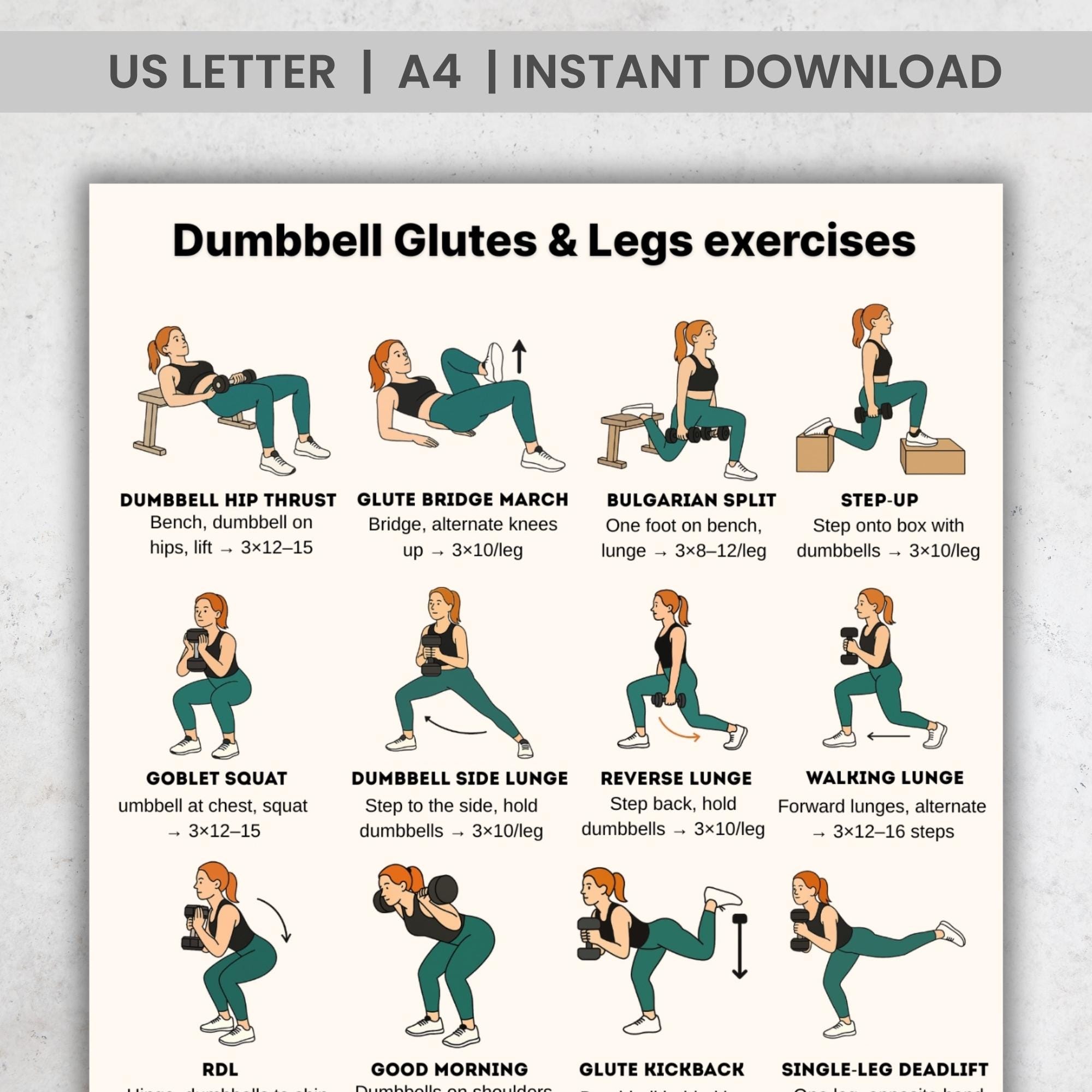
Dumbbell Hip Thrust
This is a top choice for glute growth.
How to do it:
Sit on the ground with your upper back against a bench or sturdy couch. Roll a dumbbell onto your hips. Plant your feet flat, shoulder-width apart. Push through your heels to lift your hips, squeezing your glutes at the top.
Lower back down.
Tips:
- Keep your chin tucked.
- Don’t over-arch your lower back.
- Pause for a second at the top for extra tension.
Why it works:
The hip thrust gives your glutes maximum tension at the top, which is where these muscles work hardest.
Dumbbell Romanian Deadlift (rdl)
A classic move to target your glutes and hamstrings.
How to do it:
Stand tall holding a dumbbell in each hand. Keep a slight bend in your knees. Hinge forward at your hips (not your waist), pushing your butt back. Lower dumbbells until you feel a stretch in your hamstrings, then stand up by driving your hips forward.
Tips:
- Keep your back flat.
- Don’t round your shoulders.
- Move slowly for better control.
Why it works:
The RDL stretches your glutes under load, which is key for muscle growth.
Dumbbell Bulgarian Split Squat
This single-leg move builds strength, balance, and size.
How to do it:
Stand a few feet in front of a bench or chair. Rest your back foot on it. Hold dumbbells at your sides. Lower your back knee toward the floor while keeping your chest up. Push through your front heel to stand back up.
Tips:
- Lean forward slightly to target glutes more.
- Don’t let your front knee cave in.
- Use a pad under your back knee if needed.
Why it works:
Training one leg at a time fixes imbalances and improves glute activation.
Dumbbell Step-up
Great for building glute power and stability.
How to do it:
Hold a dumbbell in each hand. Step up onto a bench or sturdy box with one foot. Push through your heel to lift your body up. Lower back down with control.
Tips:
- Use a box high enough to create a 90-degree angle at your knee.
- Avoid pushing off the lower leg.
Why it works:
Step-ups mimic real-life movements like climbing stairs and work your glutes hard.
Dumbbell Sumo Squat
Targets your glutes, especially the inner and outer parts.
How to do it:
Stand with feet wider than shoulders, toes pointed out. Hold one dumbbell with both hands between your legs. Squat down, keeping your chest up and knees over your toes. Push through your heels to stand up.
Tips:
- Don’t let your knees collapse inward.
- Keep your back upright.
Why it works:
The wide stance hits the glutes more than a regular squat.
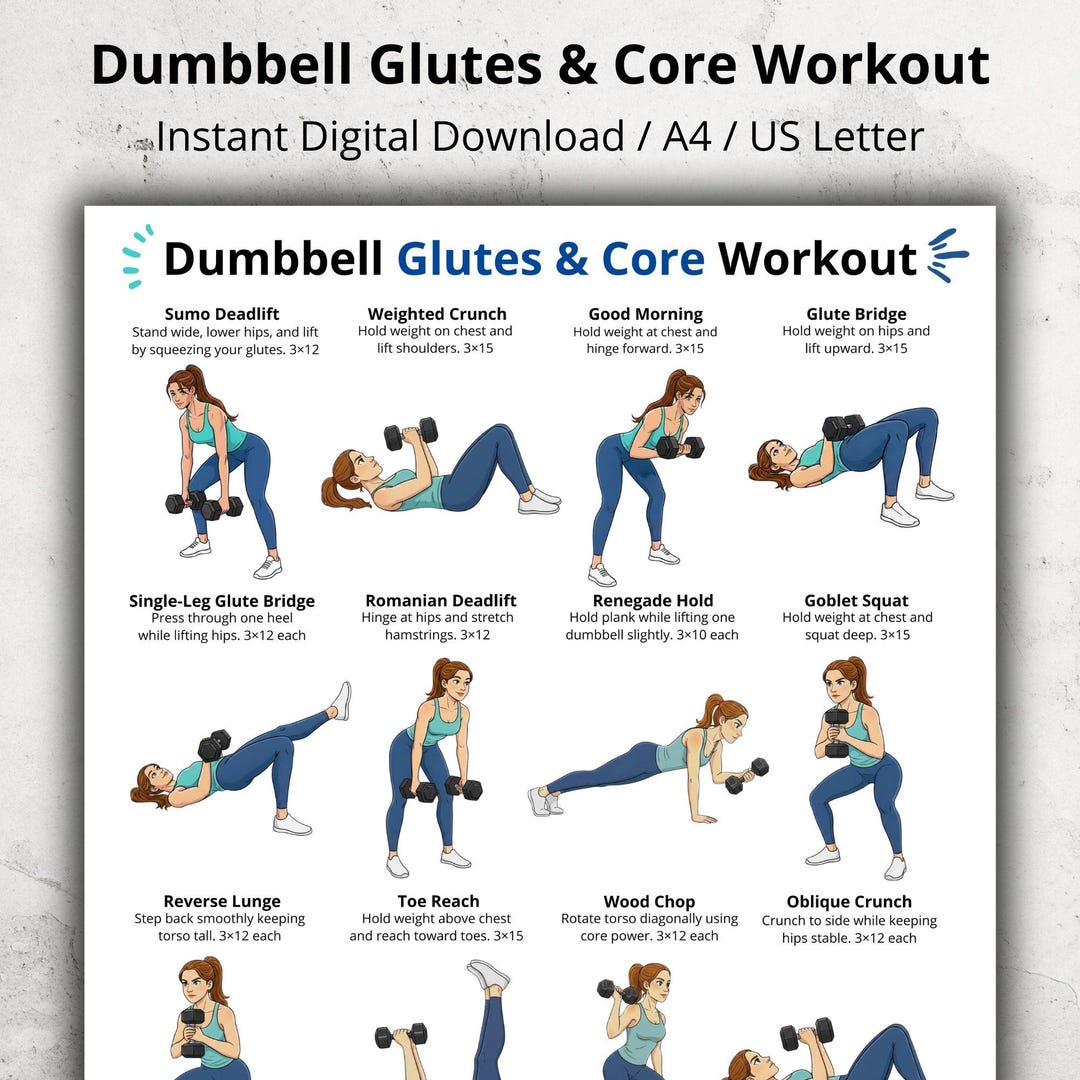
Dumbbell Glute Bridge
A beginner-friendly move that still packs a punch.
How to do it:
Lie on your back with knees bent, feet flat. Place a dumbbell on your hips. Push through your heels to lift your hips, squeeze your glutes, then lower down.
Tips:
- Don’t push with your lower back.
- Pause at the top for a stronger contraction.
Why it works:
The glute bridge isolates your glutes with less strain on your lower back.
Dumbbell Curtsy Lunge
Adds a twist to regular lunges, targeting the glute medius.
How to do it:
Stand tall with dumbbells at your sides. Step one leg behind and across your body, lowering your knee toward the floor. Push through your front heel to return.
Tips:
- Keep your chest up.
- Don’t let your front knee go past your toes.
Why it works:
The sideways step hits the outer glutes and improves hip stability.
Dumbbell Frog Pump
A lesser-known but powerful move.
How to do it:
Lie on your back, knees bent, feet together, and knees open wide (like a frog). Place a dumbbell on your hips. Push your hips up, squeeze glutes hard, then lower.
Tips:
- Keep feet together throughout.
- Focus on squeezing at the top.
Why it works:
Frog pumps target the glutes from a unique angle and are great for high reps.
Dumbbell Single-leg Glute Bridge
Unilateral moves force each side to work on its own.
How to do it:
Lie on your back, one knee bent, the other leg straight. Place a dumbbell over your bent knee. Push through your heel to lift your hips, then lower.
Tips:
- Keep your hips level.
- Start with bodyweight if needed.
Why it works:
Single-leg work reveals and fixes weaknesses between sides.
Dumbbell Lateral Lunge
Hits the glutes, especially the medius and minimus.
How to do it:
Stand tall, holding dumbbells. Step out to the side, bend your stepping knee, and push your hips back. Push off to return to the start.
Tips:
- Keep your non-stepping leg straight.
- Don’t round your back.
Why it works:
Side lunges hit glute muscles that forward/backward moves often miss.
Structuring The Perfect Glute Dumbbell Workout
How you combine these exercises is as important as the moves themselves. Here’s how to build an effective session.
Choosing Sets, Reps, And Weight
- Sets: 3–4 sets per exercise is ideal.
- Reps: 8–15 reps per set for most exercises; higher reps (15–20) for bridges, frog pumps, or burnout sets.
- Rest: 60–90 seconds between sets.
- Weight: Choose a weight that feels challenging but allows you to keep good form. If you can easily do more than 15 reps, go heavier.
Example Glute Dumbbell Workout
Try this sample routine, perfect for home or gym:
- Dumbbell Hip Thrust – 4 sets of 12 reps
- Bulgarian Split Squat – 3 sets of 10 reps per leg
- Dumbbell Romanian Deadlift – 4 sets of 10 reps
- Dumbbell Curtsy Lunge – 3 sets of 12 reps per leg
- Dumbbell Frog Pump – 3 sets of 20 reps
Weekly Frequency
- Beginners: 1–2 times per week
- Intermediate/Advanced: 2–3 times per week, with at least 48 hours between sessions
Warm-up And Cool-down
A good warm-up prevents injury and helps your glutes fire properly.
- Warm-up: 5–10 minutes of light cardio (jumping jacks, jogging) plus dynamic stretches (leg swings, hip circles).
- Cool-down: Stretch your glutes, hamstrings, and hips after your workout.

Credit: www.youtube.com
Glute Dumbbell Workout Progression
You’ll need to challenge your glutes more over time for continued growth. Here’s how:
- Increase weight: When you can easily do all your reps, use heavier dumbbells.
- Add reps or sets: Slowly increase how many you do.
- Slow down reps: Move more slowly to increase time under tension.
- Try harder moves: Progress to more advanced exercises (like single-leg versions).
- Shorten rest: Rest less to make the workout tougher.
Here’s a simple progression example:
| Week | Hip Thrust Weight | Reps | Sets | Notes |
|---|---|---|---|---|
| 1 | 20 lbs | 10 | 3 | Focus on form |
| 2 | 25 lbs | 12 | 3 | Add weight |
| 3 | 25 lbs | 15 | 4 | Add reps/sets |
| 4 | 30 lbs | 12 | 4 | More weight again |
Common Mistakes In Glute Dumbbell Workouts
Many people spend months training without seeing results because of simple errors. Avoid these common mistakes:
- Neglecting form: Rushing reps or using momentum means your glutes aren’t working as hard as they should.
- Using too much weight: If you can’t control the movement, your lower back or thighs may take over.
- Not squeezing glutes: At the top of each rep, pause and squeeze. This boosts muscle activation.
- Too little variety: Only doing squats or bridges misses key glute muscles.
- Skipping warm-ups: Cold muscles don’t fire well and are more likely to get injured.
Here’s a quick comparison of good vs. bad form in glute training:
| Good Form | Poor Form |
|---|---|
| Controlled movement | Rushing or bouncing reps |
| Full range of motion | Partial reps |
| Flat back, chest up | Rounded back |
| Pausing at the top | No pause, no squeeze |
How To Activate Glutes Better With Dumbbells
One insight many beginners miss is that just moving the weight isn’t enough. You need to actively contract your glutes during each rep, especially at the hardest point (usually the top). Here’s how to do that:
- Visualize your glutes working. Picture the muscle squeezing.
- Go slow on the lowering (eccentric) phase. This increases muscle tension.
- Touch your glutes lightly between sets to remind your brain to fire them.
- Use pre-activation drills (like bodyweight bridges or band walks) before picking up dumbbells.
Adapting Glute Dumbbell Workouts For All Levels
You don’t need to be an expert to get results, but you do need to start at the right level. Here’s how to adjust:
Beginners
- Use lighter weights or just bodyweight at first.
- Focus on learning the movement pattern.
- Keep rep ranges higher (12–20) for easier exercises.
Intermediate
- Use moderate to heavy dumbbells.
- Add single-leg moves (split squats, single-leg bridges).
- Mix in higher and lower rep ranges.
Advanced
- Use heavy dumbbells and advanced variations.
- Shorten rest periods.
- Use supersets (two moves back-to-back) or drop sets (reduce weight mid-set).
Glute Dumbbell Workout Vs. Other Glute Training Methods
How does dumbbell training compare to bands, barbells, or machines? Each has its benefits:
| Training Tool | Main Benefits | Main Limitations |
|---|---|---|
| Dumbbells | Versatile, accessible, balance/stability, easy progression | Max weight may be limited, challenging for very heavy lifts |
| Resistance Bands | Cheap, portable, good for activation/warm-up | Hard to build max strength, not great for overload |
| Barbells | Allow for very heavy loads, excellent for strength | Require gym equipment, less balance work |
| Machines | Easy for beginners, isolate muscles | Less functional, less stabilization |
Tip: If you have access to all equipment, combining dumbbells with other tools can give you the best results.
The Importance Of Nutrition And Recovery
No workout will build your glutes if you don’t support it with good nutrition and recovery.
- Protein: Aim for about 0.7–1 gram per pound of bodyweight daily.
- Calories: If you want to grow muscle, eat in a slight calorie surplus.
- Hydration: Muscles perform better when you’re well hydrated.
- Sleep: Aim for 7–9 hours per night for best muscle growth.
Non-obvious tip: Many people forget that stress, poor sleep, and low protein can slow down muscle growth—even with a perfect workout routine.
Credit: www.etsy.com
Tracking Progress And Staying Motivated
Tracking your progress is key to staying motivated and seeing results.
- Take progress photos every 4 weeks.
- Record your weights, sets, and reps in a notebook or app.
- Celebrate non-scale wins: More energy, clothes fitting better, stronger lifts.
- Set small, realistic goals (e.g., add 5 lbs to your hip thrust in 4 weeks).
Sample Glute Dumbbell Workouts For Different Goals
You can tweak your workout based on your main goal.
For Strength
- Fewer reps (6–8), heavier dumbbells, longer rest (2 minutes)
- Focus: Dumbbell hip thrust, RDL, Bulgarian split squat
For Muscle Growth (hypertrophy)
- Moderate reps (8–15), moderate weight, 60–90 seconds rest
- Focus: Hip thrust, sumo squat, step-up, frog pump
For Endurance Or Fat Loss
- Higher reps (15–20), lighter weights, short rest (30–45 seconds)
- Use circuits: Move from one exercise to another with little rest.
Tips For Maximizing Glute Growth With Dumbbells
Here are some advanced tips that most beginners miss:
- Use a full range of motion. The lower you go (with good form), the more your glutes work.
- Don’t lock your knees at the top—keep tension on the glutes.
- Try pauses and slow negatives (lowering phase) to increase muscle time under tension.
- Switch up foot position (wider, toes out) for variety.
- Finish with burnout sets (high reps, light weight) to fully fatigue the muscle.
Staying Safe: Injury Prevention Tips
Glute training is generally safe, but follow these guidelines:
- Warm up your hips and knees before heavy lifts.
- Listen to your body: Sharp pain is a warning to stop.
- Strengthen your core: A strong core supports your lower back during glute moves.
- Rest if you feel sore or tired—overtraining slows progress.
For more details on safe strength training, see CDC: Benefits and Safety of Strength Training.
Credit: www.etsy.com
Frequently Asked Questions
How Often Should I Do A Glute Dumbbell Workout?
You can train your glutes 2–3 times per week, as long as you allow at least 48 hours between sessions for recovery. Over-training can lead to fatigue and slower muscle growth.
What Size Dumbbells Should I Use For Glute Exercises?
Start with a weight that challenges you in the 8–15 rep range but allows you to keep perfect form. Many beginners start with 10–20 lbs per dumbbell, but adjust based on your strength and the exercise.
Can I Build Big Glutes With Just Dumbbells?
Yes, especially for beginners and intermediates. As long as you use enough weight, push yourself, and progress over time, dumbbells can build strong, round glutes. For advanced lifters, heavier tools like barbells may help after a certain point.
How Do I Know If My Glutes Are Working During Exercises?
You should feel tension and a “burn” in your glute muscles, especially at the top of movements. If you only feel your thighs or lower back, check your form and slow down your reps.
How Long Does It Take To See Results From Glute Dumbbell Workouts?
Most people start to see some changes in 4–8 weeks with consistent effort, good nutrition, and enough rest. Bigger changes take several months. Track your progress with photos and strength gains, not just the mirror.
Unlocking the full potential of your glutes doesn’t require fancy equipment—just smart training and a pair of dumbbells. Use the tips, exercises, and progressions here to shape stronger, more powerful glutes and enjoy the benefits in every part of your life.
