

How to Affirmations: Unlock Your Potential With Daily Practices
How To Affirmations: A Clear Guide For Beginners
Imagine waking up and feeling positive about yourself, your day, and your goals. Many people struggle with negative thoughts and self-doubt. But there is a simple tool that can help — affirmations. Affirmations are short, positive statements that you repeat to yourself. They can help you build confidence, change your mindset, and improve your life. This guide will show you how to use affirmations effectively, with real examples, practical advice, and insights you may not find elsewhere.
What Are Affirmations?
Affirmations are positive phrases you say to yourself. They focus your mind on what you want to believe or achieve. For example, saying “I am confident” helps you think and feel more confident. These statements can be about your abilities, feelings, or goals.
Some people use affirmations to:
- Improve self-esteem
- Reduce stress
- Reach goals faster
- Change bad habits
Research shows that affirmations can affect how you think and act. When you repeat positive statements, your brain starts to accept them as true. This can change your behavior and attitude.
A study published in the journal Self and Identity found that self-affirmation can reduce stress and improve problem-solving skills. People who practiced affirmations felt less anxious and performed better in difficult situations.
Why Affirmations Work
Affirmations are not magic. They work because they help rewire your thoughts. Our brains are shaped by repeated ideas. If you always think “I can’t do this,” you start to believe it. But if you repeat “I am capable,” your mind starts to change.
This process is called neuroplasticity. It means your brain can form new connections and habits. By using affirmations, you train your mind to focus on positives instead of negatives.
There are two key reasons affirmations work:
- Focus: They direct your attention to your goals and strengths.
- Repetition: Repeating them makes your brain believe them, even if you doubt at first.
Many beginners miss the importance of repetition. Saying an affirmation once or twice is not enough. You need to use them daily, sometimes many times a day, for them to become part of your thinking.

Credit: sproutingzen.com
How To Create Effective Affirmations
Writing your own affirmations is simple, but there are important steps to follow. Not every positive phrase is powerful. The best affirmations are clear, specific, and meaningful to you.
Steps To Create Affirmations
1. Choose A Positive Focus
Pick something you want to improve, such as confidence, health, or happiness.
2. Use Present Tense
Write your affirmation as if it is true now. For example, “I am healthy,” not “I will be healthy. ”
3. Keep It Short And Simple
Long statements are hard to remember. Use short phrases.
4. Make It Personal
Start with “I” or “My. ” For example, “I am strong,” or “My mind is calm. ”
5. Avoid Negatives
Do not use words like “not” or “don’t. ” Focus on what you want, not what you avoid.
6. Add Emotion
Include feelings to make it stronger. “I am confident and excited about my day. ”
Here are some examples:
- “I am confident in my abilities.”
- “My body is healthy and strong.”
- “I am calm and peaceful.”
- “I attract success and happiness.”
- “My life is full of joy.”
Common Mistakes Beginners Make
Many people write affirmations that do not work. Here are mistakes to avoid:
- Using future tense (“I will be…”)
- Including negative words (“I am not scared…”)
- Making statements too general (“I am happy” — happy about what?)
Specific affirmations are more effective. For example, “I am happy and grateful for my family” is better than just “I am happy. ”
How To Use Affirmations Daily
Affirmations are most powerful when you use them regularly. Here’s how to fit them into your day.
1. Morning Routine
Start your day with affirmations. Say them while you get ready or look in the mirror.
2. Writing Them Down
Write your affirmations in a journal. This helps you focus and remember them.
3. Repeat Often
Say your affirmations several times a day. Some people set reminders on their phone.
4. Visualize As You Speak
Imagine the words are true. Feel the confidence, calm, or happiness.
5. Use Before Stressful Events
Repeat affirmations before a test, meeting, or difficult task.
6. Combine With Deep Breathing
Breathe slowly as you say your affirmations. This relaxes your mind.
7. Record Your Voice
Listen to your affirmations during the day. Hearing your own voice makes them stronger.
Example Daily Routine
- Morning: “I am ready for a successful day.”
- Noon: “I am calm and focused.”
- Evening: “I am grateful for my progress.”
Many beginners miss the benefit of saying affirmations during stressful moments. Using them before important events can reduce anxiety and improve performance.
Science Behind Affirmations
Affirmations are not just positive thinking. They have scientific support. Studies show that self-affirmation can reduce stress, help you make better decisions, and improve health.
Key Data And Findings
- People who use affirmations show lower levels of cortisol, the stress hormone.
- Self-affirmation can improve academic and work performance.
- Using affirmations before a stressful event can help you handle it better.
Here is a comparison of two groups in a research study:
| Group | Used Affirmations | Stress Level After Test |
|---|---|---|
| Group A | Yes | Low |
| Group B | No | High |
This data shows that affirmations can reduce stress, even in difficult situations.
Types Of Affirmations
There are many types of affirmations, depending on your goals.
Self-esteem Affirmations
These help you feel better about yourself. Examples:
- “I am worthy of love.”
- “I accept myself completely.”
Health Affirmations
Used for physical and mental health. Examples:
- “My body is strong and healthy.”
- “I make healthy choices every day.”
Success Affirmations
For work, study, or personal goals. Examples:
- “I am successful in my career.”
- “I achieve my goals with ease.”
Relationship Affirmations
To improve relationships. Examples:
- “I communicate clearly and honestly.”
- “I attract positive people.”
Stress Relief Affirmations
To stay calm and reduce anxiety. Examples:
- “I am calm under pressure.”
- “I handle challenges with grace.”
Choosing the right type depends on your needs. Some people mix different types for a balanced mindset.
Comparing Affirmations To Other Mindset Tools
There are other tools similar to affirmations, such as meditation, visualization, and journaling. Here is a comparison of how affirmations differ:
| Tool | Main Purpose | Time Needed | Ease of Use |
|---|---|---|---|
| Affirmations | Change thoughts | 1-5 min | Easy |
| Meditation | Calm mind | 10-30 min | Moderate |
| Visualization | Imagine goals | 5-15 min | Moderate |
| Journaling | Reflect & plan | 10-20 min | Easy |
Affirmations are fast, easy, and can be used anywhere. They do not require special tools or long periods of quiet.
Using Affirmations For Specific Goals
Affirmations can help you reach many types of goals. Here’s how to use them for different purposes.
Improving Self-confidence
Choose phrases that focus on your strengths. For example, “I am confident and skilled. ” Repeat before important tasks.
Reducing Stress
Use calming affirmations during stressful times. “I am calm and relaxed. ” Combine with deep breathing.
Achieving Success
Write affirmations about your goals. “I am moving toward success every day. ” Repeat when you feel discouraged.
Building Healthy Habits
Affirmations can help you change habits. “I enjoy eating healthy foods. ” “I am active and energetic. ”
Strengthening Relationships
Focus on positive communication. “I listen with respect. ” “I show kindness to others. ”
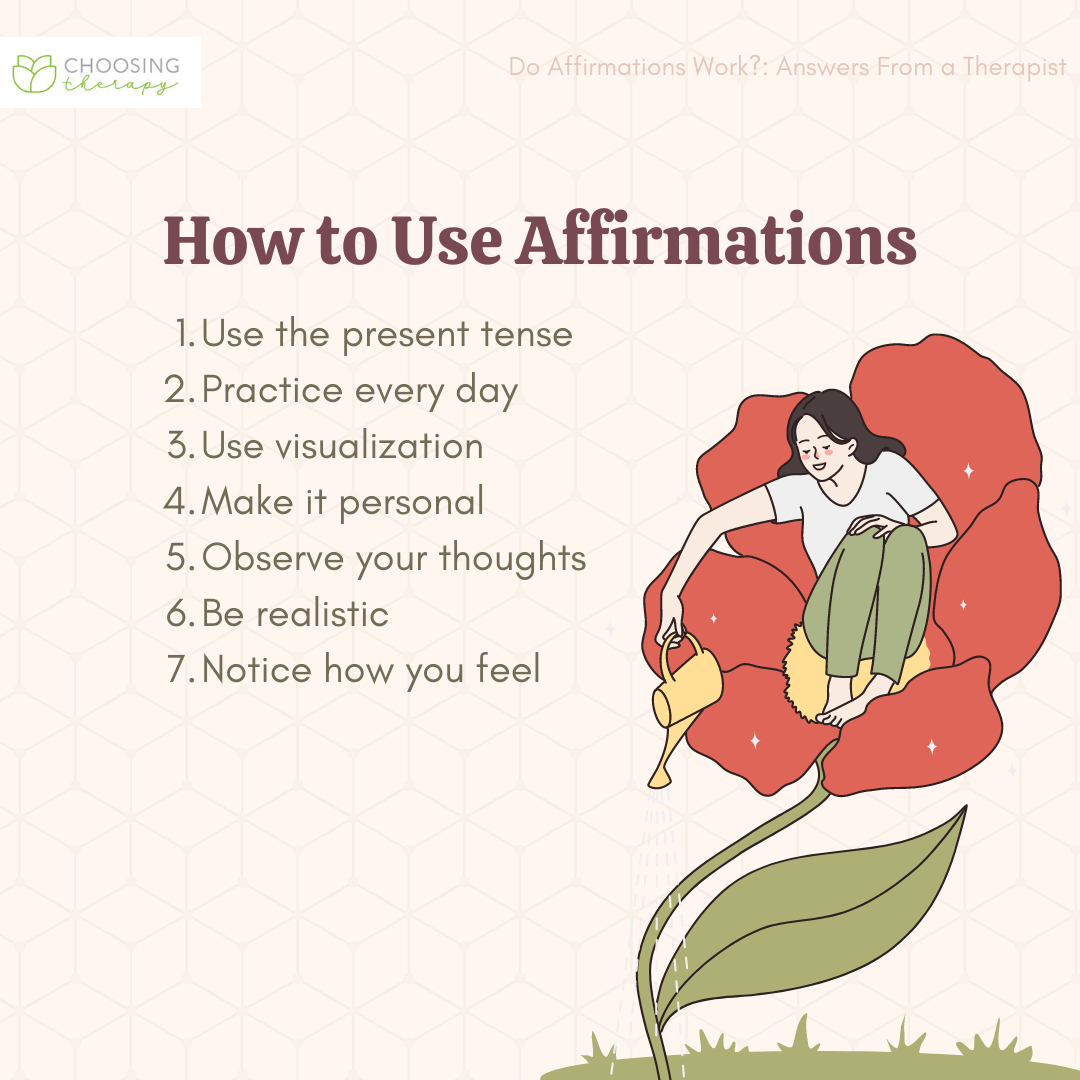
Credit: www.choosingtherapy.com
How To Make Affirmations Work Faster
Some people feel affirmations are slow to help. Here are ways to make them work better:
1. Add Visualization
Imagine yourself living the affirmation. See yourself confident, healthy, or successful.
2. Use Emotional Words
Words like “excited,” “grateful,” and “peaceful” add power.
3. Say Out Loud
Speaking affirmations is more effective than just thinking them.
4. Write Daily
Writing affirmations in a journal helps your brain remember them.
5. Create Reminder Cards
Write your affirmations on cards and keep them in your wallet, desk, or mirror.
6. Track Your Progress
Notice how you feel over time. Make changes if needed.
7. Combine With Actions
Take small steps toward your affirmation. If you affirm “I am healthy,” start a healthy habit.
Many beginners miss the importance of combining affirmations with real actions. For example, if you say “I am a good communicator,” practice speaking clearly during the day.
Common Challenges And How To Overcome Them
Affirmations are simple, but you may face problems at first.
Feeling Fake Or Silly
It is normal to feel strange saying positive phrases, especially if you do not believe them yet. Keep repeating them. Over time, your mind accepts them.
Not Seeing Results
Some people give up too soon. Affirmations take time. Use them for at least a few weeks before judging their effect.
Forgetting To Use Affirmations
Set reminders or use sticky notes. Make affirmations part of your routine, like brushing your teeth.
Negative Self-talk
If you notice negative thoughts, use affirmations right away. This helps you change your mindset quickly.

Credit: sproutingzen.com
Real-life Examples And Success Stories
Many people have changed their lives with affirmations. Here are a few examples:
- Student: A student used “I am confident in exams” daily. Over time, test anxiety reduced, and grades improved.
- Professional: A worker repeated “I am skilled and valuable.” This helped improve job performance and earn a promotion.
- Parent: A parent used “I am patient and caring.” This improved family relationships and reduced stress.
These stories show that affirmations can help in different areas of life. The key is to use them consistently and believe in their power.
How To Measure Progress
Tracking your progress is important. Here are ways to measure if affirmations are working:
1. Keep A Journal
Write your affirmations and note changes in mood, confidence, or habits.
2. Rate Your Feelings
Use a scale from 1 to 10 for confidence, happiness, or stress. See if numbers improve.
3. Notice Behavior Changes
Watch for new habits, better decisions, or improved relationships.
4. Ask Others
Friends or family may notice positive changes before you do.
Here is a simple progress tracking table:
| Week | Affirmation | Confidence Level (1-10) | Notes |
|---|---|---|---|
| 1 | I am confident | 4 | Felt unsure |
| 2 | I am confident | 6 | Less nervous |
| 3 | I am confident | 8 | Spoke up in meeting |
This helps you see real progress and stay motivated.
Advanced Tips For Affirmations
Once you are comfortable with basic affirmations, try these advanced ideas:
Use Power Words
Some words are more powerful. Try “strong,” “unstoppable,” “excited,” or “grateful. ”
Combine Affirmations With Meditation
Meditate for a few minutes, then say your affirmations. This helps you focus and absorb the words.
Create A Personal Affirmation Playlist
Record yourself saying affirmations. Listen during your commute, exercise, or before bed.
Share Affirmations With Others
Discuss or practice affirmations with a friend or family member. Sharing can increase motivation.
Adjust Affirmations Over Time
As you grow, change your affirmations to match new goals or feelings.
Add Visual Reminders
Use pictures, vision boards, or graphics with your affirmations. Seeing your goals helps your mind accept them.
Practice With Children
Affirmations work for all ages. Help children use simple phrases like “I am smart” or “I am kind. ”
Mistakes To Avoid With Affirmations
Even experienced users can make mistakes. Here are things to watch for:
1. Too Many Affirmations
Start with 3-5. Too many can confuse your mind.
2. Vague Statements
Be specific: “I am grateful for my job” is better than “I am grateful.”
3. Negative Focus
Avoid phrases like “I am not afraid. ” Say “I am brave” instead.
4. Skipping Days
Use affirmations every day. Consistency is key.
5. Ignoring Feelings
If you feel resistance, adjust your affirmation. Make it believable.
When Affirmations Are Not Enough
Sometimes, affirmations alone cannot solve deep issues. If you struggle with serious stress, anxiety, or depression, seek professional help. Affirmations are a tool, not a cure. Combine them with therapy, support, or healthy habits for best results.
Frequently Asked Questions
How Many Times Should I Repeat Affirmations Each Day?
Repeating your affirmations 3-10 times per session is a good start. Most people use them in the morning and evening. The key is consistency — use them every day, and increase repetitions if you feel comfortable.
Can Affirmations Help With Anxiety Or Stress?
Yes, affirmations can help reduce anxiety and stress. Choose calming phrases like “I am safe and relaxed.” Repeat them during stressful moments. For severe anxiety, combine affirmations with other methods or seek professional support.
Should I Write Or Say Affirmations?
Both methods work. Saying affirmations out loud helps your brain believe them. Writing them down makes them more memorable. Some people combine both — they speak and write their affirmations every day.
How Long Does It Take To See Results?
Results vary. Some people feel better in a few days, others need weeks or longer. It depends on your mindset, the affirmations you use, and your consistency. Track your progress and adjust if needed.
Are Affirmations Backed By Science?
Yes, research supports the use of affirmations. Studies show they can reduce stress, improve confidence, and help with behavior change. For more information, see Positive Psychology.
Using affirmations can change your thoughts, feelings, and habits over time. They are simple, powerful, and available to everyone.
---
Affirmations are more than just positive statements. They are a tool for changing your mindset, building confidence, and reaching your goals. With the right approach, consistent use, and belief in their power, you can see real improvements in your life.
Start with simple, personal affirmations, use them every day, and track your progress. Remember, small steps can lead to big changes. If you combine affirmations with actions, mindfulness, and support, you can unlock your best self.
