

How Often to Do Affirmations for Maximum Results
How Often to Do Affirmations: A Complete Guide to Timing, Frequency, and Lasting Success
Affirmations are simple but powerful statements that people use to shape their thoughts, feelings, and actions. Many people use affirmations to build confidence, reduce stress, or change bad habits. But if you’re new to affirmations, you might wonder: How often should you say them for real results? Once a day, twice, or more? Is it possible to overdo it? Should you use them in the morning, at night, or both?
Knowing the right frequency can make a big difference. Too little, and you might not see changes. Too much, and you risk turning them into empty words. This guide clears up the confusion. You’ll learn the science behind repetition, how often to do affirmations for different goals, and how to build a habit that fits your life.
Let’s explore the best ways to use affirmations, backed by research, expert advice, and real-world stories.
What Are Affirmations And Why Do They Matter?
Affirmations are short, positive sentences you repeat to yourself. They help you focus on what you want instead of what you fear or dislike. For example, saying “I am confident” can help you feel more sure of yourself.
The idea is simple: your thoughts influence your actions. When you repeat positive messages, you slowly teach your brain to believe them. This can lead to better mood, higher motivation, and even changes in your behavior.
Research has shown that affirmations can help people:
- Reduce stress before big events
- Improve performance in school or at work
- Overcome negative thinking
- Support mental health and emotional balance
But the real power of affirmations comes from regular, mindful practice. That’s why finding the right frequency is so important.
The Science Behind Affirmation Frequency
How often you repeat an affirmation affects how well it works. There are three reasons for this:
- Repetition shapes belief: Your brain learns best through repetition. The more you hear or say something, the more likely you are to believe it.
- Neural pathways strengthen: Each time you repeat a positive statement, you create and strengthen connections in your brain. These make the new belief feel more natural over time.
- Consistency builds habit: Doing affirmations regularly helps them become part of your routine, like brushing your teeth.
A study published in the journal “Social Cognitive and Affective Neuroscience” found that self-affirmation can activate reward centers in the brain, making people more open to positive change. But this effect is strongest with regular practice, not just a one-time effort.
How Often Should You Do Affirmations? Key Principles
There’s no perfect number that fits everyone, but experts agree on a few key points:
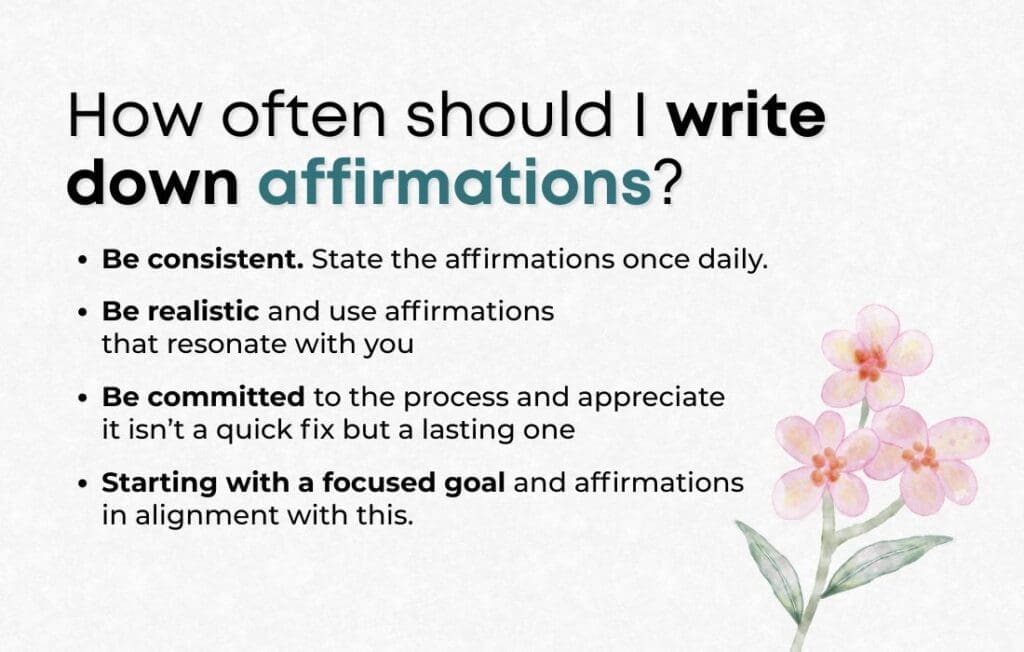
- Daily practice is best: Saying your affirmations every day is more effective than doing them once in a while.
- Twice a day works well for most: Many people find that doing affirmations in the morning and before bed gives the best results.
- Quality matters more than quantity: Saying an affirmation 5 times with full attention works better than repeating it 50 times with no feeling.
Let’s break down the main options for frequency, with practical tips and examples for each.
Once A Day: The Starting Point
For beginners, doing affirmations once a day is a good way to build the habit. Choose a time when you can focus, like after waking up or before sleep. This keeps the practice simple and easy to remember.
Example: After brushing your teeth in the morning, stand in front of the mirror and repeat your chosen affirmation 3–5 times.
Tip: Write your affirmation on a sticky note and place it somewhere you’ll see daily, like your bathroom mirror or computer.
Twice A Day: Morning And Night
Repeating affirmations twice a day is one of the most popular routines. This doubles your exposure and helps your brain process the message at two key moments:
- Morning: Sets a positive tone for the day.
- Night: Reinforces the idea before your mind rests.
Many top athletes and public speakers use this schedule to keep their mindset strong.
Non-obvious insight: Saying your affirmation at night can help your subconscious mind work on the idea while you sleep. Some people report waking up feeling more positive after doing affirmations before bed.
Three Times Or More: For Deep Change
If you’re working on a big goal or fighting strong negative beliefs, you might benefit from repeating affirmations three or more times a day. For example, you could say them:
- When you wake up
- During a lunch break
- Before going to sleep
Warning: More isn’t always better. If you say affirmations too often without focus, they can start to lose meaning. It’s better to have a few mindful sessions than to repeat them all day on autopilot.
Practical tip: Use reminders on your phone to prompt you at set times, but don’t force yourself if you’re tired or distracted. Quality over quantity always wins.
Comparing Affirmation Frequency Options
To make things clearer, here’s a comparison of common affirmation schedules:
| Frequency | Best For | Pros | Cons |
|---|---|---|---|
| Once a day | Beginners, busy people | Easy to remember, low pressure | Slower results |
| Twice a day | Most users | Balanced, fits most routines | Needs more commitment |
| Three or more times | Deep change, breaking strong habits | Intense reinforcement | Risk of burnout, can feel forced |
Best Times Of Day For Affirmations
When you say your affirmations can matter just as much as how often.
Morning Affirmations
Starting your day with positive statements puts you in a good mindset. Many people find that morning affirmations help them feel hopeful and energized.
- Stand in front of a mirror and say your affirmation.
- Write it in a journal as you plan your day.
Nighttime Affirmations
Doing affirmations before bed can help you let go of stress and doubts from the day. It’s also a great time to plant new ideas in your mind while you sleep.
- Sit quietly and repeat your affirmation in your head.
- Pair your affirmation with a short meditation or breathing exercise.
During Stressful Moments
You don’t need to wait for a set time. Using affirmations during tough moments can help you calm down and refocus. For example, before a big meeting, try repeating “I am prepared and capable. ”
Non-obvious insight: Some people find it helpful to record their affirmations and listen to them during commutes or exercise. This uses “passive repetition” to reinforce the message without extra time.
How Many Times Should You Repeat Each Affirmation?
Another common question is how many times to repeat each statement during a session. Experts offer several suggestions:
- 3 to 5 times: Enough for focus, not too much to get bored.
- 10 times: For stronger reinforcement, especially with new or difficult beliefs.
- No set number: Some coaches say to repeat until it feels true, or until you notice a shift in your mood.
Key point: If you notice your mind drifting, that’s a sign to stop. Quality is more important than hitting a target number.
Example Routine
Here’s a simple routine for twice-daily affirmations:
- Choose a quiet spot.
- Take a few deep breaths.
- Say your affirmation out loud 5 times, focusing on the meaning.
- Picture yourself living the affirmation (visualization helps).
- Finish with a smile or a thank you.
Repeat this in the morning and at night for best results.
How Long Should You Continue Doing Affirmations?
Building new beliefs takes time. Most people need at least three weeks of daily practice to see small changes, and up to two or three months for bigger shifts. However, some people feel better after just a few days, while others need longer.
Don’t stop as soon as you notice progress. Keep going to make the new mindset stick. Even after reaching your goal, you can use affirmations to maintain confidence or handle new challenges.
Non-obvious insight: If you get bored with one affirmation, it’s okay to change or update it. The key is to keep the practice fresh and meaningful.
Personalizing Your Affirmation Routine
Everyone’s life and needs are different. The best affirmation schedule is one you can stick to without stress. Consider:
- Your daily routine: Fit affirmations into moments you already have, like while getting dressed or during your commute.
- Your main goal: If you’re fighting deep-seated doubts, more frequent practice may help.
- Your energy levels: Some people do better in the morning, others at night. Listen to your body.
Example Schedules
Here are three sample routines for different lifestyles:
Busy Professional
- Morning: Repeat affirmation in the shower (3 times).
- Midday: Read affirmation on a sticky note at your desk.
- Night: Quick repetition before bed (3 times).
Student
- Before class: Say affirmation quietly or write it in a notebook.
- After study: Repeat affirmation as part of a relaxation routine.
Parent
- Morning: Affirmation with kids at breakfast (great for family bonding).
- Night: Repeat affirmation while reading to children or during quiet time.
Common Mistakes And How To Avoid Them
Using affirmations is simple, but some pitfalls can slow your progress.
1. Repeating Without Feeling
If you say your affirmation with no emotion, it won’t have much effect. You need to feel the words as you say them. Imagine what your life would be like if the statement were already true.
2. Using Negative Language
Affirmations should always be positive and present tense. Avoid phrases like “I am not afraid. ” Instead, use “I am confident and brave. ”
3. Being Unrealistic
If your affirmation feels unbelievable, it can backfire. Choose statements that are positive but still believable, such as “I am becoming more confident every day. ”
4. Overdoing It
Repeating affirmations all day can make them feel empty. Limit your practice to focused sessions.
5. Forgetting To Practice
Consistency is the secret to success. Set reminders, write your affirmation somewhere visible, or link it to a daily habit.
The Role Of Environment And Triggers
Your environment can help or hurt your affirmation habit. Surround yourself with cues that remind you to practice. For example:
- Place notes on your mirror or fridge.
- Use phone alarms with your affirmation as the label.
- Tell a friend or family member your goal for accountability.
You can also use “habit stacking. ” Add affirmations to another daily activity, like drinking coffee or brushing your teeth.
How To Tell If Affirmations Are Working
It can be hard to measure progress, but here are some signs your affirmations are making a difference:
- You feel more positive or hopeful during the day.
- Old negative thoughts show up less often.
- You notice small changes in behavior (speaking up more, trying new things).
- Friends or coworkers comment on your attitude.
Keep a journal to track your feelings and successes. Looking back can show you how far you’ve come.
Should You Write Or Say Affirmations?
Both speaking and writing affirmations have benefits. Saying them out loud engages your voice and hearing, which reinforces the message. Writing them down can help you focus and remember.
Some people find it helpful to do both: say the affirmation, then write it in a journal.
Comparison: Speaking Vs. Writing
Here’s a quick overview of the pros and cons:
| Method | Pros | Cons |
|---|---|---|
| Speaking | Engages emotions, easy to fit into routine | Might feel awkward at first |
| Writing | Improves focus, creates a record | Takes more time |
Try both methods and see which feels best for you.

Credit: www.amazon.com
Using Technology To Support Your Affirmation Practice
Apps and digital reminders can make it easier to stay consistent. Many affirmation apps offer daily reminders, recorded affirmations, and progress tracking.
- Set calendar reminders to prompt you at the right times.
- Record your voice saying your affirmation and listen during commutes.
- Use wallpaper or lock screen images with your affirmation.
Just be careful not to let technology replace real, mindful attention.
Affirmations For Different Goals: Does Frequency Change?
Your goal can affect how often you should do affirmations. Here are some examples:
For Confidence And Self-esteem
Repeating affirmations once or twice a day is usually enough. Focus on feeling the words and noticing small wins.
For Breaking Bad Habits
You may need more frequent practice—up to three times a day. Use affirmations before the moments you usually slip up.
For Stress And Anxiety
Use affirmations as needed during stressful moments, plus a regular daily routine. Pair with deep breathing or relaxation.
For Success And Motivation
Morning affirmations can set the tone for the day. Repeat before big tasks or meetings.
Non-obvious insight: Some people create “affirmation playlists” with multiple statements and listen while doing chores or exercising. This is a creative way to boost repetition without extra effort.
Credit: tiffanywoodfield.com
Tracking Progress: The Role Of Journaling
Writing about your affirmation experience helps you see changes over time. A simple journal can include:
- The affirmation you used
- How you felt before and after
- Any changes you noticed that day
Journaling also helps you adjust your practice. If one affirmation no longer feels right, you can switch to a new one.
How Affirmations Affect The Brain
When you repeat an affirmation, your brain’s reward system releases dopamine, a chemical linked to motivation and pleasure. Over time, this makes positive self-talk feel natural instead of forced.
A study by researchers at the University of Pennsylvania found that self-affirmation activates regions of the brain involved in self-processing and valuation. This means you’re not just “tricking yourself”—you’re rewiring your thinking.
For more about the science, you can read the research on self-affirmation theory.
Common Questions About Affirmation Frequency
Many people have similar questions when starting with affirmations. Let’s answer the most frequent ones.
Frequently Asked Questions
How Long Does It Take For Affirmations To Work?
Most people notice small changes in mood or thinking within two to three weeks of daily practice. For bigger shifts in belief or behavior, it can take a few months. The key is regular, mindful repetition.
Can I Do Affirmations Too Much?
Yes. If you repeat affirmations all day without emotion or focus, they can lose their effect. It’s better to have a few meaningful sessions than to overdo it. Listen to your feelings—if you get bored or stressed, cut back.
Should I Use The Same Affirmation Every Time?
You can repeat the same affirmation until it feels true or you reach your goal. If you get bored or your needs change, it’s fine to switch to a new one. The most important thing is that your affirmation feels meaningful.
Do Affirmations Work If I Don’t Believe Them?
At first, you might not fully believe your affirmation. That’s normal. Over time, repetition helps your brain accept the new idea. If an affirmation feels too unbelievable, make it more gentle (e. g. , “I am learning to be confident” instead of “I am always confident”).
Is It Better To Say Or Write Affirmations?
Both work. Speaking helps you engage emotion, while writing helps you focus and remember. Try both and see which feels better for you, or combine them for extra effect.
Affirmations are a powerful tool, but only when used with attention and care. The right frequency depends on your needs, your routine, and your goals. Start simple, stay consistent, and adjust as you learn what works best for you. Over time, you’ll find that positive words can become positive beliefs—and positive changes in your life.
Credit: calmerry.com
