

Affirmation Vs Confirmation: Unlocking Mindset Success
Affirmation Vs Confirmation: Understanding The Key Differences, Uses, And Impact
Many people use the words affirmation and confirmation as if they mean the same thing. But while they sound similar, their meanings, uses, and impact are very different. Knowing the difference can help you communicate better, boost your confidence, and make stronger decisions in life and work.
Imagine you’re facing a tough situation. You want to believe in yourself, but you also need proof that your actions are right. This is where understanding affirmation versus confirmation becomes important. Both play vital roles, but they serve unique purposes. This article will guide you through their core meanings, real-life examples, psychological impact, and practical use. You’ll also discover common mistakes, learn how to use each concept effectively, and find answers to the most asked questions on this topic.
Let’s dive into the world of affirmation and confirmation, and see how each can help you grow.
What Is Affirmation?
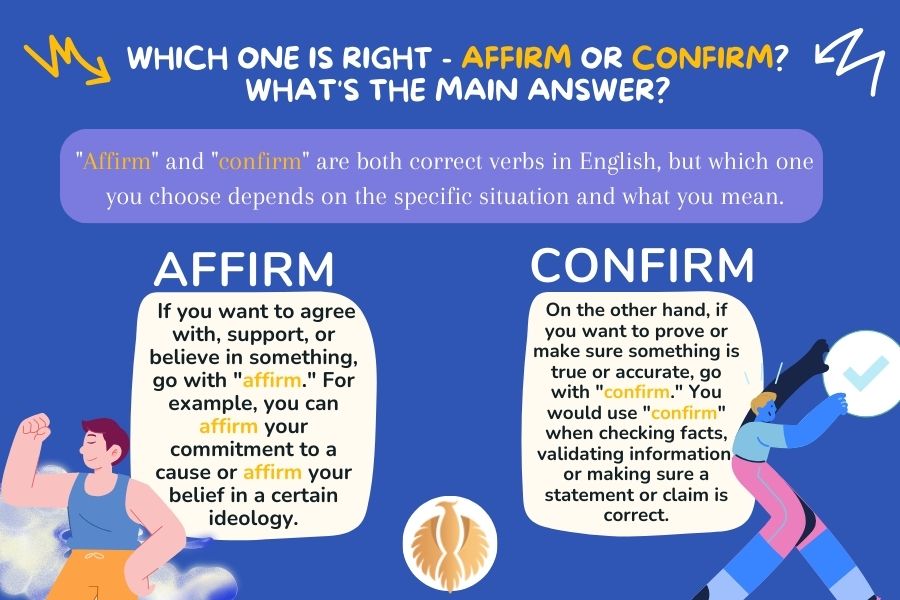
Affirmation is a statement you say or think to encourage, support, or motivate yourself or someone else. It’s about expressing something positive that you want to believe or make true. Affirmations are not always based on current reality; instead, they focus on what you want to achieve or feel.
For example, saying “I am confident in my abilities” is an affirmation. You may not feel confident at the moment, but repeating this statement can help change how you think and feel over time. Affirmations are commonly used for self-improvement, mental health, and goal setting.
Types Of Affirmations
- Self-Affirmations: Positive statements about yourself, like “I am worthy of success.”
- Motivational Affirmations: Statements that push you to reach goals, such as “I can finish this project.”
- Supportive Affirmations: Encouraging words for others, for example, “You are doing great.”
- Daily Affirmations: Regular phrases you repeat each day to build a positive mindset.
How Affirmations Work
Affirmations work by changing your internal dialogue. When you repeat positive statements, your brain begins to believe them. Over time, this can lead to improved self-esteem, lower stress, and better mental health.
Scientific studies show that positive self-affirmation activates the reward centers in your brain. This can reduce anxiety and increase motivation. However, affirmations are most effective when they are realistic and relevant to your goals.
Examples Of Affirmations In Daily Life
- “I am learning and growing every day.”
- “I accept myself as I am.”
- “I choose to see the good in every situation.”
People often use affirmations in meditation, before important events, or when facing challenges. Athletes, students, and professionals all use affirmations to stay focused and confident.
What Is Confirmation?
Confirmation is the process of proving or showing that something is true, correct, or has happened. It’s about getting proof, evidence, or agreement from a source outside yourself. Confirmation is usually based on facts, actions, or events.
For instance, when you receive an email saying your order has shipped, that is a confirmation. It’s evidence that your request was processed. In science, confirmation comes from experiments or data that support a theory. In daily life, confirmation might be someone agreeing with your opinion or a test result proving your answer is correct.
Types Of Confirmation
- Verbal Confirmation: Someone tells you, “Yes, your answer is right.”
- Written Confirmation: An official letter or document states something is true.
- Physical Confirmation: You see or experience proof, like a receipt after a purchase.
- Scientific Confirmation: Data or experiments validate an idea or hypothesis.
How Confirmation Works
Confirmation involves looking for evidence or feedback. It happens when another person, a document, or a fact supports what you already believe or have done. This process removes doubt and gives you certainty.
In business, confirmation is crucial for contracts, payments, and agreements. In personal life, confirmation gives us peace of mind and helps us trust information.
Examples Of Confirmation In Daily Life
- A text message saying your appointment is scheduled.
- A friend agrees with your suggestion.
- A test result proves you passed.
Unlike affirmation, confirmation is not about hope or belief. It is about proof.
Comparing Affirmation And Confirmation
Although both terms sound similar, their meanings and uses are quite different. Here’s a side-by-side comparison to clarify the differences:
| Aspect | Affirmation | Confirmation |
|---|---|---|
| Definition | Positive statement or expression of belief | Evidence or proof that something is true |
| Source | Internal (from yourself) | External (from others or facts) |
| Purpose | Encourage, motivate, or support | Prove or verify |
| Timing | Before or during action | After action or event |
| Example | “I can do it.” | Test result showing you did it. |
Key Differences
- Affirmation is about creating belief; confirmation is about getting proof.
- Affirmation starts inside you; confirmation comes from outside sources.
- Affirmations help you feel positive; confirmations help you feel certain.
Why The Difference Matters
Mixing up affirmation and confirmation can lead to confusion. For example, if you only rely on affirmation without seeking confirmation, you might feel good but lack real results. On the other hand, waiting only for confirmation may make you miss chances to encourage yourself.
Understanding both helps you:
- Build confidence before results appear (affirmation)
- Feel secure after results are confirmed (confirmation)
Psychological Impact: Affirmation And Confirmation
Both affirmation and confirmation affect your mind, but in unique ways.
Affirmation And Mental Health
Repeated positive affirmations can change how you see yourself and the world. People who use affirmations regularly often report:
- Higher self-esteem
- Lower stress levels
- Better focus on goals
A study from the University of Pennsylvania found that self-affirmation can protect against negative feedback and social stress. When you remind yourself of your strengths, you feel less threatened by criticism.
However, experts warn that unrealistic affirmations, such as “I am the best at everything,” can backfire. If your brain does not believe the statement at all, it may cause frustration instead of motivation.
Confirmation And Confidence
Getting confirmation—like passing an exam or receiving positive feedback—boosts your sense of certainty. It reassures you that your actions or beliefs are correct. This can:
- Strengthen your confidence
- Reduce anxiety about the unknown
- Help you make better decisions
For example, when a doctor confirms your health is improving, you worry less and feel more secure. In work, confirmation from a boss or client can motivate you to keep going.
But relying too much on confirmation can make you dependent on outside approval. It’s important to balance internal affirmation with external confirmation.
The Balance: Using Both Together
The most successful people use both affirmation and confirmation. They start with positive self-talk to build motivation, and then seek confirmation to check their progress.
For instance:
- A student says, “I can learn this subject” (affirmation), then reviews their test scores to confirm improvement (confirmation).
- An athlete visualizes winning (affirmation) and checks performance stats after the game (confirmation).
This balance helps you stay motivated and realistic.
Credit: phoenixenglishlang.com
Practical Uses In Daily Life
Affirmation and confirmation appear everywhere, from home to office to social life. Let’s see how you can apply each concept in real situations.
Using Affirmation Effectively
- Start Your Day with Affirmation
- Begin each morning by repeating a positive statement, like “Today will be productive.”
- Before a Challenge
- Use affirmations to calm nerves before presentations, interviews, or exams.
- During Stressful Times
- Remind yourself of your strengths: “I have overcome difficulties before.”
- For Goal Setting
- Write down your goals as affirmations: “I am building healthy habits.”
Practical tip: Make your affirmations specific and believable. Instead of “I will be a millionaire,” try “I am improving my financial habits.”
Using Confirmation In Life
- Check Your Progress
- Use test results, feedback, or reports to confirm you’re on track.
- Validate Decisions
- Ask for a second opinion or look for data before making big choices.
- Build Trust
- Confirm plans with others to avoid misunderstandings.
- Celebrate Achievements
- Recognize and confirm your milestones, like getting a certification or finishing a project.
Practical tip: Don’t wait too long for confirmation. Sometimes, taking action is more important than waiting for every detail to be proven.
How They Work Together
Imagine you want to lose weight. You start with the affirmation, “I am committed to a healthy lifestyle. ” As you exercise and eat better, you check your weight and health stats for confirmation. Both steps are needed for real change.
Common Mistakes And Misconceptions
Even though affirmation and confirmation are powerful, people often use them incorrectly. Here are some common errors to watch out for.
Mistakes With Affirmation
- Using Unrealistic Statements
- If you affirm something you don’t believe at all, it may not help.
- Neglecting Action
- Saying positive words is not enough without taking steps toward your goal.
- Ignoring Negative Feelings
- Affirmations should not hide real problems. Address your emotions honestly.
Mistakes With Confirmation
- Seeking Endless Proof
- Waiting for too much confirmation can lead to “analysis paralysis.”
- Relying Only on Others
- Needing constant approval can damage self-confidence.
- Misreading Signals
- Sometimes, lack of confirmation does not mean failure. Look for real evidence, not just opinions.
Non-obvious Insights
- Affirmations Can Change Brain Patterns
- Research shows that regular affirmations can actually rewire neural pathways, making positive thinking easier over time.
- Confirmation Is Not Always Immediate
- Sometimes, you have to act before you can get confirmation. Patience is key, especially in long-term goals.
Affirmation Vs Confirmation In Different Fields
The concepts of affirmation and confirmation are used in many areas. Let’s look at how they appear in work, relationships, science, and education.
In The Workplace
- Affirmation: Managers use affirmations to motivate teams: “We are capable of reaching this target.”
- Confirmation: Performance reviews, client feedback, and sales results confirm achievements.
Balancing both keeps employees motivated and ensures that progress is measured.
In Relationships
- Affirmation: Partners say, “I value you,” to strengthen bonds.
- Confirmation: Actions, such as keeping promises or celebrating anniversaries, confirm love and care.
Affirmation builds trust, but confirmation proves it.
In Science
- Affirmation: A scientist proposes a theory, believing it has value.
- Confirmation: Experiments and data confirm or disprove the theory.
Science relies more on confirmation, but affirmation is needed for creativity and new ideas.
In Education
- Affirmation: Teachers encourage students: “You can solve this problem.”
- Confirmation: Test scores and assignments confirm learning progress.
Both are needed to support and measure student success.
Cultural And Linguistic Differences
The way people use affirmation and confirmation can change between cultures and languages.
- In some cultures, affirmation is a common part of daily conversation. People often encourage each other with positive words.
- Other cultures focus more on confirmation, valuing facts and evidence over positive statements.
For language learners, the difference between affirmation and confirmation can be confusing. For example, in English, “affirmative” means a positive reply (“Yes”), while “confirmation” means checking or proving something.
Understanding these differences can help avoid misunderstandings in international communication.
How To Practice Affirmation And Seek Confirmation
Knowing the theory is good, but how do you use these ideas in real life? Here are some steps to practice affirmation and seek confirmation effectively.
Steps To Practice Affirmation
- Choose a Specific Area: Pick one part of your life you want to improve.
- Write a Positive Statement: Make it short, clear, and believable.
- Repeat Daily: Say your affirmation out loud or write it down every day.
- Visualize Success: Picture yourself achieving the goal.
- Adjust as Needed: Change your affirmation if it no longer feels true or helpful.
Steps To Seek Confirmation
- Set Clear Goals: Know what you want to confirm.
- Look for Evidence: Use facts, feedback, or results.
- Ask for Feedback: Get opinions from people you trust.
- Review Progress Regularly: Check in on your goals and adjust based on confirmation.
- Accept Both Positive and Negative Confirmation: Learn from all results, not just the ones you want.
Real-life Scenarios: Affirmation And Confirmation In Action
Let’s see how affirmation and confirmation work in real situations.
Scenario 1: Job Interview
- Affirmation: Before the interview, you tell yourself, “I am prepared and confident.”
- Confirmation: After the interview, you receive a job offer or positive feedback.
Scenario 2: Starting A New Habit
- Affirmation: “I am someone who exercises regularly.”
- Confirmation: After a month, you see improved fitness and track your workouts.
Scenario 3: Group Project
- Affirmation: You encourage your team, “We can finish this on time.”
- Confirmation: The project is completed successfully and the client is happy.
Scenario 4: Learning A Language
- Affirmation: “I am improving my English every day.”
- Confirmation: You understand more conversations and pass language tests.
Scenario 5: Parenting
- Affirmation: Parents tell children, “You are smart and kind.”
- Confirmation: Children show good behavior and do well in school.
These examples show how both affirmation and confirmation are needed for success and growth.
The Role Of Technology
Today, technology makes affirmation and confirmation easier.
- Apps for Affirmation: Many apps send daily positive affirmations to your phone.
- Digital Confirmation: Emails, notifications, and digital receipts confirm actions instantly.
For example, fitness trackers provide real-time confirmation of your progress, while meditation apps offer affirmations to start your day.
However, it’s important to use technology wisely. Don’t let digital confirmation replace real achievements, and make sure your affirmations are personal, not just automated messages.
Data And Research: What Studies Show
Research supports the power of both affirmation and confirmation.
- A study found that people who practiced daily affirmations had lower levels of stress hormones and better problem-solving skills.
- Another research project showed that confirmation from supervisors at work increased employee motivation by nearly 30%.
Interestingly, combining both affirmation and confirmation produced the best results. People who believed in themselves and also looked for real evidence of progress were the most successful in reaching their goals.
For more in-depth scientific information, you can visit the Wikipedia page on self-affirmation.
When To Use Affirmation Vs Confirmation
Knowing when to use each is key.
- Use affirmation when you need motivation, encouragement, or to build a positive mindset—especially before starting something new.
- Use confirmation when you want to verify results, check facts, or make decisions based on evidence—especially after actions are taken.
In many cases, both are needed. Start with affirmation, act, then seek confirmation.
Additional Comparison Table: When To Use Each
Here’s another way to see the right time for affirmation and confirmation.
| Situation | Affirmation | Confirmation |
|---|---|---|
| Before a test | “I have studied well and can do this.” | Get results after the test to confirm success. |
| Applying for a job | “I am qualified for this position.” | Receiving an interview or job offer confirms it. |
| Starting a business | “I am ready to lead my own company.” | First sales or positive feedback confirms progress. |
| Improving health | “I am getting healthier each day.” | Medical reports confirm health improvement. |
How To Teach The Difference To Others
If you want to help others understand affirmation vs confirmation, use clear examples and simple language.
- Explain that affirmation is about what you want to believe or achieve, while confirmation is about proving something is true.
- Use stories or real-life situations.
- Encourage them to practice both: Start with positive statements, then look for proof.
This helps build both self-motivation and real-world results.
Frequently Asked Questions
What Is The Main Difference Between Affirmation And Confirmation?
The main difference is that affirmation is a positive statement you say to encourage yourself or others, while confirmation is about getting proof or evidence that something is true. Affirmation is internal and about belief; confirmation is external and about fact.
Can Affirmation Replace Confirmation?
No, affirmation cannot replace confirmation. While affirmation helps you stay motivated and positive, you still need confirmation to know if you are on the right track or if your actions are working.

Credit: www.oreilly.com
Are Affirmations Effective For Everyone?
Affirmations can be effective for many people, but they work best when the statements are realistic and related to real goals. Some people may need extra support or different strategies if affirmations alone do not help.
Is Confirmation Always Needed?
Confirmation is important when you need to make decisions, check results, or avoid mistakes. However, not every situation needs confirmation—sometimes belief and motivation (affirmation) are enough to take the first step.

Credit: www.uccresources.com
How Can I Use Both Affirmation And Confirmation Together?
Start by using affirmation to build your confidence or encourage yourself. Take action toward your goal. After that, look for confirmation through results, feedback, or evidence. This way, you stay motivated and also know you are making real progress.
Affirmation and confirmation are two powerful tools that, when used together, can help you achieve more, feel better, and make better decisions. Knowing when and how to use each one is the key to personal and professional growth.
