

Workout Triceps And Biceps Together: Maximize Arm Gains Fast
Working Out Triceps And Biceps Together: The Complete Guide
Building strong, defined arms is a common goal for many people who go to the gym. Two of the most important muscles for arm development are the triceps and biceps. Many beginners wonder if it's effective to work these muscles on the same day, or if they should be separated. If you want bigger, stronger arms, knowing how to train triceps and biceps together can help you see results faster, use your time well, and make your workouts more enjoyable. This guide will show you the best ways to combine these muscle groups, avoid mistakes, and get the most from your training.
Why Train Triceps And Biceps Together?
Combining triceps and biceps in one workout session is a popular method for both beginners and advanced lifters. There are several reasons this approach is effective:
- Time Efficiency: Working both muscle groups together saves time. You don’t need two separate arm days each week.
- Balanced Development: Training both ensures you don’t neglect one muscle, leading to balanced, strong-looking arms.
- Enhanced Pump: Alternating between pushing (triceps) and pulling (biceps) exercises increases blood flow, giving you a better “pump” and possibly improving muscle growth.
- Recovery: When you train both on the same day, your arms have more days to recover fully before the next session.
Some advanced lifters also find it easier to focus on arms together, since upper body pushing and pulling movements already involve these muscles indirectly.
Anatomy: Understanding Your Arm Muscles
To get the most from your workout, it's important to know the basic anatomy of your arm muscles. This helps you choose the right exercises and understand how to target each muscle.
The Biceps
The biceps brachii sits on the front of your upper arm. It has two heads:
- Short head: Located on the inside, adds width to your arm.
- Long head: Runs along the outside, gives the “peak” when you flex.
The Triceps
The triceps brachii is on the back of your upper arm and has three heads:
- Long head: The biggest part, runs along the back.
- Lateral head: The outer part, gives the “horseshoe” shape.
- Medial head: Sits deeper, helps with arm stability.
Why Both Matter
Your triceps actually make up about two-thirds of your upper arm mass, while the biceps make up the rest. For truly bigger arms, you cannot ignore the triceps. Still, both need focused work for a balanced, powerful look.
Key Benefits Of Training Both Together
Some people worry that training both muscles in one day is “too much” or will limit gains. In reality, if done right, you can see several unique benefits:
- Maximized Arm Growth: Training both muscles fully stresses the arm, leading to better muscle-building signals.
- Improved Strength: Stronger arms help with many other exercises, like bench press and pull-ups.
- Better Mind-Muscle Connection: Focusing just on arms lets you “feel” each muscle working, leading to better results.
- Variety: Changing your arm workout keeps training fun and motivates you to stick with it.
When To Train Triceps And Biceps Together
There are several popular ways to fit arm training into your routine. Here are the most common:
- Arm Day: Dedicate one session per week to just biceps and triceps.
- Push/Pull/Legs Split: Train biceps after back (pull) and triceps after chest/shoulders (push), or combine arms on a separate day.
- Upper/Lower Split: Train arms after main upper body lifts.
For most people, an “arm day” or combining arms after a main workout works best. If you train arms after big lifts (like bench or rows), remember that your arms may already be a bit tired.

Credit: www.youtube.com
How To Structure A Combined Triceps And Biceps Workout
A good workout has the right balance of exercises, sets, reps, and rest. Here’s a simple structure you can use:
Warm-up
Never skip warming up. A proper warm-up boosts blood flow, prepares your joints, and can help prevent injury. For arms, try:
- 5–10 minutes of light cardio (like walking or cycling)
- Arm circles and shoulder mobility drills
- 1–2 light sets of biceps curls and triceps pushdowns
Exercise Order
There are two main ways to organize your session:
- Alternate Sets (Supersets): Do a triceps exercise, then a biceps exercise, resting only after both. This saves time and gives a strong pump.
- Straight Sets: Do all sets for one muscle, then switch to the other.
Many people find supersets more fun and time-efficient.
Sets And Reps
- Sets: 3–4 sets per exercise
- Reps: 8–15 reps per set (higher reps for isolation, lower reps for compound movements)
- Rest: 45–90 seconds between sets
Example Workout Structure
- Compound triceps exercise (e.g., dips)
- Compound biceps exercise (e.g., barbell curls)
- Isolation triceps exercise (e.g., overhead triceps extension)
- Isolation biceps exercise (e.g., hammer curls)
- Optional: Finisher (e.g., triceps pushdowns or cable curls for high reps)
Best Triceps And Biceps Exercises
Choosing the right exercises is key for results. Here are some of the most effective moves for each muscle:
Top Triceps Exercises
- Close-Grip Bench Press: Works all three triceps heads and also helps chest strength.
- Dips: Use parallel bars; leaning forward hits chest, staying upright hits triceps.
- Overhead Triceps Extension: Targets the long head.
- Triceps Pushdown: Focuses on the lateral head; easy to control form.
- Skull Crushers: Good for all-around triceps growth.
Top Biceps Exercises
- Barbell Curl: Classic move for overall biceps size.
- Alternating Dumbbell Curl: Lets you focus on one arm at a time.
- Hammer Curl: Hits the brachialis, adds thickness to the upper arm.
- Preacher Curl: Reduces cheating, isolates the biceps.
- Concentration Curl: Maximum focus on the biceps peak.
Comparison Of Exercise Effectiveness
Below is a comparison of some popular triceps and biceps exercises for muscle activation:
| Exercise | Target Muscle | Muscle Activation (EMG %) |
|---|---|---|
| Close-Grip Bench Press | Triceps (all heads) | 85% |
| Triceps Dips | Triceps (long, lateral) | 80% |
| Barbell Curl | Biceps (long head) | 75% |
| Hammer Curl | Brachialis/Biceps | 70% |
| Skull Crushers | Triceps (long, lateral) | 78% |
| Preacher Curl | Biceps (short head) | 73% |

Credit: us.humankinetics.com
Sample Workouts: Beginner, Intermediate, And Advanced
Every level needs a different approach. Here are three sample routines for different experience levels.
Beginner Arm Workout
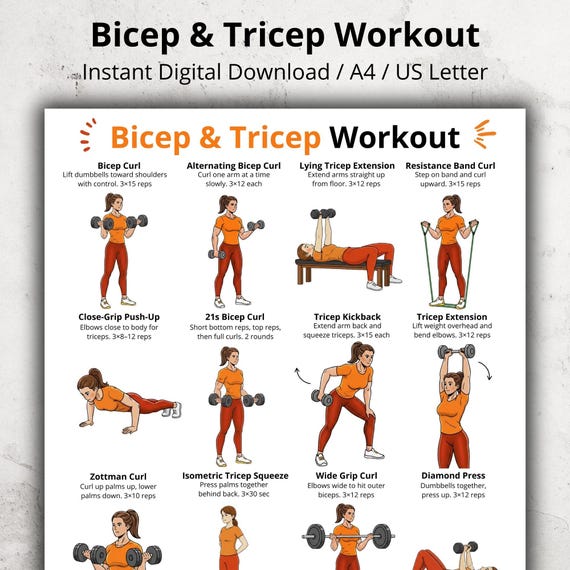
- Close-Grip Push-Ups: 3 x 12
- Dumbbell Curls: 3 x 10
- Triceps Kickbacks: 3 x 12
- Hammer Curls: 3 x 12
Rest about 60 seconds between sets. Focus on learning good form.
Intermediate Arm Workout
- Close-Grip Bench Press: 4 x 8
- Barbell Curl: 4 x 8
- Overhead Dumbbell Extension: 3 x 10
- Preacher Curl: 3 x 10
- Triceps Pushdown: 3 x 12
- Concentration Curl: 2 x 12
Superset triceps and biceps exercises for a better pump.
Advanced Arm Workout
- Weighted Dips: 4 x 8
- Barbell Curl: 4 x 8
- Skull Crushers: 3 x 10
- Incline Dumbbell Curl: 3 x 10
- Cable Overhead Triceps Extension: 3 x 12
- Hammer Curl: 3 x 12
- High-Rep Finisher: Rope Pushdowns + Cable Curls (2 x 20 each, back-to-back)
Increase weight as you get stronger, but always use good form. Advanced lifters can try drop sets or rest-pause sets for extra intensity.
Choosing The Right Weight And Progression
Picking the right weight is important for safety and results. Here’s how to do it:
- Choose a weight you can lift with good form for the target reps. You should struggle on the last 2–3 reps, but never lose control.
- Progressive overload: To keep growing, you must slowly increase the weight, reps, or sets over time.
- Log your workouts: Write down your sets, reps, and weight. This helps you track progress and avoid plateaus.
- Change exercises every 4–6 weeks to keep your muscles challenged.
Don’t chase big weights if your form suffers. Injuries slow progress more than using a lighter weight for a few weeks.
Supersets: The Secret Weapon For Arm Growth
Supersets are when you do two exercises back-to-back with little or no rest. For arms, the most common is alternating a triceps and a biceps exercise. This has big benefits:
- Time-saving: Do more work in less time.
- Intense pump: Blood rushes to both sides of your arm, giving a fuller look.
- Better recovery: While one muscle works, the other rests.
Here’s an example superset:
- Triceps Pushdown x 10, immediately followed by Barbell Curl x 10. Rest 60 seconds, repeat for 3–4 sets.
Try adding one or two supersets to your arm workout if you want a challenge.
Common Mistakes When Training Both Muscles Together
Many people make simple mistakes that slow down their progress. Here are some of the most common:
- Doing Too Many Sets: More is not always better. If you do 20+ sets per muscle, you risk overtraining and injury.
- Poor Form: Swinging weights or using momentum reduces muscle work and can cause injury.
- Neglecting Triceps: Many focus on biceps curls, forgetting that triceps are even more important for arm size.
- Not Changing Exercises: Doing the same routine for months leads to boredom and plateaus.
- Too Little Rest: Muscles grow when you rest. Training arms hard 3–4 times per week is usually too much.
A smart, balanced approach will always win over just working harder.
How Often Should You Train Triceps And Biceps Together?
The best frequency depends on your goals and full routine. Here’s a simple guide:
- Beginners: 1–2 times per week, with at least 2 rest days between sessions.
- Intermediate/Advanced: 2 times per week is common, but only if recovery is good.
- If you do heavy pushing or pulling exercises: Your arms get extra work, so avoid too much extra arm training.
Below is a sample weekly schedule for combining arm workouts:
| Day | Main Focus | Triceps/Biceps Work |
|---|---|---|
| Monday | Chest & Triceps | Triceps (compound + isolation) |
| Wednesday | Back & Biceps | Biceps (compound + isolation) |
| Friday | Arms (Triceps & Biceps together) | Both (full workout) |
This type of plan gives your arms plenty of work and enough rest for growth.
How Nutrition Supports Arm Growth
No matter how good your workouts are, you won’t build muscle without the right nutrition. Here are basic guidelines for growing your triceps and biceps:
- Eat enough protein: Aim for 0.7–1 gram per pound of body weight per day. Good sources include chicken, fish, eggs, and beans.
- Get enough calories: To grow muscle, you must eat more calories than you burn.
- Stay hydrated: Muscles need water to recover and grow.
- Don’t avoid healthy fats: Fats help hormone production, which supports muscle growth.
For more detailed nutrition advice, check resources like the Academy of Nutrition and Dietetics.
Recovery: The Missing Piece
Muscles grow when you rest, not just when you train. Here’s how to recover well:
- Sleep: Get 7–9 hours per night.
- Rest days: Give your arms at least 48 hours before training them hard again.
- Stretch: Gentle stretching after workouts helps with soreness and flexibility.
- Active recovery: Light cardio or easy movement on rest days improves blood flow.
Some beginners miss the importance of sleep and nutrition for arm growth. Don’t make this mistake—your recovery habits matter as much as your lifting.
Tips For Better Results
To get the best results from training triceps and biceps together, try these practical tips:
- Use full range of motion: Don’t cut reps short. Stretch and squeeze the muscle each time.
- Control the weight: Lower weights slowly. This “negative” part builds more muscle.
- Switch grips: Try different grips (overhand, underhand, neutral) to target all areas.
- Track progress: Write down what you do each week. Small improvements add up.
- Listen to your body: If you’re too sore or tired, take an extra rest day.
Hidden Insights Beginners Miss
- Elbow Health Matters: Many arm injuries come from poor elbow care. Warm up your elbows and never “lock out” harshly on triceps moves.
- Arm Size Depends on Shoulders Too: Strong shoulders give the illusion of bigger arms. Don’t skip shoulder workouts if you want impressive arms.
Adapting Workouts For Different Goals
Not everyone trains arms just to get bigger. Some want more strength, others want endurance or tone. Here’s how you can adjust:
- For Strength: Do lower reps (6–8) with heavier weights. Focus on big compound moves like close-grip bench press and weighted dips.
- For Size (Hypertrophy): Use 8–15 reps, moderate weight, and focus on the pump.
- For Endurance/Tone: Use lighter weights, higher reps (15–20), and shorter rest.
Changing your approach every few months can also help prevent boredom and plateaus.
Tracking Progress: What Really Matters
Some people chase bigger numbers or flex in the mirror daily. But real progress comes from:
- Increased weights or reps over time
- Better form and control
- Consistent workout logs
- Reduced soreness for same or more work
Taking arm measurements every 4–6 weeks also helps you see real changes, not just what you “feel. ”
When To Separate Triceps And Biceps Workouts
While training both together is great for most people, there are times when separating them is smart:
- If you’re training for a specific goal, like a powerlifting meet, you might want to focus more on one muscle group at a time.
- If you have an injury, splitting sessions can reduce fatigue.
- If you plateau, changing your split can help you break through.
Listen to your body and don’t be afraid to change things if progress stalls.
Advanced Techniques For Arm Training
If you’ve been training for a while and want more challenge, try these advanced methods:
- Drop Sets: After your last set, immediately reduce weight by 20–30% and continue to failure.
- Rest-Pause Sets: Pause for 10–15 seconds after a set, then do a few more reps.
- Tempo Training: Slow the lowering (eccentric) part of each rep to 3–4 seconds.
- Forced Reps: With a partner, do 1–2 extra reps after failure (use only occasionally).
Don’t use all these at once—add one technique at a time to avoid overtraining.
The Role Of Genetics
Some people naturally have bigger or more defined arms. Genetics play a role in muscle shape and growth speed, but everyone can improve with smart training and patience. Don’t compare yourself to others—focus on your own progress.
Staying Motivated
Building great arms is a long-term project. Keep your motivation high by:
- Setting small, achievable goals (add 5 lbs to your curl, do one more rep)
- Training with a friend for accountability
- Changing up your routine every few months
- Celebrating progress, no matter how small
Credit: www.etsy.com
Frequently Asked Questions
How Long Does It Take To See Arm Muscle Growth?
Most people notice some muscle growth and strength in 4–8 weeks if they train and eat well. Visible changes depend on body fat, genetics, and consistency. Stick with your program and measure progress every month.
Can I Train Triceps And Biceps Together If I’m A Beginner?
Yes, beginners can safely train both in one session. Start with basic exercises and focus on good form. Two arm workouts per week are enough for most people starting out.
Should I Train Arms Before Or After My Main Workout?
If arms are your main focus, train them first. If you’re doing arms after a big lift (like chest or back), expect less strength. For balanced growth, a separate arm day works well.
What Should I Do If My Arms Are Not Growing?
Check your nutrition—are you eating enough protein and calories? Make sure you’re using good form, increasing weight slowly, and getting enough rest. Try changing your exercises or adding supersets for a few weeks.
Is It Bad To Train Arms Two Days In A Row?
Yes, it’s not recommended. Muscles need time to recover and grow. Wait at least 48 hours before training triceps and biceps hard again.
Working out triceps and biceps together is a proven way to build stronger, bigger, and better-looking arms. By following the right structure, using smart exercises, and paying attention to recovery and nutrition, you’ll see progress you can be proud of.
Remember, the key is consistency and patience—stick with your plan, challenge yourself, and your arms will reward you.
