

Tricep Workout Ideas: Build Stronger Arms Fast
Tricep Workout Ideas
Building strong, defined triceps does more than just make your arms look good. The triceps brachii muscle makes up about two-thirds of your upper arm size. It plays a key role in pushing, locking out your elbows, and supporting your chest and shoulder exercises. Whether you want bigger arms, better strength, or simply want to move better in daily life, focusing on your triceps is a smart move.
Many people train their biceps often but overlook the triceps. This is a common mistake. If you want balanced arm development, you should pay as much attention to your triceps as you do to your biceps. In this article, you’ll find a range of tricep workout ideas for all levels. You’ll learn the best exercises, how to mix them for growth, and tips to avoid injury. You’ll also find tables comparing equipment, techniques, and intensity to help you choose what’s right for you.
Whether you’re training at the gym or at home, you’ll get practical advice for every situation. And if you’re a beginner, don’t worry. You’ll discover simple steps and common mistakes to avoid, so you can get the best results safely.
Let’s dive into the world of tricep workouts and unlock the full potential of your arms.
Why Tricep Training Matters
Your triceps are much more than just a “side muscle” for your arms. They are responsible for elbow extension, which means straightening your arm. This movement is used in nearly every pushing exercise, such as push-ups, bench presses, and even daily tasks like pushing open a door.
A well-developed tricep improves your:
- Upper body strength: You can push heavier weights in bench presses, shoulder presses, and dips.
- Arm appearance: Defined triceps give your arms a toned, athletic look.
- Joint stability: Strong triceps protect your elbows and shoulders from injury during sports and lifting.
If you want to break through a plateau in your bench press or get past that last tough push-up, stronger triceps are often the missing link.
The Three Heads Of The Triceps
The triceps muscle is made up of three parts or “heads”:
- Long head: Runs along the back of your arm and is visible when you flex.
- Lateral head: The outer part that gives your arm that “horseshoe” shape.
- Medial head: Tucked under the long and lateral heads, helps with overall arm size and strength.
A good tricep workout should target all three heads for balanced growth and strength.
Key Principles For Effective Tricep Workouts
Before jumping into exercises, it’s important to understand what makes a tricep workout effective. Many beginners train only with light pushdowns or do too many sets, but don’t see results. Here’s what you need to know:
1. Overload And Progression
Your triceps need to be challenged to grow. This means increasing weight, reps, or sets over time. If you always use the same weight and reps, your muscles will stop growing.
2. Full Range Of Motion
Exercises that stretch the triceps (like overhead extensions) build more muscle than short, partial movements. Always use a full range of motion unless you have a joint issue.
3. Variety Of Angles
Each head of the triceps is worked better at certain angles. For example, overhead movements hit the long head, while close-grip presses target the medial and lateral heads. Mixing exercises ensures full development.
4. Rest And Recovery
Triceps are used in chest and shoulder training. Don’t overwork them. Rest at least 48 hours between hard tricep sessions to avoid injury and allow growth.
5. Mind-muscle Connection
Focus on feeling your triceps work during each rep. Don’t just move the weight—make your triceps do the work.
Non-obvious insight: Many people’s triceps don’t grow because their shoulders or chest “take over” during pressing exercises. Slow down your reps, and use less weight if needed, to keep tension on the triceps.
Essential Tricep Exercises
There are dozens of tricep exercises, but only a few deliver the best results. Here are the most effective moves, how to do them, and what makes each one special.
1. Close-grip Bench Press
This compound movement lets you use heavy weight and works all three heads.
- Lie on a bench, grip the bar slightly closer than shoulder width.
- Lower the bar to your chest, elbows tucked.
- Press up, focusing on squeezing your triceps.
Tip: Don’t go too narrow. Hands should be just inside shoulder width to avoid wrist pain.
2. Tricep Dips
Dips hit your triceps, chest, and shoulders.
- Use parallel bars or a sturdy bench.
- Lower your body by bending elbows to 90 degrees.
- Push back up, locking your elbows at the top.
Practical tip: Lean forward for more chest, stay upright for more triceps. If you’re a beginner, start with bench dips.
3. Overhead Tricep Extension
This move stretches the long head for maximum growth.
- Stand or sit, hold a dumbbell or cable overhead with both hands.
- Lower the weight behind your head, keeping elbows close.
- Extend your arms upward.
Common mistake: Letting elbows flare out. Keep them pointed forward for best tricep activation.
4. Skull Crushers (lying Tricep Extensions)
Great for isolating the triceps.
- Lie on a bench with a barbell or dumbbells.
- Lower the weight to your forehead, bending elbows.
- Extend your arms, but don’t lock elbows hard.
Safety tip: Start light to protect your elbows.
5. Tricep Pushdown
A favorite for beginners and advanced lifters.
- Use a cable machine with a rope or straight bar.
- Keep elbows pinned to your sides.
- Push the handle down, then slowly return.
Non-obvious insight: Twist your wrists outward at the bottom for a stronger contraction.
6. Diamond Push-ups
A bodyweight move that burns.
- Place hands close together under your chest, forming a diamond shape with your thumbs and index fingers.
- Lower your body, elbows in, then press up.
Variation: Do on knees if regular push-ups are too hard.
7. Kickbacks
Targets the lateral head.
- Bend forward with a dumbbell in each hand.
- Keep upper arms still, extend forearms back.
- Squeeze triceps at the top.
Beginner tip: Use a mirror to check your form.
8. Cable Overhead Extensions
Like dumbbell overhead extensions, but cables provide constant tension.
- Face away from the cable, grab the rope with both hands overhead.
- Stretch and extend arms, keeping elbows close.
Why it matters: Reduces joint strain compared to free weights.
9. Single-arm Dumbbell Extension
Helps fix muscle imbalances.
- Hold a dumbbell overhead in one hand.
- Lower behind head, then extend up.
- Switch arms after each set.
Practical advantage: If one arm is weaker, this move helps balance them.
10. Bench Dips
A simple move you can do anywhere.
- Sit on a bench, hands next to hips.
- Slide off and lower your body until elbows are at 90 degrees.
- Push back up.
Caution: If you feel shoulder pain, stop and try regular dips or pushdowns.
Gym Vs. Home Tricep Workouts
Some people have access to full gyms, while others train at home. Both options can build great triceps, but the tools and exercises might be different.
Here’s a comparison of common equipment and their uses for triceps:
| Equipment | Best Exercises | Home or Gym | Difficulty Range |
|---|---|---|---|
| Dumbbells | Overhead Extensions, Kickbacks, Skull Crushers | Both | Beginner to Advanced |
| Barbell | Close-Grip Bench Press, Skull Crushers | Gym (or home with bench and rack) | Intermediate to Advanced |
| Cable Machine | Pushdowns, Overhead Extensions | Gym | All Levels |
| Bodyweight | Dips, Diamond Push-Ups, Bench Dips | Both | Beginner to Advanced |
| Resistance Bands | Pushdowns, Overhead Extensions | Both | Beginner to Intermediate |
Non-obvious insight: If you train at home with only your bodyweight, you can still hit all three heads. Adjust hand positions and arm angles to make each exercise harder.
How To Build Your Own Tricep Workout
Mixing the right exercises is key for muscle growth and strength. Here’s how to create a balanced tricep workout, whether you’re a beginner or advanced.
Step 1: Choose Your Focus
- Muscle size: Use a mix of heavy presses (6–10 reps) and isolation moves (10–15 reps).
- Strength: Focus on heavy compound lifts like close-grip bench presses and dips.
- Endurance or toning: Use lighter weights, higher reps (15–20), and short rest periods.
Step 2: Pick 3–4 Exercises
Choose one from each group:
- Compound Press: Close-grip bench press, dips, diamond push-ups.
- Overhead Movement: Overhead extension, cable overhead extension.
- Isolation Move: Pushdowns, kickbacks, single-arm extensions.
Step 3: Set And Rep Range
For most people, 3–4 sets of 8–15 reps per exercise is ideal. Beginners should start with fewer sets and focus on form.
Step 4: Rest And Frequency
- Rest 1–2 minutes between sets for muscle growth.
- Train triceps 1–2 times per week, leaving at least 48 hours before repeating.
Example Tricep Workouts
Beginner (Home):
- Diamond Push-Ups – 3 sets of 8–12 reps
- Bench Dips – 3 sets of 10–15 reps
- Overhead Dumbbell Extension – 3 sets of 10–12 reps
Intermediate (Gym):
- Close-Grip Bench Press – 4 sets of 8–10 reps
- Cable Pushdowns – 4 sets of 10–12 reps
- Overhead Cable Extension – 3 sets of 12–15 reps
Advanced (Gym or Home with weights):
- Weighted Dips – 4 sets of 6–10 reps
- Skull Crushers – 4 sets of 8–12 reps
- Cable or Band Overhead Extension – 3 sets of 12–15 reps
- Kickbacks – 3 sets of 15 reps
Technique Tips For Maximum Results
Getting the most from your tricep workouts is not just about the exercises you choose. Small adjustments in technique make a big difference.
Elbow Position
- Keep elbows close to your body during pushdowns and extensions.
- Don’t let elbows flare out; this reduces tricep tension and stresses your joints.
Range Of Motion
- Lower weights fully for a deep stretch, then extend all the way up.
- Don’t “lock out” harshly at the top; stop just before elbow lockout.
Grip And Wrist Position
- Use a neutral grip (palms facing each other) for less elbow strain.
- For cable pushdowns, finish with palms facing down and wrists slightly turned out.
Controlled Reps
- Lower weights slowly (2–3 seconds), pause, then press up with power.
- Rushing leads to poor form and less muscle activation.
Breathing
- Exhale as you push or extend.
- Inhale as you lower the weight.
Non-obvious insight: On overhead extensions, tilting your upper body slightly forward increases stretch on the long head, leading to better growth.
Common Tricep Training Mistakes
Avoiding mistakes can help you see faster results and reduce the risk of injury.
1. Using Too Much Weight
It’s tempting to lift heavy, but swinging or poor form limits muscle growth and can injure your elbows.
2. Not Locking Elbows Properly
Fully locking the elbows at the top can put stress on the joint. Stop just short of lockout to keep tension on the muscle.
3. Ignoring Overhead Movements
Most people do only pushdowns and bench presses. Overhead moves are essential for hitting the long head.
4. Training Triceps Too Often
Since triceps are involved in chest and shoulder days, overtraining is easy. Limit direct tricep work to 2 times per week.
5. Letting Other Muscles Take Over
If your shoulders or chest help too much, you won’t work your triceps well. Lower the weight if needed and focus on the muscle.
6. Neglecting Warm-up
Not warming up your elbows and shoulders can lead to injury. Start every session with light pushdowns or arm circles.
Tricep Training For Different Goals
Your goal changes the way you should train your triceps.
For Muscle Size (hypertrophy)
- Use a mix of compound and isolation moves.
- 3–4 sets of 8–15 reps per exercise.
- Focus on slow negatives and strong contractions.
For Strength
- Use heavy compound lifts (close-grip bench, weighted dips).
- 4–6 sets of 4–8 reps.
- Longer rest between sets (2–3 minutes).
For Endurance And Toning
- Use bodyweight and light weights.
- 3–4 sets of 15–20 reps.
- Short rest (30–60 seconds).
Here’s a table comparing goals, exercises, and ideal rep ranges:
| Goal | Best Exercises | Rep Range | Rest Period |
|---|---|---|---|
| Muscle Size | Pushdowns, Skull Crushers, Overhead Extensions | 8–15 | 60–90 sec |
| Strength | Close-Grip Bench Press, Dips | 4–8 | 2–3 min |
| Endurance | Diamond Push-Ups, Band Extensions | 15–20 | 30–60 sec |
Non-obvious insight: Even if you train for size, adding a few weeks focused on strength (low reps, heavy weights) can break plateaus and lead to new muscle growth.
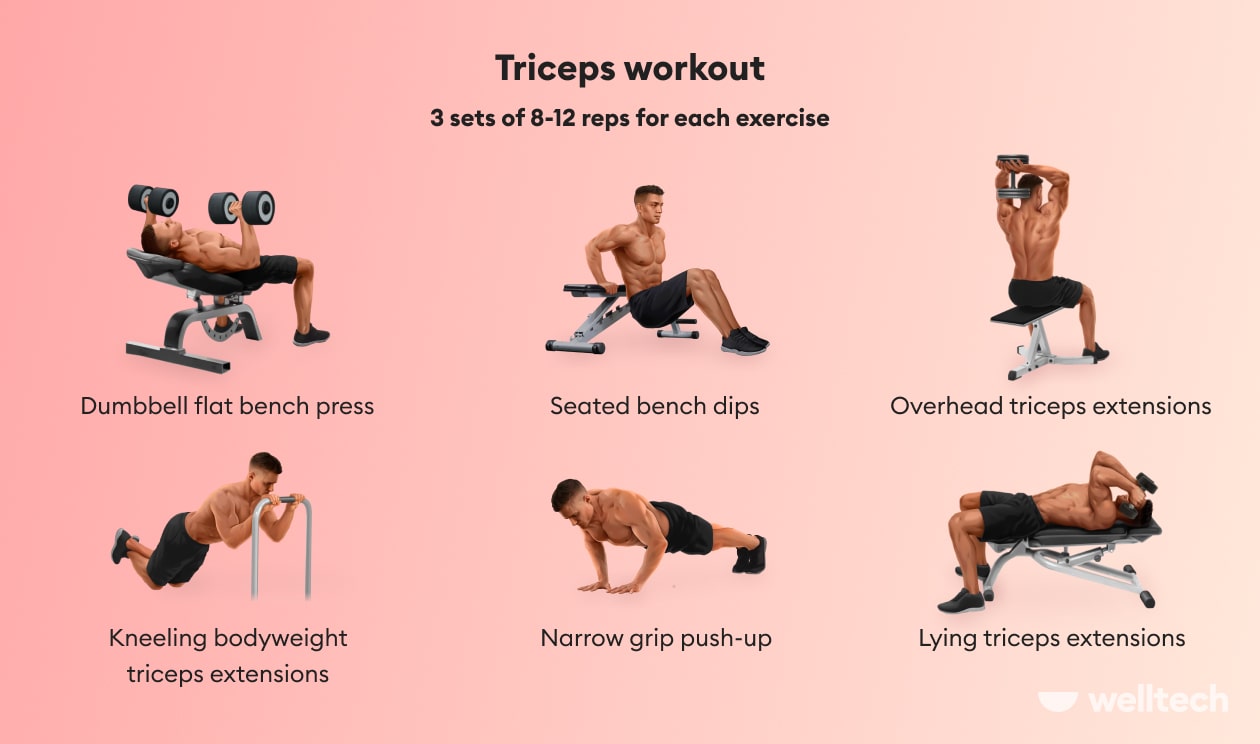
Credit: welltech.com
How To Progress And Track Your Tricep Gains
Seeing steady progress is motivating. Here’s how to make sure your triceps keep getting stronger and more defined.
Keep A Workout Log
Write down the exercises, weights, reps, and sets each session. Try to add weight or reps every 1–2 weeks.
Use Photos And Measurements
Measure your arms around the midpoint and take progress photos every month. Sometimes, changes are easier to see than to measure.
Change Exercises Every 6–8 Weeks
Your body adapts quickly. Switch up the order of exercises, or try new variations to keep your muscles guessing.
Test Your Strength
Every month, test your max reps on diamond push-ups or your top weight on close-grip bench press.
Non-obvious insight: If your triceps stop growing but your chest or shoulders are getting stronger, change your grip and arm angle to refocus on the triceps.
Advanced Tricep Workout Methods
If you’ve been training for a while and want to push your triceps further, try these advanced techniques.
Supersets
Do two exercises back-to-back with no rest. For example, do pushdowns followed immediately by overhead extensions.
Drop Sets
At the end of a set, lower the weight and do more reps without resting. This increases muscle fatigue and growth.
Rest-pause
Do as many reps as possible, rest 10–15 seconds, then do a few more. Repeat 2–3 times to push your muscles further.
Tempo Training
Slow down the lowering phase to 3–5 seconds per rep. This increases tension and muscle growth.
Partial Reps
At the end of a set, do short reps in the hardest range (like the bottom of an overhead extension) to finish off the muscle.
| Advanced Method | How It Works | When to Use |
|---|---|---|
| Supersets | Two exercises, no rest between | For muscle size and endurance |
| Drop Sets | Reduce weight, keep going | Last set of an exercise |
| Rest-Pause | Short rest, more reps | Breaking plateaus |
| Tempo Training | Slow negatives, fast positives | For growth and control |
Warning: Use these methods only after you have mastered basic form and built a foundation of strength.
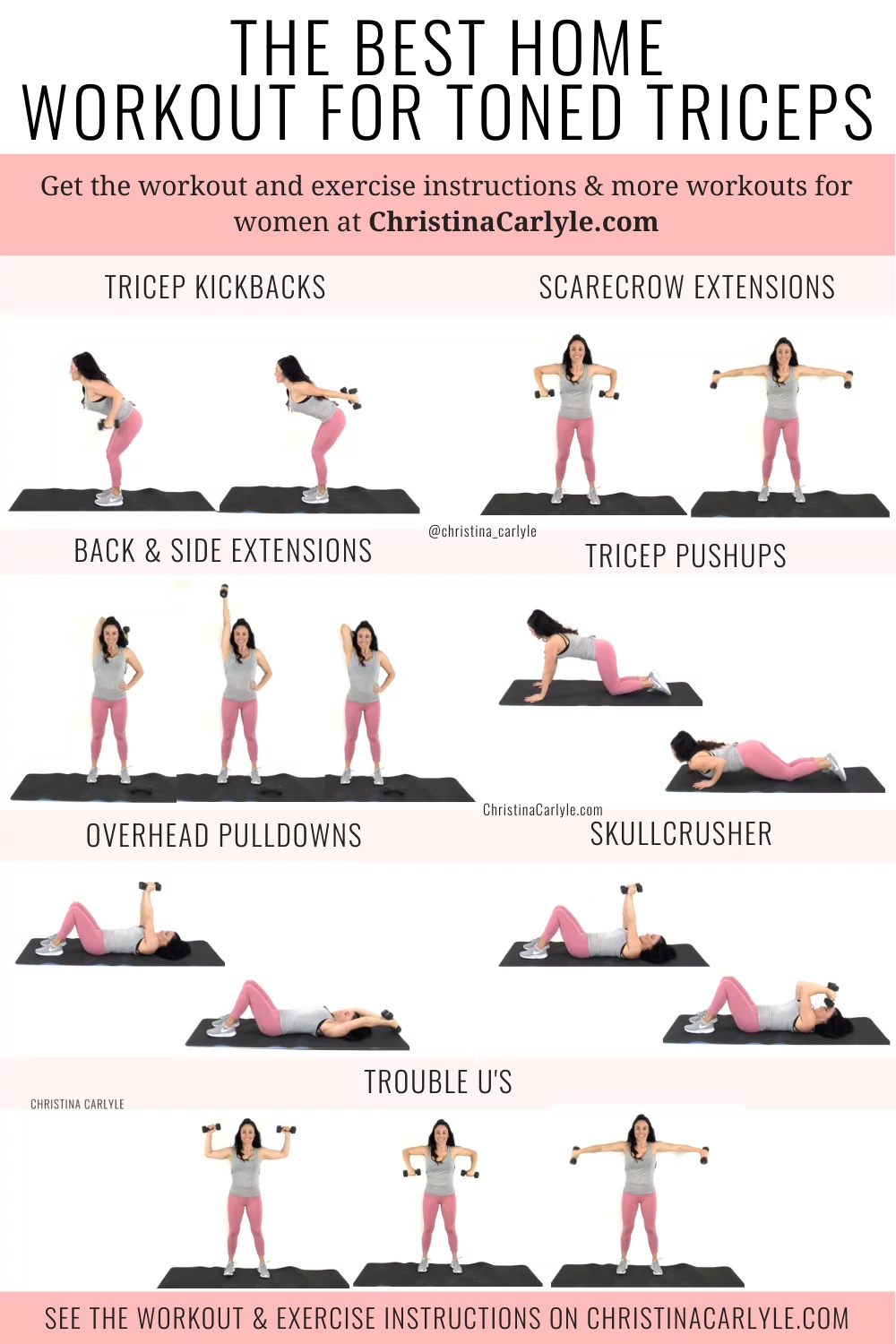
Credit: www.christinacarlyle.com
Tricep Training For Women
Some women avoid tricep training because they fear getting bulky arms. In reality, building strong triceps leads to toned, lean arms and helps with daily tasks.
- Use bodyweight moves (dips, push-ups) and light weights for high reps.
- Focus on form over heavy weights.
- Include tricep work 1–2 times per week.
Non-obvious insight: Since women often have less upper body muscle, training triceps improves posture and helps with pushing, lifting, and carrying.
Injury Prevention And Elbow Health
Tricep training can stress the elbows if done incorrectly. Here’s how to protect your joints:
- Always warm up with light sets and arm circles.
- Don’t lock out elbows harshly at the top of lifts.
- If you feel sharp pain, stop and check your form or switch exercises.
- Include pushing and pulling movements for balanced arm health.
If you have an old injury or chronic pain, consult a doctor or physical therapist before starting a new program.

Credit: centr.com
Nutrition Tips For Bigger Triceps
Even the best workout will not show results without proper nutrition.
- Eat enough protein (at least 0.7 grams per pound of body weight per day).
- Include carbs around your workout for energy.
- Stay hydrated, as dehydration can cause muscle cramps.
If your goal is size, eat a slight calorie surplus. For toning, keep your calories balanced and focus on losing fat while keeping muscle.
For more science-backed information, check Examine.com.
Frequently Asked Questions
How Often Should I Train My Triceps?
For most people, 1–2 times per week is enough for growth. If you also train chest and shoulders, remember your triceps get worked during those sessions too. Allow at least 48 hours between direct tricep workouts.
What Is The Fastest Way To Grow Triceps?
The fastest way is to focus on progressive overload—increase your weights or reps over time. Mix compound lifts (like close-grip bench press) with isolation moves (like pushdowns and extensions), and use a full range of motion. Don’t neglect nutrition and recovery.
Are Bodyweight Exercises Enough For Triceps?
Yes, if you use challenging moves like diamond push-ups and dips. Slow down your reps, add pauses, or increase sets to make them harder. For extra challenge, elevate your feet or add weight.
Can I Train Triceps And Biceps On The Same Day?
Yes. Many lifters do “arm days” with both. Do larger muscles (triceps or biceps) first, or alternate between the two. Just don’t overwork your elbows—listen to your body.
Why Do My Elbows Hurt During Tricep Exercises?
Elbow pain is often due to poor form, too much weight, or not warming up. Keep elbows close to your body, use lighter weights, and warm up before hard sets. If pain persists, rest and consult a professional.
---
Training your triceps is about more than just adding size to your arms. Strong triceps improve your performance in every upper body exercise, help protect your joints, and give your arms a powerful, athletic look. With the right mix of exercises, smart technique, and good nutrition, anyone can build impressive triceps—at the gym or at home.
Start with the basics, focus on your form, and enjoy the progress you make. Your stronger, more defined arms will thank you.
