

Leg And Glute Workout With Resistance Bands: Sculpt & Strengthen Fast
Leg And Glute Workout With Resistance Bands
Building strong legs and glutes is not just about looks—it’s about supporting your body, improving movement, and boosting confidence. Many people think they need a gym or heavy weights to get results. But you can achieve impressive strength, shape, and tone using just resistance bands. These simple tools are portable, affordable, and powerful for training your lower body anywhere.
If you want to lift, tone, or shape your legs and glutes, resistance bands are a smart choice. You can use them at home, in a park, or while traveling. They work for all fitness levels—from beginners to athletes—because you control the resistance.
Bands help you build muscle, improve your balance, and even support healthy joints.
This article will show you how to use resistance bands to target your legs and glutes. You’ll discover different types of bands, learn the best exercises, and get practical tips for creating a complete workout. Whether you want to grow muscle, get lean, or just feel stronger, you’ll find everything you need right here.
Why Resistance Bands Are Powerful For Legs And Glutes
Resistance bands might look simple, but they offer unique benefits for lower body training. Here’s why they work so well:
- Constant tension: Bands keep muscles engaged during the whole movement, not just at the top or bottom.
- Versatility: You can use bands for hundreds of exercises, targeting every part of your legs and glutes.
- Joint safety: Bands are gentle on your knees and hips, reducing the risk of injury compared to heavy weights.
- Progressive overload: By changing band thickness or stretch, you increase resistance as you get stronger.
- Accessibility: Bands are lightweight, easy to store, and cost much less than gym equipment.
One non-obvious advantage: bands can help you activate muscles before you lift weights or run. This “muscle wake-up” improves your mind-muscle connection and reduces injury risk. Many athletes use bands for warm-ups for this reason.
Another benefit beginners miss: bands force you to control the movement more than weights. This builds better balance and coordination, which helps in daily life and sports.
Types Of Resistance Bands For Lower Body Training
Not all resistance bands are the same. Choosing the right type makes your workouts safer and more effective. Here are the most common options:
1. Loop Bands (mini Bands)
These are small, thick bands shaped like a loop, often placed around the legs. They’re best for glute activation, squats, and lateral movements.
2. Long Loop Bands
These are larger loops (often called “pull-up bands”). They work for assisted squats, deadlifts, and leg presses.
3. Tube Bands With Handles
These have handles on the ends and sometimes come with ankle straps. They’re good for standing leg work, like kickbacks or abductions.
4. Therapy Bands (flat Bands)
These are flat, wide bands without loops. They offer light resistance, ideal for beginners or rehab.
How To Choose The Right Band
- For glute activation: Use mini loop bands.
- For compound exercises: Use long loops or tube bands.
- For rehab or warm-up: Use therapy bands.
Beginners often make the mistake of picking a band that’s too thick. Start with a medium resistance. If you can’t complete a set with good form, switch to a lighter band.
Here’s a comparison of the most popular resistance band types for legs and glutes:
| Type | Best For | Typical Resistance Range | Portability |
|---|---|---|---|
| Mini Loop Bands | Glute activation, side steps | 10-40 lbs | Excellent |
| Long Loop Bands | Squats, deadlifts, presses | 15-150 lbs | Good |
| Tube Bands w/ Handles | Standing leg work, kickbacks | 10-50 lbs | Good |
| Therapy Bands | Rehab, warm-up | 2-20 lbs | Excellent |
Key Muscles Targeted During Leg And Glute Workouts
Understanding which muscles you’re working helps you train smarter. Here are the main groups:
- Gluteus maximus: Your largest glute muscle, responsible for hip extension (standing up from a squat).
- Gluteus medius/minimus: Located on the sides, these muscles move your leg out (abduction) and stabilize your hips.
- Quadriceps: Front thigh muscles, used in squats and lunges.
- Hamstrings: Back of the thigh, working in deadlifts and hip hinges.
- Adductors: Inner thigh muscles, help pull your legs together.
- Calves: Lower leg muscles, important for balance and athletic movement.
An effective workout hits all these areas, not just the glutes. Many beginners focus only on squats, but a balanced approach prevents injury and builds a better-looking lower body.
The Best Leg And Glute Resistance Band Exercises
Here’s a breakdown of top exercises you can do with resistance bands. Each one targets different muscles and can be adapted for all fitness levels.
1. Glute Bridge With Band
- Lie on your back, knees bent, feet flat, band above your knees.
- Push your hips up while pressing knees outward.
- Squeeze your glutes at the top, then lower down.
Targets: Glutes, Hamstrings
Tips: Keep your core tight and don’t let your knees collapse in.
2. Squat With Band
- Place a band just above your knees.
- Stand with feet shoulder-width apart.
- Lower into a squat, pushing knees outward against the band.
Targets: Quads, Glutes, Abductors
Tips: Go as low as you can without rounding your back.
3. Lateral Band Walk
- Put a band above your knees or around your ankles.
- Bend your knees slightly, step side-to-side.
Targets: Glute Medius, Outer Thighs
Tips: Stay low and keep tension in the band the whole time.
4. Standing Kickback
- Place a loop band around your ankles.
- Stand tall, kick one leg straight back, squeeze your glute.
- Return and repeat.
Targets: Glute Maximus
Tips: Keep your core braced and don’t swing your upper body.
5. Clamshell
- Lie on your side, knees bent, band above your knees.
- Open your top knee as far as you can, then lower.
Targets: Glute Medius, External Rotators
Tips: Keep feet together; don’t twist your hips.
6. Banded Deadlift
- Stand on a long loop band, hold the ends.
- Hinge at the hips, lower your torso, stand up tall.
Targets: Hamstrings, Glutes, Lower Back
Tips: Don’t round your back; push hips back.
7. Seated Abduction
- Sit on a bench or chair, band above knees.
- Open your knees outward, keep feet planted.
Targets: Glute Medius
Tips: Move slowly and control the band.
8. Bulgarian Split Squat
- Stand in front of a chair, one foot behind.
- Hold a band under your front foot, ends at your shoulders.
- Lower into a lunge, then rise.
Targets: Quads, Glutes, Hamstrings
Tips: Keep your front knee over your ankle.
9. Banded Leg Curl
- Lie face down, loop a band around one ankle, anchor the other end.
- Curl your heel toward your glutes.
Targets: Hamstrings
Tips: Move slowly; don’t arch your back.
10. Monster Walk
- Band around your ankles.
- Squat slightly, walk forward and backward with wide steps.
Targets: Glutes, Abductors
Tips: Maintain squat position; don’t let knees cave in.
11. Banded Hip Thrust
- Sit with upper back on a bench, band above knees.
- Thrust hips up, squeeze glutes.
Targets: Glutes, Hamstrings
Tips: Tuck your chin and keep ribs down.
12. Reverse Lunge With Band
- Stand on a band with one foot, ends at shoulders.
- Step back into a lunge, return.
Targets: Quads, Glutes
Tips: Drive through your front heel.
13. Fire Hydrant
- On all fours, band above knees.
- Lift one knee out to the side.
Targets: Glute Medius, Core
Tips: Don’t twist your hips.
14. Single-leg Glute Bridge
- Lie on your back, one foot on the floor, one leg straight.
- Band above knees, lift hips.
Targets: Glutes, Hamstrings
Tips: Push through your heel and keep hips level.
15. Banded Step-up
- Place a band under your foot, hold ends at shoulders.
- Step onto a bench or box.
Targets: Quads, Glutes
Tips: Push hard through your heel.
Here’s a quick look at which muscles each exercise targets:
| Exercise | Primary Muscles Worked | Band Type |
|---|---|---|
| Glute Bridge | Glutes, hamstrings | Mini loop |
| Squat | Quads, glutes | Mini loop or long loop |
| Lateral Walk | Glute medius | Mini loop |
| Standing Kickback | Glute maximus | Mini or tube |
| Clamshell | Glute medius | Mini loop |
| Banded Deadlift | Hamstrings, glutes | Long loop |
| Seated Abduction | Glute medius | Mini loop |
| Bulgarian Split Squat | Quads, glutes | Long loop |
| Banded Leg Curl | Hamstrings | Tube |
| Monster Walk | Glute medius | Mini loop |
How To Structure A Leg And Glute Resistance Band Workout
A well-designed workout hits all main muscle groups, mixes strength and activation, and fits your schedule. Here’s a sample structure:
1. Warm-up (5–10 Minutes)
Get your blood flowing and activate your glutes with light band work:
- Bodyweight squats
- Glute bridges (no band)
- Lateral band walks (light band)
2. Main Workout (20–40 Minutes)
Pick 5–7 exercises, mixing compound (multi-joint) and isolation (single muscle) moves:
- Squat with band – 3 sets of 12–15 reps
- Glute bridge with band – 3 sets of 15–20 reps
- Lateral band walk – 3 sets of 12–20 steps
- Bulgarian split squat – 3 sets of 10–12 reps per leg
- Clamshell – 3 sets of 15 reps per side
- Banded deadlift – 3 sets of 12–15 reps
Rest 45–90 seconds between sets.
3. Burnout/finisher (optional, 5 Minutes)
End with a high-rep move to “burn out” the muscles:
- Monster walks – 60 seconds
- Seated abduction – 30 reps
4. Cool-down (5 Minutes)
Stretch your glutes, quads, and hamstrings. Use a band for gentle stretching if you like.
Workout Frequency And Progression
Train your legs and glutes 2–3 times per week for best results. Give yourself at least one rest day between sessions to recover.
To keep improving:
- Increase band resistance every few weeks.
- Add more sets or reps as you get stronger.
- Try harder exercises or slower tempo.
A common mistake: doing the same workout for months without change. Your body adapts quickly. Track your progress and switch things up every 4–6 weeks.
Sample 4-week Resistance Band Leg And Glute Routine
Here’s a practical 4-week plan for beginners or intermediates. Do each workout twice per week, with at least one day of rest between.
Weeks 1–2:
- Squat with band – 3x12 reps
- Glute bridge with band – 3x15 reps
- Lateral band walk – 3x15 steps per side
- Standing kickback – 3x12 reps per leg
- Clamshell – 3x15 reps per side
Weeks 3–4:
- Banded deadlift – 3x12 reps
- Bulgarian split squat – 3x10 reps per leg
- Monster walk – 3x12 steps forward/back
- Seated abduction – 3x20 reps
- Single-leg glute bridge – 3x12 reps per leg
Tips:
- Rest 1–2 minutes between sets.
- If you finish all reps easily, move to a thicker band.
- Focus on slow, controlled movements for best muscle activation.
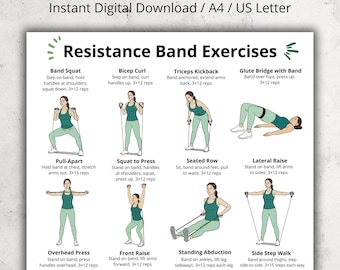
Credit: www.etsy.com
How To Get The Most Out Of Your Resistance Band Workouts
Even the best exercises won’t work if your technique is off. Here’s how to maximize your gains:
Focus On Muscle Activation
Don’t just move the band—feel your glutes working. Before each set, try a few bodyweight reps, squeezing your muscles hard. This “mind-muscle connection” helps you get more from every rep.
Control The Tempo
Slow down both the lifting and lowering phase. A common mistake is to let the band snap back—this reduces the work your muscles do. Try a 2-second up, 2-second down rhythm.
Keep Tension On The Band
The band should stay tight throughout the movement. If it goes slack, adjust your setup or use a smaller band.
Use Full Range Of Motion
Go as deep as your flexibility allows, but don’t sacrifice form. Deeper squats and bridges use more muscle fibers.
Change Angles And Stances
Small changes—like turning your feet out or using a wider stance—can target different parts of your glutes and thighs.
Common Mistakes To Avoid
- Using a band that’s too strong: If your form breaks down, you won’t hit the right muscles.
- Letting your knees cave in: This takes tension off the glutes and can stress your knees.
- Rushing reps: Fast, sloppy movements don’t build muscle.
- Neglecting the hamstrings: Don’t focus only on squats and bridges. Add deadlifts and leg curls.
- Skipping warm-ups: Cold muscles are less effective and more prone to injury.
A non-obvious mistake: forgetting to breathe. Exhale on the hardest part of the movement (the “push” or “lift”). This helps you stay strong and prevents dizziness.

Credit: veteranslegalaid.org
How Resistance Bands Compare To Free Weights For Legs And Glutes
Many people wonder if bands can replace dumbbells or barbells. The answer: bands offer different benefits, and both can be effective. Here’s a comparison:
| Factor | Resistance Bands | Free Weights |
|---|---|---|
| Muscle activation | High (constant tension) | High (especially with heavy loads) |
| Joint stress | Low | Can be high |
| Progression | Change band thickness or stretch | Add more weight |
| Portability | Excellent | Poor |
| Cost | Low | High |
| Variety | Many exercises, angles | Many exercises, but some angles limited |
Bands are ideal for home, travel, or when you want to protect your joints. Free weights are better for maximum muscle growth, but bands can help you get very strong and lean.
Advanced Tips For Faster Progress
Once you master the basics, you can make your band workouts even more powerful:
- Try supersets: Do two exercises back-to-back with no rest (e.g., squat with band + lateral walk). This saves time and increases intensity.
- Use pauses: Pause at the hardest part of the movement (bottom of squat, top of bridge) for 2–3 seconds.
- Add slow negatives: Lower the band slowly (4 seconds) to create more muscle tension.
- Combine with weights: For example, hold a dumbbell while using a band for squats.
- Train single-leg: Moves like single-leg glute bridges or Bulgarian split squats challenge stability and build more muscle.
A non-obvious insight: bands are great for “finisher sets.” After your main workout, use a band for 50–100 reps of a simple move (like clamshells). This “pump” increases blood flow and can help with muscle growth.
How To Care For Your Resistance Bands
Taking care of your bands means they’ll last longer and stay safe:
- Store them away from sunlight or heat.
- Check for cracks or tears before each use.
- Wash with mild soap and water; let them air dry.
- Don’t overstretch (most bands are designed for 2–3x their length).
- Replace bands every 1–2 years or at the first sign of wear.
Many people forget this step and end up snapping a band during a workout. Safety first!
Nutrition And Recovery For Leg And Glute Growth
Your workout is only part of the process. To see results, you need to support your body with good food and recovery:
- Eat enough protein: Aim for at least 0.7 grams per pound of body weight daily to help muscles grow.
- Stay hydrated: Muscles work better when you’re well hydrated.
- Sleep: 7–9 hours per night helps your body repair and grow.
- Rest days: Give your legs and glutes at least one full day off between hard workouts.
- Stretch and foam roll: This keeps muscles flexible and reduces soreness.
A non-obvious tip: If you’re stuck, track your food for a week. Many people don’t realize they’re undereating, which slows progress.
For more information on nutrition for muscle growth, visit EatRight.org.

Credit: www.amazon.com
Frequently Asked Questions
What Size Resistance Band Should I Use For Glute Exercises?
Start with a medium-resistance mini loop band. If you can do more than 20 reps easily, move to a thicker band. If you struggle to keep good form, switch to a lighter band. For most people, a band offering 20–40 lbs of resistance is a good starting point for glute work.
How Often Should I Train Legs And Glutes With Resistance Bands?
Two to three times per week is ideal for most people. This lets your muscles recover and grow. Beginners may start with twice a week; advanced users can go up to three sessions, but always allow for recovery between sessions.
Can Resistance Bands Build Muscle, Or Just Tone?
Yes, resistance bands can build muscle if you train hard, use enough resistance, and eat enough protein. Bands provide tension and overload, which are the key drivers for muscle growth. For maximum size, you may add weights, but bands alone are effective for strength, shape, and muscle definition.
How Long Does It Take To See Results?
Most people notice stronger, firmer legs and glutes in 4–8 weeks if they train consistently, eat well, and increase resistance over time. Visible changes depend on your starting point, diet, and genetics, but you’ll likely feel stronger and more stable within a month.
Are Resistance Band Workouts Safe For Knees And Hips?
Yes, bands are gentle on joints and can help protect your knees and hips. They allow natural movement and strengthen stabilizer muscles. Always use good form, don’t overstretch, and start with a light band if you have any pain or injury history.
Building your best legs and glutes doesn’t require a gym or heavy weights. With resistance bands, you have a flexible, effective, and joint-friendly way to train anywhere. Focus on good form, muscle activation, and steady progression. In a few weeks, you’ll feel—and see—the difference.
