

Is Tricep a Pull Workout? Unveiling the Truth for Lifters
Is Tricep A Pull Workout
When you begin your fitness journey, you quickly hear about "push" and "pull" workouts. People talk about these terms when planning gym routines or discussing how to build a balanced body. But confusion often appears with certain muscles, especially the triceps. Many ask: Is tricep a pull workout? Or does it belong to the push category? If you have wondered about this, you are not alone. Understanding this topic will help you train smarter, avoid injuries, and get better results from your workouts.
Knowing how the triceps work, and how they fit into push and pull routines, is not just for bodybuilders. Anyone wanting toned arms or functional strength should care. This article explains the role of triceps, the science behind muscle actions, common myths, and how to structure your training for the best results.
If you want clear answers without complicated jargon, keep reading.
What Are Push And Pull Workouts?
Before we talk about the triceps, it helps to understand what "push" and "pull" workouts really mean. These terms describe the main action your muscles do during an exercise.
Push workouts include exercises where you push weight away from your body. Examples are push-ups, bench presses, and shoulder presses. The main muscles used are the chest, shoulders, and triceps.
Pull workouts include exercises where you pull weight toward your body. Examples are pull-ups, rows, and biceps curls. The main muscles here are the back, biceps, and forearms.
Most gym routines split muscle groups this way because it allows certain muscles to rest while others work. This is important for muscle recovery and growth.
The Anatomy Of The Triceps
To decide if the triceps are a pull workout muscle, we need to understand what they do.
The triceps brachii, or simply "triceps," are found on the back of your upper arm. They make up about two-thirds of your upper arm’s muscle mass. The triceps have three heads (parts):
- Long head
- Lateral head
- Medial head
All three heads connect near your shoulder and elbow, working together to straighten your arm. The main job of the triceps is elbow extension—that is, making your arm go from bent to straight. For example, when you push open a door, your triceps are working.
Here's a simple comparison of the triceps and biceps:
| Muscle | Main Action | Workout Type |
|---|---|---|
| Triceps | Elbow Extension (Straightening) | Push |
| Biceps | Elbow Flexion (Bending) | Pull |
Is Tricep A Pull Workout? The Clear Answer
The triceps are not a pull workout muscle. They are a push muscle. This means that exercises that work the triceps mostly involve pushing movements.
When you do a push-up or a bench press, your triceps help push your body or the weight away from you. During a pull-up or a row, your triceps are not the main workers; instead, your biceps and back muscles do the pulling.
To put it simply: Triceps are for pushing, not pulling.
Why Is This The Case?
It all comes down to how your arms move:
- When you push something away (like doing a push-up), your triceps contract to straighten your elbow.
- When you pull something toward you (like doing a pull-up), your biceps contract to bend your elbow.
This is the key difference. The action of the muscle decides whether it is for push or pull.
Common Tricep Exercises And Their Classification
Understanding which exercises work your triceps helps you build better workout plans.
Push Exercises For Triceps
Most tricep exercises are push-type movements. Here are some common examples:
- Push-Ups: Both chest and triceps work to push your body up.
- Bench Press: Triceps help straighten your arms as you press the bar away.
- Overhead Press: Shoulders and triceps push the weight overhead.
- Tricep Dips: You push your body up using your triceps.
- Skull Crushers: Lying down, you straighten your arms against gravity.
- Tricep Kickbacks: You push the weight back, extending your elbow.
Pull Exercises And Triceps
Some exercises might feel like they use the triceps during a "pull" movement, but the main workers are different. For example:
- Pull-Ups: Main muscles are back and biceps.
- Rows: Main muscles are back and biceps.
The triceps may help stabilize your arm, but they do not do the pulling.
Comparing Push And Pull Muscles
To see where the triceps fit, let’s compare main push and pull muscles:
| Push Muscles | Pull Muscles |
|---|---|
| Chest (Pectorals) | Back (Lats, Trapezius, Rhomboids) |
| Shoulders (Deltoids) | Biceps |
| Triceps | Forearms |
| Quadriceps (front thigh) | Hamstrings (back thigh) |
| Calves | Lower Back |
As you can see, the triceps sit clearly in the push group.
Why The Confusion About Triceps And Pull Workouts?
Some people think triceps are worked during pull exercises, and there are reasons for this misunderstanding.
1. Arm Movement Looks Similar
Both push and pull exercises move the arms, but the joint action is different. In a pull-up, your arms move, but your elbows bend (biceps work). In a push-up, your elbows straighten (triceps work).
2. Triceps Help Stabilize
During some pulling movements, the triceps help keep your arm steady. But they are not the main workers. This supporting role can confuse new gym-goers.
3. Compound Movements
Exercises like the bench press or rows use many muscles at once. Sometimes, it is hard to know which muscle is doing the most work.
4. Gym Slang And Shortcuts
In gym talk, people sometimes group all arm muscles together. This can lead to mistakes in understanding which muscle does what.
How To Structure Your Workouts: Push, Pull, Legs (ppl)
Knowing which muscles are push or pull helps you organize your training plan for balanced strength and muscle growth. One of the most popular routines is the Push, Pull, Legs (PPL) split.
- Push Day: Focuses on chest, shoulders, triceps.
- Pull Day: Focuses on back, biceps, forearms.
- Leg Day: Focuses on quads, hamstrings, calves, glutes.
A simple weekly plan might look like this:
- Monday: Push (triceps included)
- Tuesday: Pull
- Wednesday: Legs
- Thursday: Rest or repeat
This system gives each muscle group time to rest while you work the others.
Benefits Of Separating Push And Pull Workouts
Dividing your workouts by push and pull has several benefits:
- Better Recovery: Muscles get time to repair and grow.
- Balanced Strength: Prevents one group from getting stronger than another.
- Lower Injury Risk: Less chance of overworking the same muscles.
- Efficient Training: You can train more often without burning out.
When Do Triceps Work In Pull Exercises?
Though the triceps are not the main muscle in pull exercises, they sometimes play a small role.
- Stabilization: The triceps help keep the elbow stable during heavy rows or pull-ups.
- Assisting Movements: If your form is bad, the triceps might help a little, but this is not ideal.
However, if you want to build bigger or stronger triceps, you must focus on push exercises.
The Science Of Muscle Actions: Agonists And Antagonists
Muscles work in pairs. When one muscle contracts, the other relaxes. These pairs are called agonists and antagonists.
- Agonist: The main muscle doing the work.
- Antagonist: The muscle doing the opposite action.
For example, during a biceps curl:
- Biceps = Agonist (bending elbow)
- Triceps = Antagonist (relaxing so elbow can bend)
During a triceps extension:
- Triceps = Agonist (straightening elbow)
- Biceps = Antagonist (relaxing so elbow can straighten)
This is why, in pull exercises, the triceps do not contract as the main mover. They are on the "resting" side.

Credit: www.skimble.com
How To Target Triceps For Growth
If you want strong or defined triceps, focus on push-type movements. Here are some effective ways to train your triceps:
1. Isolation Exercises
These focus directly on the triceps.
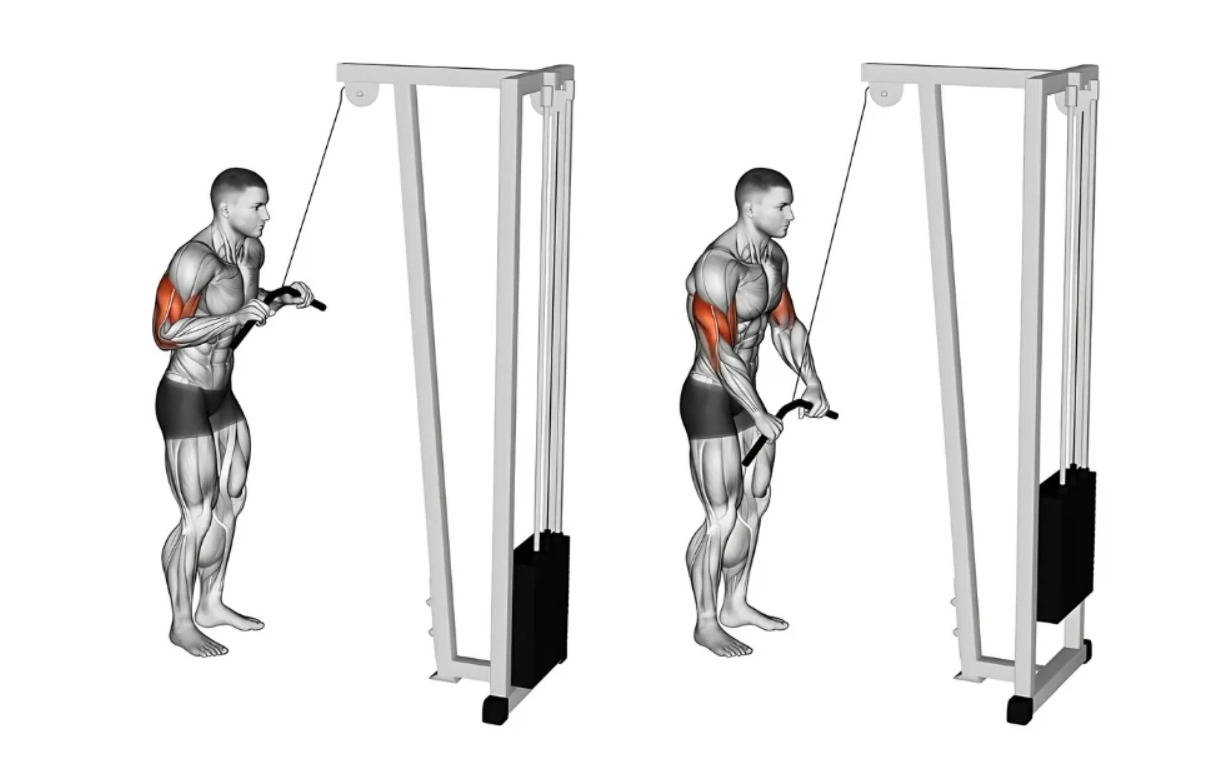
- Triceps Pushdowns: Using a cable machine, push the handle down by straightening your arms.
- Overhead Triceps Extension: Hold a dumbbell overhead and straighten your elbows.
- Skull Crushers: Lie down and lower a barbell or dumbbells toward your forehead, then push back up.
2. Compound Push Exercises
These work several muscles, including triceps.
- Bench Press
- Push-Ups
- Dips
3. Progressive Overload
To build muscle, increase the weight or the number of repetitions over time. Keep your form correct to avoid injury.
4. Mind-muscle Connection
Focus on feeling the triceps work during each push movement. This helps with muscle activation and growth.
Mistakes Beginners Make With Triceps Training
Many people waste time or hurt themselves by making common mistakes.
1. Training Triceps On Pull Day
Some beginners include triceps exercises in their pull workouts. This can lead to overtraining, because triceps also get worked during push exercises.
2. Using Too Much Weight
Trying to lift heavy with poor form can injure your elbows or shoulders. Use a weight that allows you to move with good control.
3. Not Using Full Range Of Motion
Only moving halfway cheats your triceps. Straighten your arm fully (but do not lock out hard) for best results.
4. Forgetting About The Three Heads
The triceps have three parts. Using different exercises helps develop all areas for better strength and appearance.
5. Ignoring Rest
Muscles grow while resting, not while training. Give your triceps enough time to recover between sessions.
Real-world Examples: How Athletes Train Triceps
Elite athletes and trainers rarely work triceps on pull days. They follow the push-pull split for best results.
- Bodybuilders: Use isolation and compound push exercises for arm definition.
- Athletes (football, basketball): Focus on push strength for better performance in pushing and throwing.
- CrossFit: Uses push-ups, dips, and presses—never rows or pull-ups for triceps strength.
This real-world experience matches the science: triceps are push muscles.
Key Differences: Triceps Vs. Biceps In Training
To avoid mistakes, know how triceps and biceps differ in both function and training.
| Feature | Triceps | Biceps |
|---|---|---|
| Main Function | Straightens elbow | Bends elbow |
| Workout Type | Push | Pull |
| Common Exercises | Push-Ups, Dips, Extensions | Curls, Pull-Ups, Rows |
| Location | Back of upper arm | Front of upper arm |
How To Program Triceps In Your Routine
To get the most from your workouts, plan your triceps training smartly.
1. Include Triceps On Push Days
Add 1-3 triceps exercises at the end of your chest or shoulder workout.
2. Do Not Overtrain
Since triceps are used in many push movements, do not add too many isolation exercises. Two or three good sets are enough.
3. Rest And Recover
Allow at least 48 hours before training triceps hard again.
4. Vary Your Exercises
Change your triceps exercises every few weeks to target all heads and prevent boredom.
Can You Train Triceps And Biceps Together?
Some advanced routines combine triceps and biceps in the same workout, often called "arm day. " This is fine as long as you do not overtrain.
Tips for arm day:
- Warm up well to avoid injury.
- Start with either biceps or triceps and switch every session.
- Include both compound and isolation exercises.
- Rest between sets.
But for beginners, the push/pull split is usually easier to follow and more effective.
Practical Tips For Beginners
If you are new to training, here are some useful tips:
- Learn proper form before increasing weight.
- Focus on quality, not quantity.
- Track your progress to see improvement.
- Listen to your body—pain means stop, soreness is normal.
- Ask a coach or trainer if you are unsure about technique.
Non-obvious Insights About Triceps Training
Here are two less-known facts most beginners miss:
1. Triceps Size Matters More Than Biceps for Big Arms
Many believe biceps make arms look big. In reality, the triceps are the larger muscle. If you want impressive arms, focus on triceps as much (or more) than biceps.
2. Overlapping Recovery Is Key
Since triceps work in both chest and shoulder push exercises, training them too often can slow recovery and growth. Plan your push workouts so triceps have time to rest.
Do Triceps Play Any Role In Pulling Movements?
While the triceps do not pull, they do help stabilize the elbow and shoulder during pulling movements. For example, when you do a heavy row, your triceps keep the elbow joint steady so the biceps and back can pull safely.
However, this is a supporting role, not the main movement. You cannot build big triceps by only doing pull exercises.
Triceps And Joint Health
Strong triceps are important for elbow health. Weak triceps can lead to joint pain or injuries, especially if you do a lot of pushing or throwing in sports.
To keep your elbows healthy:
- Use good form with push exercises.
- Do not overtrain—listen to joint pain.
- Stretch your arms after workouts.
Credit: trainingstation.co.uk
Gender And Age Differences In Triceps Training
Both men and women benefit from triceps training. Women sometimes avoid push exercises, fearing "bulky" arms, but triceps help with daily activities like pushing a stroller or getting up from a chair.
As you age, muscle naturally decreases (a process called sarcopenia). Training triceps helps keep your arms strong for daily tasks and reduces the risk of falls.
Can You Feel Triceps In Pull Workouts?
Some people say they "feel" their triceps during pull workouts. This usually means they are tensing or bracing the muscle, not actually working it as a prime mover. If you feel your triceps burning during a pull-up, check your form—your biceps and back should be doing most of the work.

Credit: www.nocofitness.com
How To Avoid Overtraining Triceps
Because triceps are used in many push movements, overtraining is common. Signs of overtraining include:
- Soreness that lasts more than 2-3 days
- Weakness during push exercises
- Elbow pain
To avoid this:
- Limit triceps isolation to 1-2 times per week
- Rest at least 48 hours between push workouts
- Stretch and use proper warm-up routines
The Role Of Nutrition In Triceps Growth
Muscles need fuel to grow. Eating enough protein and overall calories is key. Good protein sources include chicken, fish, eggs, beans, and dairy.
Hydration also matters. Muscles are about 75% water, and dehydration reduces performance and slows recovery.
The Mind-muscle Connection: Advanced Triceps Activation
For the best triceps results, focus on the mind-muscle connection. This means thinking about your triceps working during each rep. Research shows this can increase muscle activation and growth. To practice:
- Move slowly and control the weight.
- Pause at the top of the movement.
- Visualize your triceps contracting.
Sample Push Workout Including Triceps
Here is an example push day workout that hits the triceps effectively:
- Bench Press: 4 sets x 8-10 reps
- Overhead Press: 3 sets x 10 reps
- Incline Dumbbell Press: 3 sets x 10 reps
- Triceps Pushdown: 3 sets x 12 reps
- Overhead Triceps Extension: 2 sets x 15 reps
Rest 60-90 seconds between sets. Warm up before starting.
Advanced Training: Supersets For Arms
A superset is doing two exercises back-to-back with no rest. Some athletes superset triceps and biceps to save time and increase the pump.
Example superset:
- Triceps Pushdown (12 reps)
- Biceps Curl (12 reps)
- Rest 1 minute, then repeat for 3-4 sets
This is optional but can add variety to your arm training.
Evidence From Research
Research supports the push-pull split. Studies show that grouping push muscles together and pull muscles together can increase strength and muscle growth by allowing better recovery and less overlap. For more on muscle actions, see this Wikipedia article.
Frequently Asked Questions
Is It Okay To Train Triceps On Pull Day?
It is better to train triceps on push day. Triceps are worked during push exercises like bench press and shoulder press. Training them on pull day can lead to overtraining and slow recovery.
Why Do My Triceps Feel Tired After Pull Workouts?
This usually happens if you use poor form or tense your triceps for stability. The main muscles in pull workouts should be back and biceps. If your triceps are tired, check your technique.
What Is The Best Exercise For Triceps Growth?
There is no single best exercise, but triceps pushdowns, dips, and overhead extensions are very effective. Using a mix of these hits all parts of the triceps for balanced growth.
How Often Should I Train Triceps For Best Results?
Most people get good results training triceps 1-2 times per week, as part of a push workout. Make sure you rest at least 48 hours between hard push sessions.
Can I Get Big Triceps Without Heavy Weights?
Yes, you can build triceps with bodyweight exercises like push-ups and dips. The key is to use good form, enough repetitions, and gradually increase difficulty as you get stronger.
Working out is a journey, and knowing the role of each muscle helps you make the most of your effort. The triceps are a push muscle—focus on push movements to build strength, improve arm shape, and keep your joints healthy.
With smart planning and consistent effort, you will see progress and reach your goals.
