

How Tricep Workout Boosts Strength and Defines Your Arms
How Tricep Workout
Building strong triceps doesn’t just improve your arm shape—it boosts your overall strength and confidence. Many people focus on biceps, but the triceps make up about two-thirds of your upper arm. When you train them well, you see faster progress, lift heavier, and feel more powerful every day. Still, tricep workouts can be tricky. If you use poor form or pick the wrong exercises, you might not see results or even hurt yourself. This guide will help you train your triceps the right way, using simple explanations and practical advice.
Understanding The Triceps Muscle
The triceps brachii sits at the back of your upper arm. It has three heads—long, lateral, and medial. Each head plays a different role:
- The long head helps move your arm backward and stabilizes your shoulder.
- The lateral head is responsible for the arm’s overall size and definition.
- The medial head gives your arm endurance and supports the other heads.
Many exercises target all three heads, but some focus more on one. Knowing this helps you choose the best moves for your goals.
Triceps: Why They Matter
Strong triceps help with:
- Pushing strength (bench press, push-ups, overhead press)
- Arm shape (fuller, more toned look)
- Injury prevention (protects elbows and shoulders)
If you neglect your triceps, your arms may look uneven, and you risk joint pain. Plus, daily tasks like lifting groceries or pushing doors become easier with healthy triceps.
Key Principles For Effective Tricep Training
Before you jump into exercises, understand these basics:
- Form is everything. Bad form can cause elbow pain or slow your progress.
- Choose the right weight. Too heavy, and you use other muscles. Too light, and you don’t challenge your triceps.
- Full range of motion. Lower your weights all the way and extend fully for maximum gains.
- Variety matters. Mix up exercises to hit all three heads.
- Recovery is essential. Muscles grow when you rest, not just when you train.
Many beginners miss the importance of tempo—how fast you move the weight. Slow, controlled reps (especially when lowering the weight) make a big difference.

Credit: www.reddit.com
Best Tricep Exercises
Let’s break down the most effective tricep exercises, including how to do them and tips for good form.
1. Close-grip Bench Press
This is a classic for pushing strength and overall triceps development.
- Lie on a bench, hands close together (shoulder-width).
- Lower the bar slowly to your chest, keeping elbows close to your body.
- Push back up, squeezing your triceps.
Tips: Keep your wrists straight. Don’t flare your elbows.
2. Tricep Dips
Great for bodyweight training and boosting muscle endurance.
- Use parallel bars or a sturdy chair.
- Lower your body until elbows are at 90 degrees.
- Push yourself back up.
Tips: Don’t shrug your shoulders. Keep your body upright.
3. Overhead Tricep Extension
Targets the long head and stretches your triceps for deeper activation.
- Hold a dumbbell with both hands overhead.
- Lower the weight behind your head, elbows pointing forward.
- Extend your arms fully.
Tips: Avoid arching your back. Keep elbows close.
4. Skullcrushers (lying Tricep Extensions)
Very effective for the lateral head.
- Lie on a bench with a barbell or dumbbells.
- Lower the weights toward your forehead.
- Extend arms back up.
Tips: Move only your elbows, not your shoulders.
5. Tricep Pushdowns
Usually done on a cable machine.
- Stand facing the cable, hold the bar or rope.
- Push down until arms are straight.
- Return slowly to starting position.
Tips: Keep elbows still. Don’t swing your body.
6. Diamond Push-ups
A simple bodyweight exercise that hits the triceps hard.
- Place hands together so thumbs and index fingers form a diamond.
- Lower yourself, keeping elbows close.
- Push back up.
Tips: Keep core tight. Don’t let hips sag.
Sample Tricep Workout Routines
Choosing the right routine depends on your fitness level. Here are two sample routines:
Beginner Routine
- Tricep Pushdowns – 3 sets of 12 reps
- Overhead Tricep Extension – 3 sets of 10 reps
- Diamond Push-Ups – 2 sets of 8 reps
Rest 60 seconds between sets. Focus on slow, controlled movement.
Intermediate Routine
- Close-Grip Bench Press – 4 sets of 8 reps
- Skullcrushers – 3 sets of 10 reps
- Tricep Dips – 3 sets of 12 reps
Rest 90 seconds between sets. Increase weight gradually.
Advanced Routine
- Weighted Tricep Dips – 4 sets of 8 reps
- Skullcrushers – 4 sets of 10 reps
- Cable Pushdowns (with rope) – 3 sets of 15 reps
- Overhead Tricep Extension – 3 sets of 12 reps
Rest 60–90 seconds. Use challenging weights but keep form strict.
Choosing The Right Equipment
Different tools can change your tricep workout. Here’s a comparison of the main options:
| Equipment | Benefits | Drawbacks |
|---|---|---|
| Dumbbells | Flexible, easy to use, good for home | Limited weight, can be awkward for some moves |
| Barbells | Best for heavy lifts, great for strength | Needs a bench, may strain wrists |
| Cable Machine | Constant tension, good for isolation | Needs gym access |
| Bodyweight | No equipment needed, builds endurance | Hard to progress, not ideal for max strength |
If you’re training at home, dumbbells and bodyweight exercises are most practical. For gym workouts, cables and barbells add variety and intensity.
Common Mistakes In Tricep Workouts
Even experienced lifters make errors that hold back their progress. Here are the most frequent mistakes:
- Using too much weight: This forces other muscles to help, so triceps don’t get the full benefit.
- Not locking out: Some people don’t fully extend their arm at the end of each rep, missing peak contraction.
- Neglecting elbow health: Fast, jerky movements can cause pain.
- Overtraining: Too many sets or not enough rest leads to soreness and slow progress.
- Ignoring the long head: Many exercises only hit the lateral head. Overhead moves are needed for full development.
A non-obvious insight: The long head responds best to exercises where your arm is overhead. Many beginners focus only on pushdowns and miss this.
How Often Should You Train Triceps?
Triceps recover quickly, but they also work during chest and shoulder training. Most experts suggest:
- 2 times per week is ideal for growth.
- Allow 48–72 hours between sessions.
If you train triceps with chest or shoulders, count those exercises as tricep work, too. For example, bench press and push-ups also hit triceps.
Tricep Training For Different Goals
Your approach should match your goal. Here’s how to adjust:
For Muscle Size (hypertrophy)
- Use moderate weight (70–80% of your max).
- Aim for 8–12 reps per set.
- Focus on slow lowering and full contraction.
For Strength
- Use heavy weight (80–90% of max).
- Do 4–6 reps per set.
- Add compound lifts (close-grip bench, weighted dips).
For Endurance
- Use lighter weight.
- Do 15–20 reps.
- Shorter rest periods (30–45 seconds).
Mixing these styles helps avoid plateaus and keeps training fun.
Nutrition For Tricep Growth
Muscle growth needs more than just exercise. Here’s what matters:
- Protein: Aim for 1.6–2.2 grams per kg of bodyweight per day. Good sources are chicken, eggs, tofu, lentils.
- Carbs: Needed for energy. Include whole grains, rice, potatoes.
- Healthy fats: Support hormone health. Use olive oil, nuts, avocado.
- Hydration: Drink plenty of water to aid recovery.
Many people forget about timing—eat protein within 1–2 hours after your workout for better results.
The Role Of Rest And Recovery
Triceps need rest to grow stronger. Here’s how to recover:
- Sleep: 7–9 hours per night helps muscles repair.
- Stretching: Light stretching after workouts prevents tightness.
- Active recovery: Gentle activities (walking, yoga) boost blood flow.
A non-obvious insight: The triceps can get sore from heavy chest and shoulder days, so listen to your body. If you feel pain, take extra rest.
How To Progress Your Tricep Training
Progress is key. If you do the same routine forever, your muscles stop growing. Here’s how to keep improving:
- Increase weight: If you can do 12 reps easily, add more weight.
- Change exercises: Swap pushdowns for overhead extensions, or use different grips.
- Add sets: Start with 3 sets, then try 4 or 5 as you get stronger.
- Track your results: Write down weights, reps, and how you feel after each session.
Beginners often forget to track progress, but this is essential for motivation and improvement.
Advanced Techniques For Faster Gains
When basic workouts stop working, try these methods:
Supersets
Do two exercises back-to-back with no rest. Example: Skullcrushers followed by pushdowns.
Drop Sets
After your last set, drop the weight and keep going until you can’t do any more reps.
Slow Negatives
Lower the weight very slowly (3–5 seconds) to increase tension.
Partial Reps
Do short movements at the end of your set to squeeze extra work out of the muscle.
These techniques are intense. Use them only once or twice a week.
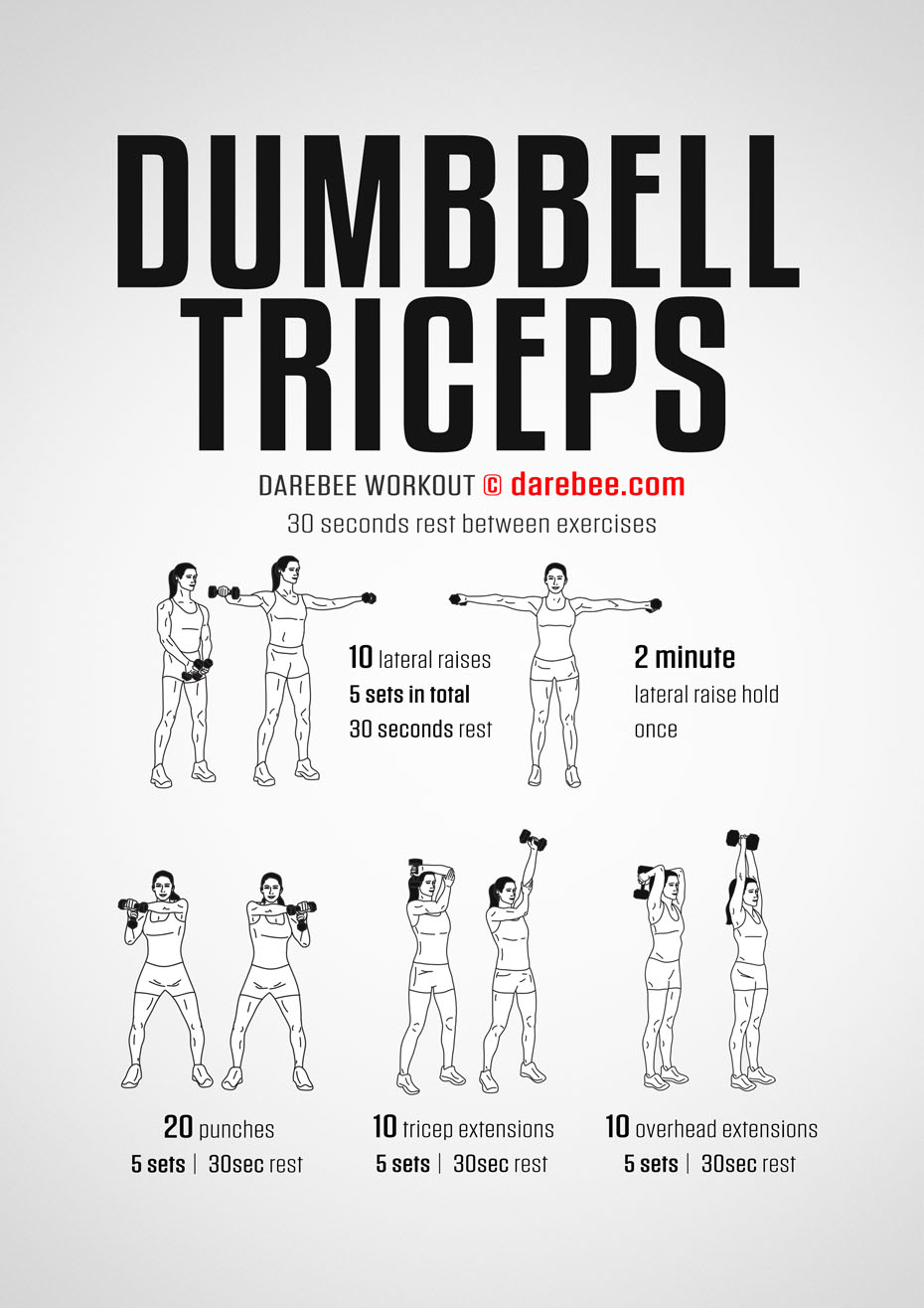
Credit: darebee.com
Tricep Anatomy Compared To Biceps
It’s helpful to see how triceps compare to biceps in size and function.
| Muscle | Heads | Main Function | Arm Size Contribution |
|---|---|---|---|
| Biceps | 2 | Bending the elbow | About 1/3 |
| Triceps | 3 | Straightening the elbow | About 2/3 |
This shows why training triceps is so important for bigger, stronger arms.
How To Avoid Elbow Pain
Tricep workouts can cause elbow soreness if you’re not careful. Here’s how to protect your joints:
- Warm up: Start with light cardio and arm circles.
- Use proper form: Never lock out too aggressively.
- Avoid heavy loads on isolation exercises: Save the heavy weights for compound moves.
- Stretch after each workout: Focus on the forearm and triceps.
If pain persists, stop and see a doctor. Don’t push through joint pain.
Should You Train Triceps With Other Muscles?
You can train triceps with chest, shoulders, or alone. There’s no single best way—it depends on your routine.
- With chest: Many chest exercises hit triceps, so add 1–2 isolation moves.
- With shoulders: Overhead presses also work triceps.
- On their own: You can focus on triceps with a full workout.
Tip: If your triceps are a weak point, train them first for maximum energy.
Women And Tricep Workouts
Many women worry tricep training will make their arms bulky. In reality, it creates a toned, lean look and improves strength for daily tasks.
- Women have less testosterone, so they build muscle differently.
- Focus on higher reps (12–20) and lighter weights for shaping.
- Include bodyweight moves like push-ups and dips.
Don’t skip triceps—everyone benefits from strong arms.

Credit: www.youtube.com
Tricep Training For Seniors
Older adults can and should train their triceps. It helps maintain independence and reduces injury risk.
- Use light weights and slow movements.
- Focus on form over heavy lifting.
- Try chair dips, band pushdowns, and gentle overhead extensions.
Always check with a doctor before starting a new workout.
How Long Does It Take To See Results?
With consistent training and good nutrition, most people see changes in 4–8 weeks. Arms will look more defined, and strength will improve.
Progress depends on:
- Age
- Diet
- Training intensity
- Rest and recovery
Don’t compare yourself to others—everyone’s body responds differently.
Tricep Workout Myths
Many myths confuse beginners. Here are the most common:
- “Training triceps every day builds muscle faster.” False. Muscles need rest to grow.
- “Isolation exercises are best.” Compound moves like bench press and dips are equally important.
- “Women shouldn’t lift heavy weights.” Lifting heavy improves strength and health for everyone.
- “Tricep training ruins elbow health.” Good form prevents injury.
Trust science, not gym gossip. For more, see the American Council on Exercise.
How Tricep Workouts Fit Into Your Full Routine
Triceps are part of many upper body workouts. Here’s how to balance them:
- Don’t train triceps right after heavy chest or shoulder days.
- Mix tricep, bicep, and shoulder exercises for balanced arms.
- Include lower body and core training for overall fitness.
If you have only a few days a week to work out, combine triceps with chest or shoulders.
Tracking Progress: What To Measure
To know if your tricep workout is working, track:
- Strength: Are you lifting heavier weights?
- Muscle size: Measure arm circumference every few weeks.
- Definition: Take progress photos.
- Endurance: Can you do more reps?
Set small goals and celebrate each win. If you plateau, change your routine or increase intensity.
Sample Weekly Tricep Training Plan
Here’s a sample schedule for a balanced approach:
- Monday: Chest + triceps (bench press, tricep pushdowns)
- Wednesday: Shoulders + triceps (overhead press, overhead tricep extension)
- Friday: Arms only (skullcrushers, dips, diamond push-ups)
Rest on other days. Adjust based on your fitness level.
Frequently Asked Questions
How Do I Know If My Triceps Are Growing?
Look for increased strength and better arm definition. Use a tape measure and take progress photos every month. You’ll also feel less fatigue during pushing exercises.
What’s The Best Tricep Exercise For Beginners?
Tricep pushdowns are easy to learn and safe for most people. They help you focus on form and build confidence before moving to harder moves.
Can I Train Triceps At Home Without Equipment?
Yes. Diamond push-ups and chair dips are great options. Use water bottles or bands for added resistance if needed.
Why Do My Elbows Hurt During Tricep Exercises?
Elbow pain is often caused by bad form or too much weight. Warm up well, use lighter weights, and avoid jerky movements. If pain continues, talk to a doctor.
How Many Sets And Reps Should I Do For Triceps?
For most people, 3–4 sets of 8–12 reps works well. Advanced lifters can add more sets or use heavier weights with fewer reps.
Building strong triceps takes patience, good form, and smart choices. Whether you train at home or in the gym, focus on quality over quantity. Mix up your routine, listen to your body, and track your progress. The result is arms that look great, feel strong, and help you in every part of life.
