

How to Tricep Workout: Build Strong Arms Fast
How To Tricep Workout
Most people want strong arms, but many focus only on their biceps. The triceps are actually the bigger muscle in your upper arm. If you want powerful, toned arms, you need to train your triceps the right way. This guide covers everything you need to know about tricep workouts—from the basics, to advanced tips, to common mistakes. Whether you are a beginner or someone who wants to upgrade your routine, you will find clear advice, practical examples, and easy-to-follow steps here. Let’s get started on building stronger, more defined arms.
Understanding Your Triceps
The triceps brachii is the muscle on the back of your upper arm. It has three parts: the long head, lateral head, and medial head. All three work together to extend your elbow and help you push. When you do any pushing movement—like a bench press or push-up—your triceps are working hard.
Why Triceps Matter
Most arm size comes from the triceps, not the biceps. If you want bigger or more defined arms, training your triceps is key. Strong triceps also help with other exercises, like chest presses or shoulder work. They support your joints and improve your strength for daily tasks.
Another important point: triceps are essential for activities that involve pushing, such as opening heavy doors, pushing a shopping cart, or even getting up from a chair. Well-developed triceps also help protect your shoulders from injury because they stabilize your arm during many movements. If your triceps are weak, your shoulders and elbows may take on extra strain.
The Three Heads Explained
- Long head: Runs down the back of your arm. It helps with shoulder and elbow movement.
- Lateral head: On the outer side of your arm. It gives your arms that “horseshoe” shape.
- Medial head: Underneath, closer to your elbow. It helps with endurance and stability.
Knowing these helps you pick exercises that target all parts of your triceps. For example, overhead movements like tricep extensions work the long head best, while pushdowns focus more on the lateral and medial heads. If you only do one type of movement, some parts of your triceps may stay weak or underdeveloped.
How Triceps Grow: The Science
Muscle growth happens when you use your triceps with enough resistance. This causes small tears in the muscle, which repair and grow stronger. For best results, you need:
- Progressive overload: Increase weight or reps over time.
- Proper form: Use good technique to avoid injury.
- Rest and recovery: Muscles grow when you rest, not just when you train.
A study from the American Council on Exercise found that triceps make up about two-thirds of your upper arm’s size. If you neglect them, you miss out on bigger arms and better strength.
It’s also important to understand that muscles adapt quickly. If you always do the same exercises, your progress will slow down. Mixing up your routine—by changing the angle, speed, or grip—can help keep your triceps growing. For some people, the mind-muscle connection is also important.
This means focusing your attention on your triceps while exercising, which can improve how much they work during each rep.
Key Principles For Effective Tricep Training
Before jumping into exercises, let’s cover important rules for tricep workouts.
Focus On Compound And Isolation Movements
- Compound exercises use multiple muscles (like chest and triceps together).
- Isolation exercises target the triceps specifically.
Both types are important. Compound moves build overall strength. Isolation moves shape the muscle.
For example, close-grip bench presses are compound movements—they train your chest, shoulders, and triceps together. Overhead extensions are isolation moves, focusing almost only on the triceps. Doing both types in your workout will give you the best results.
Train All Three Heads
Not every exercise hits all tricep parts equally. You need a mix to build balanced, strong triceps.
Changing your grip or arm position changes which head works hardest. For example, overhead exercises (like dumbbell extensions) hit the long head, while pushdowns target the lateral and medial heads. Switching exercises every few weeks keeps all three heads growing.
Use Full Range Of Motion
Move your arm through its full path—from fully bent to fully straight. This builds more muscle.
Short, half-reps may make the exercise feel easier, but they don’t challenge the muscle as much. When you use a full range, you stretch and contract the muscle, which is key for growth. If a weight is too heavy to move fully, use a lighter one so you can use good form.
Don't Overtrain
Triceps are involved in many other exercises. If you train them too often, you risk injury or slow progress. Most people do best with 2–3 tricep workouts per week.
Remember, your triceps work hard during chest and shoulder workouts as well. If you do too much, you might feel sore for days, or notice you’re getting weaker. Listen to your body and rest when needed.
Nutrition And Rest
Muscles need protein and rest to grow. Aim for 7–8 hours of sleep nightly and eat enough protein (about 0.7–1 gram per pound of bodyweight).
Carbs are also important—they give your muscles energy to train hard. Good sleep helps your muscles recover and rebuild. If you skip rest, you won’t get bigger or stronger, no matter how hard you work out.
Essential Tricep Exercises
Here are the most effective tricep exercises, with clear steps and tips for each.
1. Tricep Pushdown
This exercise uses a cable machine.
- Stand facing the cable.
- Grab the bar with both hands.
- Keep elbows tucked to your sides.
- Push the bar down until your arms are straight.
- Slowly return to starting position.
Tip: Don’t let your elbows flare out. Use a slow, controlled movement.
If you don’t have a cable machine, you can use a resistance band attached to a door.
2. Close-grip Bench Press
This targets triceps and chest.
- Lie on a bench.
- Grip the bar with hands closer than shoulder-width.
- Lower the bar to your chest.
- Push the bar back up.
Tip: Keep your elbows close to your body. Don’t arch your back.
This exercise is great for building both strength and muscle. Use a spotter if you are lifting heavy.
3. Overhead Tricep Extension
You can use a dumbbell or cable.
- Hold the weight overhead.
- Lower it behind your head.
- Extend your arms to lift the weight back up.
Tip: Keep your upper arms still. Only your forearms should move.
Try doing this seated if you have trouble keeping your back straight. You can also use both hands on one dumbbell or use two lighter dumbbells.
4. Skullcrusher
Done with a barbell or dumbbells.
- Lie on a bench.
- Hold the weight above your chest.
- Lower it towards your forehead.
- Push back up.
Tip: Move slow to avoid injury. Don’t drop the weight too fast.
If your elbows hurt during this movement, try changing the angle or using dumbbells instead.
5. Dips
Bodyweight exercise, great for strength.
- Place hands on parallel bars.
- Lower your body by bending elbows.
- Push back up.
Tip: Lean slightly forward for more triceps. Don’t swing your body.
If dips are too hard, start with bench dips (using a chair or bench for support).
6. Kickback
Isolation exercise with a dumbbell.
- Lean forward, holding a dumbbell.
- Bend your elbow, keep your upper arm still.
- Straighten your arm behind you.
Tip: Don’t use heavy weight. Focus on form.
Use a mirror or ask someone to check your form—most people swing their arm too much.
7. Diamond Push-up
Works triceps and chest.
- Place hands together under your chest, forming a diamond shape.
- Lower your body.
- Push back up.
Tip: Keep elbows close. Go slow.
If these are too hard, do them on your knees at first.
Sample Tricep Workout Plans
You can train your triceps alone or with other muscles. Here are two sample plans—one for beginners, one for intermediate.
Beginner Plan (2 Days/week)
- Tricep Pushdown – 3 sets of 12 reps
- Overhead Tricep Extension – 3 sets of 10 reps
- Diamond Push-Up – 2 sets of 8 reps
Rest: 1–2 minutes between sets.
This plan helps you learn good form and build a base. Take at least one rest day between tricep sessions.
Intermediate Plan (3 Days/week)
- Close-Grip Bench Press – 4 sets of 8 reps
- Skullcrusher – 3 sets of 10 reps
- Dips – 3 sets of 10 reps
- Kickback – 2 sets of 12 reps
Rest: 1–2 minutes between sets.
As you advance, add more sets or try supersets (two exercises back-to-back) to challenge your muscles. If you train other muscles, you can add 1–2 tricep moves to your upper body days.
How To Choose The Right Exercises
Not all exercises work for everyone. Here’s how to pick the best ones for you.
| Exercise | Equipment Needed | Best For | Difficulty |
|---|---|---|---|
| Tricep Pushdown | Cable machine | Beginners, all levels | Easy |
| Close-Grip Bench Press | Barbell, bench | Strength seekers | Moderate |
| Overhead Extension | Dumbbell/Cable | All levels | Easy |
| Skullcrusher | Barbell/Dumbbell | Intermediate | Moderate |
| Dips | Parallel bars | Strength, endurance | Hard |
| Kickback | Dumbbell | Beginners | Easy |
| Diamond Push-Up | Bodyweight | All levels | Moderate |
Choose exercises you can do safely, with proper form. If you don’t have equipment, use bodyweight moves like dips or push-ups.
Trying different exercises also helps you find what feels best for your joints. Some people feel discomfort with skullcrushers, while others find dips too hard on the shoulders. It’s normal to adjust your routine based on what works for you.
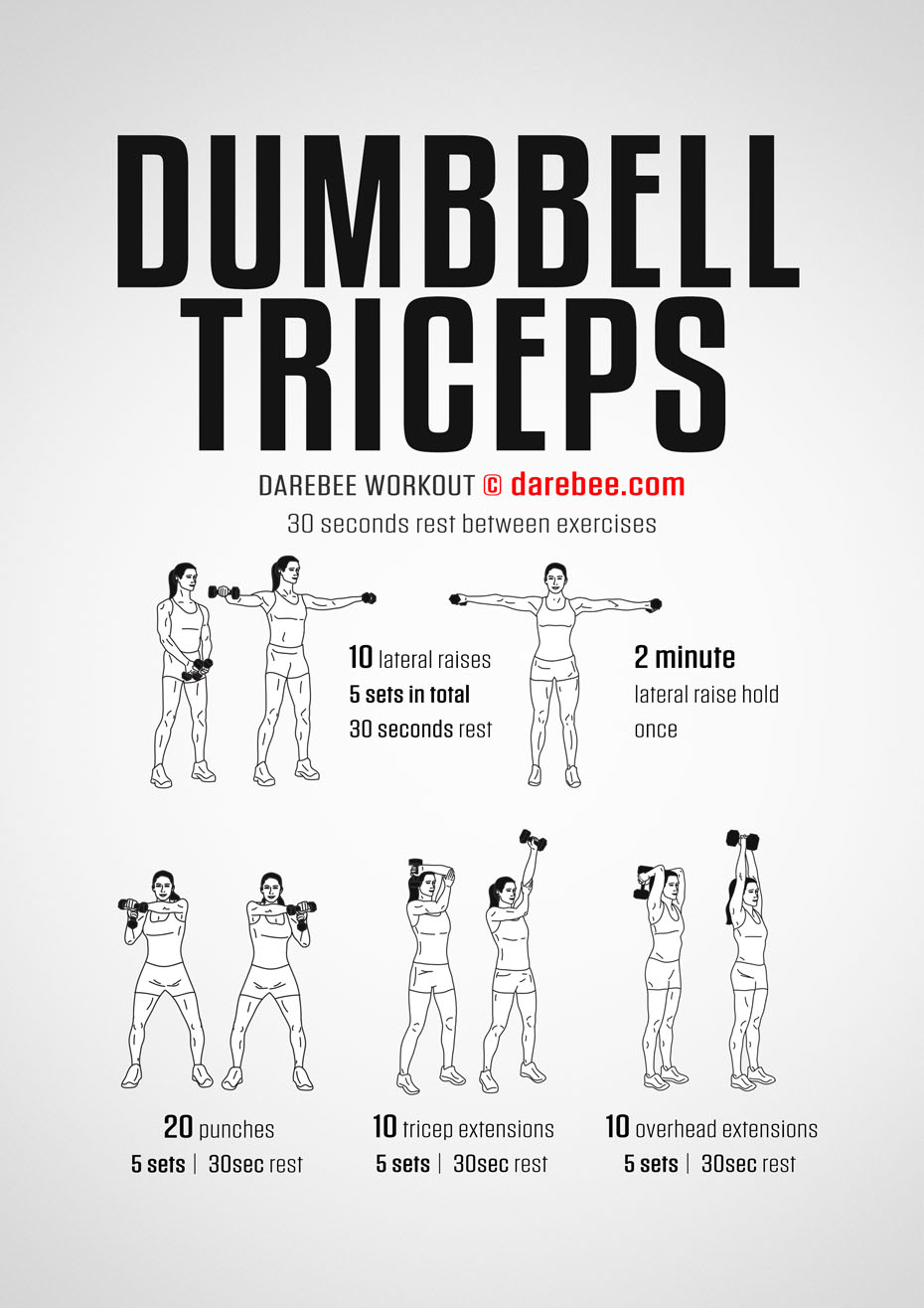
Credit: darebee.com
Common Tricep Workout Mistakes
Even experienced people make mistakes. Avoid these to get better results.
1. Using Too Much Weight
Heavy weights can cause bad form and injury. Start light, master the movement, then add weight.
Trying to impress others by lifting too heavy can backfire. Proper technique builds muscle faster and keeps you safe.
2. Not Training All Three Heads
If you only do one exercise, you miss parts of the triceps. Mix overhead, pushdown, and pressing moves.
Many people focus only on pushdowns or bench presses. But overhead extensions and kickbacks hit other areas you might miss.
3. Poor Form
Swinging arms or moving fast hurts your progress. Always use a slow, controlled motion.
Focus on feeling the muscle work, not just moving the weight. If you can’t control the motion, the weight is too heavy.
4. Not Enough Recovery
Triceps need rest. Training them daily can lead to pain or weak results.
If you notice joint pain, loss of strength, or no progress, you may need more rest days.
5. Skipping Warm-up
Cold muscles are easy to injure. Warm up with 5–10 minutes of light cardio or arm circles.
Warming up increases blood flow and makes your muscles ready to work. Don’t skip this, even if you’re short on time.
6. Ignoring Nutrition
Muscles need fuel. If you don’t eat enough protein or calories, you won’t grow.
Eating a small meal with carbs and protein an hour before your workout can also boost your energy.
How To Progress Your Tricep Workout
To keep getting stronger, you need to change your routine over time.
Increase Resistance
Add more weight when you can do your reps easily.
For example, if you can do 12 pushdowns with perfect form, try increasing the weight by 5–10%.
Add More Sets Or Reps
If you feel strong, add extra sets or reps.
Don’t jump too quickly—add one set or a few reps at a time.
Change Exercises
Try new movements to hit different parts of the triceps.
Switching from skullcrushers to overhead extensions, for example, can challenge your muscles in new ways.
Track Your Progress
Write down your workouts. See where you improved and where you need work.
| Week | Exercise | Sets | Reps | Weight |
|---|---|---|---|---|
| 1 | Pushdown | 3 | 12 | 20 lbs |
| 2 | Pushdown | 3 | 12 | 25 lbs |
| 3 | Pushdown | 3 | 12 | 30 lbs |
This shows how you can increase weight over weeks.
If you stop seeing progress for several weeks, try changing your exercise order, the number of sets, or even your rest periods. Even small changes can restart your gains.

Credit: centr.com
Advanced Tricep Workout Techniques
If you want more challenge, try these advanced methods.
Supersets
Do two tricep exercises back-to-back with no rest. Example: Pushdown + Overhead Extension.
Supersets save time and add intensity, making your muscles work harder.
Drop Sets
Start heavy, then drop weight each set. Example: Pushdown at 40 lbs, then 30 lbs, then 20 lbs.
Drop sets are great for pushing through plateaus and increasing muscle fatigue, which helps growth.
Negative Reps
Lower the weight slowly. This builds strength and muscle.
Focusing on the lowering phase (eccentric movement) can cause more muscle damage, leading to bigger gains if you recover well.
Pyramid Sets
Start with light weight and high reps, then increase weight and lower reps each set.
For example, do 15 reps at low weight, 10 reps at medium weight, and 6 reps at heavy weight. This method works both endurance and strength in one workout.
Tip: Only use advanced techniques if you have good form.
If you’re new to these methods, start with just one per workout.
How To Warm Up And Stretch Triceps
Warm up before any workout. Stretch after to avoid soreness.
Warm-up Ideas
- Arm circles: 1 minute
- Light push-ups: 2 sets of 10
- Resistance band extensions: 2 sets of 12
Jumping jacks or a few minutes of jogging can also help raise your heart rate.
Stretching Tips
- Overhead tricep stretch: Hold for 20–30 seconds
- Cross-body tricep stretch: Hold for 20–30 seconds
Stretching keeps your muscles flexible and helps prevent injury.
Try to stretch both arms equally, and don’t bounce—hold the stretch gently.
Tricep Workout For Different Goals
Your goal changes how you train.
For Strength
- Use heavy weights
- Fewer reps (6–8 per set)
- More rest (2–3 minutes)
Focus on compound movements like close-grip bench press and weighted dips.
For Muscle Size (hypertrophy)
- Moderate weights
- Moderate reps (8–12 per set)
- Shorter rest (1–2 minutes)
Mix compound and isolation moves for best results.
For Endurance
- Light weights
- High reps (15–20 per set)
- Short rest (30–60 seconds)
Great for athletes or anyone who wants muscles that last longer without fatiguing.
| Goal | Sets | Reps | Rest |
|---|---|---|---|
| Strength | 4–5 | 6–8 | 2–3 min |
| Size | 3–4 | 8–12 | 1–2 min |
| Endurance | 2–3 | 15–20 | 30–60 sec |
Pick the routine that fits your needs.
Tricep Workout At Home (no Equipment)
You don’t need a gym to build strong triceps. Try these moves:
Diamond Push-ups
- Place hands together under chest
- Lower and raise body
Tricep Dips (on Chair)
- Sit on chair edge
- Put hands beside hips
- Slide forward, lower body, raise back up
Close-grip Push-ups
- Hands close together
- Lower and raise body
Overhead Extension (with Water Bottle)
- Hold bottle overhead
- Lower behind head, raise up
Do 2–3 sets of each, 10–15 reps per set. Focus on slow, controlled movement.
If standard push-ups are too hard, try doing them on your knees. If you want more challenge, slow down the lowering phase to increase muscle tension.

Credit: www.reddit.com
Nutrition For Tricep Growth
Exercise is only half the battle. You need proper nutrition.
Protein
Muscles need protein to grow. Aim for 0.7–1 gram per pound of bodyweight. Good sources: chicken, fish, eggs, beans.
If you don’t eat animal products, try tofu, lentils, or protein-rich grains.
Carbs And Fats
Carbs fuel your workout. Fats help hormones. Eat whole grains, vegetables, healthy oils.
Don’t cut out healthy fats—avocado, olive oil, and nuts are good for muscle recovery.
Hydration
Drink water before, during, and after workouts. Dehydration slows recovery.
Being even a little dehydrated can make your muscles weaker and slow down your progress.
Supplements
If you struggle to eat enough protein, consider a protein shake. But food is best.
Creatine is another supplement some people use to increase strength, but it’s optional.
How To Avoid Injury
Triceps injuries are common if you train wrong. Here’s how to stay safe.
Warm Up Every Time
Cold muscles are easy to pull or tear.
Use Proper Form
Never swing weights or move too fast.
Don’t Overtrain
Rest at least 48 hours between tricep workouts.
Overuse can cause pain in the elbow or shoulder. Rest days are as important as workout days.
Listen To Your Body
If you feel pain, stop. Don’t push through injury.
Sharp or sudden pain is a warning sign. Rest and, if needed, get medical advice.
Increase Weight Slowly
Jumping up in weight too fast is risky.
Try increasing by 5–10% at a time, only when your current weight feels easy.
Tracking Results
Progress can be slow, but tracking helps. Here’s how:
- Write down sets, reps, and weights after each workout.
- Take pictures every 4–6 weeks to see changes.
- Measure your arm size every month.
If you don’t see progress, change your routine or nutrition.
Some people also track how many push-ups or dips they can do in a row. Watching these numbers rise is a great way to stay motivated.
Non-obvious Insights For Better Tricep Workouts
Many beginners miss these points:
- Shoulder Position Matters: If your shoulders are tense or raised, your triceps don’t work as hard. Keep shoulders relaxed.
- Elbow Path Is Key: For most exercises, keep elbows close to your body. This activates triceps more and protects your joints.
Another tip: Try pausing for one second at the top of each rep. This increases time under tension and can help build more muscle. Also, if you have trouble feeling your triceps work, slow down your reps—count to two as you lower, and two as you lift.
These small changes can boost your results and keep you safe.
Motivation And Sticking To Your Routine
Many people start strong but quit after a few weeks. To stick with your workout:
- Set clear goals. Write them down.
- Track progress weekly.
- Find a workout buddy or online group.
- Celebrate small wins, like adding weight or doing more reps.
If you lose motivation, try changing your workout music or setting a reward for hitting a goal. Remind yourself why you started. Even small improvements matter.
Remember, change takes time. Stay consistent and patient.
Frequently Asked Questions
How Often Should I Train Triceps?
Most people do best with 2–3 tricep workouts per week. This lets muscles recover and grow. If you train other muscles (like chest or shoulders), your triceps will work during those too.
Can I Train Triceps And Biceps Together?
Yes, you can. Many routines pair triceps and biceps. For example, do triceps after biceps, or alternate sets. Just don’t overtrain—arms need rest.
Supersetting biceps and triceps is popular because it saves time and pumps more blood to your arms.
Why Do I Feel Elbow Pain During Tricep Exercises?
Elbow pain often comes from poor form or too much weight. Make sure your elbows stay close to your body, and don’t lock them out. If pain continues, rest and check with a medical professional.
Wearing a light elbow support or warming up longer can sometimes help. Always listen to your body.
What’s The Best Tricep Exercise For Beginners?
The tricep pushdown is easy and safe for beginners. If you don’t have a cable machine, try diamond push-ups or kickbacks with a light dumbbell.
Start with low weight and focus on slow, controlled reps.
How Long Does It Take To See Results From Tricep Workouts?
Most people notice changes in 4–8 weeks if they train regularly, eat well, and rest enough. Results vary by age, genetics, and effort.
Taking progress photos and measurements can help you see changes that the mirror might not show.
Your Next Steps
Strong triceps help you look better, feel stronger, and improve your performance in other exercises. With the right mix of exercises, good nutrition, and steady progress, you will see results. Remember, your triceps are more than just a muscle—they support your whole upper body. Start with the basics, avoid common mistakes, and keep learning. If you want more information or advanced workout ideas, check this ACE Fitness resource. Now, put this guide into action and build the arms you want.
