

How to Do Tricep Exercise With Rope for Maximum Results
How To Do Tricep Exercise With Rope
Big arms are not just about biceps. If you want strong, defined arms, you need to focus on your triceps. The triceps make up about two-thirds of your upper arm size. Many people skip direct tricep work, but this is a mistake. One of the best ways to target your triceps is with a rope attachment on a cable machine.
This exercise looks simple, but doing it right can be tricky. Many people use wrong form or too much weight, which leads to poor results and sometimes injuries. In this article, you will learn exactly how to do tricep exercises with a rope, how to avoid common mistakes, and how to get the best results for muscle growth and strength.
You’ll also see how to adjust the movement to match your level, how to add variety, and how to choose the right equipment. Whether you are new to the gym or have some experience, this guide will give you practical advice you can use today.
Why Rope Tricep Exercises Are Special
Tricep exercises with a rope attachment are popular for good reason. The rope lets you move your hands apart at the end of the movement, creating better muscle contraction. This is something you cannot do with a straight bar. Here’s why the rope is a smart choice:
- Better muscle activation: Studies show that rope tricep exercises activate more muscle fibers, especially in the outer head of the triceps.
- Wrist comfort: The rope allows a more natural wrist position, reducing stress on your joints.
- Full range of motion: You can spread the rope at the bottom, which helps build the long head of the triceps.
- Versatility: You can do several exercises with one rope, making it a great tool for both beginners and advanced lifters.
Many people notice their arms feel much tighter and more “pumped” after using the rope, compared to a bar. This pump is a sign you are targeting the muscle well.
Key Muscles Worked
The triceps muscle has three parts, called heads:
- Long head: Runs along the back of your arm
- Lateral head: Outside part, gives the “horseshoe” shape
- Medial head: Underneath, close to your elbow
Rope tricep exercises work all three heads, but with a focus on the lateral and long heads. The “spread” at the bottom of the rope movement makes these areas contract harder.
Other muscles that help during the rope exercise include:
- Forearms: Help grip and control the rope.
- Shoulders: Stabilize your upper body.
- Core: Keeps you steady if you stand.
Choosing The Right Equipment
Many gyms have several types of cable machines and rope attachments. Not all ropes are the same. Choosing the right equipment can make your workout safer and more effective.
Rope Attachment Features
Here’s what to look for in a good rope:
- Length: The rope should be long enough to allow you to spread your hands at the bottom (usually 26–36 inches).
- Grip: Thick, rubber ends help you hold the rope without slipping.
- Flexibility: A stiff rope is hard to use; a flexible one allows natural wrist movement.
- Wear and tear: Check for frayed ropes or loose ends, which can break and cause injury.
Cable Machine Types
Most cable machines work for rope tricep exercises. However, there are some differences:
| Machine Type | Pros | Cons |
|---|---|---|
| Single-stack (one weight stack) | Simple, easy to adjust | May have lower max weight |
| Dual-stack (two weight stacks) | More weight options, often smoother | Takes more space |
| Functional trainer | Adjustable height, more exercises | May be less stable for heavy weights |
If you have a choice, pick a machine with a smooth cable and easy-to-change weights. Sometimes, resistance can feel different between machines, so choose one that feels comfortable and stable.
Setting Up For Rope Tricep Exercises
Good setup is key for safety and results. Here are the steps to set up properly:
- Attach the rope: Clip the rope securely to the high pulley on the cable machine.
- Select the weight: Start lighter than you think. Use a weight you can control for 10–15 reps with good form.
- Adjust the pulley height: The rope should start at about chest level or slightly above.
- Stand close to the machine: Your feet should be shoulder-width apart, 6–12 inches from the machine.
- Grip the rope: Use a neutral grip (palms facing each other), hands close together at the top.
This setup helps you keep balance and avoid swinging or using your back too much.
Step-by-step: How To Do A Rope Tricep Pushdown
The rope tricep pushdown is the classic rope exercise for triceps. Follow these steps for perfect form:
- Stand tall: Keep your chest up, shoulders back, and core tight.
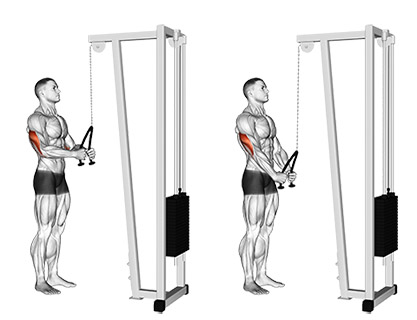
- Start position: Hold the rope with both hands, elbows close to your sides, hands at chest height.
- Push down: Extend your arms by pushing the rope downward. Keep your elbows fixed (do not move them forward).
- Spread the rope: At the bottom, pull your hands apart so the rope spreads outside your thighs. This gives a hard contraction.
- Pause: Hold for one second at the bottom, squeezing your triceps.
- Return slowly: Bring your hands back up, letting your arms bend until your forearms are parallel to the floor.
- Repeat: Perform the movement for your target reps (usually 10–15).
Key Form Tips
- Only your forearms should move. Keep upper arms still.
- Do not swing your body or use momentum.
- Control the weight both up and down.
- Exhale as you push down; inhale as you return.
Beginners often move their elbows forward or lean over too much. Keep your posture tall and elbows pinned to your sides.
Common Mistakes And How To Fix Them
Even regular gym users make mistakes with rope tricep exercises. Here are some errors to watch out for:
Using Too Much Weight
People often use more weight than they can handle, turning the movement into a “cheat” using shoulders and back. This reduces triceps activation and increases injury risk. Choose a weight you can control for at least 10 reps.
Flaring Elbows Outward
When elbows flare out, the focus shifts from triceps to shoulders. Keep elbows close to your sides throughout the movement.
Not Spreading The Rope
If you don’t separate your hands at the bottom, you miss the full contraction. Make sure to spread the rope apart at the end of each rep.
Incomplete Range Of Motion
Many stop short or don’t fully extend the arms. For best results, go all the way down and up with each rep—don’t “cut” the movement short.
Hunching Shoulders
Some people raise their shoulders while pushing down. This adds tension to your neck and reduces tricep work. Keep shoulders relaxed and low.
Advanced Tips For Better Results
Once you have the basics, these tips can help you get even more from your rope tricep exercises:
- Pause at the bottom: Hold the contraction for 1–2 seconds to increase muscle activation.
- Slow negatives: Lower the rope slowly for 2–3 seconds. This builds more muscle.
- Partial reps: At the end of your set, do a few “half reps” from halfway down to fully extended. This maximizes fatigue.
- Superset with biceps: Do rope tricep pushdowns followed by a biceps exercise. This gives a great arm pump.
Variations Of Rope Tricep Exercises
You can do more than just pushdowns with the rope. Here are some effective variations:
1. Overhead Rope Tricep Extension
- Stand facing away from the machine.
- Hold the rope behind your head, elbows up.
- Extend your arms overhead, then return slowly.
This targets the long head of the triceps and adds a deep stretch.
2. Single-arm Rope Pushdown
- Use one side of the rope, holding with one hand.
- Push down and spread at the bottom.
- Good for fixing muscle imbalances.
3. Rope Kickback
- Set the pulley low.
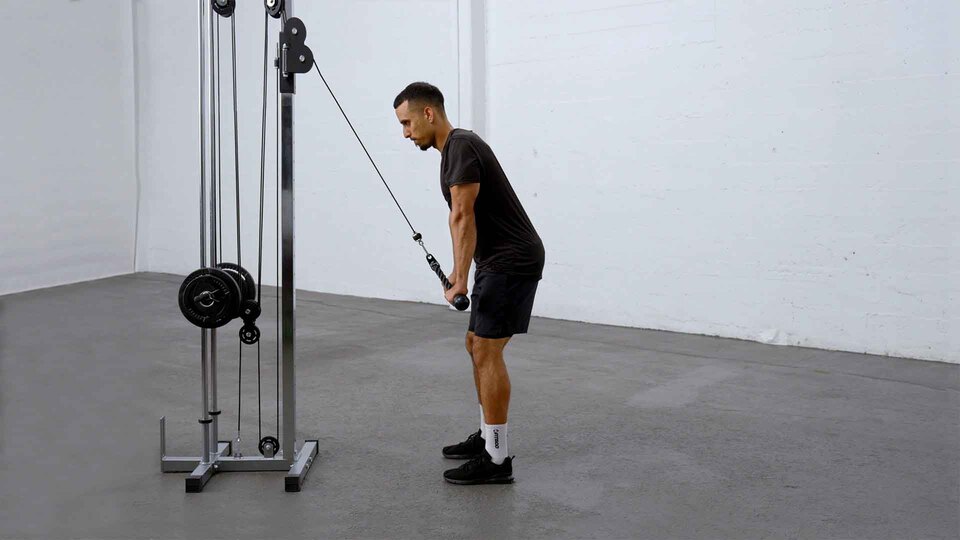
- Bend forward at the waist, upper arm parallel to floor.
- Extend your arm back, spreading the rope at the end.
4. Kneeling Rope Extension
- Kneel in front of the machine.
- Pull the rope down and extend your arms forward.
- This removes leg help, focusing on triceps.
5. Rope Tricep Press
- Lie on a bench with the rope attached to a low pulley.
- Extend your arms upward, spreading at the top.
This is a challenging variation for advanced lifters.
These variations help keep your triceps growing and prevent boredom.
Credit: fitbod.me
How Many Sets And Reps For Best Results?
For most people, 3–4 sets of 10–15 reps works well for rope tricep exercises. If you want more strength, you can try lower reps (6–8) with heavier weight. For muscle growth, higher reps (12–20) with good form are better.
Beginners should start with fewer sets to avoid soreness. Advanced lifters can use more volume if they recover well.
Here’s a quick guide for planning your workout:
| Goal | Sets | Reps | Rest (seconds) |
|---|---|---|---|
| Muscle growth | 3–4 | 10–15 | 60–90 |
| Strength | 3–5 | 6–8 | 90–120 |
| Endurance | 2–3 | 15–20 | 30–60 |
How To Add Rope Tricep Exercises To Your Routine
Rope tricep exercises fit well in many workout routines. You can do them after big “pressing” movements (like bench press or shoulder press), or as part of an arm day.
Example Split
- Push day: Do rope tricep pushdowns after chest and shoulder exercises.
- Arm day: Pair rope tricep pushdowns with biceps curls.
- Full body: Add one rope tricep exercise at the end.
Aim for 1–2 rope tricep exercises per week if you’re just starting. More advanced lifters can do up to 3 times per week, as long as recovery is good.
How To Progress Over Time
Progression is key for muscle growth. Here’s how to get better results:
- Add weight slowly: When you can do 15 reps easily, add 5–10 lbs.
- More reps: Increase reps before adding weight if you want more endurance.
- Better form: Keep strict form as you get stronger.
- Try new variations: Change the movement every 6–8 weeks.
Many people get stuck doing the same thing for months. Progress by making small, steady changes.
Safety Tips And Injury Prevention
Tricep rope exercises are safe if you use good form. However, mistakes can lead to elbow or shoulder pain. Here’s how to stay safe:
- Warm up your arms and shoulders with light weights or bands.
- Do not lock out your elbows forcefully at the bottom.
- Avoid jerking or swinging the weight.
- If you feel pain in your elbow or wrist, stop and check your form.
- Use a weight you can control for all reps.
If you have a past elbow injury, try a lighter rope or use a single-arm variation.
Benefits Beyond Bigger Arms
Tricep strength is not just for looks. Here are some real benefits:
- Better pressing power: Strong triceps help you bench press, push up, and shoulder press more weight.
- Joint health: Healthy triceps protect your elbows and shoulders.
- Sports performance: Many sports (boxing, basketball, swimming) use triceps for explosive movements.
Improving tricep size and strength carries over to many other exercises.
Rope Vs. Bar: Which Is Better?
People often ask if rope or bar is better for triceps. Both work, but there are important differences.
| Attachment | Pros | Cons |
|---|---|---|
| Rope | Better contraction, less wrist stress, more muscle activation | May be harder to control at high weights |
| Straight bar | Easy to use, allows more weight | Less natural wrist position, less contraction at bottom |
| EZ bar | Wrist-friendly, good for heavy loads | Still less range of motion than rope |
For most people, the rope is best for muscle growth and joint safety. You can alternate between attachments to keep your routine fresh.

Credit: www.youtube.com
Non-obvious Tips Beginners Miss
Some tips are not obvious but make a big difference:
- Leaning slightly forward (just 5–10 degrees) can help keep tension on your triceps and prevent using your lower back.
- At the top of the movement, keep tension on the muscle. Don’t let the weight pull your arms all the way up or let your elbows move forward.
- Use slow, controlled reps—this is more important than the amount of weight you use.
- If your grip is weak, use chalk or gym gloves. This helps you focus on triceps, not your hands.
These small adjustments can improve your results and reduce the risk of injury.
How To Know If You’re Doing It Right
After your set, your triceps should feel tight and tired, not your shoulders or wrists. If you feel pain in your joints, check your technique. You should also see your triceps working in the mirror—look for the muscle to flex and “pop” as you push down.
If you’re not sure, ask a trainer or record yourself and compare to proper form videos. Progress pictures every few weeks can also help you see growth.
When To Avoid Rope Tricep Exercises
Most people can do rope tricep exercises safely. However, you should be careful or avoid them if:
- You have a fresh elbow or wrist injury
- You have severe shoulder pain when pushing down
- The rope attachment is damaged or loose
If you have any medical conditions, ask a fitness professional or healthcare provider before starting.
Real-life Example: Quick Case Study
Carlos, a 32-year-old office worker, wanted bigger arms but always felt wrist pain during tricep exercises with the bar. After switching to the rope and focusing on spreading the rope at the bottom, he noticed less joint pain and more muscle growth in just eight weeks.
He started with 30 lbs for 12 reps, three sets. Each week, he added one rep or a few pounds. After two months, he could do 45 lbs for 15 reps with perfect form. His shirts fit tighter, and his elbow pain was gone.
This shows how small changes and good form can make a big difference.
Credit: www.hevyapp.com
Myths About Rope Tricep Exercises
Many people believe you need to lift very heavy or use complicated routines to grow your triceps. In reality, good form, full range of motion, and regular practice are more important than big weights.
Another myth is that only men should train triceps. Women can benefit just as much, as strong triceps help with daily tasks and arm definition.
How Rope Tricep Exercises Compare To Other Tricep Movements
Rope tricep exercises are effective, but not the only way to train your triceps. Here’s how they compare to other popular moves:
- Dips: Use bodyweight, work chest and shoulders too, harder for beginners.
- Skullcrushers: Use a barbell or dumbbells, give a good stretch, but can stress elbows.
- Close-grip bench press: Works triceps and chest, good for strength, needs a spotter.
- Diamond push-ups: Great for home workouts, uses your own body weight.
Rope pushdowns are safer for joints and easier to learn. For best results, combine rope exercises with other tricep movements over time.
Frequently Asked Questions
How Often Should I Do Rope Tricep Exercises?
Most people get good results doing rope tricep exercises 2–3 times per week. Make sure to rest at least 48 hours between workouts for the same muscle. Beginners can start with once a week and build up.
Can I Do Rope Tricep Exercises At Home?
If you have a cable machine and rope attachment at home, you can do these exercises easily. If not, you can use resistance bands tied to a high point as a substitute. The movement will be similar, but the resistance will change as you stretch the band.
What Is The Best Grip For The Rope Tricep Pushdown?
Use a neutral grip (palms facing each other) at the top. As you push down, spread your hands apart and turn your palms slightly outward at the bottom. This gives the best muscle contraction and is easier on your wrists.
Why Do I Feel My Shoulders Or Back During Rope Tricep Exercises?
This usually means your form needs fixing. Make sure you are not swinging your body or letting your elbows move forward. Keep your chest up, shoulders back, and only move your forearms. Lower the weight if needed until you feel your triceps working.
Are Rope Tricep Exercises Better Than Using A Bar?
Rope exercises often give a better muscle contraction and are easier on your wrists. Bars allow you to lift more weight, but can stress your joints. For most people, the rope is safer and more effective for muscle growth. You can mix both for variety.
For more details on tricep training and muscle building, you can check this Bodybuilding.com guide.
Developing strong, defined triceps takes patience and practice. With the right technique, smart progression, and the rope attachment, you’ll see real results. Start light, focus on form, and enjoy your stronger arms.
