

Glute Workout With Kettlebell: Build Stronger, Rounder Glutes Fast
Glute Workout With Kettlebell
A strong, toned set of glutes isn’t just for looks. Your glute muscles are among the largest and most powerful in your body. They help you walk, run, jump, and lift. Many people want to improve their glutes, but don’t know the best way. Gyms can feel intimidating, and machines aren’t always accessible. Luckily, you can sculpt your glutes at home or anywhere with just one tool: a kettlebell.
Kettlebell workouts are simple, but highly effective for building and strengthening your glutes. This guide will show you how kettlebells can help, which exercises work best, and how to build a glute-focused routine. You’ll also learn how to avoid common mistakes, choose the right weight, and see results faster.
Whether you’re a beginner or have some experience, you’ll find practical advice and clear steps. Let’s unlock your glute potential with kettlebell training.
Why Kettlebells Are Ideal For Glute Training
Most people think about squats or lunges when they want stronger glutes. But kettlebells offer unique benefits. Their shape and handle let you move in ways that dumbbells or barbells can’t. You can swing, thrust, and rotate. This activates your glutes from different angles and makes your muscles work harder.
Kettlebells also train your balance and coordination. Each move forces your body to stabilize, so your glutes engage more. Plus, kettlebell exercises often combine strength and cardio, burning calories while you build muscle.
Key Benefits
- Full activation: Kettlebell swings and thrusts recruit all glute fibers.
- Functional strength: Movements mimic real-life actions, improving daily function.
- Versatile routines: You can train almost anywhere.
- Balanced development: Kettlebells help fix muscle imbalances between sides.
- Core engagement: Glute moves with kettlebells also strengthen your abs and lower back.
Studies show kettlebell swings can produce similar glute activation as heavy barbell squats, but with less stress on your joints. This makes kettlebells a safer option for many people.
Anatomy Of The Glutes: What You’re Training
To build strong glutes, it helps to know what you’re working. The glute muscles are made of three main parts:
- Gluteus maximus: The largest, gives your butt its shape and power.
- Gluteus medius: Smaller, helps with balance and hip movement.
- Gluteus minimus: Deepest, stabilizes your hips.
Each kettlebell exercise targets these muscles differently. For full development, your routine should include moves that hit all three.
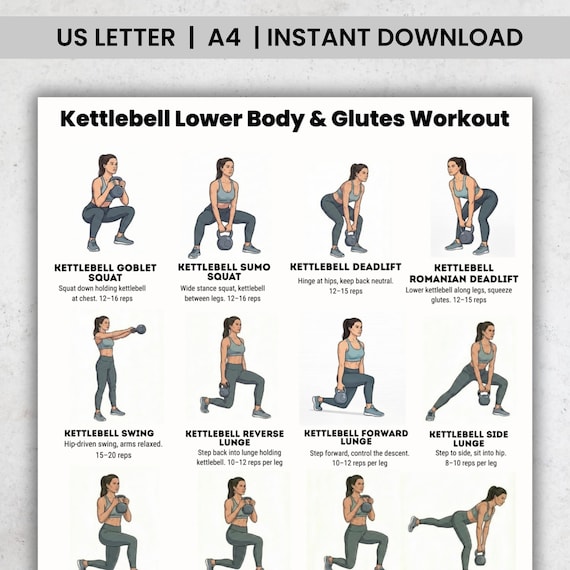
Credit: www.etsy.com
Choosing The Right Kettlebell Weight
Picking the right kettlebell is crucial. Too light, and your muscles won’t grow. Too heavy, and you risk injury or poor form.
For most beginners:
- Women: Start with 15–25 lbs (7–12 kg)
- Men: Start with 25–35 lbs (12–16 kg)
If you’re stronger or experienced, you can use heavier kettlebells. But always focus on proper form first. If you can easily do 15 reps with good form, go up in weight. If you struggle to finish 8 reps, use a lighter kettlebell.
Here’s a quick comparison of kettlebell weights for glute exercises:
| Experience Level | Recommended Weight (Women) | Recommended Weight (Men) | Exercise Examples |
|---|---|---|---|
| Beginner | 15–20 lbs | 25–30 lbs | Goblet Squat, Glute Bridge |
| Intermediate | 20–30 lbs | 30–40 lbs | Kettlebell Swing, Deadlift |
| Advanced | 30–40 lbs | 40–60 lbs | Single-Leg Deadlift, Hip Thrust |
If possible, get two kettlebells—one lighter, one heavier. This lets you adjust for different exercises.
Essential Kettlebell Glute Exercises
Building strong glutes with kettlebells means focusing on compound movements. These exercises work your glutes, but also legs, core, and back. Here’s a breakdown of the most effective kettlebell glute exercises.
1. Kettlebell Swing
This is the king of glute kettlebell moves. It’s explosive and targets the gluteus maximus.
How to do it:
- Stand with feet shoulder-width apart.
- Hold the kettlebell with both hands, arms straight.
- Bend your knees slightly, hinge at hips, and swing the kettlebell between your legs.
- Thrust your hips forward, squeeze your glutes, and swing the kettlebell to chest height.
- Let it swing back, repeat.
Tips:
- Don’t use your arms; the power comes from your hips and glutes.
- Keep your back straight.
- Start with 3 sets of 12–15 reps.
2. Goblet Squat
This move hits all glute muscles plus your quads and core.
How to do it:
- Hold the kettlebell at your chest, elbows pointing down.
- Feet shoulder-width apart.
- Squat down, keeping your chest up and back flat.
- Push through your heels to stand up, squeezing your glutes.
Tips:
- Go as low as you can without rounding your back.
- Start with 3 sets of 10–12 reps.
3. Kettlebell Deadlift
Great for building the posterior chain and targeting glutes, hamstrings, and lower back.
How to do it:
- Place the kettlebell on the floor between your feet.
- Stand with feet hip-width apart.
- Hinge at hips, grab the kettlebell with both hands.
- Stand up by pushing your hips forward, squeeze your glutes at the top.
Tips:
- Don’t round your back.
- Start with 3 sets of 10–12 reps.
4. Single-leg Romanian Deadlift
This move targets gluteus maximus and medius, improves balance, and corrects muscle imbalances.
How to do it:
- Hold the kettlebell in one hand.
- Stand on the opposite leg.
- Hinge at hips, let the kettlebell lower toward the ground as your free leg extends behind.
- Return to standing, squeeze glutes.
Tips:
- Keep your hips level.
- Start with 3 sets of 8–10 reps per leg.
5. Kettlebell Hip Thrust
Hip thrusts are a direct glute builder.
How to do it:
- Sit on the ground, upper back against a bench or sofa.
- Roll the kettlebell onto your hips.
- Bend knees, feet flat.
- Thrust hips up, squeeze glutes at the top.
- Lower and repeat.
Tips:
- Don’t arch your back.
- Start with 3 sets of 12 reps.
6. Kettlebell Glute Bridge
Similar to hip thrust, but done on the ground.
How to do it:
- Lie on your back, knees bent, feet flat.
- Place kettlebell on hips.
- Lift hips up, squeeze glutes, lower down.
Tips:
- Hold at the top for 2–3 seconds.
- Start with 3 sets of 12 reps.
7. Bulgarian Split Squat
This hits the gluteus medius and maximus, plus improves single-leg strength.
How to do it:
- Stand in front of a bench.
- Hold kettlebell at your chest.
- Place one foot behind on bench.
- Lower into a lunge, push up with front leg.
Tips:
- Keep knee in line with toes.
- Start with 3 sets of 8–10 reps per leg.
8. Kettlebell Step-up
Step-ups build glute strength and power.
How to do it:
- Hold kettlebell at chest.
- Step onto a sturdy bench or box.
- Push through heel, stand up, then step down.
Tips:
- Don’t let knee go too far forward.
- Start with 3 sets of 10 reps per leg.
9. Kettlebell Sumo Deadlift
A wider stance shifts more work to the glutes.
How to do it:
- Stand with feet wider than shoulder-width.
- Hold kettlebell with both hands.
- Lower kettlebell to floor, stand up by pushing hips forward.
Tips:
- Keep chest up.
- Start with 3 sets of 10–12 reps.
10. Kettlebell Lateral Lunge
Targets the gluteus medius and improves hip mobility.
How to do it:
- Hold kettlebell at chest.
- Step to the side, bend knee, lower into a lunge.
- Push back to starting position.
Tips:
- Don’t let knee collapse inward.
- Start with 3 sets of 8 reps per side.
Building Your Kettlebell Glute Workout Routine
To get the most from your kettlebell glute workouts, you need a plan. Random exercises won’t bring consistent results. Here’s how to structure your routine for maximum gains.
Sample Weekly Glute Workout
Aim for 2–3 glute-focused sessions per week. Muscles need time to recover and grow.
Example:
Day 1: Strength Focus
- Kettlebell Deadlift: 3x12
- Goblet Squat: 3x10
- Hip Thrust: 3x12
- Single-Leg Deadlift: 3x8 (each leg)
Day 2: Power & Endurance
- Kettlebell Swing: 4x15
- Step-Up: 3x10 (each leg)
- Glute Bridge: 3x12
- Bulgarian Split Squat: 3x8 (each leg)
Day 3: Mobility & Activation
- Sumo Deadlift: 3x10
- Lateral Lunge: 3x8 (each side)
- Single-Leg Glute Bridge: 3x10 (each leg)
Rest between sets: 60–90 seconds for strength, 30–60 seconds for power/endurance.
Progression Tips
- Increase kettlebell weight every 2–3 weeks if you can perform all reps easily.
- Add extra sets or reps for more challenge.
- Change exercises to avoid plateaus.
Common Mistakes To Avoid
Even simple kettlebell moves can go wrong. Here are mistakes that slow progress or cause injury:
- Using arms for swings: Power should come from hips, not shoulders.
- Rounding back in deadlifts: Always keep your spine neutral.
- Letting knees cave in: Maintain knee alignment in squats and lunges.
- Skipping warm-up: Warm up with light cardio or dynamic stretches.
- Too much weight too soon: Start lighter, master form, then go heavier.
Many beginners forget to engage their glutes. Actively squeeze your glutes during each rep. This increases muscle activation and builds strength faster.
Glute Activation: Why It Matters
Before your main workout, glute activation is key. If your glutes are “sleepy,” other muscles like your back or hamstrings take over. This reduces results and can cause injury.
Simple glute activation drills:
- Bodyweight glute bridges: 2 sets of 15 reps
- Clamshells: 2 sets of 12 reps each side
- Monster walks (banded): 2 sets of 20 steps
Do these before kettlebell exercises. You’ll feel your glutes working harder, and your workout will be safer.
Kettlebell Vs. Other Glute Training Methods
How do kettlebells compare to classic glute training like barbells, machines, or bodyweight?
Let’s look at a quick comparison:
| Training Method | Glute Activation | Equipment Needed | Accessibility | Joint Impact |
|---|---|---|---|---|
| Kettlebell | High | 1 kettlebell | Anywhere | Low |
| Barbell | Very High | Barbell, plates | Gym | Higher |
| Machines | Medium | Gym machines | Gym | Low |
| Bodyweight | Low–Medium | None | Anywhere | Lowest |
Kettlebells offer a balance of high activation, low joint stress, and portability. You can use them at home, outside, or in a gym.
Tracking Progress And Measuring Results
Seeing results is motivating. But glute growth and strength can be slow. Here’s how to track your progress:
- Take pictures: Photograph your glutes and legs every 4 weeks.
- Measure: Use a tape measure around your hips and thighs.
- Strength tests: Track reps, sets, and kettlebell weight over time.
- Feel: Notice improvements in daily movements, like standing from a chair or climbing stairs.
Glute changes are often subtle. Consistent training, good nutrition, and rest are key. Don’t expect overnight results, but small gains add up.
Nutrition Tips For Glute Growth
Training is only half the story. Muscles need fuel to grow. Here’s how to eat for stronger glutes:
- Protein: Aim for 1.2–1.6 grams per kilogram of body weight per day.
- Healthy fats: Include avocados, olive oil, nuts, and seeds.
- Complex carbs: Eat whole grains, sweet potatoes, fruits, and vegetables.
- Hydration: Drink water throughout the day.
If you want to build muscle, a slight calorie surplus helps. But avoid junk food or processed snacks. Focus on real, whole foods.
Advanced Glute Kettlebell Techniques
Once you master basic exercises, try advanced moves for more challenge:
1. Kettlebell Clean And Press
This full-body move builds explosive power and glute strength.
How to do it:
- Start with kettlebell on floor.
- Clean it to shoulder (pull and swing).
- Press overhead.
- Return to floor.
Tip: Use legs to drive the movement, not just arms.
2. Kettlebell Snatch
A dynamic exercise that targets glutes, hips, and shoulders.
How to do it:
- Swing kettlebell overhead in one motion.
- Catch at top, lower and repeat.
Tip: Start light and build up.
3. Kettlebell Windmill
Works glutes and core together.
How to do it:
- Hold kettlebell overhead.
- Hinge at hips, touch opposite foot.
- Return to standing.
Tip: Keep kettlebell stable overhead.
These moves require good technique. Watch videos or get coaching if you’re unsure.

Credit: www.youtube.com
Glute Training For Different Goals
Your glute routine can be adjusted depending on your goal. Here’s how to tailor your kettlebell workout:
For Muscle Growth (hypertrophy)
- Use heavier kettlebells.
- Focus on 8–12 reps per set.
- Rest 60–90 seconds.
- Mix compound and isolation moves.
For Strength
- Use maximal weight you can lift for 4–8 reps.
- Longer rest (2 minutes).
- Focus on deadlifts, hip thrusts, squats.
For Fat Loss
- Use moderate weight.
- Increase reps (15–20).
- Short rest (30 seconds).
- Combine swings with squats, lunges, bridges.
For Performance
- Add power moves (swings, snatches, cleans).
- Mix single-leg exercises for balance.
- Include plyometric drills (jump squats).
Glute Workout Safety Tips
Safety matters. Here’s how to protect yourself:
- Warm up with mobility and light cardio for 5–10 minutes.
- Start with low weight to learn the movement.
- Wear flat shoes or go barefoot for better stability.
- Don’t rush reps; focus on control.
- If you feel sharp pain, stop immediately.
If you have a history of back, knee, or hip injury, consult a trainer or doctor before starting new exercises.
Kettlebell Glute Workout For Home
You can build strong glutes anywhere. Here’s a home workout with minimal space and one kettlebell.
Warm-up: 5 minutes brisk walking or jogging in place
Workout:
- Kettlebell Swing: 3x15
- Goblet Squat: 3x12
- Single-Leg Deadlift: 3x8 each leg
- Glute Bridge: 3x15
- Step-Up (use stairs or sturdy chair): 3x10 each leg
Cool-down: Stretch glutes, hamstrings, quads for 5 minutes.
This routine takes about 30–35 minutes and works all glute muscles.
Getting The Most From Your Kettlebell Glute Workout
- Focus on mind-muscle connection. Squeeze your glutes during each rep.
- Use progressive overload. Gradually increase weight or reps.
- Vary your exercises. Change moves every few weeks.
- Record your workouts. Write down sets, reps, weight used.
- Rest and recover. Muscles need 48 hours between glute sessions.
Most people miss the importance of recovery. Your glutes grow when you rest, not just when you train.
Real-life Examples And Success Stories
Many people have transformed their bodies with kettlebell glute workouts. Here are some typical results:
- Sarah started with 15 lbs kettlebell. After 3 months, she increased to 30 lbs. Her glutes became stronger, and her posture improved.
- Mike used kettlebell swings and hip thrusts. He lost 12 pounds, built visible glute muscle, and his back pain disappeared.
- Aisha combined kettlebell deadlifts with step-ups. She noticed her running speed improved and her jeans fit better.
The secret is consistency. Even small improvements each week add up over time.
Glute Workout Variations For All Fitness Levels
No matter your level, you can adapt kettlebell glute workouts:
Beginner
- Focus on basic moves: Swings, squats, bridges.
- Use light kettlebell.
- Keep reps moderate (10–12).
- Practice form.
Intermediate
- Add single-leg moves.
- Increase weight.
- Try new exercises: Split squats, sumo deadlifts.
Advanced
- Use heavy kettlebell.
- Combine moves into circuits.
- Add plyometric drills.
- Reduce rest time.
Non-obvious insight: Even advanced trainees sometimes neglect single-leg moves. These are vital for balanced glute growth and injury prevention.
:extract_cover():upscale()/2023/11/07/694/n/1922729/b4640cad654a5a3f6b4bc1.27782436_PS23_Fitness.jpg)
Credit: www.popsugar.com
Kettlebell Glute Workout For Athletes
Athletes need strong glutes for speed, power, and stability. Kettlebell workouts fit well into sports training.
Benefits for athletes:
- Improve sprint speed (glute power)
- Reduce injury risk (better hip stability)
- Enhance jumping ability
- Support agility and balance
Add kettlebell swings, single-leg deadlifts, and step-ups to your routine for athletic gains.
Recovery And Stretching For Glutes
After kettlebell workouts, stretch your glutes and hips. This reduces soreness and helps muscles grow.
Good stretches:
- Seated figure-four stretch
- Standing hip flexor stretch
- Pigeon pose (yoga)
- Side-lying glute stretch
Hold each stretch for 20–30 seconds. Repeat 2–3 times.
Frequently Asked Questions
How Often Should I Do Kettlebell Glute Workouts?
Most people see best results with 2–3 sessions per week. This allows enough recovery and growth. Avoid training glutes every day, as muscles need time to repair.
What If I Only Have One Kettlebell?
You can still build strong glutes with a single kettlebell. Focus on moves like swings, goblet squats, deadlifts, and bridges. Adjust reps and sets for your fitness level. If needed, slow down reps or pause at the top for extra challenge.
Can Kettlebell Workouts Help Reduce Cellulite?
Kettlebell glute workouts build muscle and burn fat. This can help reduce the appearance of cellulite by tightening and firming the skin. Combined with good nutrition and hydration, results improve over time.
Are Kettlebell Glute Workouts Safe For Beginners?
Yes. Start with light weight and focus on proper form. Avoid rushing or using heavy kettlebells until you master the basic movements. If unsure, ask a trainer for help or watch instructional videos from trusted sources like ACE Fitness.
How Long Before I See Glute Gains?
Most people notice changes in 4–8 weeks with consistent kettlebell training. Results depend on your starting point, diet, and workout quality. Measure progress with photos, tape, and strength tests.
Final Thoughts
Glute workouts with kettlebells are powerful, simple, and accessible. With just one tool, you can build strength, improve balance, and shape your glutes. The variety of exercises lets you target all parts of the glute muscle, and routines can be tailored for any fitness level.
Focus on proper technique, progressive overload, and recovery. Consistency brings results. Whether you train at home or in a gym, kettlebell glute workouts can transform your body and boost your confidence. Start today and enjoy stronger, healthier glutes for life.
