

Glute Workout With Dumbbells: Build Stronger, Rounder Glutes Fast
A strong, toned lower body is not just about looks. The glute muscles—your gluteus maximus, medius, and minimus—play a big role in daily movements like walking, standing, and climbing stairs. Healthy glutes support your back, help with posture, and boost sports performance. For many people, getting a great glute workout at home or in a gym without fancy machines can seem hard. But with just a pair of dumbbells, you can target your glutes effectively, build strength, and shape your lower body.
Many fitness guides focus on squats and lunges, but these are just the beginning. Using dumbbells adds weight and challenge, helping your muscles grow and become stronger. This article will guide you through the best glute exercises with dumbbells, how to build a smart routine, common mistakes, and tips to get results faster.
Whether you are a beginner or looking to take your glute training to the next level, you’ll find clear steps, expert advice, and practical examples here.
Why Train Glutes With Dumbbells?
Dumbbells are simple, affordable, and flexible. Unlike machines, they allow your body to move more naturally, which works your glutes and supporting muscles better. Here are some of the top reasons to use dumbbells for glute training:
- Increased muscle activation: Dumbbells let you move freely, so your glutes work harder to control and lift the weight.
- Better balance and stability: Many dumbbell exercises need you to stabilize your body, which activates your core and smaller glute muscles.
- Easy to progress: As you get stronger, you can increase the dumbbell weight or change how you hold them.
- Accessible for all levels: Beginners can start with light weights, while advanced users can push with heavier loads.
- Versatile workouts: You can do many different exercises with just one or two pairs of dumbbells.
A common mistake is thinking you need a gym full of machines for strong glutes. In reality, consistency and progressive overload (gradually increasing weight or reps) matter more than equipment.
Understanding The Glute Muscles
Knowing a bit about your glute muscles helps you target them better during workouts. Your glutes are made up of three main muscles:
- Gluteus maximus: The largest, responsible for hip extension (moving your leg backward), and most of the shape and power.
- Gluteus medius: Located on the side, helps with hip abduction (moving your leg out to the side) and stability.
- Gluteus minimus: Smallest, deep inside, also helps with hip stability.
Different exercises target these parts in unique ways. For balanced development and injury prevention, you should train all three.
Key Principles For Effective Glute Workouts
Before jumping into exercises, it helps to understand what makes a glute workout effective:
- Progressive overload: Gradually increase the weight, reps, or sets over time.
- Mind-muscle connection: Focus on squeezing the glutes during each rep, not just moving the weight.
- Range of motion: Use a full, controlled range to work the muscle completely.
- Variety: Use different exercises and angles to hit all parts of the glutes.
- Rest and recovery: Muscles need time to repair and grow. Do not train glutes hard every day.
Many people miss the importance of the mind-muscle connection. Simply lifting weights isn’t enough; you must feel your glutes working during each movement. Pausing at the top of a rep or slowing down the lowering phase can help.
Essential Glute Dumbbell Exercises
Let’s break down the most effective dumbbell exercises for your glutes. These moves cover all angles and parts of the glute muscles.
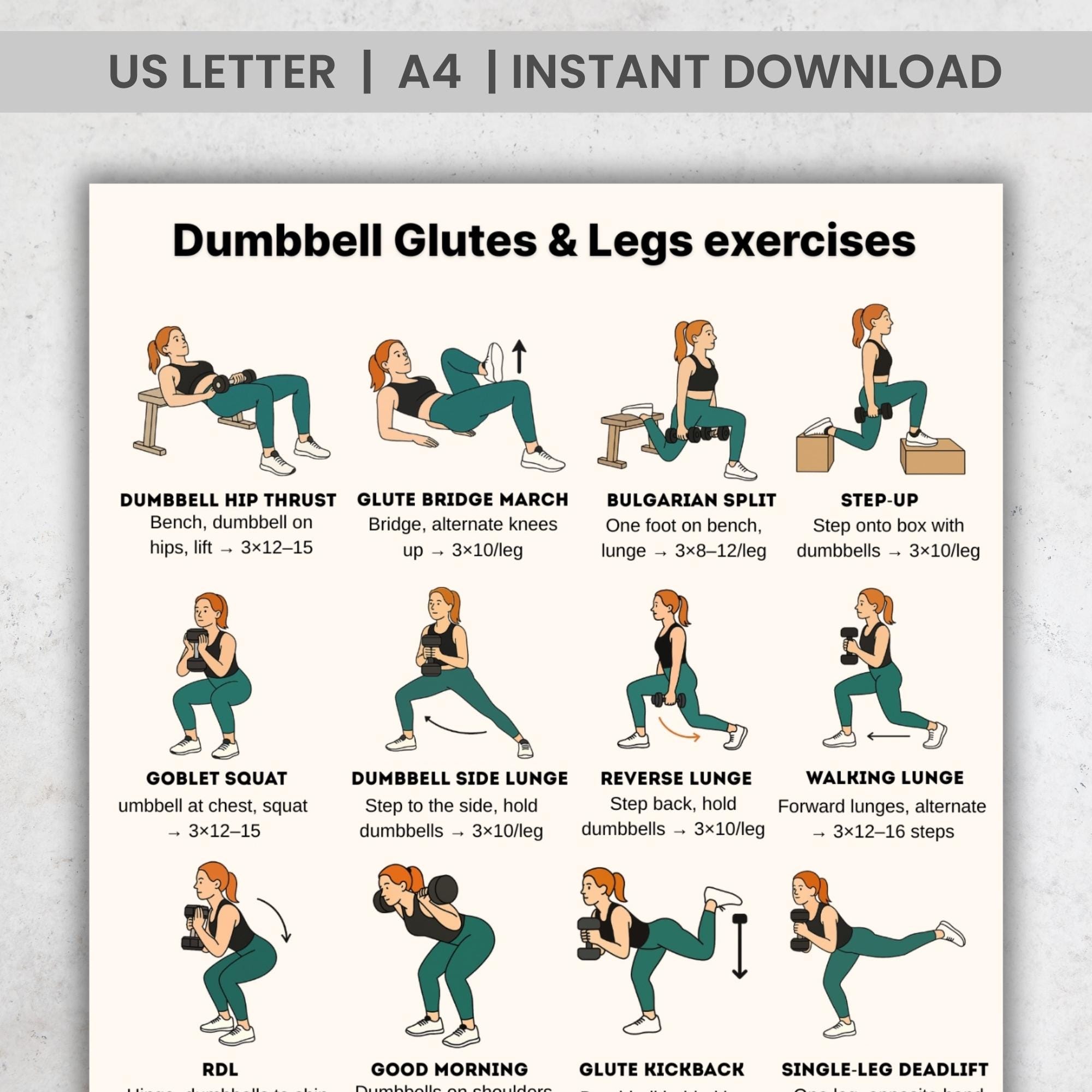
Dumbbell Hip Thrust
This exercise is a glute-building staple. You’ll need a bench or sturdy surface.
- Sit on the ground with your upper back against a bench, knees bent, and feet flat.
- Roll a dumbbell onto your hips (hold it with both hands).
- Drive through your heels, lift your hips, and squeeze your glutes at the top.
- Lower with control.
Tip: Keep your chin tucked and ribs down. Don’t arch your back.
Dumbbell Romanian Deadlift
This move targets your glutes and hamstrings.
- Stand with feet hip-width apart, dumbbells in front of your thighs.
- With a slight bend in your knees, hinge at your hips, pushing your butt back.
- Lower the dumbbells along your legs until you feel a stretch in your hamstrings.
- Drive your hips forward to stand up, squeezing your glutes.
Tip: Keep your back flat, not rounded.
Dumbbell Bulgarian Split Squat
Great for single-leg strength and glute activation.
- Stand a few feet in front of a bench. Place one foot behind you on the bench.
- Hold dumbbells at your sides.
- Lower your back knee toward the floor, keeping your front knee over your ankle.
- Push through your front heel to return to the top.
Tip: Lean slightly forward to target glutes more than quads.
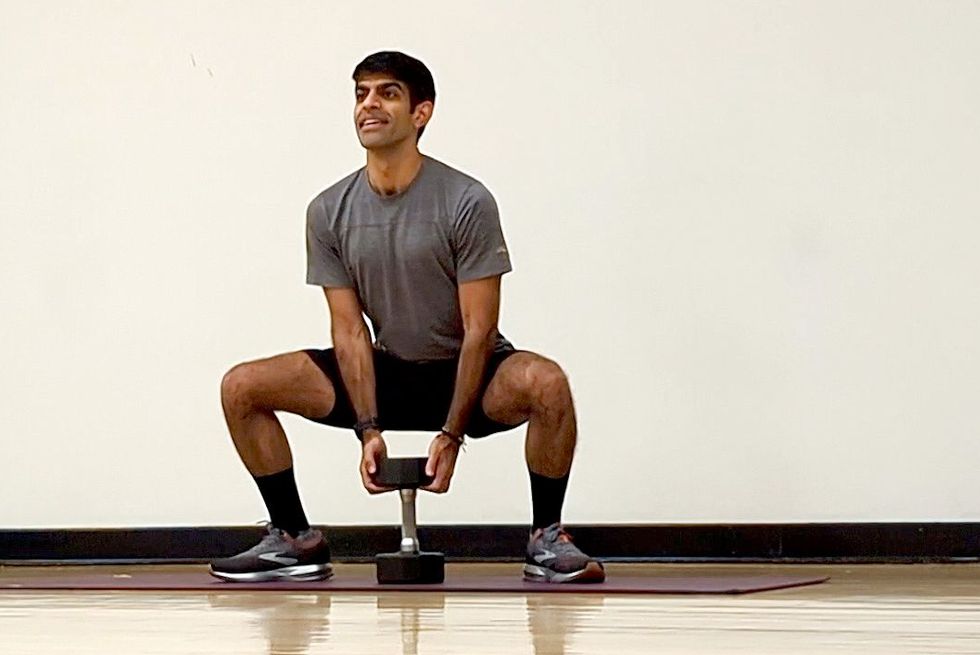
Dumbbell Sumo Squat
This squat variation targets the glutes and inner thighs.
- Stand with feet wider than hips, toes turned out.
- Hold a dumbbell with both hands at your chest or between your legs.
- Lower your hips down and back, keeping your chest up.
- Press through your heels to stand.
Tip: Don’t let your knees cave in.
Dumbbell Step-up
A functional move for strength and balance.
- Stand in front of a bench or step, holding dumbbells.
- Step up with one foot, pressing through your heel to lift your body up.
- Step down with control.
Tip: Push your hips back slightly as you step up to feel the glutes more.
Dumbbell Glute Bridge
Similar to the hip thrust but with a smaller range of motion.
- Lie on your back, knees bent, feet flat.
- Place a dumbbell on your hips.
- Drive through your heels, lifting your hips.
- Squeeze at the top, then lower down.
Tip: Keep your feet about shoulder-width apart.
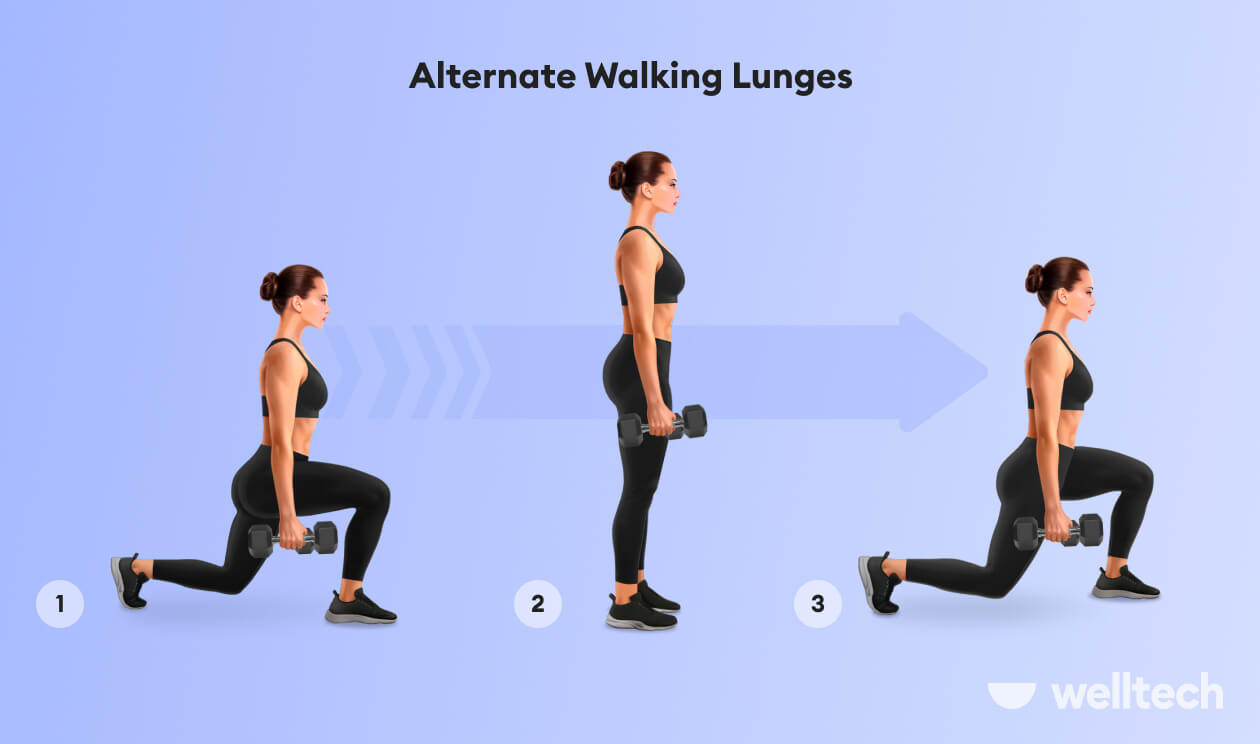
Dumbbell Curtsy Lunge
This lunge works your glutes from a different angle.
- Stand tall with dumbbells at your sides.
- Step one leg behind and across the other, lowering your back knee.
- Return to start and switch sides.
Tip: Keep your chest up and hips square.
Dumbbell Single-leg Deadlift
An excellent balance and glute exercise.
- Stand with a dumbbell in each hand.
- Shift weight to one leg, hinge at the hips, and lift the other leg behind you.
- Lower the dumbbells toward the floor, then return to standing.
Tip: Go slow for balance and control.
Dumbbell Frog Pump
A glute activation move.
- Lie on your back, feet together, knees out wide.
- Place a dumbbell on your hips.
- Thrust your hips up, squeezing glutes.
Tip: Keep knees open and heels together.
These exercises can be mixed and matched to create a complete glute workout. Beginners should focus on learning good form with light weights before increasing load.
Sample Glute Dumbbell Workout Routines
Let’s see how these exercises fit into real routines. Here are two sample workouts: one for beginners, one for more advanced lifters.
Beginner Glute Workout
- Dumbbell Glute Bridge: 3 sets x 12 reps
- Dumbbell Romanian Deadlift: 3 sets x 10 reps
- Dumbbell Sumo Squat: 3 sets x 12 reps
- Dumbbell Step-Up: 2 sets x 10 reps (per leg)
Rest 60 seconds between sets.
Advanced Glute Workout
- Dumbbell Hip Thrust: 4 sets x 12 reps
- Dumbbell Bulgarian Split Squat: 3 sets x 10 reps (per leg)
- Dumbbell Single-Leg Deadlift: 3 sets x 10 reps (per leg)
- Dumbbell Frog Pump: 3 sets x 20 reps
- Dumbbell Curtsy Lunge: 2 sets x 12 reps (per leg)
Rest 60-90 seconds between sets.
Tip: You can train glutes 2-3 times per week, but leave at least one rest day between heavy sessions.
Comparing Dumbbell Glute Exercises
It’s helpful to compare how different exercises target the glutes and supporting muscles. Here’s a quick look at some popular moves:
| Exercise | Main Glute Area | Other Muscles Worked | Difficulty |
|---|---|---|---|
| Hip Thrust | Gluteus maximus | Hamstrings, core | Medium |
| Romanian Deadlift | Gluteus maximus | Hamstrings, lower back | Medium |
| Bulgarian Split Squat | Gluteus maximus, medius | Quads, core | Hard |
| Sumo Squat | Gluteus maximus, medius | Adductors, quads | Easy |
| Step-Up | Gluteus maximus | Quads, calves | Medium |
Credit: www.etsy.com
How To Pick The Right Weight
Choosing the right dumbbell weight is key. Too light and you won’t see results; too heavy and your form may suffer.
- Beginners: Start with a weight you can lift for 12-15 reps with good form. For most people, this is 10-20 lbs per dumbbell.
- Intermediate/Advanced: Use a weight that challenges you for 8-12 reps. When you can do 2 more reps than your target, increase the weight.
A smart way to test is by doing a “last rep” check—if you can easily do more than your target, go heavier. If you cannot finish all reps with good form, reduce the weight.
Proper Form And Common Mistakes
Good form is crucial for safety and results. Here are some common mistakes and how to fix them:
- Letting knees cave in: Keep knees in line with toes, especially on squats and lunges.
- Rounding the back: Keep your chest up and back straight during deadlifts and squats.
- Using momentum: Move slowly and control the weight, especially on the way down.
- Not engaging glutes: Focus on squeezing your glutes at the top of each movement.
- Going too heavy, too soon: Master form first, then increase weight.
A common beginner mistake is using the lower back to lift in deadlifts or hip thrusts. Always keep your core tight and hinge from the hips.
Creating A Balanced Glute Program
A good program balances frequency, intensity, and variety. Here’s a simple plan:
- Train glutes 2-3 times per week.
- Use a mix of compound (multi-joint) and isolation (single-muscle) exercises.
- Change your exercises or rep ranges every 4-6 weeks.
- Include both bilateral (two-leg) and unilateral (single-leg) moves.
Example schedule:
| Day | Main Glute Exercise | Accessory Exercise |
|---|---|---|
| Monday | Dumbbell Hip Thrust | Dumbbell Curtsy Lunge |
| Wednesday | Dumbbell Romanian Deadlift | Dumbbell Frog Pump |
| Friday | Dumbbell Bulgarian Split Squat | Dumbbell Sumo Squat |
Rest at least 48 hours between hard glute workouts to allow recovery.
Tips For Faster Glute Growth
Building muscle takes time, but these tips can help you see results sooner:
- Eat enough protein: Aim for about 0.7-1 gram per pound of body weight daily.
- Prioritize sleep: Recovery happens when you sleep. Aim for 7-9 hours per night.
- Track your progress: Write down your workouts, weights, and reps.
- Focus on quality: Perfect your form before adding more weight.
- Stay consistent: Results come from regular effort over weeks and months.
A non-obvious tip: Use a mirror or film yourself to check your form. Many people think they are doing an exercise correctly but are actually missing key details.
Home Vs. Gym: Where To Train Glutes With Dumbbells?
You can get a good glute workout almost anywhere with dumbbells. Here’s a look at the pros and cons:
| Setting | Advantages | Drawbacks |
|---|---|---|
| Home | Convenient, private, no travel | Limited weights, less equipment variety |
| Gym | More weights, benches, mirrors | Travel needed, may be crowded |
A useful tip if you train at home: Invest in adjustable dumbbells. They save space and allow you to increase weight as you get stronger.
Advanced Techniques For Glute Workouts
Once you master the basics, you can use these advanced methods to boost your results:
- Paused reps: Hold the top of a hip thrust or bridge for 2-3 seconds.
- Slow negatives: Lower the weight slowly (3-4 seconds) to increase time under tension.
- Drop sets: After reaching muscle failure, drop to a lighter weight and continue.
- Supersets: Pair two exercises (like hip thrusts and frog pumps) with no rest between.
These techniques can help break through plateaus and challenge your glutes in new ways.
Credit: welltech.com
Importance Of Warm-up And Mobility
Never skip your warm-up. It prepares your muscles and joints, reduces injury risk, and improves performance.
A good glute warm-up includes:
- 5-10 minutes of light cardio (walking, cycling)
- Dynamic stretches (leg swings, hip circles)
- Glute activation drills (bodyweight glute bridges, clamshells)
Mobility work (foam rolling, stretching) can help keep your hips and lower back healthy.
The Science Behind Glute Training With Dumbbells
Studies show that free weights like dumbbells are highly effective for building glute muscle. Because dumbbells allow natural movement, they engage more stabilizer muscles than machines. Research also suggests that hip thrusts and deadlifts are among the best exercises for activating the gluteus maximus.
A key insight: It’s not just about lifting heavy. Using a full range of motion and focusing on glute activation leads to better muscle growth.
For more on the science of muscle building, check resources like the National Institutes of Health.
Nutrition For Glute Growth
Training is only half the story. The food you eat powers your workouts and repairs your muscles. Here’s what matters most:
- Protein: Needed for muscle repair and growth. Choose lean meats, dairy, eggs, beans, or plant-based protein.
- Carbohydrates: Fuel your workouts. Whole grains, fruits, and vegetables are good options.
- Healthy fats: Support hormone health. Avocados, nuts, and olive oil are smart choices.
- Hydration: Muscles need water to function well. Drink throughout the day, not just during workouts.
Many people overlook nutrition, but it can make or break your results.
How Long Does It Take To See Results?
Everyone wants fast results, but glute growth takes patience. On average:
- Visible changes: 4-8 weeks with consistent training and good nutrition
- Strength gains: Can start in 2-4 weeks
- Major muscle growth: 3-6 months or more
Factors like age, genetics, diet, and training routine affect your progress. Take progress photos every 2-4 weeks to notice changes that the mirror may miss.
Mistakes To Avoid In Glute Dumbbell Training
Some mistakes can slow your progress or cause injury. Watch out for these:
- Neglecting other muscles: Don’t skip core and leg exercises; they support strong glutes.
- Overtraining: Muscles grow when resting, not during workouts.
- Impatience: Changing routines or weights too often can slow progress.
- Bad posture: Slouching or arching the back reduces glute activation.
- Ignoring pain: Soreness is normal, sharp pain is not. Rest and see a professional if needed.
A less obvious mistake: Focusing only on heavy weights and not on the quality of each rep. Sometimes, lighter weights with better form are more effective.
Staying Motivated For Glute Training
Motivation can drop, especially when progress feels slow. Here are ways to stay on track:
- Set small, realistic goals: Like adding 5 lbs to your deadlift or doing one more rep.
- Find a workout partner: Accountability helps.
- Track your progress: Use a journal or app.
- Celebrate non-scale victories: Improved posture, more energy, better mood.
- Mix things up: Try new exercises every few weeks.
Remember, everyone’s journey is unique. Enjoy the process, not just the results.
Credit: www.bicycling.com
Frequently Asked Questions
How Often Should I Train Glutes With Dumbbells?
For most people, 2-3 times per week is enough. This gives your muscles time to recover and grow. Training more often can lead to overtraining and slower progress.
How Heavy Should My Dumbbells Be For Glute Exercises?
Start with a weight you can lift for 12-15 reps with good form. For many beginners, this is 10-20 lbs per dumbbell. As you get stronger, increase the weight. The last 2-3 reps should feel challenging.
Can I Get Big Glutes With Only Dumbbells?
Yes! Consistent training, increasing weight over time, and good nutrition can build strong, round glutes with only dumbbells. Machines and barbells are helpful but not required.
What If I Only Have Light Dumbbells?
If your weights are light, increase the number of reps, slow down your movements, or add more sets. You can also try advanced techniques like paused reps or supersets to make exercises harder.
Should I Train Glutes If I Want To Lose Fat?
Definitely. Glute training helps build muscle, which raises your metabolism and helps burn fat. You’ll also improve your shape, strength, and posture as you lose weight.
Strong, functional glutes are important for everyone—not just for looks, but for health, movement, and confidence. With dumbbells and the right plan, you can create an effective glute workout that fits your lifestyle and goals. Remember to focus on form, stay consistent, and give your body the fuel and rest it needs.
In time, you’ll see and feel the results.
