

Glute Workout With Bands: Sculpt Stronger Glutes Fast
Glute Workout With Bands
For many people, building strong glutes isn’t just about appearance. Well-developed glutes help you move better, reduce back pain, and power up sports performance. But what if you don’t have access to heavy gym equipment? Resistance bands are a simple, affordable way to get a serious glute workout almost anywhere. With the right exercises and a bit of know-how, you can sculpt your glutes, boost lower body strength, and improve stability.
Let’s discover why bands work so well for glute training, how to pick the right band, and which exercises deliver results. You’ll also get a sample workout, tips for progress, common mistakes to avoid, and answers to top questions. Whether you’re a beginner or more advanced, this guide will help you get the most out of every rep.
Why Train Glutes With Bands?
Many people wonder if resistance bands can really build muscle or shape the glutes. The answer is yes—if you use them correctly. Bands offer unique benefits that free weights and machines can’t always provide.
Key Benefits
- Constant tension: Bands keep your muscles working both as you lift and lower, which increases time under tension—a key factor for muscle growth.
- Better glute activation: Studies show bands help people feel their glutes working more, especially during moves like squats and bridges.
- Joint-friendly: Bands are gentle on knees and hips, making them a good option if you have joint issues.
- Portable and affordable: Bands fit in any bag and cost less than most gym memberships or weights.
- Versatile: You can use bands for warm-up, strength, endurance, or mobility.
Not Just For Beginners
Some think bands are only for people starting out. In truth, even advanced athletes use bands to add variety, target weak spots, or create new challenges. Bands can also help correct muscle imbalances, which is important for injury prevention.
Non-obvious insight: Bands are especially good for the upper glutes (gluteus medius and minimus), which many people neglect. These muscles stabilize your hips and prevent knee pain.
How To Choose The Right Resistance Band
Not all bands are the same. The wrong band can make exercises too easy or too hard, leading to poor results. Here’s how to pick the best option for your goals.
Types Of Bands
There are two main types used for glute training:
- Loop bands (mini bands): Short, wide loops that fit around your legs. Best for exercises like crab walks and bridges.
- Long resistance bands: Stretchy, flat bands (often 3–7 feet long) that allow more variety, like standing kickbacks or deadlifts.
Resistance Levels
Bands come in different strengths, from extra-light to extra-heavy. Most brands use color codes, but these are not universal. Always check the resistance range (in pounds or kg).
Pro tip: Start with a medium band. If you can do more than 25 reps easily, go up a level.
Material And Comfort
- Fabric bands don’t roll or snap as easily as rubber ones. They’re more comfortable for legs.
- Latex/rubber bands are cheaper, but may pinch skin or break faster.
How Many Bands Do You Need?
Most people use 2–3 bands for a full workout: one lighter band for warm-ups and two heavier bands for main exercises. If possible, buy a set so you can change resistance as you get stronger.
Quick Reference: Band Types And Uses
| Band Type | Main Uses | Pros | Cons |
|---|---|---|---|
| Loop (Mini) | Side steps, bridges, squats | Stays in place, easy to use | Limited range of motion |
| Long Flat | Kickbacks, deadlifts, rows | Versatile, full-body moves | Can slip off legs |
| Tubing with Handles | Pull-aparts, rows | Good grip, upper body use | Less common for glutes |
Anatomy Of The Glutes
Understanding your glute muscles helps you target them better. The glutes are not just one muscle—they’re a team.
The Three Main Glute Muscles
- Gluteus maximus: The largest muscle, gives your butt its shape and power. Main job: hip extension (moving your leg back).
- Gluteus medius: Sits higher and to the side. Important for hip stability and leg abduction (moving leg to side).
- Gluteus minimus: Deepest and smallest. Helps with balance and stabilizes the pelvis.
Non-obvious insight: Most people overuse their hip flexors and underuse the gluteus medius/minimus, leading to muscle imbalance and injury risk.
To get a full, round look and strong hips, your workout should target all three.
Best Glute Band Exercises
Now let’s get practical. Here are the top banded glute exercises—with cues, tips, and common mistakes for each. Mix and match these for your own routine, or use the full workout later in this guide.
1. Banded Glute Bridge
- Lie on your back, knees bent, feet flat, band above knees.
- Push through heels, raise hips until your body forms a straight line.
- Squeeze glutes at the top, hold for 1–2 seconds, lower down.
Tips: Keep knees out, don’t arch your lower back.
Common mistake: Letting knees cave in.
2. Banded Crab Walk
- Place band above knees or ankles. Slight squat position.
- Step side to side, keeping tension on the band.
Tips: Stay low, don’t let feet come together.
Common mistake: Standing up too high or dragging feet.
3. Standing Banded Kickback
- Band around ankles. Stand tall, hold onto a wall.
- Kick one leg straight back (not up), squeeze glute, return.
Tips: Don’t swing your back or use momentum.
Common mistake: Leaning forward or arching back.
4. Banded Clamshell
- Lie on side, knees bent, band above knees.
- Keep feet together, lift top knee up, lower with control.
Tips: Keep hips stacked, don’t roll back.
Common mistake: Twisting body or using lower back.
5. Banded Squat
- Band above knees, feet shoulder-width.
- Squat down, push knees out against band, stand up.
Tips: Go as low as comfort allows, keep chest up.
Common mistake: Knees collapse inward.
6. Banded Hip Thrust
- Sit with upper back on a bench, band above knees.
- Roll bar (if using) over hips, feet flat.
- Thrust hips up, squeeze glutes, lower with control.
Tips: Chin tucked, ribs down.
Common mistake: Overextending back.
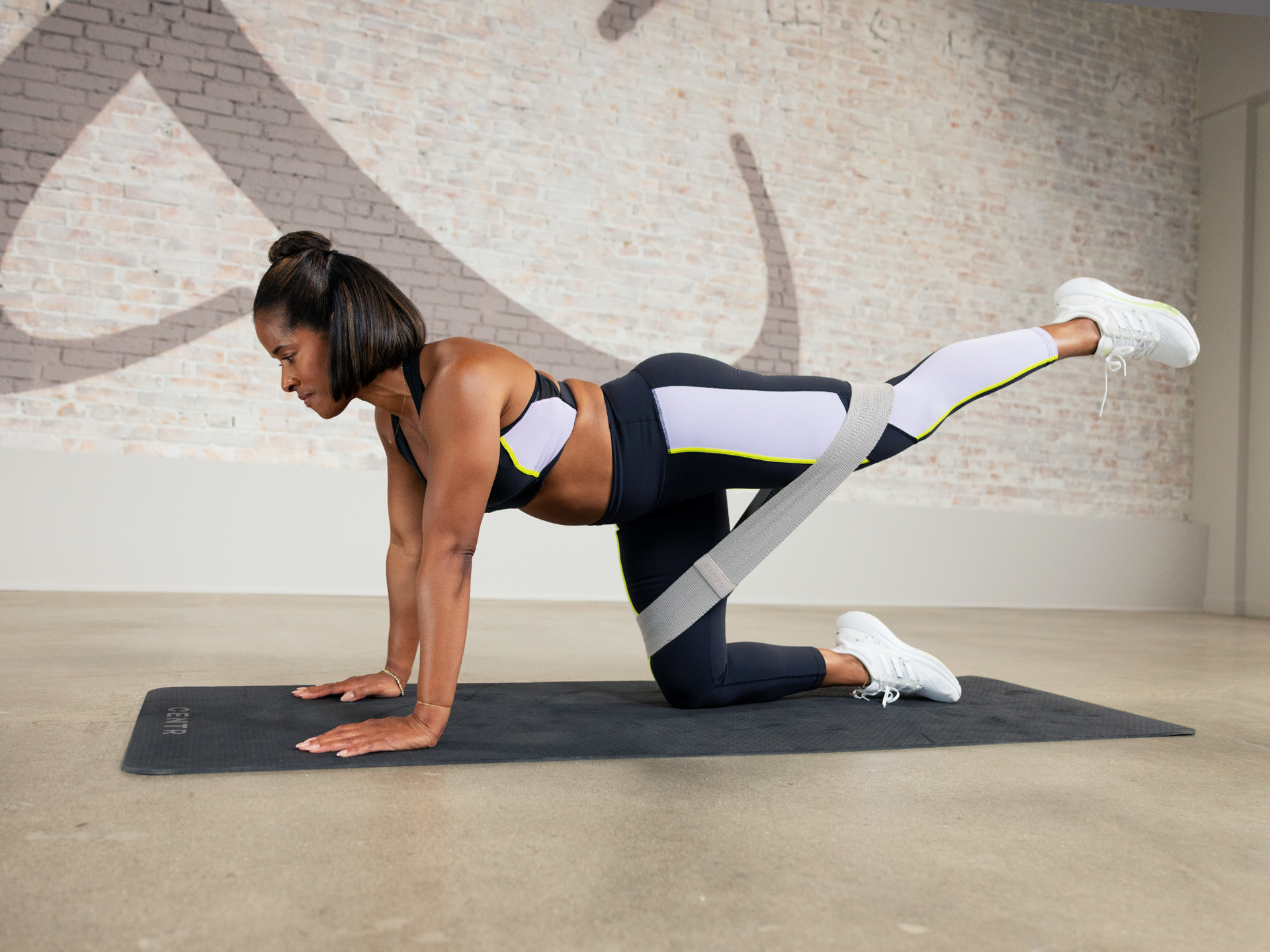
7. Banded Fire Hydrant
- On all fours, band above knees.
- Lift one knee to the side, like a dog at a fire hydrant.
- Lower slowly, repeat.
Tips: Keep core tight, avoid twisting.
Common mistake: Bending arms or shifting weight.
8. Banded Lateral Walk
- Band above ankles, slight squat.
- Step side-to-side for a set number of reps.
Tips: Move slowly, control each step.
Common mistake: Letting band snap feet together.
9. Single-leg Glute Bridge (with Band)
- Lie down, band above knees.
- One foot on ground, one leg straight.
- Push through heel, lift hips, squeeze glutes, lower.
Tips: Keep hips level, don’t twist.
Common mistake: Using lower back or pushing with arms.
10. Banded Romanian Deadlift
- Stand, band under feet, hold both ends.
- Hinge at hips, slight knee bend, keep back flat.
- Squeeze glutes to stand.
Tips: Move slowly, don’t round back.
Common mistake: Lifting with back, not hips.
Sample Glute Workout With Bands
You don’t need a gym for a great glute workout. Here’s a simple plan you can do at home with just one or two bands.
Beginner Band Glute Workout
- Banded Glute Bridge: 3 sets x 15 reps
- Crab Walk: 3 sets x 12 steps each direction
- Clamshell: 3 sets x 15 reps per side
- Standing Kickback: 2 sets x 12 reps per leg
Rest 45–60 seconds between sets.
Intermediate Band Glute Workout
- Banded Hip Thrust: 3 sets x 12 reps
- Banded Squat: 3 sets x 15 reps
- Fire Hydrant: 3 sets x 15 reps per side
- Lateral Walk: 3 sets x 10 steps each way
Rest 30–45 seconds between sets.
Advanced Band Glute Workout
- Single-Leg Bridge: 4 sets x 10 reps per side
- Romanian Deadlift: 4 sets x 12 reps
- Banded Hip Thrust: 4 sets x 15 reps
- Banded Crab Walk: 4 sets x 15 steps per side
Rest 30 seconds between sets.
How often to train: For best results, do a glute workout 2–3 times per week, with at least one rest day between sessions.
Key Variables For Glute Growth With Bands
If you want bigger, stronger glutes, you need more than just random exercises. Here’s what matters most:
1. Progressive Overload
Your muscles grow when you challenge them. With bands, you can:
- Use thicker bands
- Increase reps or sets
- Slow down each rep (tempo)
- Add short holds at the hardest part (isometric)
2. Mind-muscle Connection
Focus on squeezing your glutes, not just moving the band. This helps activate the right muscles and get better results.
3. Full Range Of Motion
Move through the whole range, don’t rush. Partial reps won’t build shape or strength as well.
4. Recovery
Muscles need time to rebuild. Don’t train glutes hard every day.
Common mistake: Doing too much, too soon. This leads to poor technique and injury.
Comparing Bands Vs. Weights For Glute Training
Is a band as good as a barbell? The answer depends on your goals and situation. Here’s a quick comparison to help you decide.
| Factor | Bands | Weights |
|---|---|---|
| Muscle Growth | Good for most people, especially beginners | Better for advanced muscle and strength gains |
| Strength | Improves endurance and stability | Builds max strength faster |
| Cost/Portability | Low cost, easy to carry | Expensive, not portable |
| Variety | Many angles, easy on joints | More exercises possible with machines |
| Safety | Less risk of injury | Heavier weights = more risk |
Summary: Bands are perfect for home, travel, or joint-friendly glute training. For maximum size or power, add weights as you progress.
How To Warm Up Glutes With Bands
A good warm-up fires up your glutes so you get more out of each exercise and lower your risk of injury. Here’s a quick routine:
- Glute bridge with band: 15 reps
- Clamshell: 12 reps per side
- Standing abduction (band around ankles): 12 reps per leg
- Bodyweight squat with band: 15 reps
Do 1–2 rounds before your main workout.
Tip: If you feel your quads or hamstrings more than your glutes, slow down and focus on squeezing your butt at the top of each rep.
How To Progress Glute Workouts With Bands
Getting results means making workouts harder over time. Here’s how you can do that with just bands:
1. Increase Band Resistance
Move from a light to a medium, then to a heavy band as you get stronger.
2. Add More Sets Or Reps
If you started with 2 sets, move to 3 or 4. Once you can do 20 reps easily, use a harder band.
3. Try Advanced Variations
Single-leg moves, pause reps (hold at the top for 3 seconds), or “1. 5 reps” (full rep + half rep) all add challenge.
4. Change Tempo
Slow down the lowering phase. Try 3 seconds up, 3 seconds down.
5. Minimize Rest
Shorter rest between sets increases intensity.
Practical example: If you did 3 sets of 15 banded squats last week, do 4 sets or use a thicker band this week.
Common Mistakes To Avoid
Even simple band exercises can go wrong. Here are pitfalls to watch for:
- Letting knees cave in: Always keep knees pushed out, especially during squats and bridges.
- Using momentum: Move slowly. Fast, swinging reps don’t build muscle.
- Band too light: If you’re not feeling the glutes after 15 reps, switch to a heavier band.
- Lack of variety: Don’t do only squats. Mix in bridges, abductions, and kickbacks.
- Not focusing on glutes: If you feel your lower back or thighs more, check your form.
- Ignoring pain: Bands should challenge, not hurt. Stop if you feel sharp pain, especially in joints.
- Skipping warm-up: Cold muscles don’t activate well or grow as fast.
Non-obvious insight: Many people let the band “snap” their legs back between reps. This reduces tension—control every inch for the best results.
Glute Training For Different Goals
How you train your glutes depends on what you want: rounder shape, more strength, or better sports performance.
For Shape/toning
- Use moderate bands (medium/heavy)
- Focus on high reps (15–20)
- Emphasize mind-muscle connection
For Strength
- Use the heaviest band you can control with good form
- Lower reps (8–12), more sets (4–5)
- Try unilateral moves (single-leg)
For Sport/function
- Mix bands with bodyweight and plyometric moves
- Add side steps, single-leg balance, and hip thrusts
Tip: You can combine these styles in one workout (e.g., start with strength, finish with high reps).
Sample 4-week Glute Band Program
For best results, follow a structured plan. Here’s a 4-week outline for all levels:
Weeks 1–2 (foundation)
- Day 1: Beginner Band Glute Workout (see above)
- Day 2: Rest or light cardio
- Day 3: Repeat Day 1
- Day 4: Rest or stretching
Weeks 3–4 (progression)
- Day 1: Intermediate Band Glute Workout
- Day 2: Rest or core workout
- Day 3: Advanced Band Glute Workout (use lighter band if needed)
- Day 4: Rest
Progression tips: Add 1 set per exercise each week, or move up in band resistance.
Recovery And Nutrition Tips
Glute muscles need more than just exercise to grow. Here’s how to support results:
1. Rest And Sleep
Muscles rebuild during rest, not workouts. Aim for 7–9 hours of sleep.
2. Protein
Eat enough protein to support muscle growth. Most people need 0. 6–0. 8 grams per pound of body weight.
3. Hydration
Bands make you sweat. Drink water before, during, and after workouts.
4. Stretching And Mobility
After your workout, stretch your glutes, hips, and hamstrings for 30 seconds each.
Pro tip: Use a foam roller on your glutes to release tension and speed recovery.
Glute Band Training For Men Vs. Women
The basics of glute training are the same for everyone, but men and women may have different goals or starting points.
- Men often want size and strength. Use heavier bands, lower reps, and add hip thrusts or deadlifts.
- Women may focus on shape and endurance. Use moderate bands, higher reps, and include more abduction/side moves.
Both should train all three glute muscles for best results.

Credit: www.afvt.org
Integrating Bands With Other Workouts
Bands aren’t just for glute days. Here’s how to add them to other routines:
- Warm-up: Use bands for activation before lifting weights or running.
- Supersets: Add a banded move after each main lift (e.g., squat + banded bridge).
- Finisher: End your workout with a high-rep band circuit for extra burn.
Practical example: After a leg day, do 2 sets of banded crab walks to finish off the glutes.
How Long To See Results
Results depend on your starting point, consistency, and nutrition. Most people notice better muscle tone or shape in 4–6 weeks with 2–3 band workouts per week.
Quick wins: You’ll likely feel your glutes working better within 1–2 sessions, even if visible changes take longer.
When To Switch To Heavier Bands Or Weights
If you’re doing 20+ reps and don’t feel much challenge, it’s time to upgrade. Most people need a new band every 4–8 weeks as they get stronger.
Sign: If you can hold a bridge or squat with a band for 30+ seconds with no burn, use a heavier band or add weight.
Best Brands And Where To Buy Bands
Look for bands with good reviews, strong material, and a range of resistances. Some popular brands include:
- Booty Bands
- TheraBand
- Fit Simplify
- Mark Bell’s Sling Shot
You can buy online or at sports stores. For more details, check the Verywell Fit guide to resistance bands.

Credit: centr.com
How To Care For Your Bands
Bands can snap if you don’t treat them right. Here’s how to make them last:
- Store in a cool, dry place (not in direct sunlight)
- Wash fabric bands by hand, air dry
- Check for cracks or tears before each use
- Don’t stretch bands more than 2.5x their length
Replace your band if you notice any damage or loss of resistance.
Advanced Band Techniques For Glutes
As you get stronger, try these strategies to keep challenging your muscles:
1. Pre-exhaust Sets
Do a high-rep band move (like 20–30 clamshells) before your main exercise. This tires the glutes so they work harder during heavier moves.
2. Mechanical Drop Sets
Start with a hard version (single-leg bridge), then drop to an easier one (double-leg bridge) without rest.
3. Band Combinations
Use two bands at once: one above knees, one at ankles, for extra resistance.
4. Paused Reps
Hold at the top of a bridge or squat for 3–5 seconds each rep.
Note: These methods work best once you have good technique and some training experience.
Credit: centr.com
Tracking Progress
To see real results, track your workouts. Write down:
- Band resistance used
- Sets and reps
- How exercises felt (burn, challenge)
- Weekly progress photos (optional)
This helps you stay motivated and know when to increase intensity.
Example Glute Band Workout Log
| Exercise | Band Used | Sets | Reps | Notes |
|---|---|---|---|---|
| Banded Bridge | Medium | 3 | 15 | Last reps hard |
| Crab Walk | Heavy | 3 | 12/side | Great burn |
| Clamshell | Light | 2 | 15/side | Easy, increase next time |
Frequently Asked Questions
What If I Only Feel My Legs, Not My Glutes, During Band Exercises?
This is common, especially for beginners. Slow down, focus on squeezing your glutes, and use a lighter band if needed. Sometimes, weak glutes or poor form make your quads and hamstrings work more. Try glute activation drills before your main workout.
How Long Should A Glute Band Workout Take?
Most workouts last 20–40 minutes, depending on sets and rest. For best results, focus on quality over quantity—slow, controlled reps work better than lots of fast reps.
Can I Use Bands Every Day For Glutes?
You can do light activation work daily, but intense resistance workouts need rest days. Muscles grow when they recover, not when you train. Aim for 2–3 focused glute sessions per week.
Are Resistance Bands Safe For Everyone?
Bands are safe for most people, including beginners and older adults. However, if you have hip, knee, or back injuries, check with a physical therapist or trainer before starting. Always start with a light band and focus on form.
Can Bands Really Build Bigger Glutes?
Yes—studies show bands can increase muscle size and strength, especially for beginners or those training at home. For maximum growth, increase resistance over time and eat enough protein. Consider adding weights later for more advanced progress.
Band training is a smart, flexible way to build your glutes, improve your movement, and stay strong—anywhere, anytime. With the right exercises, good technique, and steady progress, you’ll see and feel the difference.
