

Glute Workout Plans: Transform Your Booty With These Proven Routines
Glute Workout Plans: Build Stronger, Shapelier Glutes
People often want stronger, rounder glutes. These muscles are not just for looks—they help you move, balance, and stay healthy. A good glute workout plan can change how your body feels and performs. If you sit a lot, your glutes may get weak, which can cause back pain, poor posture, or even injuries. Training your glutes helps you stand taller, walk better, and feel more confident.
But glute workouts are not just squats and lunges. Many plans miss key moves or use the wrong sets and reps. Beginners often focus on quantity instead of quality, which stalls progress. The right plan uses science and practical steps, so you build muscle safely and fast.
This guide will show you how to train your glutes from start to finish, with clear routines, tips, and answers to common questions.
Understanding Glute Muscles
Your glutes are made up of three main muscles: gluteus maximus, gluteus medius, and gluteus minimus. Each muscle has a unique job:
- Gluteus maximus: The largest muscle in your body. It gives shape and power to your hips. It helps with big movements like rising from a chair or climbing stairs.
- Gluteus medius: Located on the side of your hip. It keeps your pelvis stable when you walk or run.
- Gluteus minimus: The smallest of the group. It works with the medius to help move your leg outward.
Strong glutes support your lower back and legs. They make sports, daily activities, and even sitting safer for your body. Weak glutes can lead to injuries or discomfort.
Why Glute Training Matters
Training your glutes is important for more than just looks. Here are some reasons why:
- Boost athletic performance: Strong glutes help you jump, sprint, and lift better.
- Prevent injuries: Good glute strength protects your knees and lower back.
- Improve posture: Your glutes help keep your spine in line, which prevents slouching.
- Shape your body: Well-developed glutes add curves and definition.
- Increase metabolism: Glute muscles burn calories even when you rest.
Many people miss these benefits because they use poor form or skip glute-specific exercises. You need a plan that targets all parts of your glutes, not just the maximus.

Credit: spotebi.com
Key Principles For Effective Glute Workouts
Before you start, understand these vital principles:
- Progressive overload: Increase weight, reps, or difficulty over time. This helps your glutes grow.
- Mind-muscle connection: Focus on feeling your glutes work during each exercise.
- Variety: Mix different movements—don’t rely only on squats.
- Recovery: Muscles need rest to grow. Avoid training glutes every day.
- Form over speed: Proper technique is more important than rushing through reps.
A good plan balances strength, endurance, and mobility. This prevents plateaus and injuries.
Glute Workout Plan For Beginners
If you’re new to glute training, start with simple movements. Aim for 2–3 sessions per week. Here’s a sample plan:
Warm-up
Always warm up before starting. Spend 5–10 minutes with:
- Glute bridges (bodyweight)
- Bodyweight squats
- High knees
- Leg swings
This increases blood flow and prepares your muscles.
Main Workout
Repeat for 3 weeks before increasing intensity.
- Bodyweight squats – 3 sets of 12–15 reps
- Glute bridges – 3 sets of 15 reps
- Step-ups (use a bench or sturdy chair) – 3 sets of 10 reps per leg
- Standing hip abduction – 3 sets of 12 reps per side
- Walking lunges – 2 sets of 12 reps per leg
Rest 60–90 seconds between sets.
Cool Down
End with light stretching:
- Standing quad stretch
- Seated hamstring stretch
- Child’s pose
Hold each stretch for 20–30 seconds.
Practical Tips
- Focus on quality reps—don’t rush.
- Use a mirror or film yourself to check form.
- Progress by adding weight or reps every few weeks.
Intermediate Glute Workout Plan
Once you master basic moves, add difficulty with resistance and new exercises. Train glutes 3 times per week.
Warm-up
- Single-leg glute bridge – 2 sets of 10 reps per leg
- Jumping jacks – 2 sets of 20 reps
Main Workout
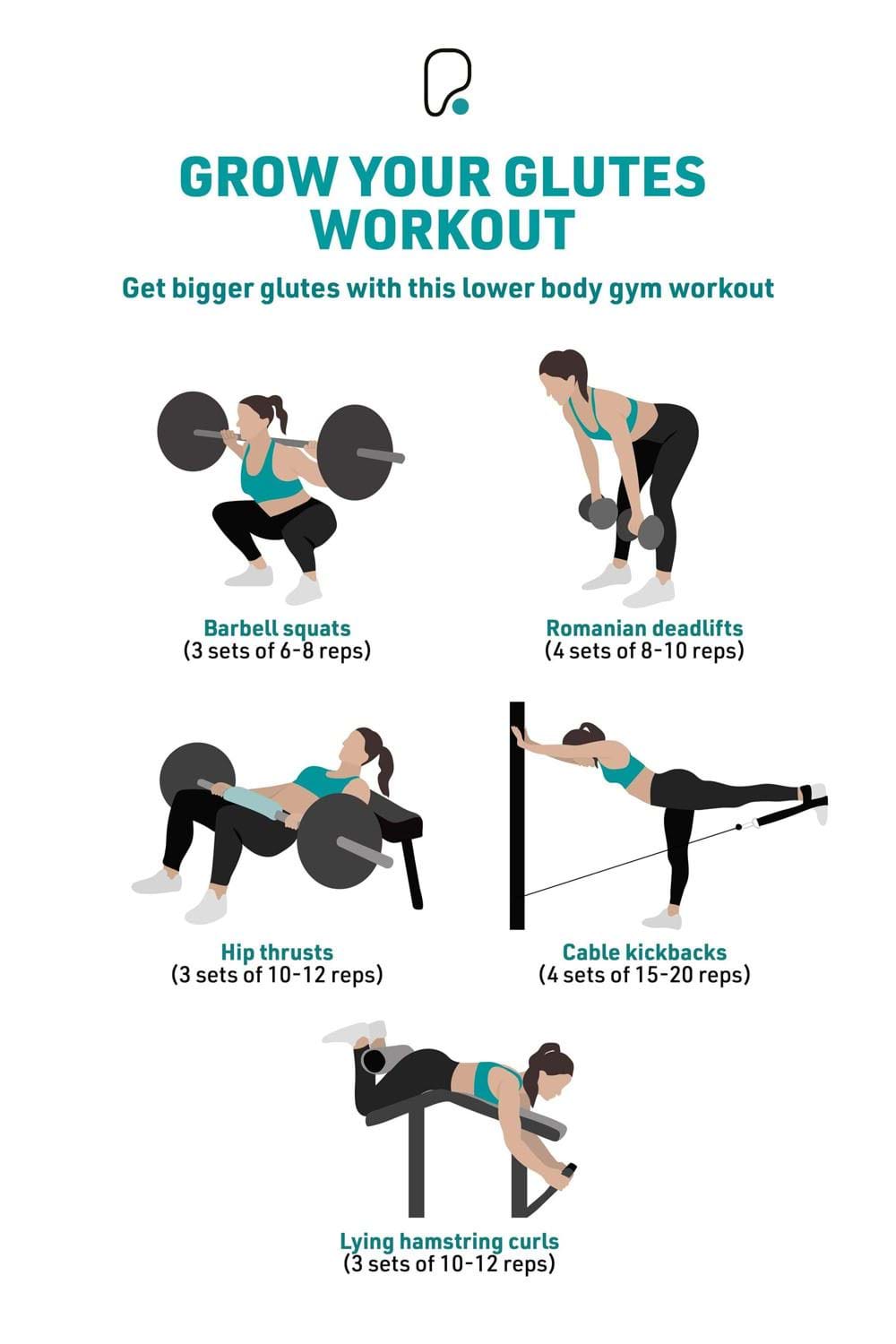
- Barbell hip thrust – 4 sets of 10–12 reps
- Bulgarian split squat – 3 sets of 10 reps per leg
- Romanian deadlift – 3 sets of 12 reps
- Cable kickback – 3 sets of 15 reps per leg
- Side-lying clamshell – 2 sets of 15 reps per side
Rest 90 seconds between sets.
Cool Down
Stretch and foam roll:
- Pigeon pose
- Hip flexor stretch
- Foam rolling glutes and hamstrings
Practical Tips
- Increase weight slowly (2.5–5 lbs per week).
- Use full range of motion for every rep.
- Don’t forget mind-muscle connection—feel your glutes working.
Advanced Glute Workout Plan
For experienced lifters, use heavy weights, plyometrics, and more complex routines. Train glutes 3–4 times per week.
Warm-up
- Banded glute activation (monster walks, lateral band walks)
- Dynamic stretches (leg swings, hip circles)
Main Workout
- Heavy barbell hip thrust – 5 sets of 8–10 reps
- Sumo deadlift – 4 sets of 8 reps
- Weighted step-up – 3 sets of 10 reps per leg
- Single-leg Romanian deadlift – 3 sets of 10 reps per side
- Frog pump – 3 sets of 20 reps
- Plyometric jump squats – 2 sets of 15 reps
Rest 90–120 seconds between sets.
Cool Down
- Deep hip stretches
- Foam rolling
- Light walking for 5 minutes
Practical Tips
- Track weights and reps for each session.
- Take extra rest if you feel muscle fatigue.
- Use spotters or trainers for heavy lifts.
Home Glute Workout Plan
You don’t need a gym to build strong glutes. With bodyweight and simple tools, you can still see results.
Equipment Needed
- Resistance bands
- Dumbbells (optional)
- Sturdy chair or step
Sample Home Routine
- Banded glute bridge – 4 sets of 15 reps
- Single-leg squat to chair – 3 sets of 8 reps per leg
- Banded lateral walk – 3 sets of 20 steps
- Reverse lunges – 3 sets of 12 reps per leg
- Standing kickbacks – 3 sets of 15 reps per leg
Rest 60 seconds between sets.
Extra Tips
- If you don’t have dumbbells, fill water bottles for weight.
- Use slow, controlled movements to maximize muscle activation.
- Change band resistance as you get stronger.
Glute Activation: The Secret To Better Workouts
Many people skip glute activation. This step wakes up your muscles, so they work harder during main exercises. If your glutes are “sleepy,” other muscles (like your lower back) may take over, which can cause pain or poor results.
Best Glute Activation Moves
- Monster walks
- Lateral band walks
- Fire hydrants
- Single-leg glute bridge
Do 2 sets of 15 reps for each move before your main workout. This boosts muscle engagement.
Why It Matters
When you activate your glutes, you:
- Improve muscle growth
- Reduce injury risk
- Get more out of each exercise
Beginners often skip this step, thinking it’s not important. But it’s one of the fastest ways to see progress.
Common Mistakes In Glute Training
Even with good plans, many people make mistakes that stop results.
Most Frequent Mistakes
- Poor form: Rushing or using wrong technique causes injuries and limits gains.
- Skipping activation: Not warming up glutes means other muscles take over.
- Not using enough resistance: Bodyweight alone is not enough after a few weeks.
- Ignoring recovery: Training glutes daily leads to fatigue and poor growth.
- Neglecting variety: Doing only squats or lunges misses other glute muscles.
How To Avoid Mistakes
- Watch videos or ask trainers for feedback.
- Use different exercises each week.
- Increase weights gradually.
- Always rest at least 48 hours between hard sessions.
How To Build A Glute Workout Plan (step-by-step)
Designing your own plan lets you control progress. Here’s how to do it:
- Set your goal: Decide if you want strength, size, or endurance.
- Choose key exercises: Pick compound moves like hip thrusts and squats.
- Add isolation moves: Include kickbacks, clamshells, or fire hydrants.
- Plan sets and reps: For strength, use fewer reps and heavier weight. For size, use moderate weight and more reps.
- Schedule workouts: Space sessions to allow recovery.
- Track progress: Record weights, reps, and how you feel.
Example Plan For Muscle Growth
- Hip thrusts – 4 sets of 12 reps
- Bulgarian split squat – 3 sets of 10 reps per leg
- Cable kickbacks – 3 sets of 15 reps per leg
- Glute bridge – 3 sets of 15 reps
Repeat 3 times per week.
Best Glute Exercises (with Data)
Some exercises are more effective for glute growth. Here’s how popular moves compare in muscle activation:
| Exercise | Glute Activation (%) | Difficulty |
|---|---|---|
| Barbell hip thrust | 87 | Advanced |
| Squat | 70 | Intermediate |
| Bulgarian split squat | 75 | Intermediate |
| Glute bridge | 63 | Beginner |
| Romanian deadlift | 60 | Intermediate |
| Cable kickback | 65 | Intermediate |
Hip thrusts lead in glute activation, but squats and lunges still play important roles.
Glute Workout Plans For Different Goals
Your plan should match your goal. Here’s how to adjust:
For Muscle Size
- Use higher reps (12–15)
- Moderate to heavy weights
- 3–4 sets per exercise
- Focus on full range of motion
For Strength
- Lower reps (6–8)
- Heavy weights
- 4–5 sets per exercise
- Use compound moves
For Endurance
- High reps (15–20)
- Lighter weights or bodyweight
- 2–3 sets per exercise
- Short rest periods
Sample Comparison
| Goal | Sets | Reps | Weight | Rest |
|---|---|---|---|---|
| Size | 3–4 | 12–15 | Moderate | 90 sec |
| Strength | 4–5 | 6–8 | Heavy | 120 sec |
| Endurance | 2–3 | 15–20 | Light | 60 sec |
Choose your plan based on your goal and adjust as you progress.
How Often Should You Train Glutes?
Most people train glutes 2–4 times per week. More isn’t always better. Muscles need recovery to grow.
- Beginners: 2 times per week
- Intermediate: 3 times per week
- Advanced: 3–4 times per week
Listen to your body. If you feel sore or tired, take an extra rest day.
Glute Training For Men Vs Women
Glute workouts work for everyone, but there are some differences:
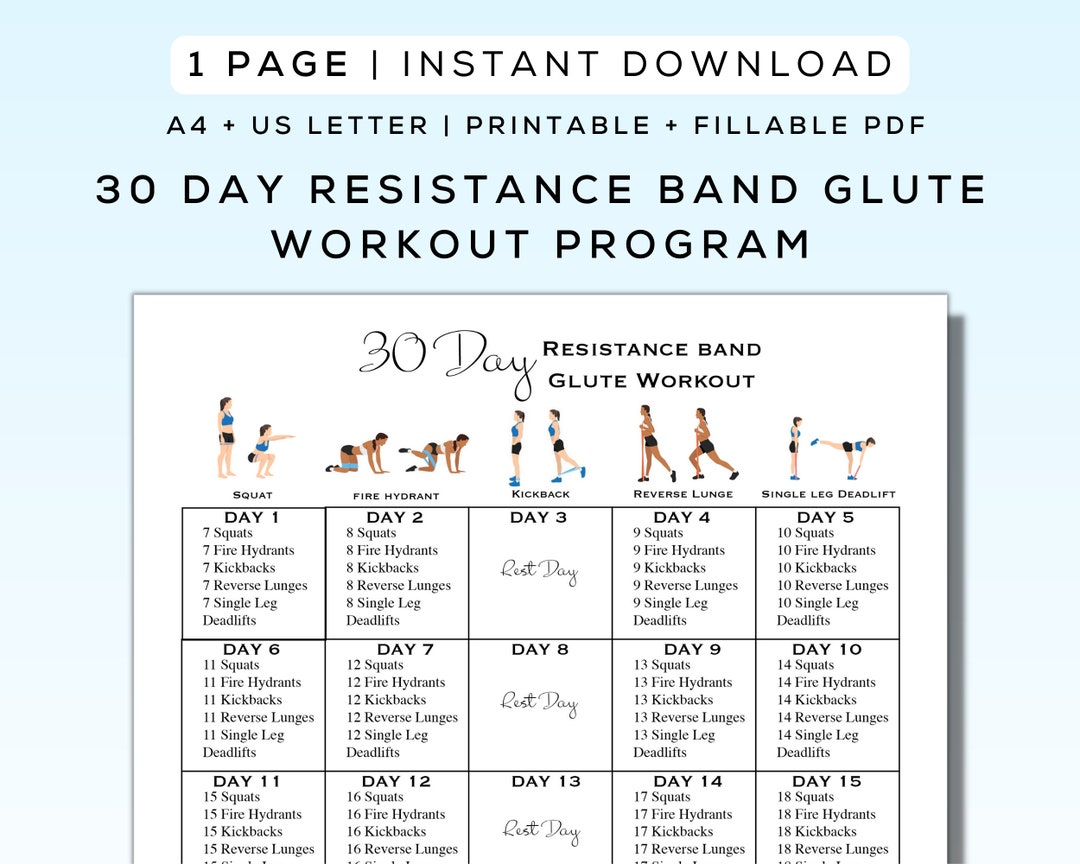
- Women often focus on shape and muscle tone. They use higher reps and more isolation moves.
- Men may prefer strength and power. They use heavier weights and compound exercises.
Both need balanced routines. Don’t skip isolation moves or only use heavy weights. Variety helps all glute muscles grow.
Credit: www.etsy.com
Nutrition For Glute Growth
Exercise is key, but nutrition plays a big role. Your muscles need:
- Protein: Builds and repairs muscle. Aim for 0.6–0.8 grams per pound of body weight.
- Healthy carbs: Fuel for workouts and recovery.
- Fats: Support hormone balance.
Eat after your workout for best results. Don’t skip meals, as this slows progress.
Sample Post-workout Meal
- Grilled chicken breast (protein)
- Brown rice (carbs)
- Steamed broccoli (fiber)
- Olive oil drizzle (healthy fat)
Drink water throughout the day to keep muscles hydrated.
Tracking Progress: How To Measure Glute Gains
Seeing progress motivates you to keep going. Here’s how to track:
- Take photos: Every 2–4 weeks, from different angles.
- Measure hips: Use a tape measure around the widest part.
- Log weights and reps: Use a notebook or app.
- Check how clothes fit: Tighter pants or shorts may mean muscle growth.
Don’t rely only on the scale—it doesn’t show muscle changes.
Glute Workout Plans For Busy People
Short on time? You can still train glutes with quick routines.
15-minute Glute Workout
- Banded glute bridge – 2 sets of 15 reps
- Walking lunges – 2 sets of 12 reps per leg
- Standing kickback – 2 sets of 15 reps per leg
No rest between exercises. Repeat circuit twice.
Tips For Busy Schedules
- Use resistance bands—they’re fast and effective.
- Train in the morning for better energy.
- Combine glute moves with cardio if needed.
Glute Workout Plans For Seniors
Older adults benefit from glute training, too. It prevents falls and improves daily movement.
Safe Glute Exercises
- Chair squats
- Standing hip abduction
- Glute bridge
Start with 2 sets of 8–10 reps. Use slow, controlled movements.
Safety Tips
- Hold onto a sturdy surface for balance.
- Avoid jumping or heavy weights.
- Listen to your body—stop if you feel pain.
Glute Workout Plans For Athletes
Athletes need powerful glutes for sports. Their routines use explosive moves and heavy lifts.
Athlete Routine Example
- Barbell hip thrust – 4 sets of 8 reps
- Power cleans – 3 sets of 6 reps
- Depth jumps – 3 sets of 10 reps
- Single-leg squat – 3 sets of 8 reps per leg
Rest 120 seconds between sets.
Benefits For Athletes
- Faster sprinting
- Higher jumping
- Better balance
Athletes often use sports-specific glute moves to match their needs.
Glute Workout Plans For Injury Recovery
If you’re recovering from injury, focus on gentle moves and avoid heavy weights.
Sample Recovery Routine
- Glute bridge – 3 sets of 10 reps
- Standing hip abduction – 3 sets of 12 reps per leg
- Foam rolling – 5 minutes
Work with a physical therapist if needed. Progress slowly and stop if you feel pain.
Comparing Gym Vs Home Glute Workouts
Which is better—gym or home? Here’s a quick comparison:
| Factor | Gym | Home |
|---|---|---|
| Equipment | Wide range, heavy weights | Bands, bodyweight, light dumbbells |
| Variety | Many exercise options | Limited, but still effective |
| Cost | Membership fees | Low cost |
| Convenience | Requires travel | Workout anytime |
| Results | Faster for advanced | Good for beginner/intermediate |
Home workouts are great for beginners, but gyms offer more for advanced lifters.
Sample Weekly Glute Workout Schedule
Here’s a sample plan to fit your week:
- Monday: Hip thrusts, lunges, glute bridges
- Wednesday: Bulgarian split squats, cable kickbacks, fire hydrants
- Friday: Romanian deadlifts, step-ups, frog pumps
Rest on other days or do light cardio. This routine targets all glute muscles and allows for recovery.
Glute Workout Plans For Different Body Types
Everyone’s body is unique. Some build glutes faster, others need more time.
- Ectomorphs (slim): Use heavier weights and more calories.
- Mesomorphs (athletic): Mix strength and endurance moves.
- Endomorphs (curvy): Focus on higher reps and cardio.
Adjust your plan based on your body and progress. Avoid copying others without tweaking for your needs.
Bonus Tips For Glute Success
Here are some non-obvious ways to boost glute gains:
- Pause at the top: Hold the peak contraction for 2 seconds in hip thrusts.
- Use slow negatives: Lower weights slowly to increase muscle tension.
- Try unilateral moves: Single-leg exercises prevent muscle imbalances.
- Don’t always start with squats: Begin with hip thrusts or bridges for better activation.
Most beginners miss these small changes, but they make a big difference.
Where To Learn More
For deep scientific knowledge and exercise videos, visit Bret Contreras, a top authority on glute training.
Frequently Asked Questions
What Is The Best Glute Exercise For Building Muscle?
Barbell hip thrusts are the top exercise for glute muscle growth. They activate the gluteus maximus more than squats or lunges. Use heavy weights and focus on squeezing your glutes at the top.
How Long Does It Take To See Results From Glute Workouts?
Most people notice changes in 4–8 weeks. Visible results depend on your starting point, workout consistency, and nutrition. Track progress with photos and measurements, not just the scale.
Can I Train Glutes Every Day?
No. Training glutes daily can cause fatigue and slow growth. Muscles need at least 48 hours to recover. Train glutes 2–4 times per week for best results.
Do I Need Weights To Grow My Glutes?
Weights help, but you can build glutes with bodyweight and resistance bands. As you get stronger, add weight to keep challenging your muscles.
What Are Common Signs Of Glute Activation During Workouts?
You should feel a strong squeeze in your glutes during exercises like hip thrusts and bridges. If you feel pain in your lower back or hamstrings, check your form and slow down.
Building stronger, shapelier glutes takes a good plan, smart training, and patience. Use these tips and routines to reach your goals—whether at home, in the gym, or for sports. Focus on quality, listen to your body, and enjoy the results as your glutes grow and your whole body improves.
Credit: www.puregym.com
