

Glute-Building Workout: Transform Your Glutes Fast with These Moves
Building strong, rounded glutes is more than just a trend—it’s a game-changer for fitness, confidence, and overall health. Whether you want to lift heavier, run faster, or simply fill out your jeans, a focused glute-building workout can help you reach your goals. Many people spend hours on cardio or do endless squats, but still don’t see results in their glutes. The real secret is smart training, proper technique, and consistency. This article will show you exactly how to build glutes that are both strong and shapely, with science-backed exercises, routines, and tips for all levels.
Why Glutes Matter More Than You Think
Strong glutes are not just for looks. The gluteus maximus, medius, and minimus are the largest and most powerful muscles in your body. They play a vital role in:
- Hip extension and rotation (helping you walk, run, and climb)
- Pelvic stability (reducing back and knee pain)
- Athletic power (jumping, sprinting, and lifting)
- Posture support (keeping your body upright and balanced)
Weak glutes can lead to common problems like low back pain, knee injuries, and poor athletic performance. Focusing on glute strength improves your daily life and reduces injury risk.
The Science Behind Glute Growth
Glute hypertrophy—the process of muscle growth—happens when you challenge your glutes with resistance and allow them to recover. Two main factors create growth:
- Mechanical tension: Lifting heavy weights or using resistance bands stresses your muscles.
- Metabolic stress: High reps, short rest, and volume create a “burn” that triggers adaptation.
However, not all glute exercises are equal. Some target the glutes more directly, while others use supporting muscles. Choosing the right moves and using correct form is essential for results.
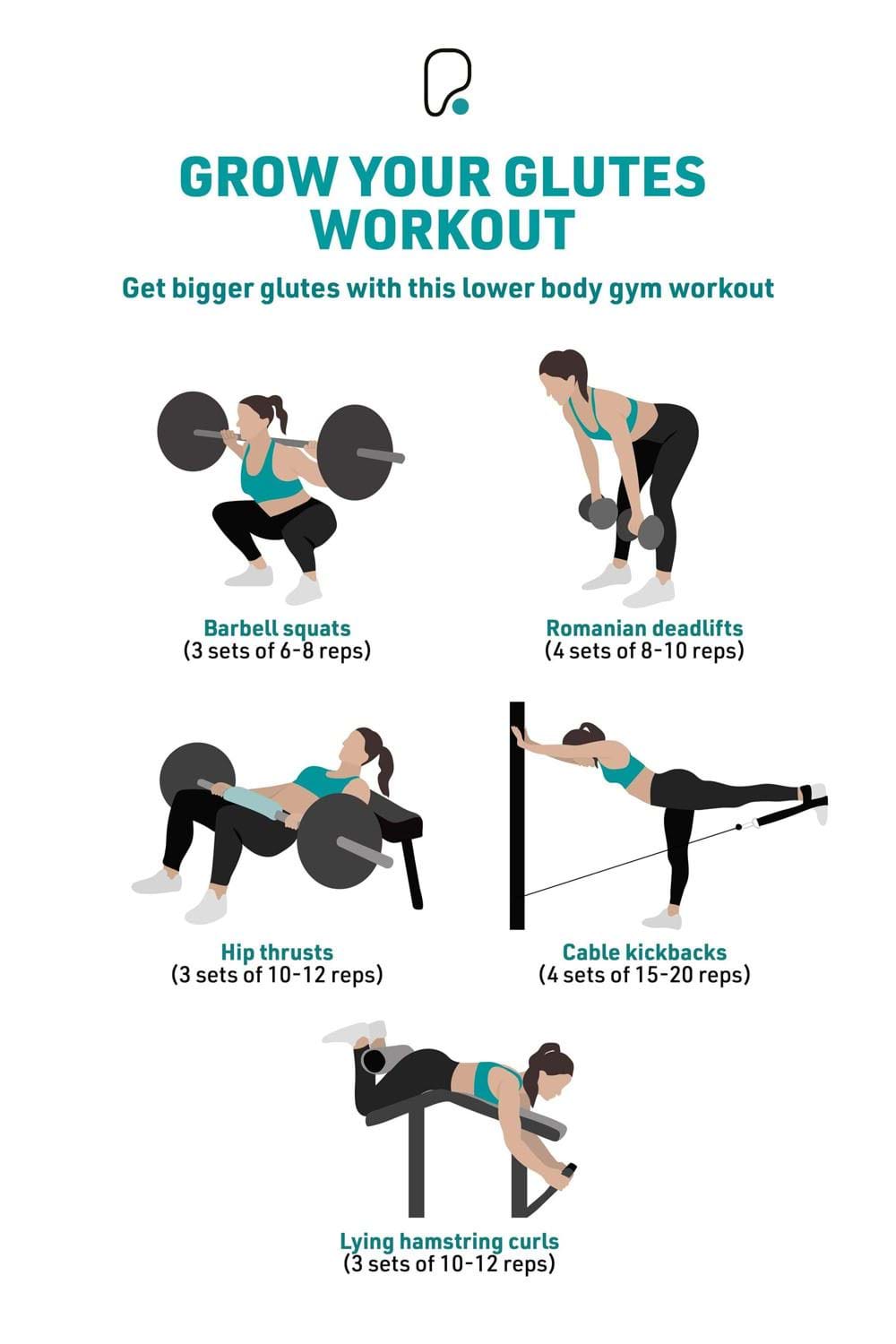
Credit: www.puregym.com
Key Glute-building Exercises
Not every exercise labeled as a “glute move” will actually activate and grow your muscles. Below are the most effective exercises for glute development, with explanations of why they work.
Hip Thrust
The hip thrust is a powerhouse for glute activation. Sitting with your upper back against a bench, you thrust your hips up with a loaded barbell or bodyweight. It offers a full range of motion and isolates the glutes more than squats.
- Why it works: Research shows hip thrusts activate the gluteus maximus more than squats or lunges.
Barbell Glute Bridge
Similar to the hip thrust, but with your back on the floor, the glute bridge is easier for beginners and great for building strength.
- Tip: Pause at the top and squeeze your glutes for better results.
Bulgarian Split Squat
This single-leg squat variation targets each glute separately, helping correct muscle imbalances.
- How to do it: Place one foot behind you on a bench, lower your back knee, and drive up with your front leg.
Romanian Deadlift (rdl)
The RDL works the glutes and hamstrings. It’s a hinge movement, meaning you push your hips back while keeping a straight back.
- Key point: Lower the bar only as far as you can keep your back flat.
Cable Kickback
This isolation move helps shape and target the upper glutes.
- Execution: Attach an ankle strap to a low cable, kick your leg back and up, focusing on squeezing the glutes.
Step-up
Simple but effective, step-ups build strength and stability.
- Variation: Use a higher platform or add dumbbells for extra resistance.
Sample Comparison: Glute Activation Levels
Here is a look at how much some common exercises activate the glutes, measured by EMG (muscle activation).
| Exercise | Glute Activation (EMG %) |
|---|---|
| Hip Thrust | ~80% |
| Back Squat | ~60% |
| Deadlift | ~55% |
| Lunge | ~50% |
Insight: Exercises that keep constant tension on the glutes (like hip thrusts) usually give the best results for growth.
Structuring A Glute-building Workout
A well-designed glute-building workout will include both compound (multi-joint) and isolation (single-joint) exercises. Compound moves build overall size and strength; isolation exercises refine shape and detail.
Sample Glute Workout Routine
Here’s an example routine suitable for most lifters, two to three times per week:
- Hip Thrust: 4 sets x 8-12 reps
- Bulgarian Split Squat: 3 sets x 8-10 reps per leg
- Romanian Deadlift: 3 sets x 8-12 reps
- Cable Kickback: 3 sets x 12-15 reps per leg
- Step-Up: 2 sets x 12 reps per leg
Rest 60-90 seconds between sets. Focus on controlled movement, not speed.
Weekly Training Frequency
You can train glutes up to three times per week, with at least 48 hours between sessions. Overtraining can slow growth, so balance is key.
Example Weekly Split
| Day | Focus |
|---|---|
| Monday | Glutes + Hamstrings |
| Wednesday | Upper Body |
| Friday | Glutes + Quads |
| Saturday | Optional Glute Isolations |
Training glutes with other lower body muscles lets you recover properly.

Credit: www.youtube.com
Progression: How To Keep Building Your Glutes
Beginners often stall after a few months. To grow continuously, you need to increase the challenge over time—this is called progressive overload.
Ways to progress:
- Increase weight: Add weight to your hip thrust, squat, or deadlift gradually.
- Increase reps/sets: Add more sets or reps each month.
- Slow down the movement: Lower slowly and pause at the hardest part.
- Shorten rest: Resting less makes your muscles work harder.
- Try advanced variations: Switch to single-leg moves or resistance bands.
Non-obvious insight: Many people forget to track their workouts. Write down what you do each session to make sure you’re making progress.
Form And Technique: Avoiding Common Mistakes
Proper form is vital for glute activation and avoiding injury. Two common mistakes:
- Letting your lower back arch: This shifts work to your back and reduces glute activation.
- Not reaching full hip extension: Stopping short at the top of a hip thrust or bridge reduces muscle contraction.
Tips for better form:
- Always brace your core.
- Push through your heels, not your toes.
- Control the lowering phase (eccentric).
Experience-based tip: Filming yourself can reveal technique issues you don’t feel during the exercise.
Nutrition For Glute Growth
Muscle growth depends not only on training but also on nutrition. If you don’t eat enough, your glutes won’t grow.
Protein
Aim for 0.7–1.0 grams of protein per pound of body weight daily. Good sources:
- Chicken breast
- Eggs
- Greek yogurt
- Beans and lentils
Calories
You need a calorie surplus (eating more than you burn) to build new muscle. Use an online calculator to estimate your needs, and add 200–300 calories per day.
Carbs And Fats
Carbs give you energy for heavy workouts, while healthy fats support hormone balance.
Non-obvious insight: Many people undereat on rest days, slowing their progress. Keep your calories and protein high, even when not training.
Glute-building For Different Experience Levels
Not everyone should train the same way. Here’s how to adapt glute workouts for beginners, intermediates, and advanced lifters.
Beginners
- Focus on bodyweight exercises: Glute bridges, step-ups, and air squats
- Learn proper form before adding weight
- Train glutes 2x per week
Intermediate
- Add free weights: Barbells, dumbbells, and resistance bands
- Start using machines like leg press or cable kickbacks
- Try unilateral (single-leg) moves
Advanced
- Use progressive overload with heavier weights
- Add advanced variations: Deficit reverse lunges, pause hip thrusts, banded RDLs
- Consider using drop sets or supersets for more volume
Glute-building For Men Vs. Women
Many people wonder if men and women need different glute workouts. The truth: muscle responds the same way to resistance training for both sexes. However, women may prefer more volume (higher reps) and slightly shorter rest.
Example: Men Vs. Women Glute Training
| Factor | Men | Women |
|---|---|---|
| Reps per set | 6-10 | 10-15 |
| Rest between sets | 90-120 sec | 60-90 sec |
| Total weekly sets | 12-16 | 15-20 |
Both men and women should focus on strong, quality movements.
Home Vs. Gym Glute Workouts
Don’t have a gym membership? You can still build glutes at home.
Home Glute Exercises
- Bodyweight hip thrust
- Single-leg glute bridge
- Step-up on a chair
- Resistance band kickbacks
- Wall sit
You’ll need to be creative with resistance. Use heavy backpacks, water jugs, or resistance bands.
When To Join A Gym
If you stop seeing progress at home, the gym gives you access to heavier weights and machines that make further growth possible.
Equipment: What You Need (and Don’t)
Building glutes doesn’t require fancy machines, but some tools can help.
Useful Equipment
- Barbell and plates: For hip thrusts, deadlifts, and squats
- Bench or box: For step-ups, hip thrusts, and split squats
- Resistance bands: Great for extra tension and warm-ups
- Cable machine: For isolation exercises like kickbacks
Not Essential
- Smith machine: Can work, but not better than free weights
- Abductor/adductor machine: Good for finishing, but not main growth
Straight-to-the-point advice: Start with what you have, then add equipment as your strength improves.
Warm-up And Mobility For Glute Activation
Warming up properly helps your glutes fire during exercise.
Dynamic Warm-up
- Leg swings: 20 per leg
- Bodyweight squats: 15 reps
- Glute bridges: 15 reps
Activation Drills
- Clamshells with resistance band: 15 reps per side
- Monster walks: 10 steps each way
These moves “wake up” your glutes, so they work during heavy lifts.
Sample 4-week Glute-building Plan
Here’s a simple plan to follow for one month. Adjust weights to your level.
Week 1–2: Foundation
- Day 1: Hip thrusts, step-ups, bodyweight squats, glute bridges
- Day 2: Rest or light cardio
- Day 3: Bulgarian split squats, RDLs, cable kickbacks
- Day 4: Rest
- Day 5: Repeat Day 1
Week 3–4: Progression
- Day 1: Add weight to hip thrusts, increase reps on step-ups
- Day 3: Add pause at bottom of split squats, add resistance bands to RDLs
- Day 5: Try single-leg glute bridges, add extra set to kickbacks
Practical tip: Listen to your body. If you’re sore, take extra rest.
Recovery And Rest: The Missing Piece
Muscles grow when you rest, not when you train. Don’t skip sleep or active recovery.
Key Recovery Tips
- Sleep 7–9 hours per night
- Take rest days or do light stretching
- Eat enough calories and protein
- Massage or foam roll sore areas
Overtraining sign: If you feel tired for days, your performance drops, or you lose motivation, reduce volume for a week.
Glute-building Myths You Should Ignore
Many glute-building tips online are outdated or just wrong.
Common Myths
- “Squats are all you need.” While squats are good, they’re not the most effective glute builder alone.
- “You must lift heavy every session.” Form and consistency matter more than max weight.
- “High reps only shape, not build.” Both high and low reps can build muscle if you train hard enough.
- “Women will get too bulky.” Muscle grows slowly; most women simply get more curves.
Calm expert’s advice: Focus on smart, consistent training, not quick fixes or viral tricks.
Supplementing For Glute Growth
Supplements are not required, but a few can support your results.
Helpful Supplements
- Whey protein: Makes it easier to meet daily protein needs
- Creatine monohydrate: Boosts strength and muscle growth
- Omega-3s: Reduces inflammation for better recovery
Always check with a healthcare professional before starting new supplements.
For trustworthy supplement information, see the Examine.com database.
Tracking Progress: How To Measure Glute Growth
It’s easy to feel like nothing is changing. Use these methods to track your progress:
- Take measurements: Use a tape measure around your hips/glutes every 2–4 weeks.
- Progress photos: Take pictures from the side and back under the same lighting.
- Strength numbers: Are you lifting heavier or for more reps?
- Clothing fit: Do pants and shorts fit differently?
Remember, muscle builds slowly, and small changes add up over time.
Advanced Glute Training Strategies
If you’ve been training for a year or more, you can use advanced methods:
- Paused reps: Hold the contraction at the top of a hip thrust for 2–3 seconds.
- Banded resistance: Add a resistance band above your knees for hip thrusts.
- Supersets: Pair two glute moves back-to-back, like RDLs and cable kickbacks.
- Eccentric focus: Lower the weight slowly for 4 seconds per rep.
These techniques increase the challenge and can break plateaus.
Common Questions And Troubleshooting
“why Don’t I Feel My Glutes Working?”
Often, your quads or lower back take over. Focus on slow movement, use less weight, and try activation drills.
“how Long Until I See Results?”
Visible changes can take 8–12 weeks for most people, but you may feel stronger and more stable within a few weeks.
“i Only Feel Glutes On One Side, What Should I Do?”
Add more single-leg work. Start each set with your weaker side.
Friendly mentor tip: Don’t compare your progress to others. Everyone’s genetics and lifestyle are different.
Frequently Asked Questions
How Many Times A Week Should I Train My Glutes?
Most people see best results training glutes 2–3 times per week. This gives enough stimulation for growth, while also allowing for recovery. Beginners can start with 2 sessions and add more as they adapt.
What’s The Best Exercise For Building Glutes?
The hip thrust is widely considered the most effective glute builder due to its high muscle activation. Combine it with other exercises like RDLs and split squats for complete development.
Can I Grow My Glutes At Home Without Weights?
Yes, you can make progress at home using bodyweight exercises and resistance bands. Focus on single-leg glute bridges, step-ups, and banded exercises. For continued growth, increase resistance over time with household items or heavier bands.
How Long Does It Take To See Bigger Glutes?
Most people notice visible changes within 8–12 weeks if they train consistently, eat enough protein, and rest well. Strength improvements can happen even sooner, but muscle size takes time.
Do I Need To Eat More To Build Glutes?
Yes. Building muscle requires a calorie surplus. Eat slightly more than your maintenance calories and focus on high-protein foods. Without enough fuel, your body cannot build new muscle.
Building your glutes is about more than just exercise—it’s a mix of smart training, good nutrition, and patience. With the right approach, anyone can achieve strong, healthy glutes that support both performance and appearance. Remember to focus on progress, not perfection, and celebrate every small win on your journey.

Credit: www.menshealth.com
