

Which is Better Shirt Or T Shirt? Ultimate Style Comparison
Which Is Better: Shirt Or T-shirt
Choosing between a shirt and a t-shirt might seem simple, but this decision can actually impact how you look, feel, and even how others see you. Both shirts and t-shirts are basic pieces in almost every wardrobe. Still, they serve different purposes, work better for different occasions, and send different messages. It’s not just about style—comfort, versatility, cost, care, and even the weather can all play a role in deciding which to wear. This article explores every angle, so by the end, you’ll know exactly when and why to pick a shirt or a t-shirt, and which one might be better for your needs.
Understanding Shirts And T-shirts
Before comparing, it’s important to know what makes a shirt and a t-shirt different.
A shirt usually has a collar, buttons, and sometimes cuffs on the sleeves. It’s often made from woven fabrics like cotton or linen and is seen as more formal. Shirts come in many styles: dress shirts, casual button-downs, and even patterned or colored designs.
A t-shirt is a collarless, pullover top, usually with short sleeves. It’s made from knit fabric, giving it stretch and a softer feel. T-shirts are seen as casual and are usually worn without tucking in.
While these are the basic definitions, fashion today allows a lot of mixing. Still, these differences shape how and when each is worn.
Comfort And Fit
Comfort is one of the first things people think about when choosing clothes.
Shirts
Shirts, especially formal ones, can feel stiff because of their structure. The collars and buttons sometimes restrict movement. Long sleeves can feel hot, and the fit is usually less forgiving. However, when made from good cotton or linen, shirts can feel cool and smooth on the skin.
Casual shirts, like flannel or chambray, are often softer, but they still have a more tailored fit.
T-shirts
T-shirts are known for comfort. They stretch easily, move with your body, and feel soft. The absence of collars and buttons means nothing digs into your neck or chest. T-shirts are usually lighter and cooler, making them popular in hot weather or for relaxing at home.
Non-obvious insight: Many people overlook how layering affects comfort. Shirts can be worn over t-shirts for extra warmth and style, but t-shirts under shirts can also prevent sweat stains on the shirt, making the shirt last longer.
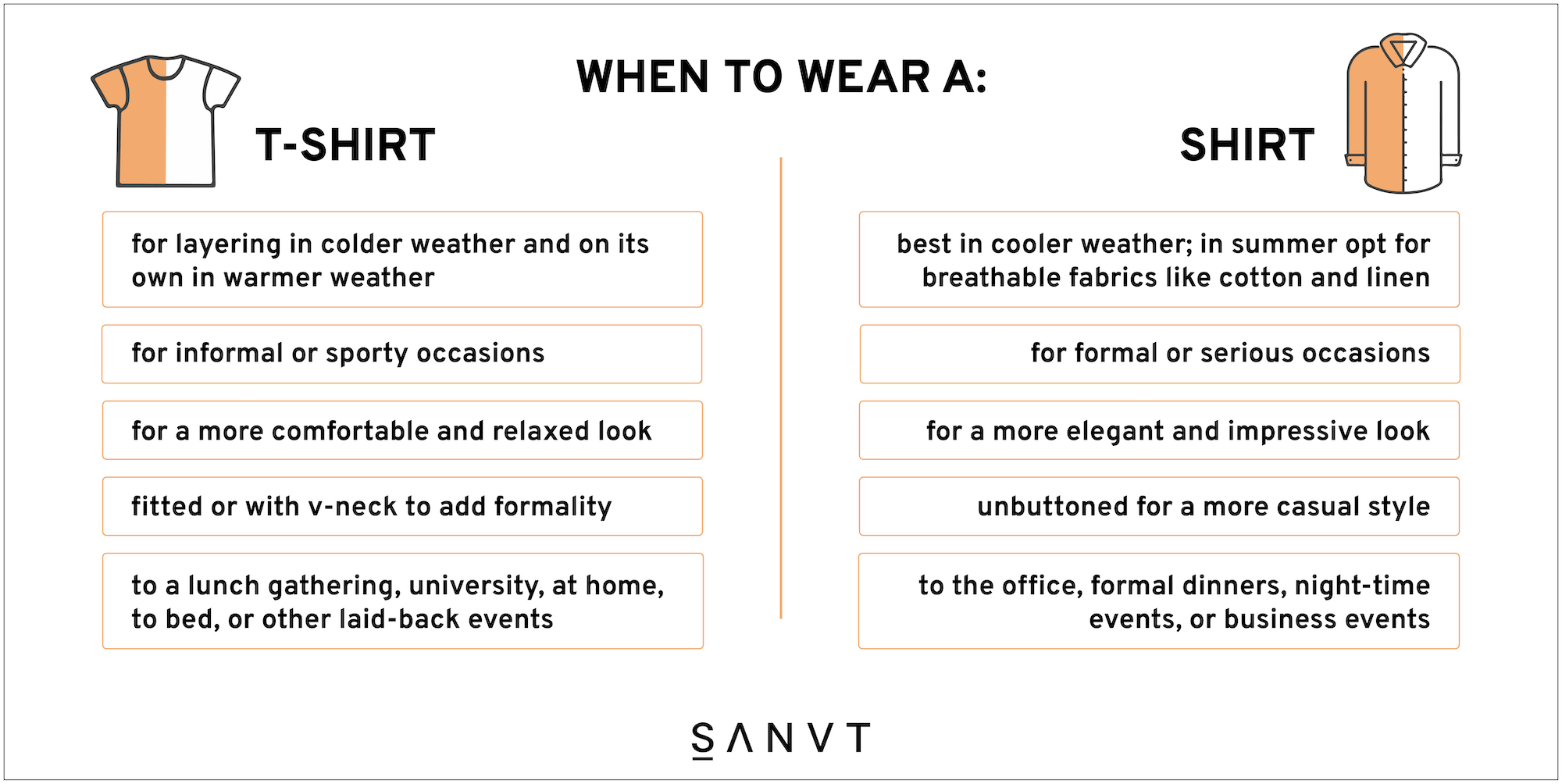
Credit: sanvt.com
Style And Appearance
How you look matters, especially at work, events, or meetings.
Shirts
Shirts give a polished and structured look. They’re often required for offices, interviews, or formal events. A simple white shirt with black trousers is a classic example of professional style. Shirts can be tucked in for a neat look or left out for a relaxed vibe.
Non-obvious insight: Rolling up the sleeves of a shirt can make you appear more approachable without losing style points.
T-shirts
T-shirts offer a relaxed and youthful appearance. They are best for casual settings—weekends, gatherings with friends, or travel. Graphic t-shirts can show personality or interests, while plain t-shirts are easy to match with almost any bottom.
Some people layer t-shirts under jackets or shirts for a blend of casual and smart.
Versatility
Versatility means how many ways you can wear an item.
Shirts
Shirts work in many settings. You can wear them to the office, at a party, or even on a date. Change the fabric or color, and a shirt fits almost every occasion. For example, a light blue shirt with chinos is perfect for business-casual events.
Shirts can also be worn open over t-shirts for a more casual look.
T-shirts
T-shirts are very versatile for casual use. They go with jeans, shorts, and even under blazers for a smart-casual style. However, there are limits. Most t-shirts are not suitable for formal or business occasions.
Weather Suitability
Weather should influence your clothing choices.
Shirts
Many shirts are made from woven cotton, which is breathable and good for warm weather. Linen shirts are perfect for very hot climates. However, long-sleeve shirts may feel uncomfortable in the heat, unless the sleeves are rolled up. Shirts also provide better coverage in cooler weather, especially when layered.
T-shirts
T-shirts are best for warm or hot weather because they are light and allow air to pass through easily. In cold weather, t-shirts can be used as a base layer under sweaters or jackets.
Practical tip: Wearing a t-shirt under a shirt in winter adds warmth without much bulk.
Durability And Care
How long your clothes last and how easy they are to care for matters, especially if you’re busy or on a budget.
Shirts
Shirts can be delicate, especially if they’re made from fine cotton or have special finishes. They often need ironing to look sharp, and some require dry cleaning. Collars and cuffs may show wear first.
However, if properly cared for, shirts can last many years. Avoiding high-heat drying and washing in cold water helps.
T-shirts
T-shirts are usually easy to wash and quick to dry. Most can go straight into the washing machine. However, they can fade, stretch, or lose shape faster than shirts, especially if made from low-quality fabric.
Non-obvious insight: Turning t-shirts inside out before washing helps keep prints and colors bright.

Credit: www.menshealth.com
Cost And Value
Budget is a key factor for many people.
Shirts
Shirts often cost more than t-shirts because of their structure, material, and details. Formal shirts, in particular, can be expensive. However, a high-quality shirt can last for years and works for many occasions, making it a good investment for your wardrobe.
T-shirts
T-shirts are generally cheaper and easier to replace. This makes them great for experimenting with colors or prints. But buying many low-quality t-shirts can end up costing more than a few good shirts over time.
Value tip: Sometimes it’s smarter to buy one good shirt instead of many t-shirts, especially if you need to look professional often.
Social Perception
What you wear tells others something about you.
Shirts
Wearing a shirt usually signals seriousness, professionalism, or elegance. People might treat you with more respect if you wear a shirt to a meeting or event. Even in casual settings, a shirt can make you stand out as someone who cares about appearance.
T-shirts
T-shirts show a relaxed, fun, and approachable side. They are great for creative jobs, casual meetings, or social events. Sometimes, wearing a t-shirt in a very formal setting can look unprofessional.
Non-obvious insight: In creative industries, a clean, stylish t-shirt can actually give you credibility, while a formal shirt may look too stiff or traditional.
Occasions: Where Each Works Best
Choosing between a shirt and a t-shirt often comes down to the occasion.
Best Occasions For Shirts
- Job interviews: Shows professionalism
- Business meetings: Required in most offices
- Formal events: Weddings, parties, or dinners
- Presentations or public speaking: Commands respect
- First dates: Makes a good impression
Best Occasions For T-shirts
- Casual outings: Picnics, shopping, or coffee with friends
- Exercise or sports: Breathable and flexible
- Travel: Comfort for long journeys
- Home: Relaxing after a long day
- Creative workspaces: Design studios, tech offices
Practical tip: If you’re unsure, wear a t-shirt under a shirt. You can remove the shirt if the situation is more casual.
Fabric Choices And Their Impact
The material affects not just comfort, but also how a shirt or t-shirt looks, lasts, and feels.
Common Shirt Fabrics
- Cotton: Soft, breathable, most common
- Linen: Very cool, perfect for hot weather
- Polyester blends: Less wrinkling, easy care
- Silk: Luxurious, mostly for special events
Common T-shirt Fabrics
- Cotton jersey: Soft, stretchy, standard for most t-shirts
- Polyester: Quick-drying, good for sports
- Blends: Mix of cotton and synthetic for durability
Some fabrics are better for skin, while others last longer or are easier to wash. Natural fibers like cotton and linen are good for sensitive skin.
Fashion Trends: How Shirts And T-shirts Evolve
Fashion is always changing, but shirts and t-shirts both have timeless appeal.
Shirts
Classic white, blue, and light-colored shirts never go out of style. Patterns like stripes or checks come and go. In recent years, oversized shirts and bold prints have become popular in casual fashion.
T-shirts
T-shirts allow more freedom to experiment. Graphic t-shirts can show everything from art to slogans. Fitted t-shirts are always in demand, but loose, oversized styles are also trendy.
Non-obvious insight: Vintage band t-shirts or logo shirts have become collector’s items. Sometimes, a simple t-shirt can be a statement piece.
Environmental Impact
The planet matters, and your clothing choices can make a difference.
Shirts
Shirts, especially those made from high-quality cotton or linen, can last many years if cared for. This means less waste. However, shirts often use more water and energy in production and care (think of all the ironing and washing).
T-shirts
T-shirts are often made cheaply and thrown away quickly. Fast fashion means many t-shirts end up in landfills. Choosing organic cotton or recycled fabrics helps reduce your footprint.
Practical tip: Buy fewer, better-quality pieces instead of many cheap ones. This is better for your wallet and the environment.
Gender And Age: What Works For Whom
Shirts and t-shirts are worn by all genders and ages, but the style and fit may change.
For Men
Men often choose shirts for formal events, work, and dates. T-shirts are popular for casual wear and sports.
For Women
Women have more options: shirts can be formal, casual, or even styled as dresses. T-shirts are great for layering or as simple tops.
For Children And Teens
T-shirts are the go-to for kids and teens because they are easy to wear and care for. Shirts are saved for school, events, or family gatherings.
Layering And Styling Tricks
Knowing how to layer can help you get more from both shirts and t-shirts.
Layering Shirts
- Over a t-shirt: Casual, easy style
- Under a sweater or blazer: Adds formality and warmth
- With rolled sleeves: Relaxed look
Layering T-shirts
- Under a shirt: Keeps the shirt fresh, adds color
- Under a jacket: Smart-casual style
Practical tip: Use colors and patterns to create contrast. For example, a plain white t-shirt under a patterned shirt.
A Quick Comparison
Here’s a side-by-side look at the main differences:
| Factor | Shirt | T-Shirt |
|---|---|---|
| Formality | Formal to casual | Casual only |
| Comfort | Structured, less stretch | Soft, stretchy |
| Care | May need ironing | Easy wash, no iron |
| Durability | Long-lasting if cared for | May lose shape faster |
| Price | Usually higher | Usually lower |
Real-life Examples
Let’s look at a few scenarios to see what works best.
- Job Interview: A plain, well-fitted shirt with trousers makes a strong first impression. A t-shirt could look too relaxed.
- Weekend Outing: A t-shirt with jeans is comfortable and easy. For dinner afterward, add a casual shirt on top.
- Traveling: T-shirts are perfect for moving around. Bring a shirt to change your look for dinner or meetings.
- Outdoor Event: In hot weather, a linen shirt or cotton t-shirt both work. If there’s a chance of getting cold, layer both.
- Creative Office: A graphic t-shirt under a blazer or shirt mixes fun with professionalism.
Common Mistakes To Avoid
- Wearing a t-shirt to a formal event: This can look careless.
- Choosing the wrong size: Shirts should fit the shoulders; t-shirts should not be too tight or too loose.
- Ignoring care instructions: Both shirts and t-shirts last longer with proper washing and drying.
- Overusing bold prints: Too many prints can make you look less mature, especially in professional settings.
- Not considering the weather: Wearing a thick shirt in summer or a thin t-shirt in winter is uncomfortable.
What Should You Choose?
There’s no single answer. It depends on your needs, lifestyle, and personal style. If you want versatility and a polished look, invest in a few good shirts. If comfort and easy care matter most, focus on t-shirts.
Ask yourself:
- Where will I wear this?
- How do I want people to see me?
- What is my budget?
- How much effort do I want to spend on care?
Most people need both in their wardrobe for different reasons.
Style And Budget: Building A Balanced Wardrobe
If you’re starting out or trying to simplify your closet, here’s a useful plan:
| Item | How Many | Why |
|---|---|---|
| White Shirt | 2 | Works for formal and semi-formal events |
| Patterned/Colored Shirt | 2 | Adds variety for casual or work settings |
| Plain T-shirt | 3-4 | Comfortable for daily wear |
| Graphic T-shirt | 1-2 | Shows personality, great for weekends |
This mix lets you handle most situations without buying too much.
Cultural And Regional Differences
In some countries, shirts are almost required in public or formal spaces, while t-shirts are seen as too casual. In other places, t-shirts are common everywhere, even at work. Always consider local customs, especially when traveling or meeting new people.
Non-obvious insight: In some cultures, even a simple t-shirt may need to cover the arms or torso for modesty.
Celebrity Influence And Media
Celebrities and influencers can change how we see shirts and t-shirts. Famous people often mix both for unique styles—think of a t-shirt with a blazer on the red carpet or a shirt worn open over a t-shirt at a concert.
Media trends can make one seem cooler for a while, but both have long-lasting appeal.
Final Thoughts
So, which is better: a shirt or a t-shirt? The answer depends on your lifestyle, needs, and personal taste. Shirts offer more formality, structure, and versatility, especially for work or events. T-shirts excel in comfort, ease, and casual style. Most people will find that both are essential for a balanced wardrobe. By understanding when and how to wear each, you’ll always make the right impression and feel comfortable wherever you go.
For more about clothing and fabric types, you might find Wikipedia's clothing overview helpful.

Credit: forrestfrank.com
Frequently Asked Questions
What Is The Main Difference Between A Shirt And A T-shirt?
The main difference is that a shirt usually has a collar, buttons, and sometimes cuffs, while a t-shirt is collarless, pullover, and made from stretchy knit fabric. Shirts are often formal, while t-shirts are mostly casual.
Can You Wear A T-shirt Under A Shirt?
Yes, wearing a t-shirt under a shirt is common. It adds comfort, absorbs sweat, and can create interesting style layers. Choose a plain t-shirt for a clean look.
Which Lasts Longer, A Shirt Or A T-shirt?
A shirt, especially when made from high-quality fabric and cared for properly, usually lasts longer than a t-shirt. T-shirts can lose shape or color faster, but good quality ones can also last for years.
Are T-shirts Ever Suitable For Formal Occasions?
T-shirts are generally not suitable for formal occasions. Some workplaces or events allow plain, high-quality t-shirts under jackets for a smart-casual look, but for important events, a shirt is the safer choice.
How Should I Care For Shirts And T-shirts To Make Them Last?
Wash shirts and t-shirts in cold water and avoid high heat. Iron shirts when needed, but t-shirts usually don’t need ironing. Turn t-shirts inside out to protect prints and colors. Store both folded or hung to keep their shape.
