

What Does Business Casual Women Look Like? Style Guide 2024
What Does Business Casual Women Look Like
Business casual for women is a phrase that sounds simple but can be confusing. What does it really mean? Is it a suit, jeans, or a dress? In most offices, business casual sits between formal and relaxed. It lets you look professional but feel comfortable.
However, the rules can change from one company to another. This guide will help you understand what business casual for women looks like, with examples, tips, and comparisons. If you want to dress right for your office, interview, or meeting, you’ll find everything you need here.
Understanding Business Casual For Women
Business casual is about balance. You want to look polished, but not stiff. It’s not jeans and sneakers, but it’s also not a traditional suit. For women, business casual can include pants, skirts, dresses, blouses, and closed-toe shoes. The colors are usually neutral or soft, but a pop of color is fine. Patterns are allowed, but they shouldn’t be loud.
Most companies say “business casual” because they want employees to look neat and friendly. However, what is allowed can depend on your workplace culture. Some offices are stricter. Others are more relaxed. If you’re unsure, check your company’s dress code or observe what others wear.
Key Elements Of Business Casual Women’s Attire
Let’s look at the main pieces that create a business casual wardrobe for women.
Blouses And Tops
Blouses are a staple. You can wear a cotton blouse, silk top, or a button-down shirt. Patterns should be simple—think stripes or dots. Avoid tops with slogans or bold images.
- Sleeves are usually required. Short sleeves are fine, but spaghetti straps are not.
- Necklines should be modest. V-necks are okay, but avoid deep plunges.
- Materials like cotton, linen, or silk are best.
Pants And Trousers
Pants are comfortable and professional. Choose dress pants, chinos, or tailored trousers.
- Avoid jeans unless your office allows them. If you wear jeans, pick dark, non-distressed styles.
- Capri pants can work if they’re tailored and not too short.
- Avoid leggings unless paired with a long top.
Skirts And Dresses
Skirts and dresses give you variety. They should be knee-length or longer.
- Pencil skirts, A-line skirts, and midi dresses are popular.
- Avoid mini skirts, tight bodycon dresses, or anything revealing.
- Patterns and colors are fine, as long as they’re not too bold.
Blazers And Cardigans
Blazers add a formal touch. Cardigans are more relaxed but still professional.
- Blazers should fit well and not be too bulky.
- Cardigans can be worn over a blouse or dress.
- Avoid hoodies, sweatshirts, or oversized sweaters.
Shoes
Shoes should be closed-toe and comfortable. Heels, flats, and loafers are common.
- Heels should be moderate (under 3 inches).
- Flats and loafers are safe choices.
- Avoid flip-flops, sandals, or athletic shoes.
Accessories
Accessories should be simple. Think stud earrings, watches, or a small necklace.
- Avoid large statement jewelry or noisy bracelets.
- Bags should be structured, not slouchy or casual.
- Scarves can add style if they’re subtle.
Business Casual Vs. Formal Vs. Casual: Comparison
To help you understand the differences, here’s a comparison of business casual, formal, and casual dress codes.
| Feature | Business Casual | Formal | Casual |
|---|---|---|---|
| Top | Blouse, Button-down | Suit Jacket, Dress Shirt | T-shirt, Sweater |
| Bottom | Tailored Pants, Skirt | Matching Suit Pants/Skirt | Jeans, Shorts |
| Shoes | Flats, Loafers, Low Heels | Pumps, Heels | Sneakers, Sandals |
| Accessories | Minimal | Elegant, Classic | Casual, Fun |
| Outerwear | Blazer, Cardigan | Blazer, Coat | Hoodie, Jacket |
You can see that business casual sits in the middle. It’s not as strict as formal, but not as relaxed as casual.
Choosing Colors And Patterns
In business casual, colors are important. Neutral colors like black, navy, gray, and beige are safe. You can add color with a blouse or accessory.
- Avoid bright neon colors or clashing patterns.
- Pastel shades and earth tones work well.
- Patterns like stripes, checks, and dots are fine.
If you want to show personality, use a colored scarf, a patterned blouse, or a statement necklace—but keep it subtle.
What Not To Wear In Business Casual
Many beginners make mistakes when dressing business casual. Here are common items to avoid:
- Shorts – Too casual for most offices.
- Tank tops – Not professional unless under a blazer.
- Mini skirts – Too short for business settings.
- Flip-flops – Not allowed; wear closed-toe shoes.
- Ripped jeans – Only dark, non-distressed jeans are sometimes allowed.
- Workout clothes – Leggings, yoga pants, sweatshirts are too casual.
- Graphic tees – Avoid shirts with slogans, cartoons, or bold images.
Some offices allow jeans, but only in dark colors and with a tailored look. Always check your company’s rules.
Examples Of Business Casual Outfits For Women
Let’s look at real-life outfit combinations. These examples show how you can mix pieces to create a business casual look.
Outfit 1: Classic And Safe
- Navy tailored pants
- White cotton blouse
- Gray cardigan
- Black flats
- Small pearl earrings
Outfit 2: Modern And Stylish
- Black pencil skirt
- Light pink silk top
- Fitted black blazer
- Patterned scarf
- Nude loafers
Outfit 3: Relaxed Yet Professional
- Beige chinos
- Striped button-down shirt
- Olive green cardigan
- Brown loafers
Outfit 4: Dress Option
- Knee-length navy sheath dress
- Thin black belt
- Tan structured handbag
- Low black heels
Outfit 5: Jeans Allowed
- Dark blue jeans (no rips)
- Light blue blouse
- Gray blazer
- Black loafers
These combinations work in most offices. They are comfortable but also look polished.

Credit: www.youtube.com
Business Casual For Different Body Types
Business casual is not one-size-fits-all. You can look great no matter your body shape. Here are some tips:
- If you’re petite, choose cropped pants and fitted blazers. Avoid oversized pieces.
- If you’re curvy, wrap dresses and A-line skirts flatter your shape. Avoid tight bodycon dresses.
- If you’re tall, midi dresses and long trousers look balanced. Avoid skirts that are too short.
Fit is the most important thing. Clothes should not be too tight or too loose.
Seasonal Business Casual
Your business casual look should change with the seasons. Here’s how:
Spring/summer
- Lightweight fabrics like cotton and linen
- Short-sleeve blouses
- Knee-length skirts and dresses
- Light cardigans
Fall/winter
- Wool trousers
- Long-sleeve blouses
- Blazers and sweaters
- Closed-toe shoes, boots
In winter, layer with a scarf or coat. In summer, avoid heavy fabrics.
Business Casual For Remote Work
With more people working from home, business casual has changed. Many companies expect you to look professional on video calls.
- Wear a blouse or shirt on camera.
- Avoid pajamas, tank tops, or graphic tees.
- Simple accessories, like a necklace or earrings, can help.
- Choose colors that look good on camera (blue, green, gray).
Remember: You don’t need to wear shoes at home, but your top half should look neat.
Business Casual In Different Industries
Business casual rules can change depending on your job. Here’s a quick look:
| Industry | Typical Business Casual Look | Allowed Jeans? | Allowed Sneakers? |
|---|---|---|---|
| Finance | Blazer, blouse, tailored pants | No | No |
| Tech | Button-down, jeans, flats | Yes | Sometimes |
| Education | Cardigan, skirt, loafers | Sometimes | No |
| Marketing | Patterned blouse, pants | Yes | Yes |
| Healthcare Admin | Blazer, dress, flats | No | No |
Always check with your company or observe what others wear.
How To Build A Business Casual Wardrobe
If you’re starting from scratch, here’s how to build your wardrobe:
- Buy basics: Black pants, navy skirt, white blouse.
- Add layers: Cardigans, blazers.
- Choose shoes: Flats, loafers, low heels.
- Pick accessories: Watch, small earrings.
- Add color: Scarf, patterned blouse.
Start with a few pieces. Mix and match to create different looks.
Smart Shopping Tips
When shopping for business casual:
- Choose clothes that can be mixed and matched.
- Buy quality basics; they last longer.
- Try on clothes before buying. Fit is key.
- Look for sales and outlet stores.
- Avoid buying trendy pieces that go out of style fast.
A well-planned wardrobe saves money and time.
Grooming And Personal Care
Business casual is not just about clothes. Grooming matters too.
- Hair should be neat and clean.
- Makeup should be subtle. Avoid bold colors.
- Nails should be trimmed and clean.
- Avoid strong perfumes.
A polished look makes a strong impression.
Common Mistakes Beginners Make
Many women new to business casual make mistakes. Here are some to avoid:
- Wearing gym clothes because they seem comfortable.
- Choosing oversized sweaters or hoodies.
- Wearing shoes that are too casual (sneakers, sandals).
- Picking tops with bold slogans or images.
- Forgetting about grooming.
Another mistake: ignoring company culture. Always check the dress code.
How To Adapt Business Casual For Special Occasions
Sometimes you need to dress up or down for special events.
- For a client meeting, add a blazer.
- For an office party, wear a patterned dress.
- For interviews, dress one step more formal—add a blazer or suit jacket.
If unsure, ask your manager or HR.
Business Casual For Plus Size Women
Business casual is for everyone. If you’re plus size:
- Choose pieces that fit well but don’t cling.
- Look for wrap dresses, A-line skirts, and tailored pants.
- Avoid clothes that are too tight or too loose.
- Try brands that specialize in plus size business wear.
Confidence is more important than size.
Sustainable Business Casual Choices
More women are choosing eco-friendly clothes. Here’s how to build a sustainable wardrobe:
- Buy clothes made from organic cotton, linen, or wool.
- Shop at brands that use ethical practices.
- Buy fewer, better pieces.
- Donate or recycle old clothes.
Sustainability is becoming important in fashion. You can look good and help the planet.
Business Casual Around The World
Business casual is not the same everywhere. In the US and Europe, it’s relaxed. In Asia, it can be more formal. Some countries expect more modesty.
- In Japan, business casual often includes a blazer.
- In India, traditional wear like kurta is allowed.
- In Australia, business casual is very relaxed.
If you travel or work with global teams, ask about local dress codes.
Insider Tips Most Beginners Miss
- Tailoring makes a big difference: Even cheap clothes look better when tailored to fit you.
- Keep a spare outfit in your office or car. You never know when you’ll need to change for a meeting.
- Plan your outfits ahead: Saves time and stress in the morning.
- A structured bag elevates your look: It gives a professional finish, even if your outfit is simple.
- Pay attention to fabrics: Wrinkle-free materials help you look neat all day.
Many women ignore these tips, but they make you look and feel more professional.
Business Casual For Interviews
For interviews, play it safe. Choose business casual that leans a bit formal.
- Wear a blazer or structured cardigan.
- Pick neutral colors.
- Closed-toe shoes only.
- Avoid loud jewelry.
Research the company before your interview. If they are strict, dress up. If they are relaxed, you can dress down a bit.

Credit: www.cottoncashmerecathair.com
Data: Business Casual Preferences
Surveys show that about 60% of offices use business casual as their dress code. Among women:
- Blouses and cardigans are top choices.
- Pencil skirts are more popular than A-line skirts.
- Flats are preferred over heels for comfort.
About 25% of offices allow jeans on Fridays. Only 10% allow sneakers.
How To Transition From Formal To Business Casual
If you move from a formal office to a business casual one:
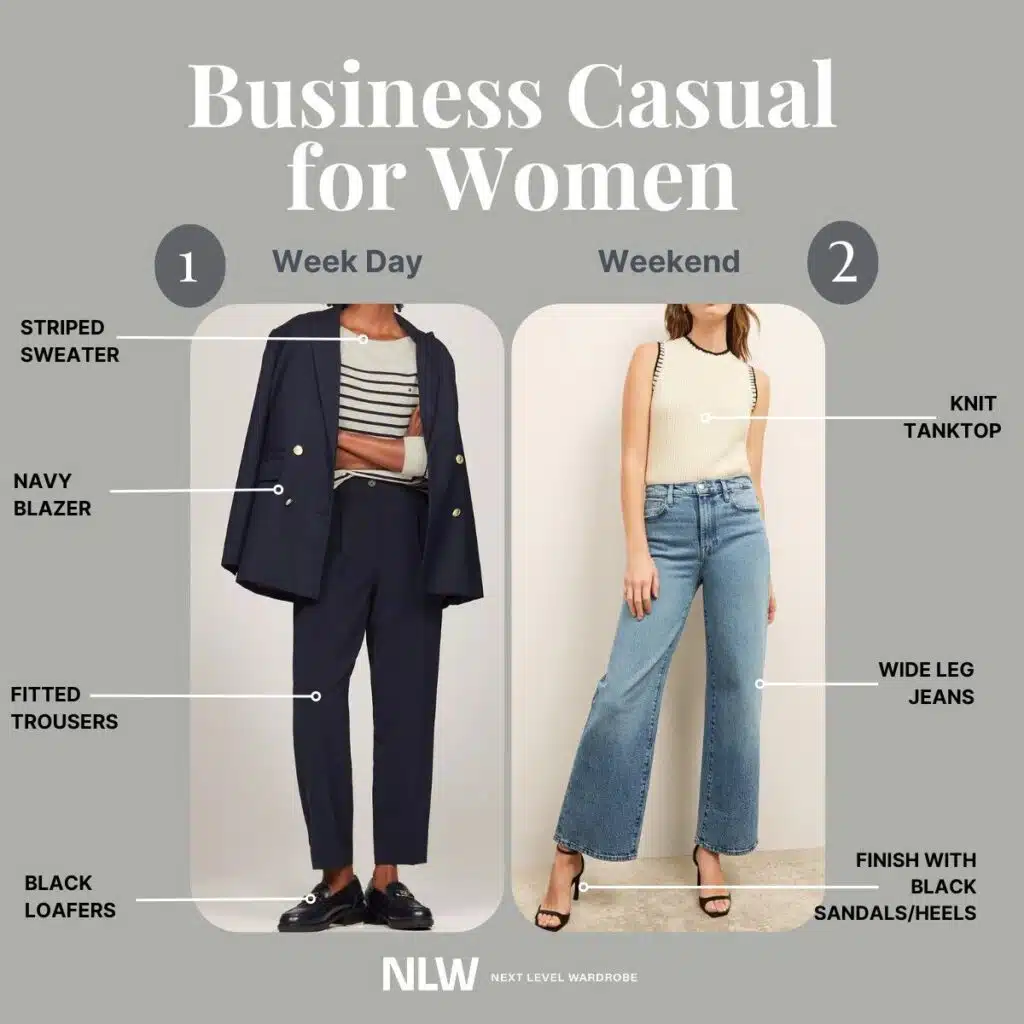
- Drop the suit jacket. Replace with a cardigan or blazer.
- Swap dress pants for chinos or tailored trousers.
- Try patterned blouses instead of plain white shirts.
- Keep shoes professional—flats or loafers.
You can keep your formal pieces and mix them with casual ones.
Credit: nextlevelwardrobe.com
Business Casual For Different Age Groups
Business casual works for all ages, but style changes with age.
- Young professionals: Try modern cuts, slim-fit pants, patterned blouses.
- Mid-career: Stick to classics, add layers like blazers.
- Senior professionals: Choose elegant pieces, simple jewelry.
Age doesn’t matter as much as fit and professionalism.
Making Business Casual Personal
You can add personality to your business casual wardrobe.
- Wear a colored scarf or statement necklace.
- Choose patterned blouses or skirts.
- Add a fun bag.
- Try different shoes—loafers, oxfords, ballet flats.
Stay professional, but don’t be afraid to show your style.
Real-life Business Casual Stories
Many women worry about business casual. Here are two examples:
- Maya works in marketing. She wears dark jeans, patterned blouses, and loafers. She adds a blazer for meetings. She feels comfortable and confident.
- Linda is in finance. She wears tailored pants, a white blouse, and a navy blazer. She keeps jewelry simple. She says, “I never worry about what to wear.”
Both use basics and add their own touches.
Business Casual For Office Events
Office events can be tricky. For company lunches or parties:
- Choose a patterned dress or skirt.
- Add a blazer for meetings.
- Wear comfortable shoes.
For team outings, jeans may be allowed. Always check the event invitation.
Business Casual For Travel
If you travel for work, pack smart:
- Choose wrinkle-free fabrics.
- Pack basics that mix and match.
- Take a blazer for meetings.
- Wear comfortable shoes.
Keep a spare blouse in your bag. You’ll always be ready.
Business Casual For Moms
If you’re a mom returning to work, business casual is a good choice.
- Choose easy-care fabrics.
- Keep a spare top for spills.
- Comfortable shoes are a must.
- Simple accessories are best.
Business casual helps you balance work and home.
Business Casual For Students
Students in internships or first jobs often ask, “What should I wear?” For business casual:
- Buy basics: Black pants, white blouse, simple flats.
- Avoid jeans unless allowed.
- Keep jewelry minimal.
First impressions matter. Dress professional, even if you’re new.
Frequently Asked Questions
What Is The Difference Between Business Casual And Smart Casual?
Business casual is more formal than smart casual. Business casual usually means tailored pants, blouses, and closed-toe shoes. Smart casual can include jeans, trendy tops, and casual shoes. Business casual is for offices; smart casual is for social events.
Can Women Wear Jeans In Business Casual?
Sometimes. If your office allows jeans, choose dark, non-distressed styles. Pair with a blouse and blazer. Never wear ripped or faded jeans. Always check your company’s dress code.
Are Open-toe Shoes Allowed In Business Casual?
Usually not. Closed-toe shoes like flats, loafers, or low heels are safest. Some offices allow open-toe shoes in summer, but sandals or flip-flops are never allowed.
How Can I Make Business Casual More Stylish?
Add personality with colorful accessories, patterned blouses, or a fun bag. Try different shoes like loafers or ballet flats. Layer with cardigans or blazers. Always keep the look professional.
Where Can I Find Inspiration For Business Casual Outfits?
You can find ideas on fashion blogs, Pinterest, or Instagram. Many brands show business casual outfits on their websites. For more details, check Vogue’s office style guide.
Business casual for women is about looking professional and feeling comfortable. With the right pieces, you can create a wardrobe that works for your job and shows your style. Remember: fit, color, and grooming are key. Don’t be afraid to ask questions or try new looks. With these tips, you’ll always look business-ready.
