

Shirts Vs Tshirts: Key Differences and Style Guide
Shirts Vs Tshirts: A Complete Comparison For Everyday Style
Choosing between a shirt and a t-shirt may seem simple, but both offer unique advantages for different situations. Understanding the real differences can help you dress smarter, feel more comfortable, and express your style better. Whether you are getting ready for work, a weekend outing, or just relaxing at home, knowing when to pick a shirt or a t-shirt makes a big difference.
This guide goes deep into the details of shirts vs t-shirts. You will learn about their history, design, fabric, fit, comfort, style options, care, and even the small things most people overlook. If you have ever wondered which is better for an interview or what works best in hot weather, you will find clear answers here. Let’s explore every angle and help you choose with confidence.
The Basics: What Is A Shirt? What Is A T-shirt?
It is easy to mix up shirts and t-shirts because both are upper-body clothing. However, they have clear differences in structure and use.
A shirt usually means a collared garment with a full-length opening at the front, closed by buttons. Shirts often have long or short sleeves with cuffs, and sometimes pockets. They are made for both formal and casual situations. Common examples include the dress shirt, casual shirt, and flannel shirt.
A t-shirt, on the other hand, is much simpler. It has no collar, often no buttons, and usually comes with short sleeves. T-shirts are pulled over the head and have a straight, loose fit. They are mostly worn for casual settings, sport, or as innerwear.
The word “t-shirt” comes from the “T” shape of the body and sleeves. Shirts, in contrast, have a more tailored look.
History And Evolution
Shirts have been around for centuries, often worn as undergarments or formal wear. In many cultures, shirts were symbols of status. Over time, they became a standard part of business and everyday dress.
T-shirts started as simple undergarments for soldiers and workers. Gradually, they became popular as outerwear, especially after being used by athletes, movie stars, and musicians. Today, t-shirts are a symbol of comfort and personal expression, used for everything from branding to protest messages.
Design And Structure Differences
Understanding the structure helps you know why shirts and t-shirts feel so different when worn.
Shirts
- Collar: Most shirts have a structured collar, adding formality.
- Buttons: Front buttons allow for easy wearing and ventilation control.
- Cuffs: Sleeves end with cuffs, sometimes adjustable with buttons.
- Placket: This is the reinforced strip of fabric where buttons are attached.
- Hem: Often curved, designed to be tucked in.
- Pockets: Some shirts include one or two chest pockets.
- Fit: Tailored to fit closer to the body.
T-shirts
- Neckline: Usually round (crew neck) or V-shaped (V-neck), no collar.
- No buttons: Pulled over the head, simple construction.
- Sleeves: Short or sometimes long, but without cuffs.
- Hem: Usually straight, made to be worn untucked.
- Pockets: Rare, but some designs have a small chest pocket.
- Fit: Generally looser, though fitted options exist.
Fabric Choices: What Matters Most
The fabric is key for comfort, durability, and style.
Shirt Fabrics
Shirts are made from a wide range of fabrics:
- Cotton: Most common, soft and breathable.
- Linen: Light, perfect for warm weather, wrinkles easily.
- Polyester blends: More wrinkle-resistant, less breathable.
- Silk: Luxurious, smooth, but delicate.
- Flannel: Brushed cotton, warm for colder climates.
- Denim: Thick and durable, used for casual shirts.
T-shirt Fabrics
T-shirts focus on comfort and stretch:
- Jersey Cotton: Soft, stretchy, and breathable.
- Polyester: Dries quickly, used in sports t-shirts.
- Blends: Cotton-polyester mixes for better durability and less shrinkage.
- Organic Cotton: Environmentally friendly, softer feel.
- Tri-blend: Mix of cotton, polyester, and rayon for softness and shape retention.
Non-obvious insight: Some high-end shirts use “two-ply” or “long-staple” cotton, which feels smoother and lasts longer. Most t-shirts, even premium ones, do not use this grade of cotton.
Credit: sanvt.com
Fit And Comfort: What Feels Best?
Comfort is subjective, but the cut and material play a big part.
Shirt Fit
- Slim Fit: Close to the body, modern look, best for slim builds.
- Regular Fit: A bit looser, suits most body types.
- Relaxed Fit: More room, often in casual shirts.
Shirts should fit well at the shoulders and chest. The collar must not choke or hang loose. Sleeves should end at the wrist bone.
T-shirt Fit
- Classic Fit: Loose around the body, easy movement.
- Fitted/ Athletic Fit: Hugs the chest and arms, tapers at the waist.
- Oversized: Trendy among youth, extra loose.
T-shirts are more forgiving in size. But a too-tight t-shirt can look awkward, while a baggy one may appear sloppy unless styled intentionally.
Non-obvious insight: The cut of a shirt (like darts at the back) can make it look tailored even on different body types, while t-shirts rarely have such shape-enhancing features.
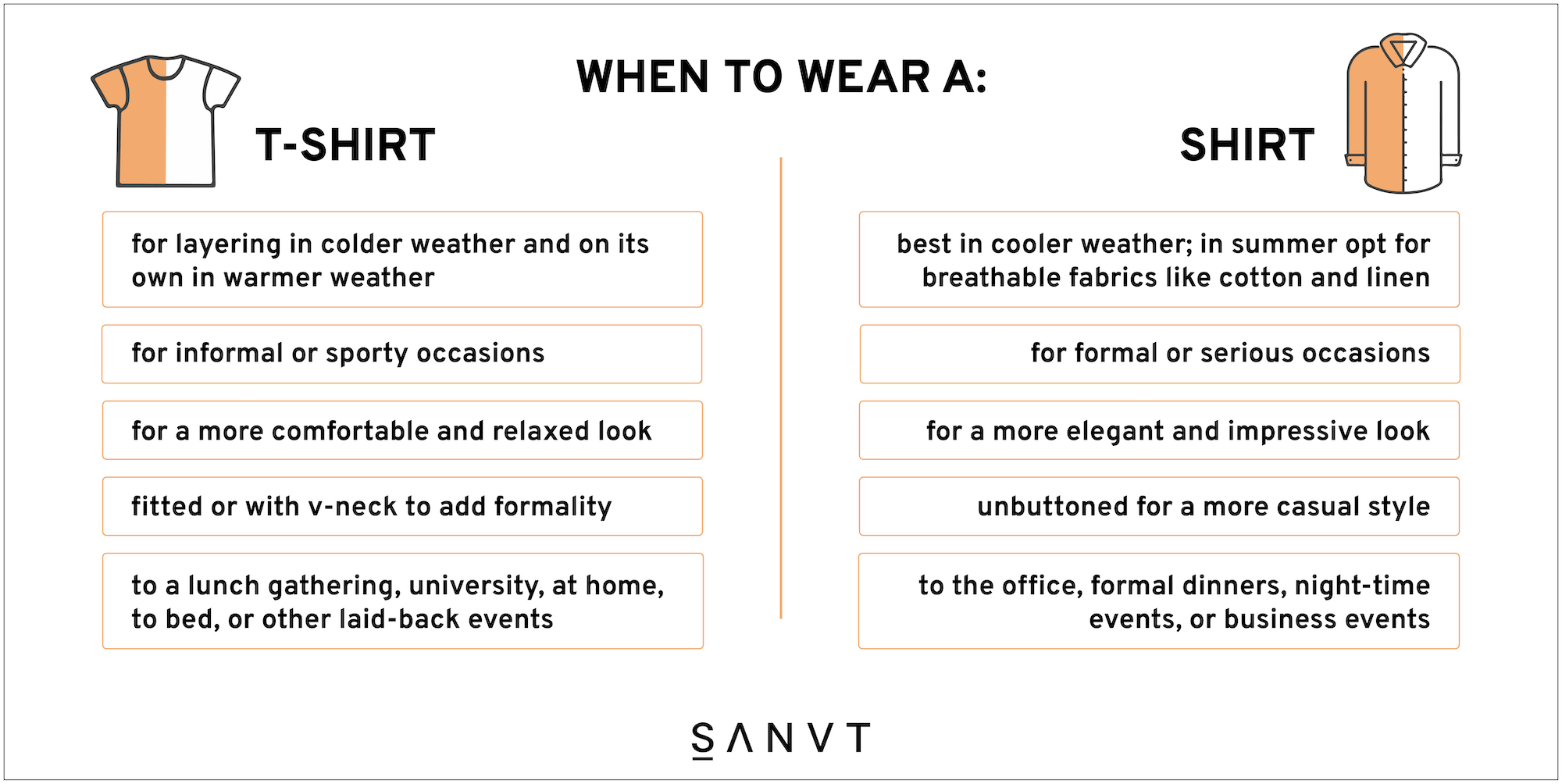
When To Wear: Occasions And Dress Codes
Knowing when to choose a shirt or t-shirt is essential for looking appropriate and feeling comfortable.
Shirts
- Formal Events: Business meetings, interviews, weddings.
- Semi-Formal: Dinner dates, office wear, presentations.
- Smart Casual: Paired with jeans or chinos for a relaxed yet sharp look.
Shirts can be dressed up with a tie and jacket, or dressed down by rolling up the sleeves.
T-shirts
- Casual Outings: Parks, movies, casual dining.
- Sports and Activities: Gym, running, outdoor games.
- Layering: Under shirts, jackets, or hoodies.
T-shirts are not suitable for formal settings, but perfect for comfort and self-expression.
Style And Versatility
Both shirts and t-shirts come in many styles, but their versatility is different.
Shirt Style Options
- Dress Shirts: Best for suits and formal wear.
- Casual Shirts: Checkered, denim, flannel; good for weekends.
- Short-sleeve Shirts: Cooler, more relaxed.
- Printed or Patterned Shirts: For parties or creative settings.
Shirts can be tucked in or left out, layered with sweaters or blazers, and accessorized with ties, cufflinks, or scarves.
T-shirt Style Options
- Graphic T-shirts: Carry messages, art, or brand logos.
- Plain T-shirts: Clean, easy to match.
- V-neck, Crew Neck, Scoop Neck: Different neckline shapes.
- Long-sleeve T-shirts: Good for layering in cooler weather.
T-shirts are easy to match with almost anything—jeans, shorts, skirts, or joggers.
Maintenance And Care
How you care for your clothes affects their lifespan and look.
Shirt Care
- Washing: Most shirts need gentle washing. Some require dry cleaning.
- Ironing: Many shirts wrinkle easily and need ironing.
- Storage: Hanging is best to avoid creases.
T-shirt Care
- Washing: Easy to machine wash.
- Drying: Can be tumble dried, but air drying keeps shape longer.
- Ironing: Usually not needed, but can be done for a crisper look.
- Storage: Folding is fine; hanging can stretch the neck.
Practical tip: Always check the care label. Some shirt fabrics, like linen, shrink if washed hot. T-shirts with prints can fade fast if washed in hot water.
Cost And Value
Price depends on material, brand, and construction.
Shirt Pricing
- Affordable: Mass-market cotton shirts, simple designs.
- Mid-range: Branded shirts with better fabric and fit.
- Premium: Designer or custom-made, fine fabrics, special details.
T-shirt Pricing
- Budget: Plain, single-color tees in packs.
- Mid-range: Branded, better stitching, or organic cotton.
- Premium: Limited editions, artist-designed, or technical fabric.
On average, shirts cost more than t-shirts because of the complex construction and materials.
Practical Comparison: Side-by-side
Here is a simple comparison to help you see the main differences at a glance.
| Feature | Shirt | T-shirt |
|---|---|---|
| Collar | Yes | No |
| Buttons | Full/Partial | No |
| Sleeve Type | Long/Short, with cuffs | Mostly short, no cuffs |
| Formality | Formal/Semi-formal/Casual | Casual |
| Average Price | Higher | Lower |
| Care | More demanding | Easy |
| Customizability | Moderate | High (prints, colors) |
| Layering | Outer or under sweater/blazer | Base layer |
Durability And Lifespan
Shirts are usually built to last, especially if made from strong cotton or blends. They are less likely to lose shape, but can get worn at the collar, cuffs, or underarms. T-shirts, especially cheaper ones, may stretch out, fade, or develop holes faster.
Expert tip: Investing in a few well-made shirts can save money over time, especially for work. For t-shirts, buying mid-range quality gives a better fit and longer wear than the cheapest options.
Trends And Fashion Impact
Both shirts and t-shirts follow fashion trends, but t-shirts change faster.
- Shirts: Classic colors and patterns (white, blue, stripes) stay in style for years. New trends may include bold prints or unusual fabrics.
- T-shirts: Graphics, slogans, and colors change quickly. What’s popular one season may be outdated the next.
Some fashion experts say a white shirt is timeless, while t-shirts are great for showing personality or supporting causes.

Credit: sanvt.com
Environmental Impact
The environmental footprint depends on fabric and production methods.
- Cotton shirts and t-shirts: Cotton farming uses a lot of water and chemicals.
- Synthetic fabrics: Polyester and blends need less water, but are made from oil and can shed microplastics.
- Organic cotton: Lower impact, but more expensive.
- Longevity: Shirts usually last longer, reducing waste.
Overlooked fact: Most people replace t-shirts more often than shirts. Choosing higher-quality t-shirts, or donating old ones for recycling, helps reduce fashion waste.
Personal Expression And Customization
T-shirts are often used for branding, team spirit, or making a statement. They are easy to print, dye, or decorate. Shirts allow for expression too, but in more subtle ways—like fabric choice, pattern, or accessories.
Example: A band t-shirt shows your music taste, while a patterned shirt might reflect your love of art or travel.
Comfort In Different Climates
T-shirts are light and cool, making them best for hot, humid weather. Shirts, especially in linen or light cotton, can also be comfortable, and offer protection from the sun. In colder climates, shirts work well as a layering piece over a t-shirt or under a sweater.
Practical example: On a sunny day, a light cotton shirt with rolled sleeves keeps you cool and protects your arms from sunburn, while a t-shirt keeps things simple but leaves arms exposed.
Gender And Age: Who Wears What?
Both shirts and t-shirts are worn by all genders and ages, but preferences vary:
- Men: Often wear shirts for work, t-shirts for casual.
- Women: Shirts can be styled with skirts or pants, t-shirts with jeans or layered under dresses.
- Children: T-shirts are more popular due to ease of wear.
- Elderly: Shirts for formal occasions, t-shirts for comfort.
Fashion brands now offer a wide range of fits and styles for every body type and age.
Common Mistakes When Choosing
- Ignoring fit: A well-fitted shirt or t-shirt looks better than an expensive, ill-fitting one.
- Choosing the wrong fabric: Wearing polyester shirts in hot weather can be uncomfortable.
- Wearing t-shirts to formal events: Unless specifically allowed, t-shirts are usually too casual.
- Not checking care instructions: Some shirts shrink or lose color if washed incorrectly.
- Overlooking layering: A simple t-shirt under a shirt can help with sweat and comfort, but not all shirts are meant for layering.
Table: Shirt Vs T-shirt In Key Situations
Here’s a quick reference for choosing between a shirt and a t-shirt for different activities.
| Situation | Best Choice | Why |
|---|---|---|
| Job Interview | Shirt | Looks professional and formal |
| Picnic in Park | T-shirt | Comfortable and easy to move |
| Casual Friday at Work | Shirt or T-shirt | Depends on office culture |
| Running/Jogging | T-shirt | Breathable, lightweight |
| Date Night | Shirt | Shows effort and style |
| Concert or Festival | T-shirt | Easy to express personality, comfort |
| Travel | T-shirt | Packs small, easy to wash |
| Formal Event | Shirt | Required by dress code |
The Role Of Accessories
Shirts work well with many accessories: ties, cufflinks, watches, and even suspenders. T-shirts pair best with casual accessories like caps, watches, and simple jewelry.
Style tip: Layering a t-shirt under an open shirt is a classic casual look, while a shirt with a bold tie makes a strong formal statement.
Longevity: How To Make Them Last
- Shirts: Rotate between several shirts to reduce wear. Use gentle detergent and avoid high heat.
- T-shirts: Wash inside out to protect prints. Avoid over-stretching the neck when putting on.
Overlooked habit: Many people hang t-shirts, which stretches the neck. Folding preserves the shape much better.

Credit: www.pennypincherfashion.com
Making The Right Choice: Key Takeaways
- For work or formal events, always go with a shirt.
- For comfort, travel, and relaxed days, t-shirts are unbeatable.
- Consider fabric and fit for both. Quality matters more than quantity.
- Layering a t-shirt under a shirt gives flexibility for changing weather or settings.
- Care instructions matter for keeping both shirts and t-shirts looking good.
For deeper history on shirts and t-shirts, you can check this Wikipedia article for more details.
Frequently Asked Questions
What Are The Main Differences Between A Shirt And A T-shirt?
The main differences are in structure and formality. Shirts have collars, buttons, and cuffs, making them suitable for formal and semi-formal wear. T-shirts are collarless, usually have short sleeves, and are best for casual situations.
Can I Wear A T-shirt To A Job Interview?
In most cases, a t-shirt is too casual for a job interview. A shirt, preferably with a collar and in a neutral color, is a better choice for a professional impression.
How Can I Make My T-shirts Last Longer?
Wash t-shirts inside out, use cold water, and avoid high heat drying. Fold instead of hanging to keep the neck from stretching. Higher-quality t-shirts also last longer than cheaper ones.
Is It Okay To Wear A Shirt And T-shirt Together?
Yes, wearing a t-shirt under an open shirt is a popular and versatile style. It adds comfort and makes adjusting to temperature changes easier.
Which Is More Environmentally Friendly: Shirts Or T-shirts?
It depends on the fabric and how often you replace them. Shirts usually last longer, but both can have a high environmental impact if made from conventional cotton or synthetics. Choosing organic fabrics and recycling old clothes helps reduce this impact.
Shirts and t-shirts each have their place in your wardrobe. By knowing their strengths and limits, you can make smarter choices for work, play, and everything in between. Good style is not just about what you wear, but how you choose and care for your clothes.
