

What is Positive Affirmations for Success: Unlock Your Potential
What Is Positive Affirmations For Success
Everyone wants to succeed, but often negative thoughts and doubts hold us back. You may have heard people talk about “positive affirmations,” and wondered if they really help. The idea sounds simple: repeat positive phrases about yourself and your goals, and you will become more confident and successful. But does this actually work? And how can you use positive affirmations to create real results in your life, work, or studies?
In this article, you’ll discover what positive affirmations for success really are, how they work, and how to use them effectively. You’ll learn the science behind affirmations, see practical examples, and get tips to avoid common mistakes. This guide is designed to help you start using affirmations in a way that feels genuine, practical, and helpful—no matter your background or experience.
If you want to understand affirmations deeply and use them to reach your goals, you’re in the right place.
Understanding Positive Affirmations
Positive affirmations are simple statements that you repeat to yourself, usually aloud or silently, to help you build a better mindset. They focus on success, confidence, or self-worth. You don’t need special training or tools to use affirmations. Anyone can start today.
What Makes An Affirmation “positive”?
A positive affirmation is:
- Short and easy to remember
- Focused on what you want, not what you fear
- Written in present tense, as if it’s already true
For example: “I am confident and capable,” “I handle challenges with grace,” or “I deserve success.”
How Affirmations Affect Your Mind
When you repeat positive statements, your brain starts to accept them as truth. This process is called self-suggestion. Over time, affirmations can help replace negative thoughts with positive ones. You feel more motivated, hopeful, and ready to take action.
Studies in psychology show that self-affirmation can reduce stress, improve performance, and boost self-esteem. The effect is strongest when you truly believe the affirmation and repeat it regularly.
Why Success Affirmations Matter
Success is not only about skills or luck. It’s about mindset. Many successful people use affirmations to stay focused, confident, and persistent. When you believe in yourself, you try harder and don’t give up easily. Positive affirmations help you build this belief.
Science Behind Positive Affirmations
Many people think affirmations are just wishful thinking. But research shows they can change your brain and behavior.
How Your Brain Responds
Neuroscientists discovered that when you repeat positive phrases, certain areas of your brain become more active. The medial prefrontal cortex is involved in processing self-related information. When you use affirmations, this part of your brain helps you accept new beliefs about yourself.
Evidence From Studies
Several studies have tested affirmations in real life. One experiment asked students to write affirmations before exams. The students who did this performed better and felt less anxious. Another study found that people who practiced self-affirmation were more open to feedback and improved their habits faster.
Here is a comparison of how affirmation users perform versus non-users:
| Group | Average Test Score | Reported Stress Level |
|---|---|---|
| Affirmation Users | 85 | Low |
| Non-Users | 78 | High |
Real-life Examples
Many athletes, CEOs, and artists use affirmations. For example, a famous tennis player repeats “I am strong and focused” before matches. A business leader tells herself “I can solve any problem” before meetings. These affirmations help them calm nerves and perform better.
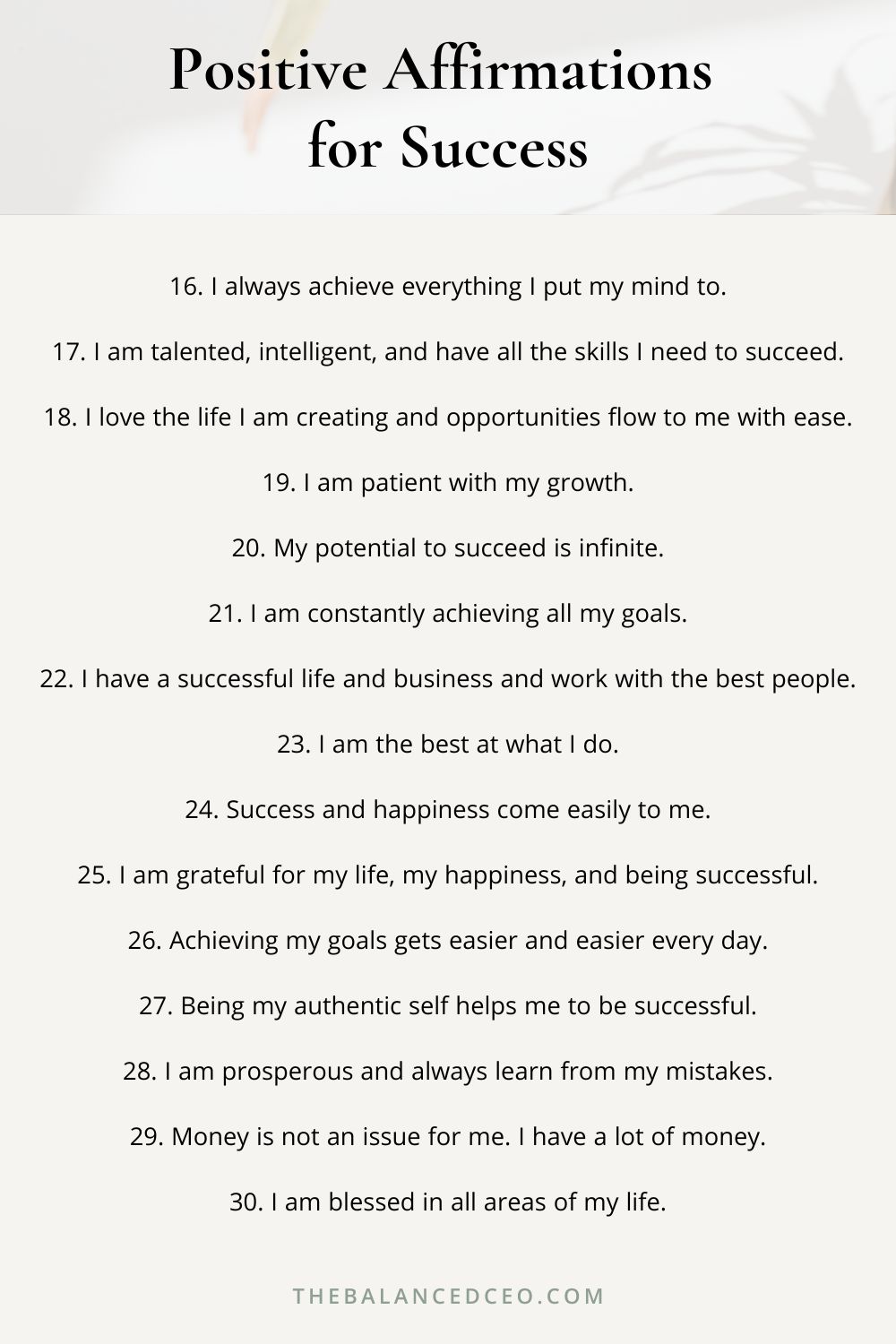
Credit: thebalancedceo.com
How To Create Effective Positive Affirmations
Not all affirmations work equally well. If you want to use them for success, you need to make them personal and meaningful.
Steps To Create Your Own Affirmations
- Identify your goal: What do you want to achieve? Confidence? Better performance? Less stress?
- Find your challenge: What negative thoughts hold you back?
- Write a positive statement: Turn your challenge into a positive, present-tense statement.
- Keep it short: One sentence is enough.
- Make it believable: Use words you trust. If “I am successful” feels unrealistic, try “I am learning and growing every day.”
Example Affirmations For Success
- “I am confident in my abilities.”
- “I learn quickly and adapt easily.”
- “I take action towards my goals every day.”
- “I handle challenges with a calm mind.”
- “I deserve to be successful.”
Tips For Powerful Affirmations
- Use your name: “I, Maria, am strong and capable.”
- Add feeling: “I feel proud of my progress.”
- Focus on action: “I take steps towards success every day.”
- Avoid negatives: Don’t use “not” or “never.”
Using Affirmations In Your Daily Life
Affirmations are most effective when you make them part of your routine. Here are practical ways to use them:
Morning Rituals
Start your day with positive affirmations. Stand in front of a mirror, look yourself in the eye, and repeat your chosen phrases. This helps set your mindset for the day.
During Stressful Moments
If you feel nervous before a test, interview, or big meeting, use affirmations to calm yourself. Take a deep breath and repeat a phrase like “I am prepared and confident. ”
Before Sleep
Repeating affirmations at night helps your mind relax and focus on positive thoughts. Your subconscious works on these ideas while you sleep.
Writing And Visualizing
Write your affirmations in a notebook every day. Some people also visualize their success while saying the words. Imagine yourself winning, speaking confidently, or solving problems.
Using Technology
Set reminders on your phone to repeat affirmations. Record your voice and listen to it during breaks. Some apps offer affirmation prompts.

Credit: www.swagmagic.com
Common Mistakes And How To Avoid Them
Many beginners make mistakes that weaken the power of affirmations. Here’s what to watch for:
Mistake 1: Using Unrealistic Statements
If you don’t believe the affirmation, it won’t work. Instead of “I am a millionaire,” try “I am building healthy financial habits. ”
Mistake 2: Not Repeating Enough
One-time repetition has little effect. Affirmations need daily practice to change your mindset.
Mistake 3: Ignoring Emotions
If you repeat words without feeling, your brain won’t accept them. Connect your affirmation to real emotions. Feel proud, hopeful, or excited.
Mistake 4: Focusing On Negatives
Saying “I am not afraid” still reminds your brain of fear. Use positive language: “I am brave and strong.”
Mistake 5: Skipping Action
Affirmations alone won’t bring success. You must also take action towards your goals. Use affirmations to build confidence, then act.
Positive Affirmations For Different Types Of Success
Success means different things to different people. Let’s look at how affirmations can help in various areas:
Academic Success
Students often struggle with fear of failure or lack of confidence. Affirmations help them focus and stay positive.
Examples:
- “I study efficiently and remember easily.”
- “I am calm during exams.”
- “I improve my skills every day.”
Career Success
In the workplace, affirmations boost performance and reduce stress. They help you face challenges and grow.
Examples:
- “I handle tasks with skill and confidence.”
- “I am a valuable team member.”
- “I learn from every experience.”
Personal Growth
Affirmations can also help you develop as a person. You become more resilient, optimistic, and balanced.
Examples:
- “I trust myself to make good choices.”
- “I am open to new opportunities.”
- “I grow stronger with every challenge.”
Financial Success
Changing your mindset about money is key. Affirmations help you build healthy habits.
Examples:
- “I manage my finances wisely.”
- “I attract opportunities for growth.”
- “I am grateful for abundance in my life.”
Data: The Impact Of Daily Affirmations
To see how daily affirmations affect people, researchers collected data from different groups.
| Frequency of Affirmation | Reported Confidence Level | Self-Esteem Improvement (%) |
|---|---|---|
| Daily | High | 60 |
| Weekly | Moderate | 30 |
| Occasional | Low | 10 |
This shows that daily practice brings stronger results. People who use affirmations daily report higher confidence and self-esteem.
How Affirmations Compare To Other Mindset Tools
Positive affirmations are not the only way to build a good mindset. Let’s compare them to other popular tools.
| Mindset Tool | Ease of Use | Time Needed | Results |
|---|---|---|---|
| Affirmations | Very Easy | 1-5 min/day | Gradual Improvement |
| Meditation | Moderate | 10-30 min/day | Deep Calm & Focus |
| Journaling | Easy | 10 min/day | Self-Reflection |
| Visualization | Moderate | 5-10 min/day | Goal Clarity |
Affirmations are quick and simple. They fit easily into daily life. Combining them with other tools can make your mindset even stronger.

Credit: www.thegoodbody.com
Non-obvious Insights: Going Beyond The Basics
Many beginners miss these deeper points about affirmations:
- Context matters: Affirmations work best when connected to real actions and experiences. For example, saying “I am confident” before giving a speech is more powerful than saying it randomly.
- Small changes add up: You might not see big results overnight. But small shifts in your mindset can lead to bigger changes over time.
- Personalization is key: Generic affirmations help less than personal ones. Tailor your phrases to your own needs and goals.
- Community support can help: Sharing affirmations with friends or groups can boost their effect. You get feedback, encouragement, and accountability.
How To Stay Motivated With Affirmations
It’s easy to start, but many people lose motivation. Here’s how to keep going:
- Set reminders: Use your phone or calendar.
- Pair affirmations with habits: Repeat them while brushing your teeth or exercising.
- Track progress: Write down how you feel before and after using affirmations.
- Celebrate small wins: Notice when you feel more confident or less stressed.
Practical Examples Of Affirmations In Action
Let’s look at real-life situations:
Example 1: Job Interview Nerves
Sarah feels nervous before interviews. She starts using “I am prepared and confident” every morning and before interviews. Over time, she notices less anxiety and clearer answers.
Example 2: Academic Challenges
Raj struggles with math. He repeats “I learn new skills every day” and “I am calm during tests. ” His grades improve, and he feels more relaxed.
Example 3: Starting A Business
Lina wants to launch her own company. She uses “I take action towards my goals” and “I handle challenges with a calm mind. ” She feels more focused, makes better decisions, and grows her business.
Affirmations For Success: Beginner’s Guide
If you’re just starting, follow these steps:
- Choose one or two affirmations that feel meaningful.
- Repeat them aloud every morning and evening.
- Write them in a notebook.
- Connect the affirmation to a real goal or action.
- Adjust as you grow—make the affirmation more specific or powerful.
Advanced Tips: Make Affirmations Work Faster
- Combine affirmations with visualization: Imagine yourself succeeding while you repeat your phrase.
- Use affirmations during action: Say them while working, studying, or facing a challenge.
- Record your voice: Listen to your affirmations during breaks.
- Join a community: Share your affirmations and progress with others.
- Reflect weekly: Review what changed in your mindset and behavior.
Questions To Ask Yourself
Before you start, ask:
- What do I really want to achieve?
- What negative thoughts do I want to change?
- Which affirmation feels true and helpful?
- How will I practice daily?
- How will I measure progress?
The Role Of Belief In Affirmations
Belief is key. If you repeat words you don’t believe, your mind resists. Start with small, believable affirmations. As you see changes, you can use stronger phrases.
Affirmations And Success: The Big Picture
Affirmations are not magic. They don’t guarantee instant results. But they help you build a positive mindset, which is essential for success. When you believe in yourself, you take more risks, learn faster, and bounce back from setbacks.
Success is a journey. Affirmations give you the fuel to keep moving forward. Combined with action, learning, and support, they can help you reach your goals.
If you want to learn more about the science of affirmations, visit Wikipedia.
Frequently Asked Questions
What Are Positive Affirmations For Success?
Positive affirmations for success are short, positive statements that you repeat to yourself to build confidence and motivation. They help you focus on your goals and replace negative thoughts with positive ones. By practicing them daily, you can improve your mindset and performance.
How Often Should I Use Affirmations?
For best results, use affirmations every day. Repeat them in the morning, before stressful events, and at night. Daily practice helps your brain accept the positive statements and makes them part of your thinking.
Can Affirmations Really Change My Life?
Yes, affirmations can change your life when combined with action and belief. Research shows that people who use affirmations regularly feel more confident, perform better, and handle stress more easily. The key is consistency and connecting affirmations to real goals.
What If I Don’t Believe My Affirmation?
Start with a smaller, believable statement. For example, instead of “I am successful,” try “I am learning new skills.” As you see progress, your belief grows, and you can use stronger affirmations. Adjust your phrases to match your current mindset.
Are Affirmations Just Positive Thinking?
Affirmations are more than just positive thinking. They are focused, active statements that help you build a new mindset. Positive thinking is general, but affirmations are specific to your goals and challenges. When combined with action, affirmations become a powerful tool.
Positive affirmations for success are simple, but powerful. They help you build confidence, focus on your goals, and change your mindset. With daily practice and real action, they can support you in reaching any level of success. Whether you are a student, professional, or just want to grow personally, affirmations offer a practical way to move forward.
Start today, and see how small changes in your words can lead to big changes in your life.
