

Is Affirmation a Love Language? Understanding Its True Impact
Is Affirmation A Love Language
Many people search for ways to connect deeply with those they love. Some use gifts, some spend time together, and others prefer touch or acts of service. But what about affirmation? Can words of praise, encouragement, and support be a true love language? This question often comes up in relationships, friendships, and even workplaces. Understanding if affirmation is a love language can change how you express care, build trust, and help others feel valued.
This article explores the concept in detail. You will learn what affirmation really means, how it compares to traditional love languages, why it matters, and how to use it effectively. We will look at real-world examples, scientific research, and practical ways to strengthen your relationships with affirmation.
By the end, you will know if affirmation is a love language—and how to use it wisely.
What Is Affirmation?
Affirmation means positive words or statements that show appreciation, encouragement, or support. It can be a simple “You did great!” or “I believe in you.” Unlike just compliments, affirmation goes deeper. It recognizes effort, character, and growth.
Types Of Affirmation
People use affirmation in many ways:
- Encouragement: “You can do this.”
- Praise: “Your idea was smart.”
- Appreciation: “Thank you for helping.”
- Recognition: “I noticed your hard work.”
These statements help others feel seen and valued. Affirmation is not just flattery. Genuine words matter.
Psychological Impact
Research shows affirmation can boost self-esteem, motivation, and happiness. In one study, people who received positive feedback felt more confident and performed better. Affirmation also reduces stress and builds resilience.
A less obvious insight: affirmation works best when it is specific. Saying “You are smart” is less effective than “You solved that problem so well.” Specific affirmation feels more sincere.
The Five Love Languages Explained
The term love languages comes from Dr. Gary Chapman’s work. He describes five main ways people give and receive love:
- Words of Affirmation
- Acts of Service
- Receiving Gifts
- Quality Time
- Physical Touch
Each person has one or two preferred ways to feel loved. For some, words matter most. For others, actions or touch are key.
Words Of Affirmation
“Words of affirmation” is one of the official love languages. It involves using positive words to express love, care, and appreciation. Examples include:
- “I love you.”
- “You mean so much to me.”
- “I’m proud of you.”
Affirmation is at the heart of this language. But is affirmation alone a love language? Or is it just part of the bigger “words of affirmation” category?
Is Affirmation The Same As Words Of Affirmation?
This is a common confusion. Let’s break it down.
Similarities
Both affirmation and “words of affirmation” use positive language. Both show care and help others feel valued. In relationships, affirmation often sounds like compliments, praise, or encouragement.
Differences
“Words of affirmation” is a broad category. It includes all types of positive words—affirmation, affection, gratitude, and even apologies. Affirmation is a subtype of this love language, focused on encouragement and recognition.
Some experts say that affirmation is the core of this love language. Others believe it is only one part. For example, saying “I love you” is a word of affirmation, but not always an affirmation of ability or character.
Practical Example
Imagine two people. One feels loved when they hear “I appreciate your help. ” The other prefers “I love you. ” Both statements are words of affirmation, but only the first is an affirmation of effort.
Why Affirmation Matters In Relationships
Affirmation is more than just nice words. It builds connection, trust, and security.
Emotional Benefits
When you give affirmation, you show that you notice and value someone. This helps:
- Build confidence
- Reduce anxiety
- Strengthen bonds
Children, partners, friends, and coworkers all benefit from affirmation.
Social Impact
Affirmation can change group dynamics. Teams work better when members affirm each other. In families, affirmation creates a safe space to grow.
A non-obvious insight: affirmation is powerful in conflict. It helps people feel heard and respected, even when they disagree.
How To Give Effective Affirmation
Affirmation works best when it is genuine, specific, and timely. Here’s how to use it well:
Be Genuine
Avoid empty praise or forced words. People sense when affirmation is not sincere.
Be Specific
Say what you appreciate clearly. Instead of “Good job,” try “I noticed how you solved that tough problem. ”
Be Timely
Give affirmation soon after the event. Waiting too long can make it lose impact.
Avoid Common Mistakes
- Don’t overdo it. Too much affirmation can feel fake.
- Don’t mix affirmation with criticism.
- Avoid generic words.
Examples In Daily Life
- At work: “Your report was clear and helpful.”
- At home: “I appreciate how you listen.”
- With friends: “You always lift my spirits.”
Affirmation Versus Other Love Languages
Affirmation is not the only way to show love. People respond to different approaches.
Comparison Table
Here’s a comparison of affirmation with other love languages:
| Love Language | How It Shows Love | Best For | Common Mistakes |
|---|---|---|---|
| Affirmation | Positive words, praise, encouragement | People who value recognition | Too generic, not sincere |
| Acts of Service | Helping, doing tasks | People who value action | Not noticing or feeling unappreciated |
| Receiving Gifts | Giving thoughtful presents | People who value symbols | Giving without meaning |
| Quality Time | Spending time together | People who value presence | Distracted or not fully present |
| Physical Touch | Hugs, holding hands | People who value closeness | Touch without emotional connection |
Choosing The Right Love Language
Knowing someone’s preferred love language is key. If affirmation is their main language, words matter most. If not, actions or gifts may mean more.
A practical tip: ask people what makes them feel loved. Many don’t know their own love language.
Scientific Research On Affirmation
Scientists study how affirmation affects relationships and self-esteem.
Key Findings
- Affirmation boosts motivation and performance.
- Couples who use affirmation report higher satisfaction.
- Affirmation helps people cope with stress.
One study found that affirmation reduces defensive behavior during arguments. People feel safer and more open.
Data Table: Affirmation Effects
Here is data from research on affirmation:
| Effect | Result | Source |
|---|---|---|
| Self-Esteem | Increased | Psychology Journal |
| Relationship Satisfaction | Higher | Couple Studies |
| Stress Reduction | Significant | Wellness Research |
| Conflict Resolution | Improved | Communication Analysis |
Additional Insights
Many people miss that affirmation is not only useful in close relationships. It also works in business, coaching, and teaching. Affirming others in these areas can improve teamwork and learning.
How Affirmation Changes Over Time
Affirmation may start strong in new relationships but fade with routine. Keeping it alive takes effort.
Common Challenges
- Forgetting to give affirmation
- Using only generic praise
- Relying on one form of affirmation
Solutions
- Set reminders to affirm others
- Learn new ways to express affirmation
- Ask for feedback
A less obvious insight: affirmation must adapt. As people grow, the kind of affirmation they need changes.
Cultural Differences And Affirmation
Affirmation is not universal. Different cultures value words in unique ways.
Table: Cultural Viewpoints On Affirmation
| Culture | Role of Affirmation | Preferred Expression |
|---|---|---|
| Western | Very important | Direct praise, open encouragement |
| Eastern | Less direct | Subtle, indirect affirmation |
| Latin American | Warm, expressive | Frequent affirmation, emotional |
| Middle Eastern | Reserved | Private affirmation |
Practical Advice
If you are in a multicultural environment, learn how people prefer affirmation. Some may find direct praise uncomfortable. Adapt your style.
The Role Of Affirmation In Parenting
Parents use affirmation to guide and encourage children. Positive words help children develop confidence and motivation.
Examples
- “You worked hard on your homework.”
- “I’m proud of how you shared with your friend.”
Research shows children who receive affirmation are more resilient and optimistic.
A non-obvious tip: affirmation should focus on effort, not just achievement. Praising effort builds a growth mindset.
Using Affirmation In Friendships
Friends often support each other with affirmation. Saying “I appreciate you” or “You always make me laugh” strengthens bonds.
Common Mistakes
- Assuming friends know you value them
- Forgetting to affirm during tough times
- Using only playful words, not serious affirmation
Practical Ways
- Write a note or message
- Give verbal praise
- Celebrate milestones
Friendship grows when affirmation is regular and honest.
Affirmation In The Workplace
Workplaces thrive on positive feedback. Affirmation increases motivation and teamwork.
How To Use Affirmation At Work
- Recognize effort: “Great job on the project.”
- Encourage growth: “You’re improving every day.”
- Celebrate success: “Your presentation was excellent.”
A less obvious insight: affirmation is not just for managers. Peers can affirm each other for stronger teams.
Data On Workplace Affirmation
Research shows that companies with regular affirmation have higher employee satisfaction and productivity. Employees are more likely to stay.
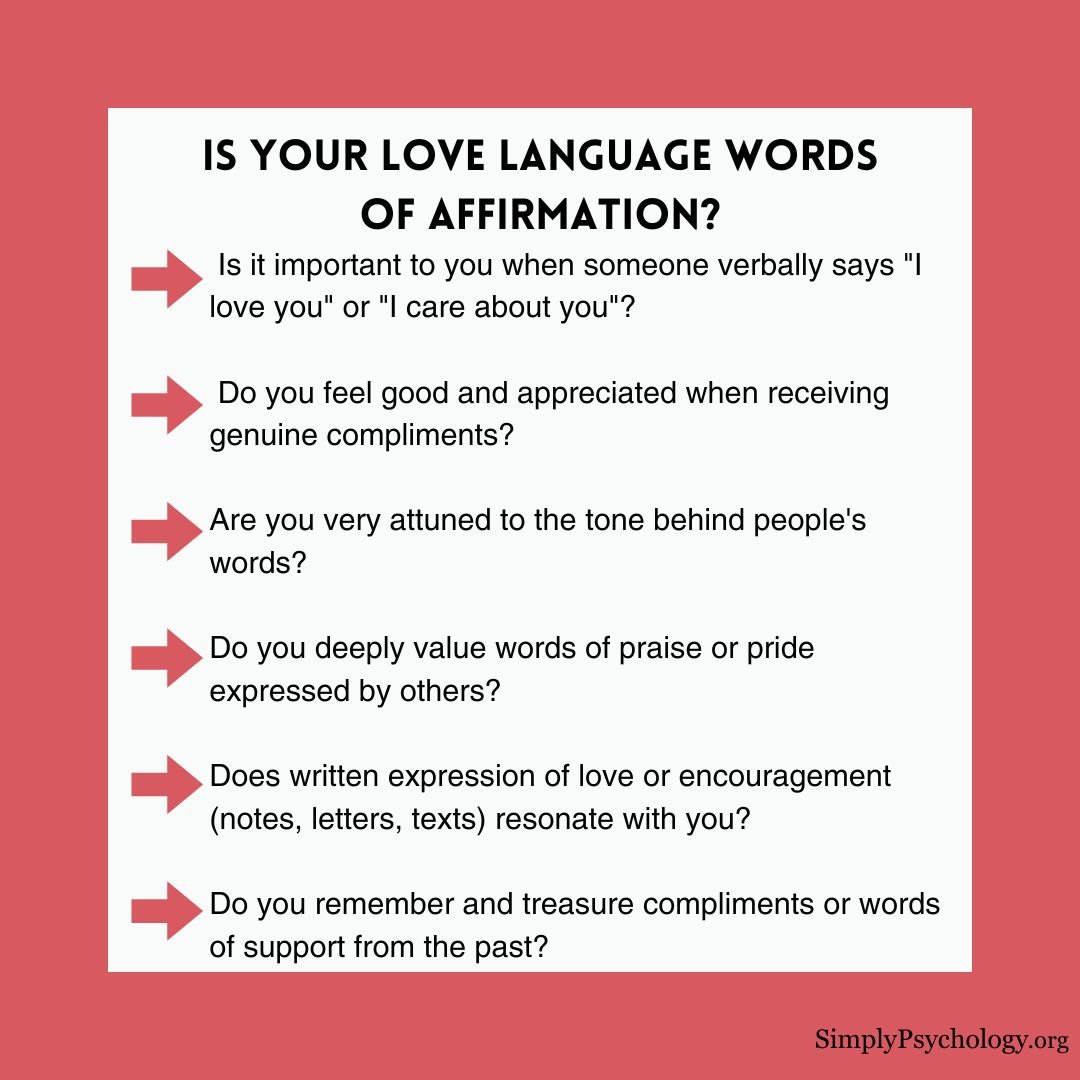
Credit: www.simplypsychology.org
Is Affirmation Enough?
Affirmation is powerful, but is it enough by itself? Sometimes yes, sometimes no.
When It Works
- For people whose main love language is affirmation
- In situations where words matter most
- When paired with sincerity
When It’s Not Enough
- If someone values actions or touch more
- When affirmation is not backed by behavior
- If affirmation is rare or inconsistent
A practical tip: combine affirmation with other love languages for best results.
How To Discover Your Love Language
Many people don’t know their own love language. Here’s how to find out:
- Reflect on what makes you feel most loved.
- Notice what you ask from others.
- Take a quiz or assessment.
- Ask trusted friends or partners.
Knowing your love language helps you ask for what you need and give it to others.
Common Myths About Affirmation
Some myths make affirmation less effective.
Myth 1: Affirmation Is Just Compliments
Compliments are part of affirmation, but affirmation also includes encouragement and recognition.
Myth 2: Affirmation Is Not Important
Some believe actions matter more. But affirmation can change behavior and mood.
Myth 3: Affirmation Is Always Positive
Affirmation can also be honest feedback. Saying “You can improve” with kindness is affirming.
How To Build Affirmation Habits
Building habits helps you use affirmation every day.
Steps To Build Affirmation Habits
- Set a goal to affirm someone daily.
- Keep a list of affirming phrases.
- Use reminders.
- Practice with friends or family.
A non-obvious tip: affirmation can be silent. A written note or a thoughtful gesture can be affirming.
Affirmation In Difficult Times
During stress or conflict, affirmation is essential. It helps people feel safe and understood.
How To Affirm During Challenges
- Acknowledge feelings: “I see you’re struggling.”
- Offer support: “I’m here for you.”
- Encourage: “You have the strength to get through this.”
Affirmation during tough times is often remembered longer than in easy moments.
Real-life Examples Of Affirmation As A Love Language
Let’s see some real stories.
Example 1: In A Relationship
A partner feels unloved until their spouse starts saying “I appreciate how you care for our family. ” The relationship improves. The affirmation is the key change.
Example 2: At Work
An employee feels unnoticed. The manager starts affirming their skills. The employee becomes more motivated, and performance goes up.
Example 3: In Parenting
A child struggles in school. The parent uses affirmation: “I see your effort.” The child becomes more confident.
Example 4: In Friendship
A friend feels lonely. Another friend says, “You matter to me. ” The bond becomes stronger.

Credit: www.simplypsychology.org
How Affirmation Shapes Identity
Affirmation is not just about relationships. It shapes how people see themselves.
Self-affirmation
Affirming yourself is important. Saying “I am capable” or “I can learn” boosts confidence.
Building Identity
People who receive affirmation believe in their abilities. This changes how they act and relate to others.
A less obvious insight: affirmation can help recover from setbacks. It builds resilience.
Combining Affirmation With Other Love Languages
Affirmation works best with other love languages.
How To Combine
- Pair affirmation with acts of service: “I appreciate you helping.”
- Use affirmation during quality time: “I enjoy spending time with you.”
- Add affirmation to gifts: Write a note.
Combining languages makes relationships stronger.
Affirmation For Non-native English Speakers
If English is not your first language, affirmation can be challenging.
Tips For Non-native Speakers
- Use simple phrases: “You did well.”
- Practice speaking or writing affirmations.
- Learn new words for affirmation.
A less obvious tip: affirmation works in any language. Use your native language if possible.
Affirmation In Digital Communication
Many people connect online. Affirmation works in texts, emails, and messages.
How To Affirm Digitally
- Send positive messages
- Use emojis or GIFs to show support
- Write thoughtful emails
Digital affirmation is important, especially in remote work or long-distance relationships.
Is Affirmation A Love Language? The Final Answer
Based on research, experience, and expert opinion, affirmation is a core part of the “words of affirmation” love language. It is not a separate love language, but it is the heart of expressing love through words. For many people, affirmation is their main way to feel loved.
Affirmation matters in all types of relationships. It builds confidence, connection, and happiness. Used with care, it can transform how you relate to others and yourself.
If you want to learn more about the science behind love languages, visit Wikipedia.
Frequently Asked Questions
Is Affirmation A Separate Love Language?
No. Affirmation is a core part of “words of affirmation,” one of the five love languages. It is not a separate language, but it is essential for those who value words.
Can Affirmation Replace Other Love Languages?
For some people, affirmation is enough. Others need actions, gifts, or touch. The best approach is to use affirmation along with other languages.
How Do I Know If Affirmation Is My Love Language?
Think about what makes you feel loved. If positive words, encouragement, or praise matter most, affirmation may be your main love language. You can also take a quiz or ask people close to you.
What Is The Best Way To Use Affirmation?
Be genuine, specific, and timely. Avoid generic praise. Affirm effort, character, and growth. Adapt affirmation to the person’s needs and culture.
Can Affirmation Be Given In Writing Or Online?
Yes. Affirmation works in spoken words, written notes, texts, and emails. Digital affirmation is important, especially in remote or long-distance relationships.
Affirmation, when used wisely, is a powerful tool for love and connection. Try it today—your relationships will thank you.

Credit: sawdustcityllc.com
