

How Many Affirmations Should I Write a Day for Maximum Results?
How Many Affirmations Should I Write A Day
Many people start using affirmations because they want to change their mindset, reach their goals, or feel more positive. But when you sit down with your journal and a pen, you might wonder, “How many affirmations should I write a day?
” Is there a magic number that brings results faster? Or does writing too many have the opposite effect? The answer is not as simple as picking a number and repeating it every morning. Let’s explore what really matters when choosing how many affirmations to write, how to get the most benefit, and what common mistakes to avoid.
What Are Affirmations And Why Do They Matter?
Affirmations are short, positive statements you repeat to yourself. These phrases help you focus on your strengths, build confidence, and change negative thinking patterns. For example, you might write, “I am confident in my abilities,” or “I attract positive opportunities.
” The goal is to rewire your mind, so your thoughts and actions align with what you want.
Science shows that self-affirmation can reduce stress, improve performance, and even help with physical health. When you repeat affirmations, your brain starts to believe them, especially if you write them down often. But to see real change, you need to use affirmations the right way—not just repeat empty words.
Is There A Perfect Number Of Affirmations?
Many people want a clear answer, like “Write 5 affirmations a day.” The truth is, there is no universal number that works for everyone. The right amount depends on your goals, time, and experience with affirmations. Let’s break down what research and experts suggest:
Different Approaches To Affirmation Quantity
- One Quality Affirmation
- Some find that focusing on a single, meaningful statement creates deep change. Writing the same phrase daily gives your mind time to accept it.
- Three to Five Affirmations
- Writing 3–5 affirmations allows you to target different areas of life, like work, health, and relationships. This approach balances focus and variety.
- Ten or More Affirmations
- Some people write 10 or more each day, especially if they want to shift several beliefs at once. This can feel powerful, but sometimes leads to less focus.
What Studies And Experts Say
Research on affirmation effectiveness highlights repetition and emotional connection as more important than the number of statements. One study from Carnegie Mellon University found that repeating a few key affirmations is enough to build resilience. Too many can overwhelm your mind, making it harder to believe any of them.
Experts like Louise Hay and Dr. Shad Helmstetter recommend quality over quantity. They advise choosing a handful of powerful phrases and repeating them with emotion, rather than writing dozens without meaning.
.jpg%3Falt%3Dmedia%26token%3D7b2583cb-cd00-4eb0-b03b-bb1489a427c2&w=1920&q=75)
Credit: www.amahahealth.com
Key Factors To Decide Your Affirmation Number
1. Your Experience Level
- Beginners: Start small, with 1–3 affirmations. This helps you focus and develop a routine.
- Intermediate: If you’re comfortable, try 3–7. This gives variety but still feels manageable.
- Advanced: If affirmations are already a habit, you might write 10 or more, but only if each one feels important.
2. Your Goals
- If you have one big goal, use one main affirmation.
- If you want to improve several areas, use different statements for each area.
3. Available Time
Consistency is more important than quantity. If you only have five minutes, write two meaningful affirmations. If you have more time, you can write more.
4. Emotional Connection
Only write as many as you can truly feel. If you find yourself rushing or losing meaning, reduce the number.
Comparing Common Affirmation Routines
Here’s a comparison of different daily affirmation routines, to help you find what fits best:
| Routine | Number of Affirmations | Best For | Potential Downside |
|---|---|---|---|
| Single Focus | 1 | Deep change on one belief | May miss other goals |
| Balanced Approach | 3–5 | Multiple life areas | Requires more time |
| Comprehensive | 10+ | Experienced users | Risk of less impact per affirmation |
How To Write Affirmations For Maximum Impact
Writing affirmations is more than just copying words. The way you write and repeat them affects your results. Follow these steps to make your affirmations work:
1. Use Present Tense
Affirmations should be in the present tense. For example, write “I am healthy,” not “I will be healthy.” This helps your mind believe the change is happening now.
2. Make Them Positive
Avoid negative words like “not” or “never. ” Instead of “I am not afraid,” write “I am confident and calm. ”
3. Keep Them Short And Simple
Short statements are easier to remember and believe. For example, “I am strong,” is more powerful than a long sentence.
4. Make Them Personal
Use “I” statements and tailor them to your life. For example, “I am a great public speaker” is better than a general statement.
5. Repeat With Emotion
Writing with emotion helps your brain accept the statement. Visualize what it feels like if the affirmation is true.
6. Write Daily
Repetition builds new beliefs. Set aside time every day, even if it’s just a few minutes.
The Role Of Repetition Vs. Quantity
Some people think the more affirmations you write, the better. But repetition of a few key phrases often brings more change than writing many statements once.
For example, writing “I am confident” ten times every day for a month creates a stronger belief than writing it once and moving on. The mind responds to repeated exposure. This principle is used in advertising and learning new skills.
A simple rule: It’s better to write three affirmations every day for a month than thirty once.
Writing Vs. Saying Affirmations
You might wonder if it’s better to write or say affirmations. Both have value, but writing has a unique effect. Studies show that writing by hand helps your brain process and remember information better.
Speaking affirmations can add emotion, but writing them down makes the statement more real and personal. For best results, combine both: write your affirmations and say them out loud.
Common Mistakes When Using Affirmations
Many people give up on affirmations because they don’t see results. Here are mistakes to avoid:
- Writing too many at once: Spreading attention over 20–30 affirmations makes each one less believable.
- No emotional connection: If the words feel empty, your mind won’t accept them.
- Not being specific: Vague statements like “I am successful” are less powerful than “I am successful at my job.”
- Inconsistency: Skipping days weakens the effect.
- Using negative words: Your mind focuses on the negative, even if you mean well.
Setting Up Your Daily Affirmation Practice
A regular routine helps affirmations work faster. Here’s a simple process:
- Choose a quiet time. Early morning or before bed works best for most people.
- Pick your affirmations. Start with 3–5 that match your goals and feelings.
- Write them by hand. Use a notebook or journal, not a phone or computer.
- Say them out loud. This adds another layer of belief.
- Visualize the outcome. Picture what life looks like if the statement is true.
- Repeat daily. Consistency is key.
How To Know If You’re Writing Too Many Affirmations
Writing more is not always better. Here are signs you might be overdoing it:
- You feel overwhelmed or bored while writing.
- The statements lose meaning.
- You rush to finish, not to believe.
- You forget what you wrote by the next day.
If you notice these, reduce your number. Focus on the few that matter most.
Balancing Variety And Focus
It’s tempting to cover every area of life with affirmations. But too much variety can dilute your focus. Here’s how to balance:
- Rotate topics by week. One week, focus on career; the next, on health.
- Change affirmations monthly. Stick with the same ones for at least a month to see results.
- Add new ones slowly. Only add new statements when you feel real progress on the old ones.
Real-life Examples Of Daily Affirmation Numbers
People often wonder what others are doing. Here’s how different people use affirmations:
- A busy professional: Writes 2 affirmations every morning about confidence and productivity.
- A student: Chooses 3 affirmations on focus, memory, and calmness before exams.
- A parent: Uses 5 affirmations—some for patience, others for self-care.
- An athlete: Repeats one strong affirmation about winning before every practice.
There is no single right answer. The key is to choose what fits your life and schedule.
Data: Popular Affirmation Numbers In Practice
A survey by a popular self-development forum found the following:
| Number of Daily Affirmations | Percentage of Users |
|---|---|
| 1–2 | 30% |
| 3–5 | 45% |
| 6–10 | 15% |
| 11+ | 10% |
Most people find 3–5 affirmations each day to be ideal. This number is enough to cover important areas but not so many that it feels like a chore.
Should You Write The Same Affirmations Every Day?
Repeating the same affirmations helps your mind accept them faster. Changing them too often can slow progress. Stick with your chosen statements for at least 21–30 days before switching.
However, if an affirmation no longer feels true or important, update it. Your goals and beliefs will grow over time.
Customizing Your Affirmation Practice
Everyone’s needs are different. Here’s how to tailor your routine:
- Start with a small number. If new, write 2–3.
- Track your feelings. Notice which affirmations feel powerful.
- Adjust as needed. If you feel ready, add more. If overwhelmed, reduce.
- Personalize statements. Use words and topics that matter to you.
The Power Of Writing By Hand
Research shows that writing by hand, instead of typing, makes affirmations more effective. Handwriting connects your mind and body, making the statement stick better. You engage more senses, which helps your brain believe what you write.
Even writing the same statement multiple times, like “I am successful” ten times in a row, can be powerful—if you focus each time.
When To Increase Or Decrease Your Affirmation Number
You may want to change how many affirmations you write as your life changes.
Increase when:
- You achieve one goal and want to add another.
- You feel strong belief in your current affirmations.
- You have more time and focus.
Decrease when:
- You feel stressed or rushed.
- Affirmations become less meaningful.
- You skip days often.
Adjust your practice to match your energy and needs.
How Long Should You Spend On Affirmations?
Time matters less than consistency and focus. Most people spend 5–15 minutes daily writing affirmations. The key is quality, not just checking a box.
If you rush, you lose the benefit. It’s better to write three affirmations with real feeling than ten quickly.
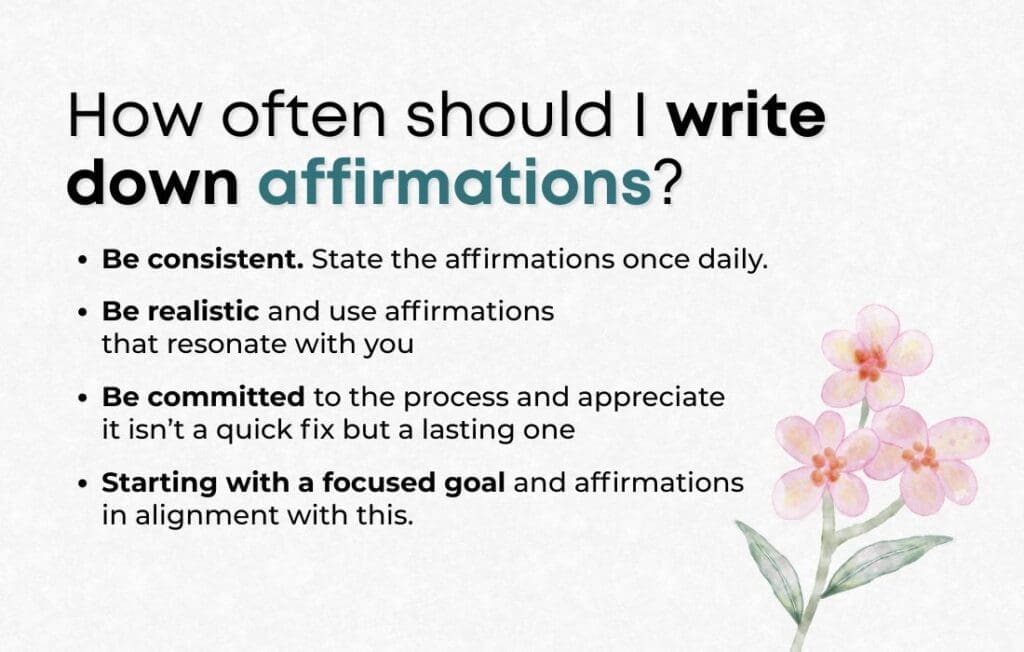
Credit: tiffanywoodfield.com
Extra Tips For Effective Affirmations
- Write in a quiet place. Fewer distractions mean more focus.
- Combine with gratitude. Write one thing you’re grateful for after your affirmations.
- Review your progress. Every week, look back and notice any changes in your mood or actions.
- Share with a friend. Saying affirmations with someone else can increase belief.
Myths About Affirmation Quantity
Let’s clear up some common myths:
- Myth: More affirmations mean faster results.
- Truth: Repetition and belief matter more than quantity.
- Myth: You must write a new affirmation every day.
- Truth: Repeating the same statement builds stronger beliefs.
- Myth: There’s a “lucky number” for affirmations.
- Truth: The right number is personal and changes with your needs.
What Beginners Often Miss
Many people start strong but give up because they don’t see quick results. Two key insights:
- Belief comes with time. Your mind may resist new affirmations at first. Stick with it.
- Less is more. Three powerful, meaningful affirmations written daily for a month beat twenty random ones written once.
Also, beginners often overlook the importance of emotion. If you simply copy words, nothing changes. Feel your affirmations, even if it takes time to believe them fully.
When Affirmations Don’t Work
Sometimes, even with effort, affirmations don’t seem to help. Common reasons:
- Your statements feel too unbelievable. Try softer wording, like “I am learning to be confident.”
- You skip writing regularly. Consistency is key.
- You focus on too many areas at once. Narrow your list.
If you need more support, consider learning about the science behind affirmations from trusted sources like Positive Psychology.
Frequently Asked Questions
How Do I Know If I’m Writing Too Many Affirmations?
If you feel overwhelmed, rushed, or lose emotional connection with your statements, you’re probably writing too many. It’s better to write fewer affirmations that feel meaningful and believable.
Should I Write The Same Affirmations Every Day Or Change Them?
Repeat the same affirmations for at least three to four weeks. This helps your mind accept the new belief. Change only when your goals or feelings shift.
Can I Combine Writing And Saying Affirmations For Better Results?
Yes, combining both can make affirmations stronger. Write them first, then say them out loud with emotion for deeper impact.

Credit: jackcanfield.com
How Long Does It Take To See Results From Affirmations?
Results vary, but many people notice small shifts in mood or confidence within a few weeks of daily practice. Major changes may take a few months of consistent effort.
What If I Don’t Believe My Affirmations At First?
It’s normal to feel doubt at first. Try softer language, like “I am learning to be confident. ” Over time, as you repeat and feel the statement, your belief will grow.
Choosing the right number of affirmations is a personal journey. Start small, focus on quality, and adjust as you grow. Consistency, emotion, and belief are your best tools for creating lasting change.
