

How Long Should You Repeat Affirmations for Lasting Results?
How Long Should You Repeat Affirmations
If you have ever tried to change your mindset or improve your self-confidence, you may have come across the idea of affirmations. These are positive statements you repeat to yourself, with the hope of influencing your subconscious mind. People use affirmations for many reasons: to attract success, reduce anxiety, boost motivation, or simply feel better about themselves. But one question often comes up: how long should you repeat affirmations before seeing real results?
This is not a simple “one-size-fits-all” answer. Everyone’s mind works differently, and the effects of affirmations depend on several factors. Some people notice changes in a few days, while others need weeks or even months. Understanding the science behind affirmations, as well as practical strategies, can help you get the most from this powerful tool.
If you want your affirmations to work, it is important to know how long and how often to use them, and what mistakes to avoid along the way.
What Are Affirmations And Why Do They Matter?
Affirmations are short, positive sentences that describe a desired state or outcome. You say them out loud, write them down, or think them quietly. Examples include:
- “I am confident and capable.”
- “Every day, I am getting stronger.”
- “I attract positive energy into my life.”
The main idea is to program your subconscious mind to believe these statements. Over time, repeating affirmations can help change negative thought patterns, reduce self-doubt, and support personal growth. Many successful athletes, entrepreneurs, and public speakers use affirmations as part of their mental training.
Scientific studies suggest that affirmations can influence the brain. According to research on self-affirmation theory, repeating positive statements can help reduce stress and improve performance by reinforcing a person’s core values. However, the brain needs time to accept new beliefs, especially if you have been thinking negatively for a long time.
Key Factors That Influence Affirmation Results
When you ask, “how long should you repeat affirmations?” you need to consider several important factors. Not every person or situation is the same. Here are some elements that can affect your results:
1. Personal Belief Level
If you strongly doubt your affirmation, it will take longer to make an impact. For example, saying “I am a millionaire” when you deeply believe you are poor may cause inner resistance. Choosing affirmations that feel believable or at least possible is key for faster results.
2. Emotional Involvement
Feelings are powerful. If you say an affirmation with genuine emotion—such as hope, excitement, or gratitude—it becomes much more effective. Flat, emotionless repetition is less likely to influence your subconscious.
3. Frequency Of Repetition
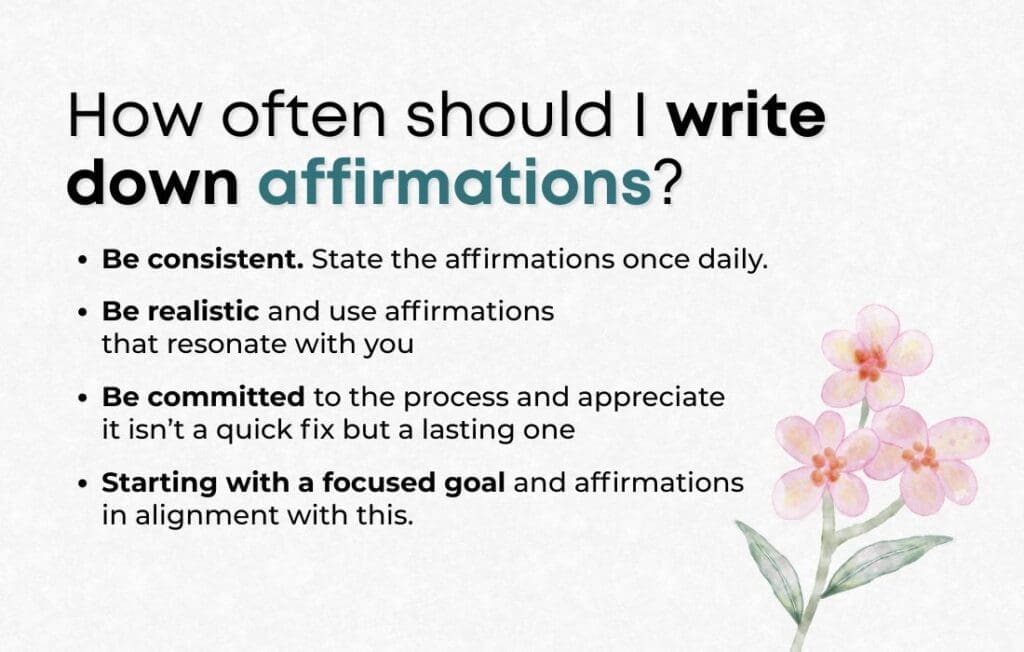
How many times you repeat an affirmation each day matters. Most experts recommend at least two sessions per day: once in the morning, and once before bed. Some suggest saying your affirmations 10–20 times per session, or more if possible.
4. Consistency Over Time
Repeating affirmations for a few days is not enough. Consistency is crucial. The brain needs repeated exposure over an extended period to form new neural pathways. Skipping days or stopping early can slow down progress.
5. Type Of Affirmation
Affirmations that are specific and personal are more effective than generic or vague statements. For example, “I am confident when speaking in meetings” is better than just “I am confident. ”
6. Mindset And Environment
Practicing affirmations in a relaxed, positive state—such as after meditation or during a quiet moment—improves effectiveness. A noisy, stressful environment can distract your mind and reduce results.
7. Supporting Habits
Affirmations work best when combined with positive action. For instance, if you affirm “I am healthy and strong,” but do not eat well or exercise, your mind may reject the statement.
The Science Behind Affirmation Repetition
You may wonder if there is any scientific evidence about how long you should repeat affirmations. While research on this exact topic is limited, some studies offer clues.
Neuroplasticity is the brain’s ability to change and form new connections. According to neuroscience, it takes regular, repeated action to rewire the brain. Many experts suggest that forming a new habit or belief can take anywhere from 21 to 66 days, depending on the complexity and the individual.
A famous study from University College London found that the average time to form a new habit was about 66 days. However, some people needed as little as 18 days, while others took more than 200 days. The key lesson: persistence is more important than speed.
Affirmations work in a similar way. The more you repeat them, and the more you believe in them, the faster your brain will start to accept them as true. But just like building a muscle, you need to train your mind consistently over time.
How Long Should You Repeat Affirmations? A Practical Guide
There is no universal answer, but there are guidelines you can follow. Let’s break down the recommended timing and repetition strategies, so you can find what works best for you.
Daily Duration And Frequency
Most coaches and psychologists suggest:
- Repeat each affirmation at least twice a day (morning and night)
- Say each affirmation 10–20 times per session
- Spend around 5–10 minutes per session on your affirmations
This routine helps anchor the statements in your subconscious, especially when your mind is more open—right after waking and before sleeping.
Recommended Timeframes
How many days or weeks should you keep going? Here’s a general overview:
| Timeframe | What to Expect |
|---|---|
| 1–7 days | You may notice small mood shifts, but deep changes are rare. |
| 2–4 weeks | Affirmations begin to feel more natural. Negative self-talk may decrease. |
| 1–2 months | Stronger belief in the affirmation. You may see real behavioral changes. |
| 3+ months | New beliefs become automatic. Old habits and doubts fade. |
Many people find that 30 days is a good minimum to start seeing results, but some need longer. The key is to keep going until the affirmation feels true and natural.
Adjusting Your Approach
If you are not seeing any results after a month or two, consider:
- Changing your affirmations to something more believable
- Adding emotion and visualization
- Increasing your daily repetitions
- Pairing affirmations with positive action steps

Credit: quotefancy.com
Common Mistakes That Slow Down Progress
Even with the best intentions, some people struggle to get results from affirmations. Here are mistakes to watch out for, and how to fix them:
1. Choosing Unrealistic Affirmations
Saying things you do not believe can backfire. For example, “I am a billionaire” may trigger inner arguments if your current reality is far from it. Start with statements that feel possible or use bridging phrases like “I am open to…”
2. Skipping Days
Consistency is more important than intensity. Missing days can break the habit and slow your progress. Make affirmations part of your daily routine, like brushing your teeth.
3. Lack Of Emotion
Repeating words without feeling is not enough. Try to connect emotionally—imagine how you would feel if the affirmation were true.
4. Multitasking
Affirmations work best when you give them your full attention. Avoid saying them while distracted by TV, social media, or other tasks.
5. Giving Up Too Soon
Some people stop after a week or two, thinking affirmations do not work. Remember, it often takes several weeks or months to see real change.
Real-life Examples: How Long It Took For People
Hearing about real experiences can be encouraging. Here are a few examples:
- Sara struggled with social anxiety. She repeated “I am calm and confident in groups” every morning and night. After three weeks, she noticed she was less nervous at work meetings. After two months, she felt much more comfortable in social settings.
- David wanted to lose weight and get fit. He affirmed “I enjoy eating healthy foods and moving my body daily.” It took about six weeks for these thoughts to feel natural, but after three months, healthy choices became a habit.
- Ayesha used affirmations to build self-worth: “I am worthy of love and respect.” It took a month before she stopped criticizing herself, and three months before she felt a deep sense of confidence.
These stories show that while small shifts can appear quickly, lasting change usually needs at least a month or more of daily repetition.
How To Maximize The Power Of Affirmations
Getting the most from affirmations requires more than just repetition. Here are methods to boost their effectiveness:
Combine Affirmations With Visualization
Imagine yourself living your affirmation. If you say “I am a successful speaker,” picture yourself on stage, feeling confident and happy. Visualization makes the statement more real to your brain.
Write Affirmations By Hand
Writing your affirmations in a notebook each day can help reinforce them. Handwriting creates a stronger connection in your brain than typing or just speaking.
Use Present-tense Statements
Always phrase affirmations in the present tense (“I am” instead of “I will be”). This tells your subconscious that the change is happening now.
Personalize Your Affirmations
Make them specific to your goals and situation. Instead of “I am happy,” try “I am happy and energized when I start my work in the morning. ”
Pair With Mindfulness Or Meditation
Practicing affirmations right after meditation or deep breathing can help you focus, making the statements more effective.
Track Your Progress
Keep a simple journal. Write down your daily affirmations and any changes you notice in your mood, thoughts, or behavior. Seeing progress, even small, keeps you motivated.
How Affirmation Results Vary By Goal
Not all goals are the same. Some changes require more time and repetition than others. Here’s a comparison of typical timelines for different affirmation goals:
| Goal Type | Typical Time to See Change | Tips for Faster Results |
|---|---|---|
| Boosting self-confidence | 2–4 weeks | Use specific examples and visualize success. |
| Breaking negative habits | 1–2 months | Pair with positive actions and habit tracking. |
| Improving relationships | 1–3 months | Practice empathy and gratitude along with affirmations. |
| Financial abundance | 3+ months | Start with believable statements, take inspired action. |
| Health and wellness | 2–8 weeks | Combine with healthy routines and visualization. |
This comparison highlights that some goals require more patience. It is normal for financial or deep emotional goals to take longer than boosting daily confidence or motivation.
Advanced Tips: Insights Most Beginners Miss
While most people focus on just repeating affirmations, there are deeper strategies that can make a big difference. Here are two non-obvious insights:
Use “why” Affirmations
Instead of just stating a fact, ask yourself a positive question: “Why am I becoming more confident every day?” This approach, sometimes called “afformations,” can help bypass resistance because the brain naturally looks for answers to questions.
Record And Listen
Record your affirmations in your own voice and listen to them on repeat, especially when you are relaxed or falling asleep. Hearing your own voice can make the statements feel more familiar and believable.
Signs That Your Affirmations Are Working
How do you know your affirmations are starting to take effect? Look for these clues:
- You catch yourself thinking or acting in line with your affirmation
- Old negative thoughts feel weaker or less frequent
- You react differently to situations—more calmly or confidently
- You feel more motivated to take positive actions
- Friends or family notice changes in your attitude or behavior
Sometimes, the first sign is a subtle shift in mood or thinking. Celebrate small wins—they mean your subconscious is starting to shift.
Credit: tiffanywoodfield.com
When To Change Or Stop Affirmations
There is no need to repeat the same affirmation forever. Here’s when you might consider changing or stopping:
- The affirmation now feels completely true and natural
- Your goal has been reached
- The statement no longer excites or motivates you
- You want to focus on a new area of growth
If you stop too soon—before the statement feels real—your old patterns may return. But if you keep going after reaching your goal, you can use affirmations to strengthen your new beliefs or build new habits.
How Affirmations Compare To Other Mindset Techniques
Affirmations are just one tool in the personal development toolbox. Here’s a quick comparison of affirmations with other popular methods:
| Technique | Main Benefit | Best For | Time to See Results |
|---|---|---|---|
| Affirmations | Rewiring self-talk | Changing beliefs, boosting confidence | 2–8 weeks |
| Visualization | Creating mental images | Goal achievement, motivation | 1–4 weeks |
| Meditation | Calming the mind | Reducing stress, increasing focus | Immediate to 4 weeks |
| Gratitude Journaling | Improving mood | Happiness, emotional health | 2–4 weeks |
| Therapy/Counseling | Deep emotional work | Healing trauma, mental health | Varies |
While affirmations are powerful, they work best when combined with other techniques. For instance, pairing affirmations with visualization or meditation can speed up results.

Credit: www.successconsciousness.com
Frequently Asked Questions
How Many Times Should I Repeat Affirmations Each Day?
Most experts recommend repeating each affirmation 10 to 20 times, at least twice a day—once in the morning and once at night. If you have more time or feel motivated, you can repeat them more often. The key is consistency, not just quantity.
Is It Better To Say Affirmations Out Loud Or In My Mind?
Both methods can work, but saying affirmations out loud is usually more effective. This is because speaking engages more of your senses and helps your brain accept the message. If you cannot speak out loud (for privacy or other reasons), thinking or whispering the affirmation still helps.
How Long Before I Notice Changes From Affirmations?
Some people feel small shifts in a few days, but most need at least 2 to 4 weeks to notice real changes. For deep beliefs or big goals, it may take several months. Be patient and look for small signs of progress along the way.
What If My Affirmation Feels Untrue Or Uncomfortable?
This is common, especially if the affirmation is very different from your current reality. Try to adjust the wording to something more believable, or use phrases like “I am open to…” or “I am learning to…” over time, as your confidence grows.
Can I Use More Than One Affirmation At A Time?
Yes, you can work with several affirmations at once, but keep the total manageable—usually 3 to 5 at a time. This keeps your focus strong and helps you remember to repeat each one with care and emotion.
Repeating affirmations is a simple but powerful way to change your mindset and life. The secret is not just in the words you say, but in how often, how long, and how deeply you believe them. Give yourself time, stay consistent, and celebrate every small step forward. If you want to dive deeper, you can read more about the research on affirmations at Wikipedia. Remember, your mind is always listening—so make sure it hears something good.
