

How Long Should You Repeat Affirmations for Lasting Results?
How Long Should You Repeat Affirmations
Affirmations are simple, positive statements you repeat to yourself, hoping to influence your thoughts and habits. Many people use them to boost confidence, shift mindset, or work toward goals. But a common question arises: how long should you keep repeating affirmations before they really work? Some claim you need only a few days, while others insist on months. The truth lies somewhere in between, influenced by science, psychology, and your personal dedication.
Understanding how affirmations affect your mind is key to using them well. Repeating them for the right amount of time can help you build new beliefs and habits. Go too short, and nothing changes. Go too long, and you might lose motivation.
In this article, you’ll discover what actually happens when you repeat affirmations, how long it typically takes to see results, and how to make your affirmation practice as effective as possible.
What Are Affirmations And How Do They Work?
Affirmations are positive sentences you say or think repeatedly, usually about yourself or your goals. For example, “I am confident” or “I attract success. ” The main idea is to reprogram your subconscious mind, which controls your habits and automatic thoughts.
When you repeat affirmations often, your brain starts to accept them as true, especially if you say them with emotion and belief. This is possible due to a process called neuroplasticity—your brain’s ability to form new connections. Over time, new beliefs replace old, negative ones. This can change how you act, feel, and even how you see yourself.
Affirmations are not magic. They work best when combined with action and a real desire to change. Saying “I am healthy” is powerful, but it’s most effective if you also eat well and exercise.
The Science Behind Repetition And The Mind
To understand how long you should repeat affirmations, let’s look at what science says about forming new beliefs and habits.
Neuroplasticity And Habit Formation
Your brain is not fixed. It constantly changes and adapts. Neuroplasticity is the reason you can learn new skills or change old patterns. When you repeat a thought or action, you strengthen certain pathways in your brain. The more often you repeat, the stronger these pathways become.
Habit formation research shows it takes time to build new mental habits. According to a widely cited study from University College London, forming a new habit takes an average of 66 days. Some people need less time, others need more—anywhere from 18 to 254 days, depending on the complexity of the habit and the person’s mindset.
The Role Of Consistency
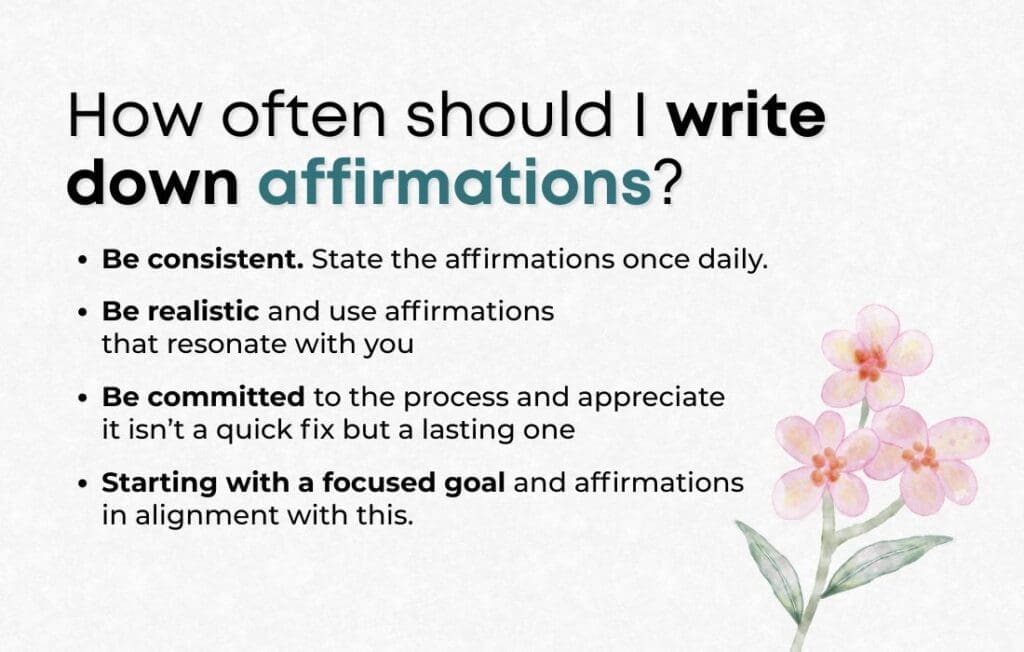
Consistency is even more important than intensity. Repeating affirmations once in a while will not create real change. Daily repetition, even for a few minutes, is better than long, irregular sessions. This is because your brain needs frequent reminders to build and keep new beliefs.
Emotional Involvement
Repeating affirmations without feeling or belief has little effect. Emotional involvement—truly feeling the affirmation as if it’s real—helps the brain accept new ideas faster. This is why many coaches suggest using visualization and emotion when repeating affirmations.
How Long Should You Repeat Affirmations?
There is no single “perfect” number of days. The answer depends on your goals, your belief in the affirmation, and how often you repeat it. However, research and practical experience provide useful guidelines.
General Timeframes
Most experts recommend repeating affirmations daily for at least 21 to 66 days. This range is based on how long it takes the brain to form new habits and beliefs.
Here’s a comparison of different recommended timeframes for repeating affirmations:
| Timeframe | Typical Results | Who Recommends |
|---|---|---|
| 21 days | Initial changes, higher awareness, early shifts | Classic self-help books |
| 30 days | Deeper belief, more consistency | Many life coaches |
| 66 days | Stronger habits, lasting mindset shift | Habit research studies |
| 90 days | Solid, automatic new beliefs | Advanced personal development programs |
Why 21 Days Isn’t Always Enough
The “21 days” rule comes from old self-help advice, but recent studies show it often takes longer. For some people, especially if their affirmation is very different from their current beliefs, 21 days may only start the change. Continuing up to 66 or 90 days increases the chance that new beliefs will stick.
Daily Practice Vs. Occasional Repetition
Repeating affirmations every day is crucial. Skipping days can slow down progress. Even if you only have five minutes, daily repetition works better than long sessions once a week.
When To Stop
You can stop repeating an affirmation when it feels completely true and natural—when you no longer feel resistance or doubt. If you feel good about the statement, and your actions match your new belief, it’s a sign the affirmation has become part of you.
How To Structure Your Affirmation Practice
Building a strong routine helps you get the most from affirmations. Here’s a practical approach:
1. Choose Your Affirmations Carefully
Pick statements that are positive, clear, and meaningful to you. Avoid phrases that feel fake or impossible. For example, “I am becoming more confident every day” may work better than “I am the most confident person in the world,” especially if you’re starting from low self-esteem.
2. Decide On Timing And Frequency
Most people find success repeating affirmations twice a day—in the morning and before bed. This fits naturally into daily routines and helps set the tone for the day or night.
3. Use Repetition And Emotion
Say your affirmation 10-20 times per session, focusing on the words and feeling the emotion behind them. Look in the mirror if it helps, or write them down.
4. Track Your Progress
Keeping a journal can help you notice changes in your thoughts, feelings, and actions over time. This also keeps you motivated to continue.
5. Adjust As Needed
If an affirmation feels stale or unhelpful, rewrite it to better fit your current goals. Flexibility keeps the practice meaningful.

Credit: quotefancy.com
Realistic Expectations: When Will You See Results?
Everyone wants quick results, but real change takes time. Your starting mindset, the depth of your old beliefs, and your consistency all play a role.
Early Results (first 1-2 Weeks)
- You might notice small shifts in mood or motivation.
- Some people report feeling more hopeful or positive.
- Don’t expect major changes yet—this is just the beginning.
Medium-term Results (3-8 Weeks)
- Old, negative thoughts may start to fade.
- You could see changes in behavior, confidence, or how you react to challenges.
- Others might even comment on your new attitude.
Long-term Results (2-3 Months Or More)
- The affirmation feels natural and true.
- Positive beliefs influence your choices automatically.
- You may forget you ever struggled with the old belief.
Not everyone moves at the same speed. If you have deeply held doubts or trauma, it may take longer to see results. Staying patient and open-minded is vital.
Factors That Influence How Long Affirmations Take
Every person is different, so many factors affect how quickly affirmations work.
Belief And Resistance
If you secretly doubt your affirmation, progress will be slower. It helps to choose statements you can almost believe, then build up to bigger changes.
Emotional State
Affirmations are more effective when you’re relaxed and open. Stress or anxiety can create mental resistance. Try meditating or taking deep breaths before repeating your affirmations.
Personal History
People with a history of negative self-talk may need more time to replace old patterns. If you grew up hearing “You’re not good enough,” it takes patience to undo this belief.
Affirmation Quality
Vague or unrealistic affirmations don’t work as well. Specific, believable, and emotionally charged statements lead to faster results.
Practice Consistency
Skipping days slows your progress. The brain needs repeated reminders to build new connections.
Support And Environment
If people around you are negative, or your environment doesn’t support your goals, change will be harder. Surround yourself with positive influences when possible.
Credit: tiffanywoodfield.com
Examples: How Long Affirmations Take In Real Life
To make these ideas clearer, here are some real-life examples.
Example 1: Building Confidence
Maria wanted to feel more confident at work. She chose the affirmation, “I handle work challenges with calm and confidence. ” She repeated it every morning and evening for 30 days. By the end of the first month, she noticed she spoke up more in meetings.
After 60 days, she felt natural confidence in stressful situations.
Example 2: Improving Health Habits
James used “I make healthy choices every day” as his daily affirmation. He said it before meals and workouts. After three weeks, he found himself reaching for healthier snacks. After two months, regular exercise and eating well became habits.
Example 3: Overcoming Fear
Priya struggled with fear of public speaking. Her affirmation was, “I speak with courage and clarity. ” She practiced for 10 minutes daily and visualized herself speaking confidently. After 21 days, her anxiety dropped. After 66 days, she volunteered to give a presentation at work.
These examples show that with steady practice, affirmations can create real change—but the timing varies by person and goal.
Common Mistakes That Slow Progress
Many people give up on affirmations too soon or use them incorrectly. Avoid these common mistakes to get the best results.
1. Not Believing The Statement
If your affirmation feels like a lie, your mind will resist. Start with statements you can almost believe and build up to bigger changes over time.
2. Skipping Days
Inconsistency weakens the effect. Make affirmations a non-negotiable part of your daily routine.
3. Using Too Many Affirmations
Focusing on too many goals at once can dilute your attention. Start with 1-3 key affirmations and master them before adding more.
4. Repeating Without Emotion
Simply saying words without feeling will not change your mindset. Imagine the affirmation is already true and feel the emotions that come with it.
5. Lacking Patience
Expecting instant results sets you up for disappointment. Trust the process and give your mind time to change.
How To Make Affirmations More Effective
If you want faster and stronger results, try these advanced tips.
Visualization
Combine affirmations with visualization. Picture yourself living your affirmation. For example, as you say, “I am successful,” imagine what success looks and feels like.
Use Present Tense
Always use the present tense, like “I am” or “I have. ” This tells your mind the statement is true now, not some day in the future.
Anchor To Habits
Tie your affirmation practice to an existing habit, like brushing your teeth or making coffee. This makes it easier to remember and stick with.
Write It Down
Writing your affirmation by hand can make it more real and memorable. Try journaling your affirmation every morning.
Record And Listen
Record yourself saying your affirmation and listen during quiet moments, like driving or walking. Hearing your own voice can boost belief.
Partner Up
Share your affirmation goals with a trusted friend or join a group. Support and accountability can help you stay consistent.
Comparing Different Affirmation Methods
People use affirmations in many ways—speaking aloud, writing, listening, or even meditating on them. Which works best?
Here’s a comparison of popular methods:
| Method | Best For | Common Duration | Notes |
|---|---|---|---|
| Speaking Aloud | Building confidence, self-image | 10-15 mins/day | Use mirror for extra impact |
| Writing | Clarity, memory, focus | 5-10 mins/day | Handwriting works best |
| Listening | Passive reinforcement | Anytime (background) | Record in your own voice |
| Visualization | Deep change, motivation | 5-10 mins/day | Combine with spoken affirmations |
Mixing methods can increase effectiveness. For example, speak your affirmation in the morning, write it at lunch, and listen before bed.
Signs Your Affirmations Are Working
Wondering if you should keep going or if your affirmations are making a difference? Look for these signs:
- You feel more positive or hopeful, even on hard days.
- Old, negative thoughts appear less often.
- You act differently—taking more risks, being kinder to yourself, or setting new goals.
- Others notice changes in your attitude or behavior.
- Your affirmation feels true, or you feel excited saying it.
If you notice at least one of these, your practice is working. If not, don’t give up—sometimes change is slow and quiet at first.
Non-obvious Insights Most Beginners Miss
- Affirmation fatigue can happen if you repeat the same statement for too long without seeing results. This is a sign to revise your affirmation or try a new approach, not to quit entirely.
- Stacking affirmations can help if you’re struggling with belief. For example, start with “I am open to becoming more confident” before moving to “I am confident.” This step-by-step approach can build belief gradually.
Practical Tips For Sticking With Affirmations
Staying consistent is the hardest part for most people. Here are ways to make affirmations a habit that sticks:
- Use reminders on your phone or sticky notes around your home.
- Attach affirmation time to a daily routine, like after brushing your teeth.
- Share your goal with a friend for accountability.
- Celebrate small wins—notice every time you act in line with your affirmation.
- Be flexible; if an affirmation stops working, change it.
When Affirmations Might Not Work
Affirmations are powerful, but they’re not a cure-all. If you struggle with deep trauma, clinical depression, or anxiety, affirmations alone may not be enough. Sometimes, professional help is needed. Affirmations can still support your healing, but don’t expect them to replace therapy or medical care. For more on the science behind affirmations and the mind, see this Wikipedia article on Neuroplasticity.

Credit: www.successconsciousness.com
Frequently Asked Questions
How Many Times A Day Should I Repeat Affirmations?
Most experts suggest repeating affirmations at least twice a day, ideally morning and night. Saying your affirmation 10-20 times per session helps create new beliefs. Consistency matters more than the exact number of repetitions.
Is It Better To Say Affirmations Out Loud Or In My Mind?
Both methods work, but saying affirmations out loud often has a stronger effect. Hearing your own voice adds power and can help build belief faster. If you can’t speak out loud, repeating in your mind is still helpful.
Can I Use Multiple Affirmations At Once?
Yes, but focusing on too many at once can weaken your results. Start with one to three key affirmations. Once these feel natural and true, you can add more.
What If I Don’t Believe My Affirmation?
It’s normal to feel doubt at first. Try modifying the statement to something you can almost believe, like “I am learning to be confident.” Over time, increase the strength of the statement as your belief grows.
Do I Have To Keep Repeating Affirmations Forever?
No. Once your affirmation feels natural and your actions match your new belief, you can reduce or stop the practice. If old habits return, start again or use new affirmations for new goals.
Building new beliefs takes patience, consistency, and honesty with yourself. Affirmations are a powerful tool, but only if you use them in a way that fits your life and mindset. Whether you see changes in a few weeks or a few months, the key is not giving up too soon.
With thoughtful repetition and real emotion, your words can shape your mind—and your life—in ways you might not expect.
