

Are Affirmation Cards Tarot Cards? Key Differences Explained
Are Affirmation Cards Tarot Cards?
If you have ever walked into a bookstore or browsed an online shop for spiritual tools, you have probably seen both affirmation cards and tarot cards. At first glance, they might seem quite similar: both are decks of cards, both often feature beautiful art, and both are used for personal growth or reflection. But are affirmation cards tarot cards? Or are they completely different tools with different purposes? This question often confuses beginners and even some people who have used these decks for a while. Understanding the differences and similarities can help you use each tool more effectively and confidently.
Let’s take a practical, clear look at what sets affirmation cards and tarot cards apart, where they overlap, and how you can choose or use them for your own needs. If you are new to card decks, or if you’re trying to decide which one is right for you, this article will give you a full picture—without jargon or confusion.
What Are Tarot Cards?
Tarot cards are a set of 78 cards traditionally used for divination, guidance, and self-reflection. The deck is divided into two parts: the Major Arcana (22 cards) and the Minor Arcana (56 cards). Each card has its own symbolism and meaning.
Structure Of A Tarot Deck
A standard tarot deck includes:
- Major Arcana: 22 cards, each with unique names and themes (like The Fool, The Magician, The Tower).
- Minor Arcana: 56 cards divided into four suits (usually Cups, Swords, Pentacles, Wands), with cards numbered Ace to 10 and four court cards per suit (Page, Knight, Queen, King).
This structure is always the same, no matter the deck’s artwork or theme.
Purpose And Use
People use tarot cards for:
- Divination: Seeking answers about the future or hidden aspects of a situation.
- Self-reflection: Exploring personal feelings, motivations, or challenges.
- Spiritual growth: Gaining deeper insight into life’s journey.
A typical tarot reading involves drawing one or more cards and interpreting their meanings in the context of a question or situation.
Tarot Symbolism
Tarot symbolism is rich and layered. Each card carries traditional meanings, colors, and symbols. For example, The Tower often represents sudden change, while the Ace of Cups might suggest new emotional beginnings.
Example Tarot Card Reading
Suppose you draw The Hermit. This card often suggests taking time for introspection or seeking wisdom within. The interpretation depends on the question asked and the position of the card in a spread.
What Are Affirmation Cards?
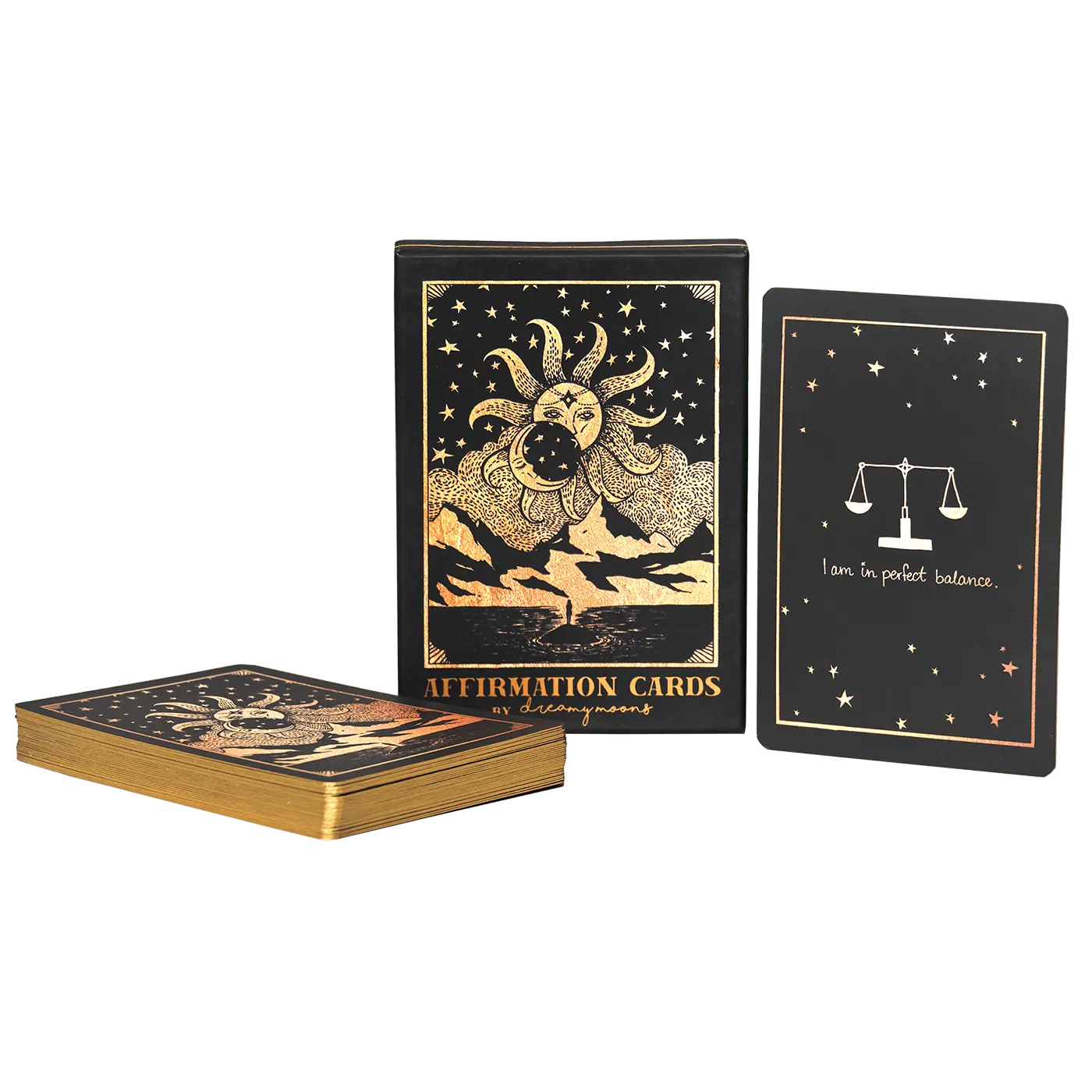
Affirmation cards are decks of cards, usually between 30 and 60, each featuring a positive statement or message. These statements are meant to encourage self-belief, confidence, and positivity.
Structure Of An Affirmation Card Deck
A typical affirmation card deck might include:
- 30–60 cards, each with a different positive statement.
- Simple, uplifting artwork or calming designs.
- No suits, numbers, or court cards.
Unlike tarot, there is no universal structure to affirmation decks. Each creator can design their own messages and themes.
Purpose And Use
People use affirmation cards for:
- Daily inspiration: Drawing a card each morning for a positive focus.
- Mental health support: Encouraging self-love and combating negative thoughts.
- Motivation: Boosting confidence before a challenge or tough day.
You don’t need to ask a specific question or know any symbolism to use affirmation cards. You simply read the card and reflect on the message.
Example Affirmation Card Use
You might draw a card that says, “I am strong and capable of overcoming challenges. ” You repeat this statement to yourself during the day to reinforce positive thinking.

Credit: www.amazon.com
Key Differences Between Affirmation Cards And Tarot Cards
Many people confuse affirmation cards with tarot cards because they can look similar and are both used for personal growth. However, there are clear and important differences.
| Aspect | Tarot Cards | Affirmation Cards |
|---|---|---|
| Deck Structure | Always 78 cards, fixed suits and court cards | Varies, usually 30–60 cards, no fixed structure |
| Purpose | Divination, guidance, self-reflection | Positive thinking, motivation, self-belief |
| Messages | Symbolic, often complex | Clear, direct, positive statements |
| Reading Method | Spread of cards, interpretation, intuition | Draw one card, repeat affirmation |
| Learning Curve | Requires study and practice | Beginner-friendly, no study needed |
Symbolism And Interpretation
Tarot relies on deep symbols, historical meanings, and often your intuition. Reading tarot well can take months or years of practice. Affirmation cards, by contrast, are straightforward. You simply read the card and apply its message.
Flexibility
Affirmation cards are flexible and can be used any way you like. Tarot has specific rules and traditions that many users follow.
Emotional Impact
Tarot readings can sometimes reveal hard truths or unexpected messages. Affirmation cards are designed to always uplift and encourage you.
Where Do People Get Confused?
It’s easy to see why people mix up affirmation cards and tarot cards. Both are decks with beautiful art and both are used for self-reflection. Sometimes, card creators blend the two styles, adding affirmations to tarot decks or giving affirmation cards a mystical look.
Similarities That Cause Confusion
- Both are used in personal growth, meditation, and mindfulness routines.
- Both can be drawn from daily or for special occasions.
- Both are found in spiritual and wellness shops.
Overlapping Uses
Some people use both decks together. For example, after a tarot reading, you might draw an affirmation card to help you focus on a positive action.
Marketing And Packaging
Some products are sold as “oracle” cards, which can be a mix of tarot, affirmation, and other styles. This adds to the confusion for beginners.
What Are Oracle Cards And How Are They Different?
Oracle cards are another type of card deck often found with tarot and affirmation cards. Oracle cards are even more flexible than affirmation cards.
Structure And Purpose
Oracle decks can have any number of cards and any theme. They might include:
- Positive messages
- Spiritual guidance
- Animal totems
- Angel messages
Some oracle cards are very similar to affirmation cards, with short, direct messages. Others are closer to tarot, with more symbolism and complex readings.
| Type | Number of Cards | Typical Content |
|---|---|---|
| Tarot | 78 (fixed) | Symbols, suits, archetypes |
| Affirmation | 30–60 (varies) | Positive statements |
| Oracle | Any (varies) | Wide range: guidance, spiritual, themed |
Key Point
Not all oracle cards are affirmation cards, but many affirmation cards can be considered a type of oracle card. Tarot, however, is always its own category with strict structure.
How Do You Use Tarot Cards Vs. Affirmation Cards?
The way you use each type of card is quite different.
Using Tarot Cards
- Set an intention or question: Think about what you want to know.
- Shuffle the deck: Focus on your question as you shuffle.
- Draw cards: This could be one card or a spread (like three-card or Celtic Cross).
- Interpret the cards: Use the card meanings, intuition, and symbolism.
- Reflect on the message: Consider how the cards relate to your question.
Tarot readings can be simple or very detailed. Many people keep journals of their tarot readings for deeper insight.
Using Affirmation Cards
- Shuffle the deck: You can do this casually, no special focus needed.
- Draw one card: Some people draw more, but usually just one.
- Read the affirmation: Say it out loud or in your mind.
- Reflect or repeat: Keep the message in mind during the day.
You don’t need to interpret or analyze affirmation cards. Their message is clear and direct.
Combining Both Decks
Some people enjoy using a tarot card for guidance and then drawing an affirmation card for a positive focus. This can help balance the deep, sometimes challenging messages of tarot with uplifting affirmations.
Pros And Cons Of Tarot Cards
Pros
- Deep insight and guidance
- Rich symbolism for personal growth
- Variety of spreads and uses
Cons
- Steep learning curve
- Some messages can be challenging or confusing
- Not always uplifting
Pros And Cons Of Affirmation Cards
Pros
- Easy to use for anyone
- Always positive and encouraging
- Quick daily boost
Cons
- No deep symbolism or complex answers
- May feel repetitive over time
- Not designed for prediction or detailed guidance
When Should You Use Tarot Cards Or Affirmation Cards?
Choosing between tarot and affirmation cards depends on your needs and mood.
When Tarot Cards Are Best
- You want deeper understanding or insight
- You are working through a complex problem
- You enjoy symbolism and tradition
When Affirmation Cards Are Best
- You need a quick boost of positivity
- You want to start or end your day on a good note
- You don’t want to study or interpret meanings
Using Both For Balance
Some days, you might want a deep tarot reading. Other days, you just need a simple affirmation. There is no rule—you can use both, separately or together.
Common Myths And Misunderstandings
Myth: Affirmation Cards Can Tell The Future
Affirmation cards are not predictive. They are not meant to answer questions about the future or unknowns. Their purpose is to support your mindset, not to give answers about events.
Myth: Tarot Cards Are Always Negative Or Scary
While some tarot cards look dark (like Death or The Tower), their meanings are not always bad. Often, these cards signal growth, change, or new opportunities.
Myth: You Must Be Psychic To Use Tarot
Anyone can learn tarot. It does not require psychic powers—just practice and study.
Myth: Affirmation Cards Are Only For “positive Thinkers”
Affirmation cards can help anyone, even people who struggle with negative thoughts. In fact, these cards can be especially helpful for building self-belief over time.
Real-world Examples: How People Use These Decks
Personal Growth
Maya, a student, uses affirmation cards every morning to boost her confidence before exams. She keeps a card on her desk to remind her of her strengths.
Spiritual Practice
Jorge, who practices meditation, uses tarot once a week for deeper self-reflection. He writes down his readings in a notebook and reviews his progress each month.
Therapy And Coaching
Some therapists and life coaches use affirmation cards with clients to encourage positive thinking or start conversations about self-worth.
Group Activities
At retreats or workshops, leaders often use affirmation cards as icebreakers or to help participants set intentions for the day.
Non-obvious Insights Beginners Often Miss
1. The Power Of Repetition
Repeating affirmations daily—even if they feel awkward at first—can create real changes in your mindset over time. The key is consistency, not instant results.
2. Tarot Is Not Always Literal
Tarot cards rarely give direct, literal answers. They work best for exploring possibilities, not for making concrete predictions. Many beginners expect tarot to be like a magic 8-ball, but its real power is in reflection.
3. You Can Personalize Your Practice
You can mix tarot and affirmation cards, create your own rituals, or even write your own affirmations. There are no strict rules—do what feels right for you.
4. Decks Reflect The Creator’s Style
Each deck, whether tarot or affirmation, is shaped by the artist’s vision and intentions. Some affirmation decks are deeply spiritual, others are simple and modern. With tarot, some decks stick to traditional symbols, while others use abstract art or cultural themes.
5. Mindset Matters More Than The Tool
Both tarot and affirmation cards are tools. The real change comes from how you use them and the mindset you bring. No card will “fix” your life, but they can guide and support you as you make changes.
Credit: www.tarotstack.com
How To Choose The Right Deck For You
Choosing between affirmation cards and tarot cards can feel overwhelming because there are so many options. Here are practical tips to help you decide.
1. Define Your Goal
Ask yourself: Do you want deep self-exploration, or do you just need a quick boost of positivity? If you want depth and complexity, tarot is a better fit. If you want simplicity and encouragement, try affirmation cards.
2. Consider Your Experience
If you are new to card decks, affirmation cards are very easy to start with. Tarot requires more study and patience.
3. Look At The Artwork
You are more likely to use a deck if you enjoy its art. Spend some time looking at sample cards online or in-store.
4. Read Reviews
See what other users say about the deck. Some decks are known for clear messages, while others are more abstract.
5. Trust Your Intuition
If a deck “calls” to you, that’s a good sign. Your connection to the cards matters more than any rule.
The Role Of Ritual In Card Use
Many people create small rituals around drawing cards, whether tarot or affirmation cards. This could be lighting a candle, taking a deep breath, or setting an intention. Rituals help you focus and make the experience feel special.
Simple Ritual Ideas
- Light a candle before drawing a card.
- Write the message in a journal.
- Share the card with a friend or group.
- Meditate on the message for a few minutes.
Ritual adds meaning and helps you remember the message throughout your day.

Credit: www.amazon.com
Are There Any Risks Or Downsides?
Using tarot or affirmation cards is generally safe and positive. However, there are a few things to consider:
- Don’t use cards to avoid real-life decisions or professional help.
- If a message feels wrong or uncomfortable, you can ignore it.
- Don’t expect cards to provide exact answers or solve problems for you.
Cards are best seen as tools for support, not as replacements for action, therapy, or medical advice.
Comparing Popular Decks
Here is a look at how some popular decks differ in structure and use:
| Deck Name | Type | Typical Use | Best For |
|---|---|---|---|
| Rider-Waite Tarot | Tarot | Traditional readings | All levels, especially learners |
| Gabrielle Bernstein's The Universe Has Your Back | Affirmation | Daily inspiration | Beginners, positivity seekers |
| Colette Baron-Reid's Wisdom of the Oracle | Oracle | Guidance, intuition | Intermediate, spiritual users |
Expert Opinions On Card Decks
Many experts in psychology and spirituality agree that both affirmation and tarot cards can help with self-reflection and personal growth. There is even research showing that affirmations can improve mindset and reduce stress when used regularly (Psychology Today).
Tarot cards are sometimes used in therapy or coaching, not for fortune-telling, but to help people explore their feelings and beliefs. Both tools are most effective when you use them to support your own growth, not as a substitute for serious decision-making.
Frequently Asked Questions
What Is The Main Difference Between Affirmation Cards And Tarot Cards?
Affirmation cards are simple, direct, and always positive. Each card gives a clear, uplifting message you can focus on for the day. Tarot cards are symbolic, complex, and used for guidance or self-reflection. They require interpretation and practice to use well.
Can I Use Both Tarot And Affirmation Cards Together?
Yes, you can use both together. Many people draw a tarot card for insight and an affirmation card for encouragement. There are no strict rules—create a practice that works for you.
Do I Need Special Training To Use Affirmation Cards?
No special training is needed. Affirmation cards are designed for anyone to use. Just draw a card, read the message, and reflect on it. Tarot, on the other hand, takes time and study to master.
Are Affirmation Cards A Type Of Tarot Card?
No, affirmation cards are not tarot cards. They are separate tools with different structures and purposes. However, both can be used for personal growth and reflection.
Can Affirmation Cards Predict The Future?
No, affirmation cards do not predict the future. Their purpose is to support positive thinking and self-confidence, not to give answers about future events.
Final Thoughts
While affirmation cards and tarot cards may look similar, they are very different in structure, purpose, and use. Tarot is a rich, symbolic system for deep reflection and guidance, while affirmation cards are simple tools to encourage positive thinking. Both can be powerful supports in your personal journey, and many people find value in using both. The most important thing is to choose the tool—or combination—that feels right for you and helps you grow. When used with intention and an open mind, these decks can add inspiration, clarity, and positivity to your daily life.
