

Affirmations to Start Your Morning: Boost Your Day Instantly
Starting your day can feel like a challenge. Maybe your mind jumps to your to-do list. Or perhaps you wake up feeling stressed or tired. What if you could change your mindset before you even leave your bed? That’s where affirmations come in. These are short, positive statements you say to yourself. They help you focus on what’s good, build confidence, and shape your attitude for the day ahead.
Many people have found that using affirmations in the morning can make a real difference. They help you start with a clear mind and a hopeful heart. If you’re new to affirmations, or if you’ve tried them before but didn’t feel a change, this article is for you. Here, you’ll find everything you need to know about affirmations to start your morning—how they work, why they matter, and how to use them in a way that feels right for you.
What Are Morning Affirmations?
Morning affirmations are positive statements you repeat to yourself after waking up. Their purpose is to set your mood, focus, and energy for the day. When you say these words, you are telling your brain what to believe. Over time, your thoughts and feelings can start to match the words you use.
Unlike just thinking “I hope today is better,” affirmations are active tools. You choose your words and say them with intention. For example, instead of “I am not tired,” you might say, “I have energy and strength for the day.” The goal is to focus on what you want to feel, not what you want to avoid.
Why Use Affirmations In The Morning?
The start of your day is important. How you feel in the first moments can affect your mood, decisions, and interactions for the next several hours. Using affirmations in the morning has many benefits:
- Boosts mood: Positive words can lift your spirits and help you feel calm.
- Increases confidence: Telling yourself you are strong or capable can make you believe it.
- Reduces stress: Affirmations help you focus on solutions, not problems.
- Improves focus: When you start with clear intentions, you are less likely to get distracted.
- Shapes your self-talk: You train your mind to think in a helpful way.
Research shows that positive self-affirmation can reduce stress and improve problem-solving skills. In one study, people who used affirmations performed better on difficult tasks. Even if you feel skeptical, there is science behind these simple phrases.

Credit: interiorloveaffair.com
How Affirmations Work: The Science Behind It
You might wonder if saying words to yourself really makes a difference. The answer is yes, and it’s backed by psychology.
Affirmations work because of a concept called neuroplasticity—the brain’s ability to change and adapt. When you repeat positive statements, you create new pathways in your brain. Over time, it becomes easier to believe these thoughts.
Another important idea is self-fulfilling prophecy. If you expect good things, you’re more likely to notice and create them. For example, if you start your day saying, “I am calm and patient,” you are more likely to act that way when stress appears.
Self-affirmation theory explains that when people focus on their values and strengths, they feel less threatened by challenges. This can help you handle difficult situations with confidence.
How To Create Effective Morning Affirmations
Not all affirmations are equally helpful. Some phrases work better because they feel true, specific, and personal. Here are tips for making affirmations that work for you:
- Use positive language: Focus on what you want, not what you want to avoid.
- Keep it simple: Short statements are easier to remember and repeat.
- Make it personal: Use “I” statements that reflect your own goals.
- Speak in the present tense: Act as if it is already true (e.g., “I am strong”).
- Believe in your words: Choose phrases that feel possible, even if they stretch you.
- Repeat regularly: Consistency helps your mind accept the new thought.
If you say, “I am a millionaire,” but you don’t believe it, your brain might resist. Instead, try, “I am learning to manage my money well. ” As your confidence grows, you can adjust your affirmations.
30 Powerful Affirmations To Start Your Morning
Here are thirty affirmations you can use to begin your day with confidence and peace. You can pick one, use several, or create your own by following the tips above.
- I am ready for a new day.
- I have the strength I need to face today’s challenges.
- I am grateful for this moment and all it brings.
- I choose to focus on what I can control.
- I am calm, centered, and balanced.
- I attract positive energy into my life.
- I am open to new opportunities.
- I believe in my abilities.
- I am kind to myself and others.
- I let go of worries about the past.
- I trust that things will work out.
- I am patient with myself and my journey.
- I am confident in my decisions.
- I choose happiness today.
- I am healthy, strong, and full of energy.
- I make time for things that matter.
- I am growing and learning every day.
- I bring value to the world.
- I am enough, just as I am.
- I forgive myself for past mistakes.
- I am focused and productive.
- I am surrounded by love and support.
- I let go of what I cannot control.
- I am excited for what today will bring.
- I choose peace over stress.
- I am proud of how far I have come.
- I am creative and resourceful.
- I trust my inner wisdom.
- I am deserving of good things.
- I welcome joy into my life.
These statements cover many areas: confidence, gratitude, energy, and kindness. Try different ones to see which feels right for you.
How To Use Affirmations In Your Morning Routine
It’s easy to read a list of affirmations and move on. But if you want real change, you need to make them part of your routine. Here are steps to use affirmations effectively:
1. Choose Your Affirmations
Pick a few statements that match your current needs or goals. You don’t need many—one or two can be enough.
2. Find A Quiet Moment
Say your affirmations after waking up, before checking your phone or starting work. You can sit up in bed, stand in front of a mirror, or close your eyes and breathe deeply.
3. Repeat With Intention
Say each affirmation out loud, or silently in your mind. Repeat each one three to five times. Focus on the meaning of the words.
4. Add Movement
Some people find it helpful to stretch or walk while repeating affirmations. Moving your body can help your mind believe the words.
5. Write Them Down
Journaling your affirmations makes them feel more real. You can keep a notebook by your bed or use a sticky note on your mirror.
6. Visualize Success
Imagine what your day looks like if the affirmation is true. For example, if you say, “I am confident,” picture yourself speaking up in a meeting or trying something new.
7. Practice Daily
Consistency is important. The more you repeat your affirmations, the stronger their effect.
Common Mistakes When Using Affirmations
Many people try affirmations and give up quickly. Here are common mistakes and how to avoid them:
- Choosing unrealistic statements: If you pick affirmations that feel false, your mind may resist. Start with what feels possible.
- Being inconsistent: Affirmations work best with daily practice, not just once in a while.
- Lack of belief: If you just repeat words without meaning, they won’t help. Focus on the feeling behind the words.
- Ignoring emotions: If an affirmation brings up strong emotions, notice them. It’s okay to adjust your statement to fit your current state.
- Expecting instant results: Change takes time. Be patient and give yourself grace.
Examples Of Morning Affirmations For Different Needs
Different days bring different challenges. Sometimes you need confidence, other times you want to feel calm. Here are examples of affirmations for various situations.
For Confidence
- I trust myself to make good choices.
- I am capable of great things.
- I speak with clarity and courage.
For Stress Or Anxiety
- I breathe in calm and breathe out tension.
- I am safe and supported.
- I let go of what I cannot change.
For Gratitude
- I am thankful for a new day.
- I notice the good around me.
- I appreciate the little things.
For Motivation
- I am ready to take on new challenges.
- I am focused and driven.
- I take action toward my goals.
For Self-love
- I am worthy of love and respect.
- I accept myself as I am.
- I treat myself with kindness.
You can create your own, combining these ideas to match your needs.
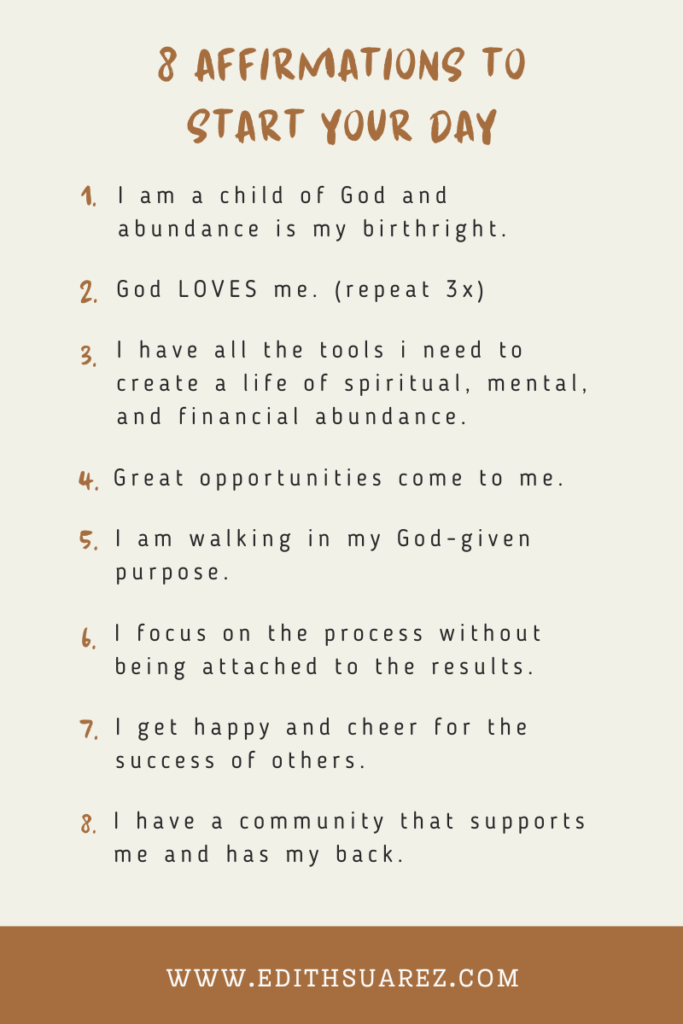
Credit: edithsuarez.com
The Best Time And Place For Morning Affirmations
The best time for affirmations is usually right after you wake up. Your mind is clear, and you haven’t yet been distracted by the day. Many people also use affirmations while:
- Brushing their teeth
- Taking a shower
- Commuting to work
- Meditating or stretching
The place is less important than your focus. Choose a spot where you feel comfortable and won’t be interrupted. Some like to look in the mirror, while others prefer a quiet corner or even outside in nature.
How Long Does It Take To See Results?
Most people want to know if affirmations really work. The answer depends on your consistency and belief. Some feel a difference after a few days, while others may need weeks or months. The key is to keep going, even if you don’t see instant changes.
Think of affirmations like exercise. One workout won’t change your body, but regular movement over time brings results. Be patient with yourself.
Research suggests it takes about 21 to 66 days to form a new habit. If you repeat your affirmations every morning, you’ll likely start to notice changes in your thoughts and feelings within a month or two.
Real-life Stories: How Affirmations Changed Mornings
Hearing how others use affirmations can inspire you to keep going. Here are a few examples:
- Maria, a teacher, starts her day with, “I am patient and present with my students.” She noticed that her stress levels dropped and her relationships with students improved.
- James, who often felt nervous before work, began using, “I am ready for today’s challenges.” Over time, his confidence grew, and he started volunteering for new projects.
- Sumi, a busy parent, says, “I make time for what matters.” This helped her focus on priorities and let go of guilt about not doing everything.
These stories show that affirmations are not magic, but they can create real shifts in your mindset and actions.
Morning Affirmations And Other Practices: What Works Best?
Some people combine affirmations with other morning habits. Here’s a comparison of common practices and how they work with affirmations.
| Practice | How It Helps | How It Pairs with Affirmations |
|---|---|---|
| Meditation | Calms the mind, reduces stress | Use affirmations at the end for focus |
| Journaling | Organizes thoughts, increases clarity | Write affirmations to reinforce beliefs |
| Exercise | Boosts energy, improves mood | Repeat affirmations while moving |
| Gratitude List | Shifts focus to positives | Combine with affirmations for extra impact |
You don’t have to do everything. Even a few minutes with affirmations can be powerful, especially if you are consistent.
Morning Affirmations Vs. Other Positive Thinking Techniques
Affirmations are just one tool for a positive mindset. Let’s see how they compare to similar practices.
| Technique | Focus | Best For | Example |
|---|---|---|---|
| Affirmations | Self-belief and intention | Daily mindset shift | "I am capable and calm." |
| Visualization | Imagining outcomes | Achieving specific goals | Picture yourself succeeding at work |
| Mantras | Calming the mind | Meditation, relaxation | Repeating "peace" or "love" |
| Gratitude Practice | Focusing on positives | Improving mood, reducing stress | Listing three good things each morning |
You can use these together or choose what works best for your routine.
Tips For Making Morning Affirmations A Habit
Building any new habit can be hard at first. Here are practical tips to make morning affirmations stick:
- Set a reminder: Use an alarm or phone notification.
- Start small: Even one minute can help.
- Pair with another habit: Repeat your affirmations while brushing your teeth or making coffee.
- Track your progress: Mark days on a calendar to build momentum.
- Celebrate small wins: Notice any changes, even tiny ones.
- Share with a friend: Accountability helps you stay consistent.
One insight many beginners miss: it’s normal to feel awkward or doubtful at first. This does not mean affirmations are not working. Your mind is getting used to a new way of thinking. Give yourself time to adjust.
Another tip that helps: If you struggle to believe your affirmation, add “I am learning to…” or “I am open to…” in front. For example, “I am learning to be confident.” This small change can make the statement feel more honest and easier to accept.
How To Measure The Impact Of Morning Affirmations
It can be hard to know if affirmations are making a difference. Here are ways to measure your progress:
- Mood tracking: Write down how you feel before and after using affirmations for a week.
- Notice your thoughts: Are you kinder to yourself? Do you react differently to stress?
- Look for small changes: Maybe you speak up more often, or worry less about mistakes.
- Ask others: Sometimes friends or family notice changes before you do.
You don’t need to see big results right away. Small shifts in attitude are signs that your affirmations are working.
Affirmations For Special Situations
Some mornings are harder than others. Here are ideas for tough days:
When You Feel Overwhelmed
- I take things one step at a time.
- I am capable of handling today.
- I give myself permission to rest.
When Facing A Big Decision
- I trust my inner wisdom.
- I am confident in my choices.
- I listen to my heart and mind.
When Experiencing Self-doubt
- I am enough as I am.
- I honor my journey and growth.
- I release the need to be perfect.
Remember, the right affirmation can change how you face your day—even during hard times.
Are Affirmations Right For Everyone?
Most people can benefit from affirmations, but they are not a cure-all. If you are struggling with deep sadness, anxiety, or mental health issues, affirmations are not a replacement for professional help. However, they can be a helpful tool alongside other supports.
If you find affirmations do not help, or they make you feel worse, it’s okay to stop or try something different. The most important thing is to listen to yourself and do what feels right.
You can read more about the science behind affirmations and positive psychology on the Wikipedia Self-affirmation page.
Frequently Asked Questions
What Are The Best Affirmations To Start Your Morning?
The best affirmations are those that feel personal and positive to you. Simple statements like “I am ready for today,” “I am strong,” or “I choose peace” work well. Pick ones that match your goals or feelings.
How Many Affirmations Should I Use In The Morning?
You don’t need a long list. One to three affirmations are enough for most people. Focus on quality and meaning rather than quantity. Use statements that matter to you.
Do I Have To Say Affirmations Out Loud?
You can say affirmations out loud, in your mind, or write them down. Speaking them can make them feel more real, but do what feels comfortable. The key is to focus on the meaning of your words.
Can I Create My Own Affirmations?
Absolutely! In fact, personal affirmations are often more powerful. Use positive, present-tense language and keep your statements short and clear. Make sure they reflect what you want to believe or feel.
How Long Does It Take For Morning Affirmations To Work?
Results can vary. Some people notice changes in a few days, others take weeks or months. The important thing is to practice daily and be patient. Over time, affirmations can shift your mindset and habits.
Starting your day with affirmations is a simple but powerful way to shape your mindset and energy. Whether you use one phrase or several, the act of focusing on positive intentions can help you meet the day with strength and hope.
Try adding affirmations to your morning routine and notice the difference in your thoughts, feelings, and actions. Remember, you have the power to choose how you start each day.

Credit: www.hanakotherapies.com
