

Affirmations Self Love: Transform Your Mindset for Confidence
Affirmations Self Love
Self-love is a powerful force that shapes how we see ourselves and how we interact with the world. Many people struggle with negative thoughts, self-doubt, and low confidence. These feelings can make daily life harder and limit what we achieve. One simple and effective tool that can help change this mindset is affirmations. Affirmations are positive statements you repeat to yourself to build confidence, change your thinking, and encourage self-respect.
Using affirmations for self love can help you feel better about yourself, boost your mood, and improve your relationships. They are not magic words, but with practice, affirmations can slowly shift your thinking and help you feel more comfortable in your own skin. In this article, we’ll explore how affirmations work, why they matter, examples to try, common mistakes, and practical ways to use them. You’ll also see comparisons, research, and answers to common questions about self-love and affirmations.
Understanding Affirmations And Self Love
Affirmations are short, positive statements that focus on strengths, values, and hopes. When repeated regularly, they can help change negative patterns and support mental health. Self love means accepting yourself, caring for your own needs, and believing you deserve happiness. It is not selfish; it simply means treating yourself with kindness and respect.
Many people find it hard to love themselves because of past experiences, social pressure, or negative self-talk. Affirmations give us a way to challenge these thoughts and replace them with more helpful beliefs. For example, instead of thinking “I am not good enough,” you can repeat “I am worthy of love and respect.
” Over time, these statements can become part of your natural thinking.
The Science Behind Affirmations
Research shows that using affirmations can:
- Lower stress and anxiety
- Improve self-esteem
- Help people recover from setbacks
- Support mental health
A study published in Social Cognitive and Affective Neuroscience found that self-affirmations activate the reward centers in the brain. This means affirmations can actually make you feel better, not just think better. Another study in the Journal of Personality and Social Psychology found that daily affirmations help people handle criticism and failure with more resilience.
However, affirmations are most effective when they are believable, specific, and used consistently. Simply repeating words without meaning may not help. The key is to choose statements that feel true or possible for you, and to practice often.
Why Self Love Matters
Self love is the foundation for a healthy mind and body. Without it, we may:
- Doubt ourselves
- Struggle with anxiety or depression
- Settle for unhealthy relationships
- Ignore our own needs
When you practice self love, you build confidence and strength. You become more likely to set boundaries, pursue goals, and treat yourself with respect. This affects your work, friendships, and even physical health.
Benefits Of Self Love
1. Better Mental Health
Self love reduces negative self-talk and makes you feel more secure. It helps you handle stress and setbacks with calm.
2. Improved Relationships
When you respect yourself, you teach others to treat you with respect. You can also support others more fully.
3. Higher Motivation
Self love encourages you to try new things, chase dreams, and learn from mistakes without fear.
4. Physical Well-being
People who practice self love are more likely to care for their bodies, eat well, and exercise.
5. Resilience
Self love helps you bounce back from challenges and stay strong during tough times.
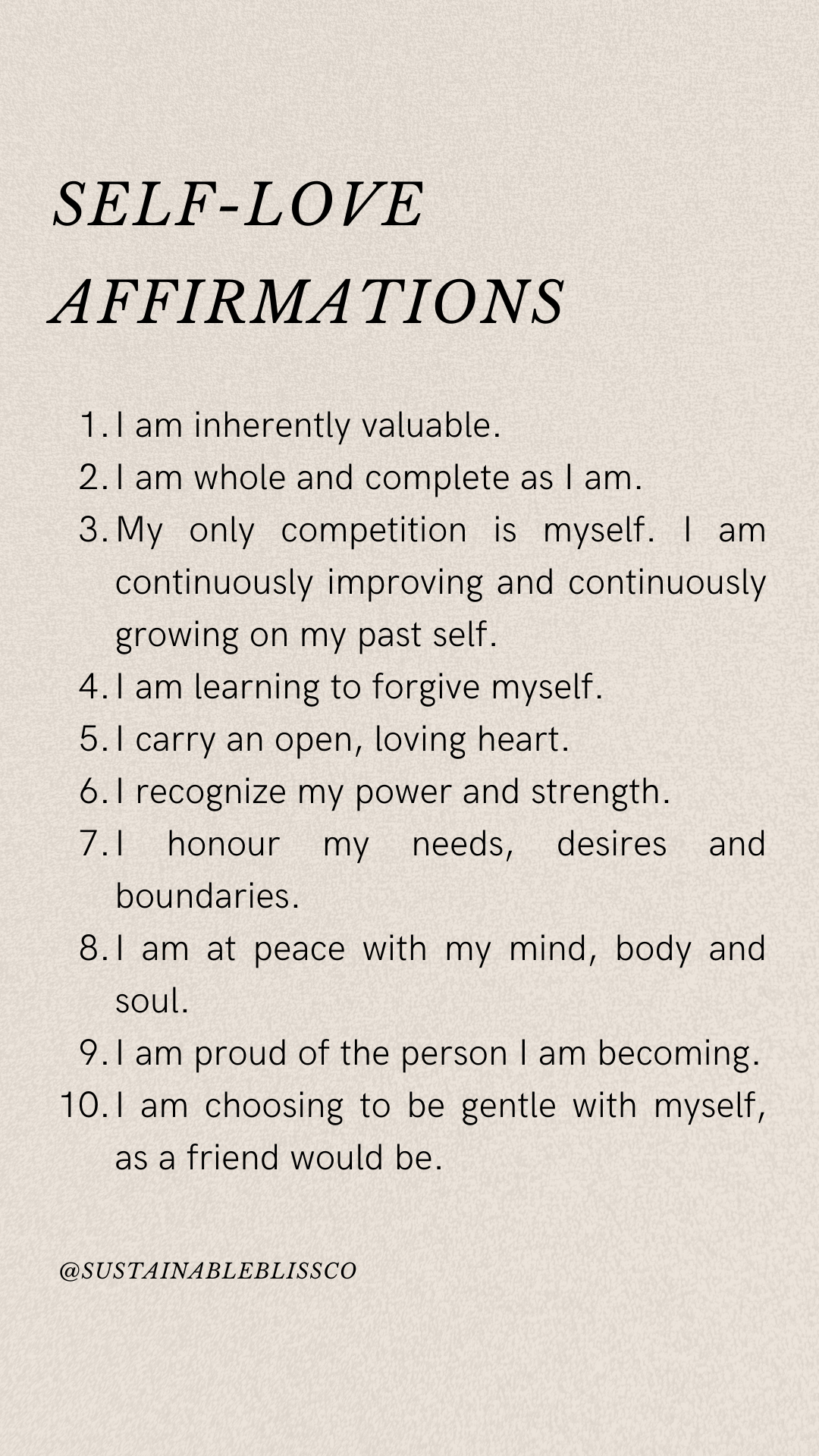
Credit: www.sustainableblissco.com
How Affirmations Build Self Love
Affirmations work by changing your thoughts and beliefs. Our minds repeat many thoughts daily. If these thoughts are negative, they can shape how we see ourselves. Affirmations help break the cycle and add positive messages.
Steps To Using Affirmations For Self Love
1. Choose Positive Statements
Pick affirmations that match your goals and values. Examples: “I am worthy,” “I accept myself,” or “I am enough.”
2. Repeat Regularly
Say your affirmations every day, preferably in the morning or before bed.
3. Believe The Words
Try to connect with the meaning. If it feels hard, start with statements that feel more true, like “I am learning to love myself. ”
4. Write And Display
Write affirmations on sticky notes or in a journal. Place them where you’ll see them often.
5. Use Visuals
Combine affirmations with images or vision boards for extra motivation.
6. Practice Patience
Changes take time. Don’t expect instant results. Keep going even if it feels strange at first.
20 Powerful Affirmations For Self Love
Here are twenty affirmations you can use to build self love. Try different ones and find what works for you.
- I am worthy of love and respect.
- I accept myself just as I am.
- I trust myself to make good choices.
- I am proud of who I am becoming.
- I forgive myself for past mistakes.
- My body is strong and beautiful.
- I deserve happiness and joy.
- I am enough.
- I honor my feelings and needs.
- I am growing every day.
- I am patient and gentle with myself.
- My life is valuable and meaningful.
- I am grateful for my strengths.
- I am free to be myself.
- I let go of negative thoughts.
- I choose peace and kindness.
- I believe in my abilities.
- I am not defined by my past.
- I celebrate my progress.
- I am confident in who I am.
You can use these affirmations as they are or change them to fit your situation. The most important thing is to say them with intention.
Practical Ways To Use Affirmations
Affirmations are flexible. You can use them in many ways to make them part of your daily routine.
Morning Routine
Start your day with affirmations. Stand in front of a mirror, look at yourself, and say your chosen statements out loud. This helps set a positive tone for the day.
Journaling
Write affirmations in a journal every morning or evening. This helps you focus and reflect on your progress.
Sticky Notes
Place sticky notes with affirmations on your fridge, computer, or bathroom mirror. These reminders keep you motivated.
Meditation
Combine affirmations with breathing exercises or meditation. Repeat your affirmations in a calm space for deeper impact.
Digital Reminders
Set phone reminders with affirmations. You’ll get positive messages throughout the day.
Visualization
Create a vision board with images and affirmations. Seeing your goals and positive words together strengthens your intention.
Comparing Affirmations With Other Self Love Practices
There are many ways to practice self love. Affirmations are just one tool. Here’s a comparison of common self love practices:
| Practice | How It Works | Strengths | Limitations |
|---|---|---|---|
| Affirmations | Repeat positive statements | Easy to start, builds confidence | Needs regular practice |
| Journaling | Write thoughts, feelings, and goals | Deep reflection, tracks progress | Can take time, needs privacy |
| Meditation | Focus on breath, relax mind | Reduces stress, improves focus | May be hard for beginners |
| Self-care Activities | Exercise, healthy food, sleep | Improves physical and mental health | Requires planning, sometimes costs money |
| Therapy | Work with a professional | Personalized support, deeper healing | Cost, access, time commitment |
Affirmations are easy and free, but they work best when combined with other practices. For example, journaling helps you understand your feelings, while self-care keeps your body healthy.

Credit: www.amazon.com
Common Mistakes When Using Affirmations
Affirmations are simple, but some mistakes can make them less effective. Here are five common errors and how to avoid them:
1. Choosing Unrealistic Statements
If you don’t believe the words, your mind may reject them. Start with affirmations that feel true or possible.
2. Inconsistent Practice
Repeating affirmations once a week won’t change your thinking. Try to use them daily.
3. Ignoring Feelings
Affirmations work best when you connect emotionally. If you feel resistance, notice it and adjust your statement.
4. Being Too General
Specific affirmations are more powerful. For example, “I am proud of my creativity” is better than “I am great. ”
5. Negative Framing
Avoid words like “not” or “never. ” Focus on what you want, not what you’re avoiding.
Example Of Effective Vs Ineffective Affirmations
| Type | Affirmation | Why It Works/Fails |
|---|---|---|
| Effective | I am learning to trust myself | Feels realistic, encourages progress |
| Ineffective | I will never feel insecure again | Negative framing, hard to believe |
| Effective | I accept my body as it is | Positive, specific, self-acceptance |
| Ineffective | I am perfect | Unrealistic, may cause doubt |
Real-life Examples: How Affirmations Changed Lives
Many people find affirmations helpful for self love. Here are three real stories:
1. Maria, A College Student
Maria struggled with low confidence after failing a test. She started using affirmations like “I am capable of learning new things. ” Over months, her grades improved, and she felt more comfortable speaking in class.
2. James, A New Parent
James felt overwhelmed by the demands of parenthood. He used affirmations such as “I am doing my best every day. ” This helped him feel less guilt and more pride in his efforts.
3. Priya, Recovering From Illness
After a long illness, Priya felt weak and insecure. She repeated “My body is healing, and I am strong. ” This gave her hope and made her focus on progress, not perfection.
These stories show that affirmations can support self love in many situations. They don’t solve all problems, but they make challenges easier to handle.
How To Write Your Own Self Love Affirmations
Personal affirmations work best. Here’s how to create your own:
1. Identify Your Needs
Ask yourself: What do I want to feel? What do I struggle with?
2. Use Positive Language
Focus on what you want, not what you want to avoid.
3. Keep It Simple
Short, clear statements are easier to remember.
4. Make It Specific
Tailor your affirmation to your life. For example, “I am proud of my hard work” if you struggle with motivation.
5. Check Believability
Choose words you can believe, even if just a little. If not, adjust until it feels right.
6. Test And Adjust
Try your affirmation for a week. If it doesn’t feel helpful, change it.
Example Process
Suppose you often feel anxious.
Step 1: Identify Need – “i Want To Feel Calm.”
Step 2: Positive language – “I am calm and in control.”
Step 3: Simple – “i Am Calm.”
Step 4: Specific – “i Am Calm During Stressful Moments.”
Step 5: Believable – “i Am Learning To Stay Calm.”
Step 6: Test – Use daily, notice feelings, adjust as needed.
Data And Statistics On Affirmations And Self Love
Studies show that self love and affirmations are linked to better mental health. Here are some numbers:
- About 75% of people who use daily affirmations report feeling more confident after three months.
- A survey by Psychology Today found that 67% of respondents felt less stress after practicing self love habits.
- In a study from the American Psychological Association, people who used affirmations were 50% more likely to handle criticism without anxiety.
These numbers suggest that regular affirmation practice can have real benefits for mood and confidence.
Comparison: People Who Use Vs. Don’t Use Affirmations
| Group | Confidence Level | Stress Level | Self Love Score |
|---|---|---|---|
| Uses Affirmations | High | Low | Positive |
| Does Not Use | Low | High | Negative |
This simple comparison shows that affirmation users often feel better about themselves and manage stress more easily.
Integrating Affirmations Into Your Lifestyle
To make affirmations effective, you need to build them into your routine. Here’s how:
- Start small: Begin with one or two affirmations each morning.
- Link to habits: Use affirmations while brushing your teeth, walking, or before bed.
- Share with others: Encourage friends or family to join you. Sharing can boost motivation.
- Track progress: Keep a journal or app to record your feelings and changes.
- Celebrate wins: Notice when you feel more positive or confident. Celebrate small steps.
Many beginners forget to track progress or celebrate wins. This makes it harder to see improvement. When you track your feelings and notice changes, you stay motivated.
Overcoming Challenges With Affirmations
Some days, affirmations may feel useless or fake. This is normal, especially when you first start. Here are ways to handle common challenges:
- Feeling silly: Remember, affirmations are new to your mind. It may take time to accept them.
- Slow results: Progress is gradual. Keep going even if you don’t see changes right away.
- Negative thoughts: If negative thoughts come up, don’t fight them. Notice them and gently return to your affirmation.
- Lack of motivation: Use reminders, join a group, or listen to affirmation audios.
- Doubts about effectiveness: Read research or stories from others to stay inspired. For more information, visit Psychology Today.

Credit: mblwrites.com
Affirmations For Different Life Situations
Affirmations can be adapted to fit different situations. Here are some examples:
For Work
- I am skilled and valuable.
- I handle challenges with confidence.
- My ideas matter.
For Relationships
- I deserve healthy, loving relationships.
- I communicate with kindness.
- I am open to love and connection.
For Health
- I honor my body’s needs.
- I am committed to my well-being.
- My body is healing every day.
For Personal Growth
- I learn from mistakes.
- I embrace change and growth.
- I am becoming my best self.
These examples show that affirmations are not just for one area of life. You can use them wherever you need self love.
Non-obvious Insights Most Beginners Miss
1. Consistency Is More Important Than Quantity.
Many beginners try too many affirmations at once, but daily repetition of one or two is more powerful.
2. Emotional Connection Boosts Effectiveness.
If you emotionally connect with your affirmation—even if you cry or feel discomfort—it works better. Don’t just repeat words; feel them.
3. Affirmations Can Trigger Resistance.
Sometimes, your mind will push back against new beliefs. This is a sign you’re challenging old patterns. Notice the resistance and keep going.
4. Personalization Increases Impact.
Affirmations you write yourself, based on your own needs and experiences, have greater effect than generic statements.
5. Progress Is Not Always Visible.
Some improvements happen inside—like feeling less anxious or more hopeful. Don’t judge by outside results alone.
Frequently Asked Questions
What Are Affirmations?
Affirmations are positive statements you repeat to yourself to change your thinking and support self love. They focus on strengths, values, and hopes. Used regularly, affirmations can help shift negative patterns and build confidence.
How Long Does It Take For Affirmations To Work?
It depends on the person and the situation. Most people notice changes in mood or confidence after a few weeks of daily practice. For deeper changes, it can take several months. The key is consistency and patience.
Can Affirmations Help With Anxiety Or Depression?
Affirmations can support mental health by reducing negative self-talk and increasing positive feelings. However, they are not a replacement for professional help. If you have serious anxiety or depression, affirmations can be one tool, but you may also need therapy or medication.
Do Affirmations Need To Be Spoken Aloud?
Speaking affirmations out loud can make them more powerful, but you can also write them or think them silently. The most important part is repetition and connecting emotionally with the words.
What If I Don’t Believe My Affirmation?
If an affirmation feels fake or hard to believe, try adjusting it. For example, use “I am learning to love myself” instead of “I love myself. ” Start with statements you can accept, and slowly build up as your confidence grows.
Practicing self love with affirmations is a journey. It takes patience, repetition, and a willingness to grow. Whether you use affirmations in the morning, during tough moments, or as part of your routine, you are building a stronger, kinder relationship with yourself.
Every small step matters. Remember, you are worthy of love and respect—always.
