

Affirmations Quit Smoking: Transform Your Mindset for Success
Quitting smoking is one of the most important decisions you can make for your health, but it often feels like an uphill battle. Cigarettes are addictive, and the mental cravings can be just as strong as the physical ones. For many people, the hardest part is changing the thoughts and habits that keep them reaching for another cigarette. That's where affirmations come in. Using positive statements can reshape your thinking, boost your confidence, and help you stay on track during your journey to become smoke-free.
In this article, you’ll discover how affirmations work, why they help, and how to use them effectively. We’ll cover practical examples, explore the science behind the method, and share tips to avoid common pitfalls. Whether you’re taking your first step or struggling after several attempts, this guide will show you how to use affirmations to support your goal of quitting smoking.
What Are Affirmations?
Affirmations are short, positive statements that you repeat to yourself. Their purpose is to encourage a positive mental attitude and to help change negative or unhelpful thoughts. When you say or think an affirmation regularly, your mind starts to accept it as true, which can shape your actions and habits.
For example, instead of thinking, “I can’t live without cigarettes,” you might say, “I am stronger than my cravings. ” Over time, these positive statements can replace negative beliefs and support new, healthier behaviors.
Why Use Affirmations To Quit Smoking?
Changing a habit like smoking is more than just a physical challenge. The mental side—your beliefs, self-image, and stress—plays a huge role. Here’s why affirmations are a valuable tool:
1. Break Negative Thought Patterns
Smokers often believe they can't quit or fear they'll fail. Affirmations help break this cycle by creating new, positive thoughts.
2. Boost Self-efficacy
Self-efficacy is the belief that you can do something. Affirmations build confidence, making you more likely to stick with your goal.
3. Reduce Stress And Anxiety
Many people smoke to cope with stress. Positive statements can help you manage anxiety and stay calm without reaching for a cigarette.
4. Support During Cravings
In tough moments, repeating affirmations can distract your mind and remind you of your commitment.
How Affirmations Work In The Brain
When you use affirmations, you are practicing a form of self-talk. Research shows that positive self-talk can change the way your brain responds to challenges. This is called neuroplasticity—your brain’s ability to form new connections and habits.
For example, studies have found that regular use of affirmations can:
- Lower activity in the areas of the brain linked to pain and stress.
- Increase activity in regions tied to self-control and reward.
- Make it easier to stick with tough goals, like quitting smoking.
In short, affirmations help “rewire” your brain, making it easier to think and act in healthier ways.
Common Myths About Affirmations
Some people believe affirmations are just wishful thinking or that they only work if you already feel confident. Here are a few common myths—and the truth behind them:
1. “affirmations Are Just Lying To Yourself.”
Affirmations are not about ignoring reality. They help you focus on what you want to achieve and build a new mindset. It’s about moving toward your goals, not denying your struggles.
2. “they Only Work If You Believe Them.”
At first, you may not fully believe your affirmations. That’s normal. Over time, repetition helps your mind accept new ideas.
3. “saying The Words Is Enough.”
Affirmations are most powerful when paired with action. They can motivate you to make better choices, but you still need to do the work.
The Most Effective Affirmations For Quitting Smoking
Not all affirmations are equal. The best ones are:
- Short and simple
- Positive (not negative or critical)
- Present tense (“I am” instead of “I will be”)
- Personal and meaningful to you
Here are some powerful examples you can use or adapt:
- I am free from smoking.
- I am in control of my choices.
- My body feels healthier every day without cigarettes.
- I am stronger than any craving.
- I choose fresh air over smoke.
- I am proud of my progress.
- Every day without smoking is a victory.
- My lungs thank me for quitting.
- I love the way I feel smoke-free.
- I am patient with myself during this journey.
- I am becoming the best version of myself.
- I can handle stress without smoking.
- I respect my body and my health.
- My mind is focused and clear.
- I inspire others by choosing to quit.
Feel free to change the words so they fit your personality or situation. The most important thing is that the affirmation feels true and motivating to you.
How To Use Affirmations In Your Quit Smoking Journey
Saying an affirmation once is not enough. To get results, you need to use them regularly and with intention. Here’s how to build affirmations into your daily routine:
1. Repeat Them Daily
Choose two or three affirmations. Say them out loud every morning and night. The more you repeat them, the stronger their effect.
2. Write Them Down
Writing helps your brain process ideas more deeply. Keep a notebook and write your affirmations several times each day. You can also stick notes on your mirror, fridge, or desk.
3. Use Them During Cravings
When you feel a craving, pause and repeat your affirmation. This breaks the automatic reach for a cigarette and reminds you of your commitment.
4. Pair With Deep Breathing
Take a slow, deep breath before saying your affirmation. This calms your body and makes your words more powerful.
5. Customize Your Affirmations
If a statement doesn’t feel right, change it. Make it fit your personality, your reasons for quitting, and your unique challenges.
6. Visualize Success
As you say your affirmation, imagine yourself living smoke-free. Picture yourself breathing easily, enjoying life, and feeling proud.
7. Track Your Progress
Keep a journal of your thoughts and feelings. Notice how your mindset changes over time. If you relapse, use affirmations to encourage yourself—not to judge.
Examples Of Affirmations In Real Life
Affirmations are not just for “positive thinkers.” Many people who have quit smoking successfully use affirmations as part of their journey. Here’s how it can look in practice:
- Sarah wrote “I am free from smoking” on her bathroom mirror. Every morning, she repeated it while brushing her teeth. At first, it felt strange. But after a few weeks, she started to believe it—and noticed she reached for cigarettes less often.
- David carried a card in his wallet with the words “I am stronger than my cravings.” Whenever he felt tempted, he took out the card, read it, and took a deep breath. This small ritual helped him pause and make better choices.
- Amina used a phone reminder to send her an affirmation every afternoon—the time she usually felt stressed at work. These reminders gave her a boost when she needed it most.
Comparing Affirmations To Other Quit Smoking Methods
Many people want to know how affirmations stack up against other methods, like medication, nicotine replacement, or counseling. Here’s a simple comparison:
| Method | Helps Physical Cravings | Improves Mindset | Side Effects | Cost |
|---|---|---|---|---|
| Affirmations | No | Yes | None | Free |
| Nicotine Replacement (gum, patch) | Yes | No | Possible | Medium |
| Medication | Yes | Maybe | Possible | High |
| Counseling/Support Groups | No | Yes | None | Low/Free |
Affirmations are not a replacement for medical support if you need it. But they are a powerful addition to any quit plan—especially for the mental and emotional parts of quitting.

Credit: styleout.ch
The Science Behind Affirmations And Quitting Smoking
You might wonder, “Is there real proof that affirmations work?” Research in psychology supports their use for changing habits. Studies show that people who use positive self-talk and affirmations are more likely to:
- Stick to their health goals
- Experience less stress during tough times
- Recover faster from setbacks
A study published in the journal “Addictive Behaviors” found that people who used affirmations as part of a quit smoking program reported higher confidence and a greater ability to resist cravings. Another research project at a major university showed that combining affirmations with behavioral support increased quit rates compared to behavioral support alone.
However, experts agree that affirmations are most effective when you use them consistently and combine them with other healthy actions—like exercise, healthy eating, or joining a support group. For more details on scientific evidence, see resources like the American Cancer Society.
Creating Your Own Affirmations
The most powerful affirmations are the ones you create yourself. Here’s a step-by-step guide to help you write your own:
1. Start With “i Am” Or “i Choose.”
This puts the focus on your current power.
2. Use Positive, Present-tense Language.
For example, say “I am strong” instead of “I will not smoke. ”
3. Keep It Short And Clear.
Long or complicated phrases are hard to remember.
4. Focus On What You Want, Not What You Fear.
Instead of “I don’t want to smoke,” try “I enjoy being smoke-free. ”
5. Make It Meaningful.
Think about your personal reasons for quitting—health, family, money, or pride. Include these in your statements.
If you need inspiration, reflect on what smoking has cost you, and what you hope to gain by quitting. Use these feelings to shape your affirmations.
When Affirmations Don’t Seem To Work
If you’re repeating affirmations and not seeing results, don’t give up. Here are some reasons they might not seem effective—and how to fix them:
- You’re only saying, not feeling.
Affirmations work best when you try to feel the truth of the words. Pause, breathe, and let the meaning sink in.
- You’re using negative language.
Make sure your statements are positive (“I am healthy”) instead of negative (“I won’t smoke”).
- You’re not consistent.
Like any habit, affirmations take time. Try them for at least a few weeks before expecting change.
- You’re not taking action.
Use affirmations as a tool to support other healthy choices—don’t expect them to do all the work.
- You’re expecting perfection.
Slipping up is normal. Use affirmations to encourage yourself to get back on track, not to feel guilty.
Combining Affirmations With Other Quit Smoking Tools
Affirmations are most effective when used alongside other methods. Here are some ways to combine them:
- With Nicotine Replacement Therapy:
Use affirmations to support your willpower while nicotine products reduce cravings.
- With Counseling or Support Groups:
Share your favorite affirmations with your group. Hearing others’ positive statements can inspire you.
- With Healthy Habits:
Pair affirmations with exercise or healthy eating. For example, after a walk, repeat: “I am strong and healthy.”
- With Stress Management:
Whenever you feel stressed, use an affirmation as a “reset button” for your mind.
- With Tracking Progress:
Each time you reach a milestone—one day, one week, one month—use affirmations to celebrate and motivate yourself.
Common Mistakes To Avoid When Using Affirmations
1. Choosing Vague Statements
Affirmations should be clear and specific. “I am healthy” is better than “Things will get better. ”
2. Not Personalizing Your Affirmations
Generic phrases are less powerful. Make them match your own reasons for quitting.
3. Repeating Them Without Emotion
Mindless repetition doesn’t work. Focus on the feeling behind the words.
4. Expecting Instant Results
Change takes time. Be patient and keep going, even if you don’t see quick results.
5. Ignoring Setbacks
If you slip, use affirmations for encouragement—not to beat yourself up.
Comparing Short Vs. Long-term Use Of Affirmations
Many people start using affirmations with energy but stop after a few days. Here’s how the effects can change over time:
| Time Frame | What to Expect | Common Challenges | Tips for Success |
|---|---|---|---|
| First Week | Feels awkward; may not believe the words | Forgetfulness, doubt | Set reminders, write them out |
| Weeks 2-4 | Start to notice small changes in thinking | Impatience, boredom | Try new affirmations, visualize success |
| After 1 Month | Affirmations feel natural; easier to resist cravings | Occasional slip-ups | Use affirmations after setbacks |
Sticking with affirmations—even after you quit—helps reinforce your new, smoke-free identity.
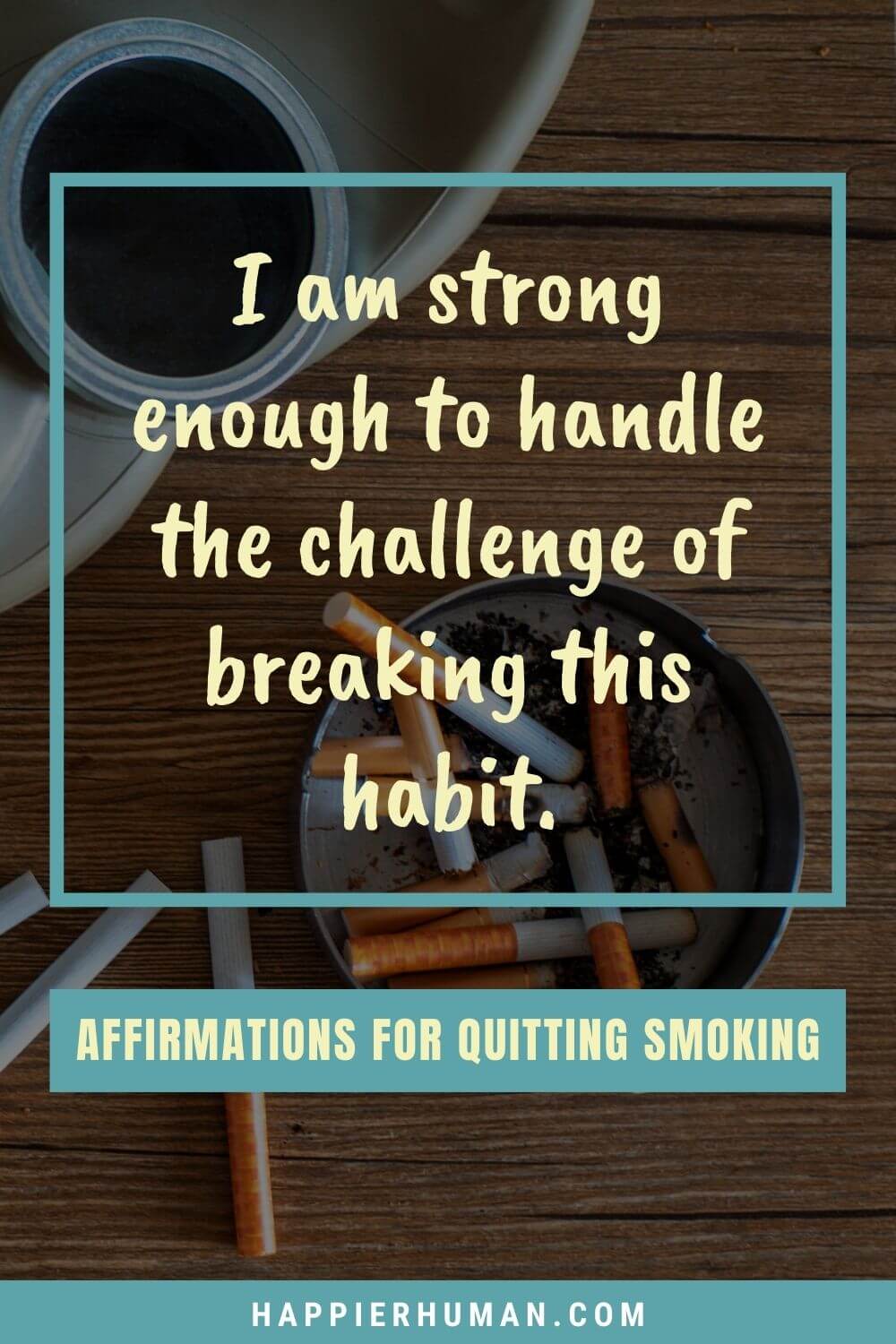
Credit: www.happierhuman.com
Unexpected Benefits Of Affirmations
Most people use affirmations just to stop smoking, but they often notice extra benefits:
- Better self-esteem:
Repeating positive statements can make you feel better about yourself in other areas.
- Improved stress management:
The habit of pausing and focusing on positive thoughts helps you handle tough situations.
- Greater resilience:
When you face other challenges, you’re more likely to use affirmations to stay strong.
- More positive outlook:
Over time, you’ll find it easier to focus on solutions instead of problems.
Real-world Success Stories
Thousands of people have used affirmations to help them quit smoking. Here are a few inspiring examples:
- John, a heavy smoker for many years, started each day by saying, “I am in control of my health.” He found that this simple ritual helped him resist cravings in the morning—the time he used to smoke the most.
- Leila joined an online quit smoking group. Members shared their favorite affirmations and encouraged each other. She said the group’s positive energy and shared affirmations kept her motivated, especially after tough days.
- Miguel wrote “My family is proud of me for quitting” on his phone’s lock screen. Every time he checked his phone, he saw this reminder. It helped him remember why he was quitting, even during stressful moments.
These stories show that affirmations can be a powerful part of your quit plan—no matter your background or experience.
Simple Tips For Making Affirmations A Habit
If you want affirmations to work, you need to use them every day. Here’s how to make them a natural part of your life:
- Link them to daily habits:
Say your affirmations while brushing your teeth or making coffee.
- Set phone reminders:
Let technology help you remember to practice.
- Record your voice:
Listen to your affirmations while you walk or drive.
- Share with a friend:
Find someone else who wants to quit. Exchange affirmations for extra support.
- Celebrate small wins:
Each day you stay smoke-free, repeat an affirmation and reward yourself—maybe with a healthy snack or a walk outside.
Frequently Asked Questions
What Are The Best Times To Use Affirmations When Quitting Smoking?
The best times are in the morning, before bed, and during cravings. Many people also use them before stressful events or when they enter places where they used to smoke. The key is consistency—find moments that work for you and make affirmations a regular habit.
Can Affirmations Replace Nicotine Replacement Or Medication?
No. Affirmations support your mental strength but do not reduce physical cravings. If you have strong withdrawal symptoms, consider combining affirmations with other methods, such as nicotine replacement therapy or talking to your doctor for medical support.
How Long Does It Take For Affirmations To Work?
It varies for each person. Some notice a change in mindset within a week, while others need a month or more. The most important thing is to keep going even if you don’t see instant results. Consistency is more important than speed.
What If I Don’t Believe My Affirmations?
This is normal, especially at first. Try to choose statements that feel possible or adjust the words until they fit you. Over time, as you repeat them and see small successes, your belief will grow.
Can I Use Affirmations After Quitting To Prevent Relapse?
Absolutely. Affirmations are helpful even after you quit. They remind you of your reasons for staying smoke-free and help you handle stress or temptation in the future.
Becoming smoke-free is a journey that challenges both your body and mind. Affirmations are a simple yet powerful tool to help you succeed. They work by changing your thoughts, building your confidence, and supporting you through cravings and setbacks. Remember, affirmations are most effective when you use them every day and combine them with other healthy habits.
With patience, persistence, and the right mindset, you can become smoke-free and enjoy all the benefits of a healthier life.

Credit: www.amazon.com
