

Affirmations About Self-Love: Transform Your Mindset Today
Affirmations About Self-love
Self-love can feel difficult for many people, especially when life gets stressful or when we face criticism. But learning to love yourself is not just a trend—it’s an important foundation for happiness and well-being. Affirmations about self-love are simple, powerful phrases you repeat to yourself.
They help change your mindset, build confidence, and remind you of your worth. In this article, you’ll discover how self-love affirmations work, why they matter, and practical ways to use them in daily life. You’ll also see examples, scientific data, common mistakes, and answers to questions people often ask.
What Is Self-love?
Self-love means accepting yourself as you are, including your strengths and weaknesses. It’s not about being selfish or arrogant. Instead, it’s about caring for your own well-being, respecting your needs, and treating yourself with kindness. When you practice self-love, you make healthier choices and feel more confident in your daily life.
Many people confuse self-love with self-esteem. While both are important, self-love is deeper. It’s about treating yourself as you would treat a close friend. For example, when you make a mistake, self-love helps you forgive yourself instead of criticizing. It also supports you during tough times.
Why Self-love Matters
Research shows that people who practice self-love:
- Have better mental health
- Handle stress more easily
- Build stronger relationships
- Feel more motivated
A study from the University of Hertfordshire found that self-compassion (a key part of self-love) is linked to lower anxiety and depression. People who show themselves kindness tend to recover faster from setbacks and feel happier.
Common Barriers To Self-love
Many struggle with self-love because of:
- Negative self-talk
- Fear of judgment
- Comparing themselves to others
- Past mistakes or traumas
These barriers can make it hard to believe positive things about yourself. Affirmations are one simple tool to help break these patterns.
Understanding Affirmations
Affirmations are positive statements you say to yourself. They help rewire your brain to think differently. For self-love, affirmations focus on accepting yourself, feeling worthy, and building confidence.
How Affirmations Work
When you repeat affirmations, your brain starts to believe them. This process is called neuroplasticity—your brain changes its connections based on what you think and feel. For example, if you say “I am worthy of love,” over time you begin to feel more deserving.
A study by Carnegie Mellon University showed that self-affirmations can reduce stress and improve performance. Participants who used affirmations before a stressful task did better and felt less anxious.
The Science Behind Affirmations
Here’s a simple breakdown of how affirmations affect your mind:
| Action | Brain Effect | Result |
|---|---|---|
| Repeat positive statements | Strengthens neural pathways | Builds confidence |
| Visualize success | Activates reward centers | Increases motivation |
| Challenge negative thoughts | Weakens old patterns | Reduces anxiety |
Non-obvious insight: The power of affirmations grows when you say them with feeling. If you just repeat words without emotion, your brain may not respond as strongly. Visualization and believing the words make affirmations more effective.
Benefits Of Self-love Affirmations
Self-love affirmations offer many benefits, both emotional and physical. Let’s look at some of the most important ones.
Boosting Confidence
Confidence is the belief that you can succeed. Affirmations like “I believe in myself” build this belief. Over time, you start to trust yourself more and take action without fear.
Reducing Negative Self-talk
Many people have an inner voice that is harsh or critical. Affirmations help you replace negative thoughts with positive ones. For example, instead of thinking “I’m not good enough,” you might say “I am enough just as I am. ”
Supporting Mental Health
Self-love affirmations can lower anxiety and depression. They remind you of your value, even when life feels hard. Studies show that daily affirmation practice can reduce stress hormones in the body.
Improving Relationships
When you love yourself, you set healthy boundaries and communicate better. You also attract people who respect you. Self-love affirmations help you recognize your worth, which improves your relationships with others.
Creating Lasting Change
Affirmations are not a magic fix, but with practice, they change how you see yourself. Small daily actions add up, leading to lasting self-esteem and inner peace.
How To Create Effective Self-love Affirmations
Not all affirmations work equally well. For best results, follow these tips.
Use Positive Language
Focus on what you want, not what you don’t want. For example:
- Good: “I am worthy of love.”
- Not helpful: “I am not unworthy.”
Make Them Personal
Affirmations should feel true for you. Use “I” or “my” to make them personal.
Keep Them Simple
Short, clear phrases are easier to remember and repeat.
Use Present Tense
Say affirmations as if they are happening now. For example, “I am confident,” instead of “I will be confident. ”
Add Emotion
Connect with the feeling behind the words. If you don’t believe your affirmation yet, try starting with “I am learning to…” or “I am open to…”
Practical Example
Let’s compare two affirmations:
| Affirmation | Why it Works |
|---|---|
| I am proud of who I am. | Clear, positive, present tense. |
| I wish I could be proud of myself someday. | Future tense, lacks confidence. |
25 Powerful Self-love Affirmations
Here are 25 examples you can use or adapt to fit your needs. Try saying them aloud or writing them in a journal.
- I love and accept myself fully.
- I am worthy of respect and kindness.
- My mistakes do not define me.
- I am enough just as I am.
- I trust myself to make good decisions.
- I forgive myself for past errors.
- My body deserves care and appreciation.
- I welcome love into my life.
- I am proud of my strengths and growth.
- I honor my feelings and needs.
- I am resilient and strong.
- I am deserving of happiness.
- I am gentle with myself during hard times.
- I value my uniqueness.
- I am open to learning and changing.
- I celebrate my progress, no matter how small.
- I release self-judgment and embrace self-compassion.
- I am grateful for who I am.
- I give myself permission to rest and recharge.
- I am patient with my personal journey.
- I listen to my inner wisdom.
- I am safe to be myself.
- I choose to love myself every day.
- I accept compliments with gratitude.
- I am a beautiful person inside and out.
Non-obvious insight: Many people forget to include physical self-love (such as “My body deserves care and appreciation”). This kind of affirmation can help you feel more comfortable in your own skin.
How To Use Self-love Affirmations In Daily Life
Affirmations work best when you use them regularly. Here are practical ways to add them to your routine.
Morning Rituals
Start your day with self-love affirmations. Say them while brushing your teeth or looking in the mirror. This sets a positive tone for the day.
Journaling
Write affirmations in a notebook each morning or evening. This helps you reflect on your feelings and notice progress over time.
Meditation
Use affirmations during meditation. Focus on your breath, and repeat your chosen phrase silently. This deepens the connection between mind and body.
Reminders
Place sticky notes with affirmations on your desk, fridge, or bathroom mirror. Visual reminders keep you focused on self-love.
Digital Tools
Apps and alarms can prompt you to repeat affirmations throughout the day. Some apps let you record your own voice for extra impact.
Group Practice
Share affirmations with friends or family. Saying them together builds a sense of support and community.
Example Daily Routine
Here’s a sample schedule for using affirmations:
| Time | Activity | Affirmation |
|---|---|---|
| Morning | Mirror talk | I am worthy of love. |
| Midday | Lunch break journaling | I honor my feelings and needs. |
| Evening | Meditation | I am gentle with myself during hard times. |
Non-obvious insight: Combining affirmations with other habits (like meditation or journaling) makes them stick. The brain learns better when new actions are linked to old routines.

Credit: www.amazon.com
Common Mistakes When Using Affirmations
Many beginners face obstacles with affirmations. Avoid these mistakes to get the best results.
Ignoring Emotion
Repeating words without feeling does not help much. Try to connect emotionally with each statement.
Using Too Many Affirmations
If you use a long list, you may forget the meaning. Focus on a few phrases that matter most to you.
Expecting Quick Results
Affirmations take time to change your mindset. Be patient and keep practicing even if you don’t see results right away.
Choosing Unrealistic Statements
If your affirmation feels false, it may make you feel worse. Start with believable phrases, like “I am learning to accept myself. ”
Skipping Consistency
Affirmations work best with daily practice. If you stop, the effect fades.
Self-love Affirmations For Special Situations
Sometimes you need self-love most during tough times. Here are affirmations for specific challenges.
After A Mistake
- I forgive myself and move forward.
- I learn from every experience.
During Stress
- I am calm and centered.
- I trust myself to handle this situation.
Facing Criticism
- I am worthy, no matter what others say.
- I value my own opinion.
Physical Self-love
- My body is valuable and unique.
- I treat myself with care and respect.
Building Boundaries
- I have the right to say no.
- I deserve healthy relationships.
Self-love Affirmations For Different Age Groups
Affirmations can help people of all ages, but the wording may change.
Children
Children benefit from simple phrases:
- I am special.
- I am loved.
- I can do hard things.
Teens
Teenagers face peer pressure and self-doubt. Affirmations like:
- I am enough.
- My voice matters.
- I can handle challenges.
Adults
Adults often struggle with work, relationships, or parenting:
- I am proud of my efforts.
- I am worthy of respect.
- I am allowed to rest.
Seniors
Older adults may deal with loneliness or health changes:
- I am valuable at every stage of life.
- My experiences matter.
- I am grateful for myself.
The Role Of Self-love In Recovery And Growth
Self-love is important for healing from trauma, addiction, or loss. Many recovery programs use affirmations to rebuild self-worth.
Recovery Example
A person in addiction recovery might use:
- I am strong enough to change.
- I deserve a healthy life.
Studies show self-affirmations increase the chance of long-term recovery. They help people believe change is possible.
Growth Mindset
Self-love affirmations support a growth mindset—the belief that you can improve and learn. This mindset leads to more success and happiness.
Comparing Self-love Affirmations With Other Self-help Tools
Affirmations are just one tool. Let’s compare them to other common methods.
| Method | Main Feature | Strength | Weakness |
|---|---|---|---|
| Affirmations | Positive statements | Easy to use, no cost | Needs consistency |
| Meditation | Focus and relaxation | Reduces stress | Requires practice |
| Therapy | Professional guidance | Personalized support | Can be expensive |
| Journaling | Self-reflection | Builds awareness | Time-consuming |
Non-obvious insight: Combining affirmations with therapy or journaling can speed up personal growth. Each tool has unique strengths.
Real-life Examples Of Self-love Affirmations
Many people have changed their lives with self-love affirmations. Here are some practical stories.
Sara’s Story
Sara was always hard on herself. She started using the affirmation “I am enough just as I am” every morning. After a month, she noticed she was less anxious and more confident at work. Her relationships improved because she set healthy boundaries.
Miguel’s Journey
Miguel struggled with body image issues. He used “My body deserves care and appreciation. ” With daily practice, he began to treat himself with more kindness. He joined a fitness class, not to change his body, but to celebrate it.
Emma’s Recovery
Emma used affirmations during her recovery from trauma. She repeated “I am safe to be myself” and “I am strong. ” These helped her rebuild trust in herself and move forward.
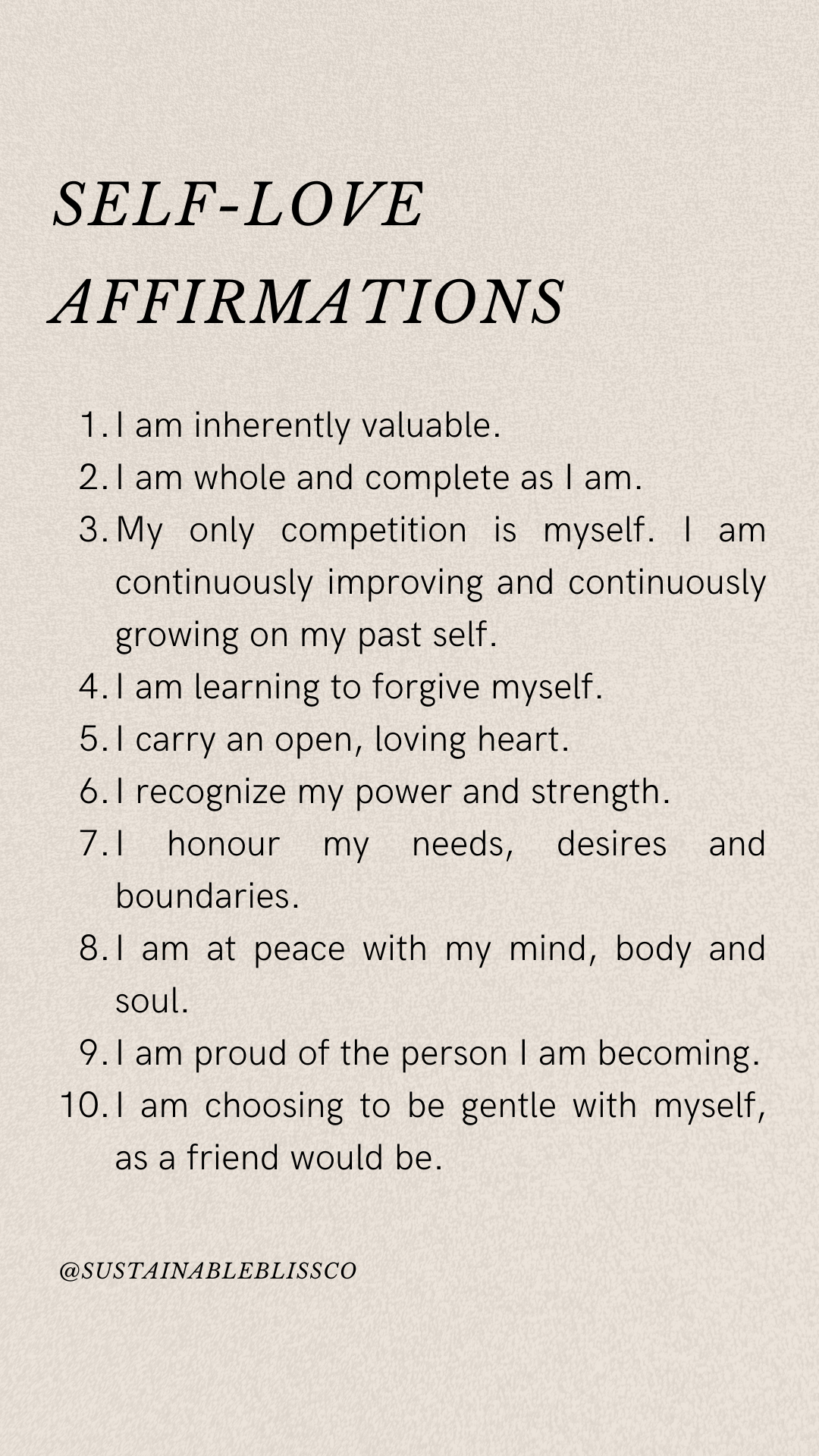
Credit: www.sustainableblissco.com
How Affirmations Fit Into Modern Self-care
Self-care is more than bubble baths or treats. It’s about taking actions that support your mental, emotional, and physical health. Affirmations are a core part of modern self-care routines.
Emotional Self-care
Affirmations help manage feelings of doubt, stress, or sadness. They remind you of your value, especially when emotions feel strong.
Physical Self-care
Affirmations about your body support healthy habits like exercise, eating well, and rest.
Social Self-care
When you love yourself, you attract positive relationships. Affirmations help you build confidence to connect with others.
Tips For Making Affirmations Work For You
Getting the best from self-love affirmations takes practice and patience. Here are practical tips.
- Choose 2-3 affirmations that feel meaningful.
- Say them aloud with emotion, not just in your mind.
- Use them at the same time each day for consistency.
- Write them down to reinforce belief.
- Adjust your affirmations as you grow.
Bonus tip: If you struggle to believe an affirmation, add “I am willing to believe…” or “I am open to…” This makes the statement feel safer and easier to accept.
The Impact Of Self-love Affirmations On Society
When individuals love themselves, communities benefit. People who feel worthy are more likely to help others and build positive relationships. Schools and workplaces that encourage self-love see less bullying and more teamwork.
For more research on self-compassion and its social impact, see Wikipedia’s Self-Compassion page.
Frequently Asked Questions
What Are Self-love Affirmations?
Self-love affirmations are positive statements you repeat to yourself. They help you build confidence, accept yourself, and change negative thinking. For example, “I am worthy of respect.”
How Often Should I Use Self-love Affirmations?
For best results, use affirmations daily. Morning and evening routines work well. You can also repeat them during stressful moments or before important events.
Do Self-love Affirmations Really Work?
Yes, studies show affirmations help reduce stress and boost self-esteem. The key is consistency and connecting emotionally with the statements.
Can I Write My Own Self-love Affirmations?
Absolutely. Personal affirmations are powerful. Make sure your phrases are positive, present tense, and feel true for you. For example, “I am learning to accept myself.”
What If I Don’t Believe My Affirmation Yet?
It’s normal to feel doubt at first. Start with phrases like “I am open to loving myself” or “I am learning to accept myself. ” Over time, your belief will grow.
Self-love affirmations are a simple but effective tool for building confidence and happiness. By using them daily, you can change your mindset and create lasting self-esteem. Remember, self-love is not selfish—it’s necessary for a healthy, fulfilling life. With practice, affirmations help you accept yourself fully and enjoy the journey.

Credit: mblwrites.com
