

Affirmation Ideas for Self Love: Boost Confidence and Happiness
Affirmation Ideas For Self Love
Self love can feel like a big word. For many people, it does not come naturally. Some days, loving yourself feels easy. On other days, you may struggle to even like yourself. This is normal. But you can change the way you think about yourself, one small step at a time. One of the simplest and most powerful tools is affirmations.
Affirmations are short, positive statements. You repeat them to yourself, often out loud or in writing. Over time, these words help shape your thoughts and beliefs. The idea is simple: when you tell yourself positive things, you begin to believe them. This is not just wishful thinking. Studies show that affirmations can reduce stress, improve mood, and help with motivation. They even change the way your brain works.
But not all affirmations are equal. For self love, you need statements that feel real and speak to you personally. In this guide, you’ll find a wide variety of affirmation ideas for self love. You’ll learn how to use them, why they work, and how to make them part of your daily life.
You’ll also see examples, tips, and answers to common questions. If you want to feel better about yourself and build a kinder inner voice, this article is for you.
Why Self Love Matters
Before you start with affirmations, it’s helpful to understand why self love is important. Self love means accepting yourself as you are. It means treating yourself with kindness, even when you make mistakes. People with healthy self love:
- Handle stress better
- Have stronger relationships
- Recover faster from setbacks
- Take better care of their health
- Feel more confident
Without self love, you might judge yourself too harshly. You may feel unworthy or anxious. Negative self-talk becomes a habit. Over time, this can affect your mental and physical health.
Affirmations help you break this cycle. They are not magic words, but they are a powerful tool to build a better relationship with yourself.
How Affirmations Change Your Mindset
It may seem strange to say nice things to yourself at first. But there’s solid science behind it. When you repeat a phrase, your brain starts to pay attention. Over time, these words create new pathways in your mind. This process is called neuroplasticity.
For example, if you always think “I’m not good enough,” your mind believes it. If you start saying, “I am enough,” your mind begins to question the old belief. With repetition, the new idea grows stronger.
Research shows that self-affirmations:
- Lower stress levels
- Improve academic and work performance
- Boost motivation to make healthy choices
- Help people recover from rejection or failure
One study in the journal *Social Cognitive and Affective Neuroscience* showed that affirmations activate reward centers in the brain. This means your mind responds to positive self-talk almost like a small reward.
The Right Way To Use Affirmations
Affirmations are most effective when you use them the right way. Here are some tips:
- Keep them short and simple. Long sentences are harder to remember and feel less real.
- Use present tense. Say “I am” instead of “I will be.”
- Make them personal. Use words that fit your life and feelings.
- Repeat daily. Consistency matters more than perfection.
- Say them out loud. Hearing your own voice makes them stronger.
- Write them down. Handwriting can help you remember and believe the words.
- Visualize. Imagine how you would feel if the affirmation were true.
- Be patient. Change takes time.
Some people use sticky notes, phone reminders, or journals. Others say affirmations while looking in the mirror. Find a routine that fits your lifestyle.
40 Powerful Affirmation Ideas For Self Love
You don’t have to use every affirmation. Choose the ones that speak to you. Over time, you can change or add new ones as you grow.
- I am enough just as I am.
- I choose to treat myself with kindness.
- My feelings are valid and important.
- I forgive myself for past mistakes.
- I honor my needs and boundaries.
- I deserve love and respect.
- My worth does not depend on others.
- I am proud of how far I have come.
- I am learning and growing every day.
- I trust myself to make good choices.
- I am allowed to put myself first.
- I am grateful for my body and mind.
- I am not defined by my struggles.
- I accept my flaws and strengths.
- I am worthy of happiness.
- My voice matters.
- I believe in my abilities.
- I am gentle with myself in hard times.
- I celebrate my small wins.
- I release the need for perfection.
- I am open to receiving love.
- I am safe to express who I am.
- I value my own opinions.
- I am deserving of good things.
- I am a work in progress, and that’s okay.
- I let go of negative self-talk.
- I choose peace over pressure.
- I respect my own journey.
- I am resilient and strong.
- I nurture my mind, body, and spirit.
- I am proud of my uniqueness.
- I listen to my inner voice.
- I give myself permission to rest.
- I am more than my mistakes.
- I am worthy of love from myself.
- I am becoming the best version of me.
- I am patient with my progress.
- I am grateful for who I am today.
- I trust the process of growth.
- I love myself unconditionally.
You can use these as they are or change words to fit your own style. The key is to feel a connection to what you say.
Examples Of Affirmations In Different Life Areas
Self love touches many parts of life. Here are sample affirmations for different situations:
For Body Positivity
- I appreciate what my body does for me.
- My body deserves care and respect.
- I am thankful for my health.
For Self-forgiveness
- I forgive myself and let go of guilt.
- I am learning from my past, not living in it.
- My mistakes do not define me.
For Confidence
- I believe in my skills and talents.
- I can handle whatever comes my way.
- I am proud of my achievements.
For Relationships
- I am worthy of healthy, loving connections.
- I set clear and kind boundaries.
- I bring value to my relationships.
For Stress And Anxiety
- I am calm and centered.
- I choose peace in this moment.
- I trust myself to get through challenges.
Creating Your Own Self Love Affirmations
While ready-made affirmations are helpful, making your own can be even more powerful. Here’s how you can create affirmations that truly fit you:
- Identify negative beliefs. Notice thoughts like “I’m not smart enough” or “I always mess up.”
- Flip the script. Turn the negative into a positive. For example, change “I’m not smart enough” to “I have unique strengths and learn quickly.”
- Keep it realistic. The affirmation should feel possible, not fake.
- Use strong, positive words. Focus on what you want to feel, not what you want to avoid.
- Test it. Say it aloud. Does it feel true, or do you feel resistance? If it feels too far from your reality, make it softer: “I am learning to…” or “I am open to…”
Here’s a simple format:
- “I am…” (e.g., “I am worthy of love.”)
- “I choose…” (e.g., “I choose to forgive myself.”)
- “I trust…” (e.g., “I trust my inner wisdom.”)
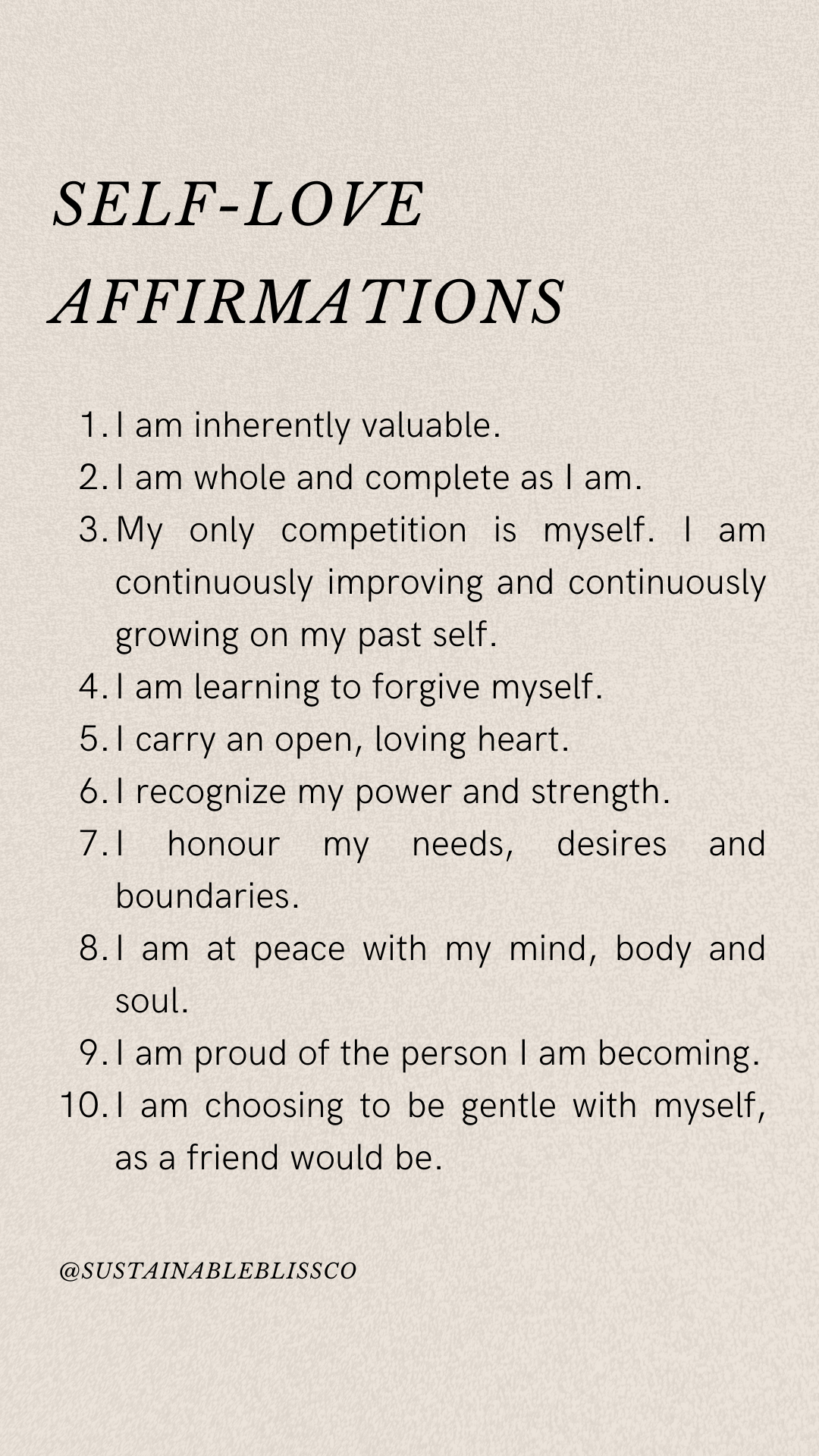
Credit: www.sustainableblissco.com
When And How Often To Use Affirmations
Consistency is more important than intensity. You don’t need to say your affirmations all day. Here are some good times to use them:
- Morning: Start your day with a positive mindset.
- Before sleep: End your day with kindness.
- During stress: Calm yourself with gentle words.
- Before a big event: Boost your confidence.
- While looking in the mirror: Build self-acceptance.
Try to use affirmations at least once a day. Even one minute of focused, positive self-talk can make a difference over time.
Affirmations Vs. Other Self Love Practices
Affirmations are not the only way to build self love. Here’s how they compare to other popular methods:
| Practice | Main Benefit | Time Needed | How It Works |
|---|---|---|---|
| Affirmations | Change self-talk | 1-5 min daily | Repeat positive statements to shape beliefs |
| Journaling | Explore feelings | 10-20 min daily | Write about thoughts and emotions |
| Meditation | Calm the mind | 5-20 min daily | Focus on breath or present moment |
| Therapy | Professional support | Weekly sessions | Talk with a trained counselor |
Some people like to mix methods. For example, you can write affirmations in your journal or use them at the end of meditation. There’s no single right way—find what feels best for you.
Common Mistakes With Affirmations
Affirmations are simple, but people often use them in ways that don’t help. Watch out for these common mistakes:
- Choosing unrealistic statements. If you say “I love everything about myself” but don’t believe it, your mind may reject it. Start small and build up.
- Not repeating them often enough. Occasional use won’t create change. Make it a habit.
- Saying them without feeling. Mindless repetition is less effective. Try to connect with the words.
- Using only negative phrases. Don’t focus on what you want to stop (“I am not anxious”). Focus on positive qualities (“I am calm and relaxed”).
- Giving up too soon. It can take weeks or months to notice real change.
If you find yourself doubting your affirmations, you’re not alone. This is normal, especially at the start. Be patient with yourself.
Science And Evidence Behind Affirmations
You may wonder if affirmations really work or if they’re just wishful thinking. In fact, there is research that supports their power. For example:
- Studies show that self-affirmations can reduce stress and help people perform better under pressure. In one experiment, students who practiced affirmations before a test had lower stress and higher grades.
- Brain scans reveal that affirmations activate the reward system in the brain, similar to winning a prize.
- People who use affirmations regularly are more likely to set and reach healthy goals.
However, affirmations work best when you believe in the possibility of change. If an affirmation feels completely false, it may not help right away. In these cases, try “I am learning to love myself” or “I am open to self-acceptance.
” Over time, you can make the statements stronger.
If you want to explore the science further, you can read more at Positive Psychology.

Credit: www.redsolesandredwine.com
Making Affirmations Stick: Tips For Daily Practice
Turning affirmations into a habit takes practice. Here are some tips to make them part of your day:
- Link to a routine. Say your affirmations while brushing your teeth or making coffee.
- Use reminders. Place sticky notes on your mirror or set phone alerts.
- Pair with deep breathing. Take a slow breath with each phrase.
- Record your voice. Listen to yourself saying the affirmations.
- Share with a friend. Practice together for support and accountability.
- Track your progress. Keep a journal to note changes in your mood or self-talk.
Here’s a sample daily routine:
| Time | Action | Why It Helps |
|---|---|---|
| Morning | Say 3 affirmations in the mirror | Sets a positive tone for the day |
| Afternoon | Repeat an affirmation during a break | Refreshes your mindset |
| Evening | Write one affirmation in a journal | Reinforces self love before sleep |
If you miss a day, don’t be hard on yourself. Just start again the next day. Self love is a lifelong journey.
Two Insights Most Beginners Miss
- The feeling behind the words matters. Many people focus only on the words, but your emotion gives them power. If possible, try to feel the truth of the affirmation, even for a second. If you can’t, soften the words until they match your reality.
- Affirmations reveal hidden beliefs. Sometimes, when you say a positive phrase, your mind pushes back. This is a sign of a belief you can work on. Instead of ignoring the resistance, notice it. Ask yourself, “Why do I feel this way?” This can help you uncover deeper patterns and start to heal them.
Affirmations For Special Situations
Everyone faces unique challenges. Here are affirmations for specific times:
After A Failure
- I am learning from this experience.
- I am proud of my effort, even if the result was not perfect.
- I give myself permission to try again.
During Major Life Changes
- I am safe and supported as I grow.
- I trust that I can handle change.
- I am open to new opportunities.
When Feeling Lonely
- I am enough, even on my own.
- I enjoy my own company.
- I am connected to others in meaningful ways.
When Facing Criticism
- I know my own worth.
- I can listen to feedback without losing self love.
- I respect my own opinions.
How To Know If Affirmations Are Working
Change is often slow and subtle. Here are some signs that your self love affirmations are starting to work:
- You notice less negative self-talk.
- You recover faster from setbacks.
- You feel more confident in daily life.
- You treat yourself with more kindness.
- You are more willing to try new things.
Some people see changes in a few weeks. For others, it takes longer. Be patient and keep going.
Combining Affirmations With Other Self Love Tools
Affirmations are powerful, but they work best with other self care habits. Here are some ideas to try together:
- Gratitude journaling: Write three things you appreciate about yourself each day.
- Physical self care: Eat healthy foods, move your body, and get enough rest.
- Mindfulness: Spend a few minutes each day being present with your thoughts.
- Acts of kindness: Do something nice for yourself, like taking a walk or reading a book you love.
Mix and match these tools to create your own self love routine.
Frequently Asked Questions
What If I Don’t Believe My Affirmations?
It’s normal to feel doubt at first. If an affirmation feels too far from your truth, try “I am learning to…” or “I am open to…” This makes the statement feel more real and easier to accept.
How Many Affirmations Should I Use Each Day?
There’s no fixed number. Most people start with 3-5. It’s better to repeat a few powerful affirmations than to rush through a long list. Focus on quality and meaning.
Can Affirmations Help With Anxiety Or Depression?
Affirmations can support mental health, but they are not a replacement for professional help. If you struggle with anxiety or depression, use affirmations along with therapy, medication, or other treatments recommended by a doctor.
Is It Better To Write Or Say Affirmations?
Both methods work. Some people find speaking more powerful because it uses your voice and hearing. Others prefer writing because it helps them focus. Try both and see what feels best.
How Long Does It Take To See Results From Affirmations?
Everyone is different. Some notice changes in a few days, while others take weeks or months. The key is consistent practice. Be patient with yourself and celebrate small wins along the way.
Self love is a journey, not a destination. Affirmations are a gentle, effective way to start changing your inner world. With patience and practice, you can build a kinder, more loving relationship with yourself—one word at a time.

Credit: nunziadreams.com
