

Standing Glute Workout: Sculpt Stronger Glutes Without Equipment
Standing Glute Workout: Build Stronger Glutes Without The Floor
If you want to shape, strengthen, and lift your glutes but hate floor exercises, you’re not alone. Many people find traditional glute workouts—like bridges, clamshells, and donkey kicks—uncomfortable or boring because they require lying down. The good news is, you can get a powerful glute workout entirely while standing.
Whether you’re at home, in the gym, or even in a small office, standing glute exercises are effective, convenient, and easy to modify for any fitness level.
Let’s explore how you can sculpt your glutes with only your bodyweight or simple equipment, all while staying on your feet. You’ll discover the science behind glute activation, common mistakes to avoid, and a complete standing glute workout plan you can start today.
Why Standing Glute Workouts Work
Many believe you need to lie down or use heavy weights to work your glutes. That’s not true. Standing glute exercises make your muscles work against gravity and often use your body’s balance system, which adds extra challenge. They don’t just target the gluteus maximus (the biggest glute muscle), but also the gluteus medius and gluteus minimus—these help with hip stability and shape.
Standing movements also involve your core and legs, making these workouts more functional. Every time you walk, climb stairs, or stand from a chair, your glutes are working. Training them in a standing position builds real-world strength and power.
Benefits Of Standing Glute Workouts
- No mat needed: Ideal for people who don’t like lying down or have limited space.
- Better balance: Standing moves train your stabilizer muscles.
- Functional strength: Mimics daily movements, improving performance in sports and daily life.
- Low equipment: Most exercises need just your bodyweight, a resistance band, or a dumbbell.
Scientific Support
Research shows that standing hip abduction and extension exercises can activate the gluteus medius and maximus just as much as floor-based moves. A study published in the Journal of Orthopaedic & Sports Physical Therapy found that standing glute movements can sometimes produce higher muscle activation than lying-down exercises, especially when performed with good form and controlled speed.
Understanding The Glute Muscles
Your glutes are more than one muscle. Knowing the roles of each part helps you train smarter, not just harder.
The Three Main Glute Muscles
- Gluteus Maximus: The largest and most visible. It powers hip extension, helping you stand up, climb, and jump.
- Gluteus Medius: Found on the outer side of the hip. It controls hip abduction (moving your leg out to the side) and stabilizes the pelvis.
- Gluteus Minimus: Smaller, deep muscle under the medius. It aids hip rotation and stabilization.
Most people have weak gluteus medius and minimus, leading to poor posture and even knee or lower back pain. Standing exercises, especially lateral and rotational movements, help target these forgotten muscles.
Key Principles For Effective Standing Glute Training
Before jumping into the exercises, keep these principles in mind:
- Mind-muscle connection: Focus on squeezing your glutes during each move.
- Controlled tempo: Move slowly and with control, both up and down.
- Proper alignment: Avoid arching your lower back or letting your knees cave in.
- Progressive overload: To see results, gradually add resistance or increase reps over time.
Two common mistakes: using momentum (swinging the leg) and not going through the full range of motion. Both reduce effectiveness. Concentrate on quality over quantity.
Essential Standing Glute Exercises
Let’s look at the most effective standing glute exercises. You don’t need to do all of them in every workout—choose 4 to 6 per session and change them up regularly.
1. Standing Glute Kickback
How to do it:
- Stand tall, feet hip-width apart.
- Hold onto a chair or wall for balance.
- Shift weight to one leg, keeping a slight bend in the knee.
- With the other leg straight, squeeze your glute and extend it backward (not up).
- Pause, then return slowly.
- Repeat 12–20 times per leg.
Tips:
- Don’t arch your back. The movement should come from your hip, not your spine.
- For more challenge, add an ankle weight or resistance band.
2. Standing Lateral Leg Raise
How to do it:
- Stand tall, hands on hips or holding a chair.
- Shift weight to one leg.
- Lift the other leg out to the side, keeping toes pointed forward.
- Squeeze your outer glute at the top.
- Lower slowly.
- Repeat 12–20 times per leg.
Tips:
- Don’t lean your torso to the side.
- Pause at the top for extra activation.
3. Curtsy Lunge
How to do it:
- Stand with feet hip-width apart.
- Step one leg back and across behind you, bending both knees (like a curtsy).
- Lower until your back knee nearly touches the floor.
- Push through your front heel to return.
- Repeat 10–15 times per leg.
Tips:
- Keep your chest up and hips facing forward.
- Go slow to feel your glutes stretch and contract.
4. Reverse Lunge With Knee Drive
How to do it:
- Stand tall.
- Step one leg back into a lunge, bending both knees.
- As you return, drive your back knee up toward your chest.
- Repeat 10–15 times per leg.
Tips:
- This move raises your heart rate and challenges balance.
- Focus on pushing through the front heel.
5. Standing Fire Hydrant
How to do it:
- Stand with feet hip-width apart.
- Slightly bend both knees.
- Lift one knee out to the side, keeping your hips facing forward.
- Pause, then lower.
- Repeat 12–15 times per leg.
Tips:
- Use a resistance band around your thighs for extra burn.
- Don’t twist your torso.
6. Bulgarian Split Squat
How to do it:
- Stand facing away from a bench or step.
- Place one foot behind you on the bench.
- Lower your body by bending the front knee.
- Push through the front heel to rise.
- Repeat 8–12 times per leg.
Tips:
- Keep your front knee aligned with your ankle.
- Hold dumbbells for more resistance.
7. Single-leg Deadlift
How to do it:
- Stand tall, holding a dumbbell in one hand (optional).
- Shift weight to one leg.
- Lean forward, lifting the other leg straight behind you.
- Lower the weight toward the floor.
- Return to standing.
- Repeat 10–12 times per leg.
Tips:
- Keep your back flat and core tight.
- Focus on balance and glute squeeze.
8. Banded Squat With Side Step
How to do it:
- Place a resistance band above your knees.
- Stand with feet hip-width apart.
- Squat down, then step to the side.
- Step back, staying low.
- Repeat 8–12 steps each direction.
Tips:
- Keep constant tension on the band.
- Don’t let your knees cave in.
9. Standing Hip Extension (cable Or Band)
How to do it:
- Attach a cable or band to your ankle.
- Stand tall, hold a support.
- Extend your leg straight back, squeezing the glute.
- Return slowly.
- Repeat 10–15 times per leg.
Tips:
- Don’t swing—move with control.
- Use light resistance to start.
10. Standing Clamshell
How to do it:
- Loop a resistance band above your knees.
- Stand with feet together, knees slightly bent.
- Open your knees apart, keeping feet together.
- Pause, then close.
- Repeat 12–15 times.
Tips:
- You should feel this in your outer glutes.
- Keep your pelvis steady.
Comparison: Standing Vs Floor Glute Exercises
Many wonder if standing glute workouts can match traditional floor routines. Here’s a quick comparison to help you understand the differences:
| Aspect | Standing Glute Exercises | Floor Glute Exercises |
|---|---|---|
| Muscle Activation | High (especially core and stabilizers) | High (focused, less core needed) |
| Balance Required | Yes, improves stability | No, more supported |
| Equipment Needed | Minimal (bands, dumbbells) | Similar (bands, weights, mat) |
| Space Needed | Small area, no mat | Mat or soft floor needed |
| Accessibility | Great for all levels, especially those who dislike getting down | May not suit those with mobility or back issues |
Standing glute exercises are not “easier” or “less effective”—they’re just different. Mixing both styles gives the best results.
Equipment Options For Standing Glute Workouts
You can do a great standing glute workout with zero equipment. But small tools can boost intensity and variety.
Resistance Bands
Mini bands or loop bands are the most popular. They add resistance to leg lifts, squats, and steps. Bands are affordable, portable, and come in different strengths.
Dumbbells
Holding a dumbbell (or two) increases the load for split squats, single-leg deadlifts, and lunges. Start light and build up.
Ankle Weights
Great for standing leg lifts or kickbacks. They force your glutes to work harder.
Cable Machines
If you train in a gym, cables let you do standing hip extensions, abductions, and adductions with constant tension.
Chairs Or Walls
Sometimes overlooked, a chair or wall is useful for balance during single-leg moves.
Here’s a quick look at how equipment changes the workout:
| Equipment | Main Benefit | Best For |
|---|---|---|
| Bodyweight | Focus on form, safe for beginners | New exercisers, warm-ups |
| Resistance Bands | Extra glute activation, portable | Home and travel workouts |
| Dumbbells | Greater strength gains | Progression, muscle building |
| Ankle Weights | Increased challenge for lifts | Glute isolation work |
| Cable Machines | Constant tension, adjustable load | Advanced gym workouts |
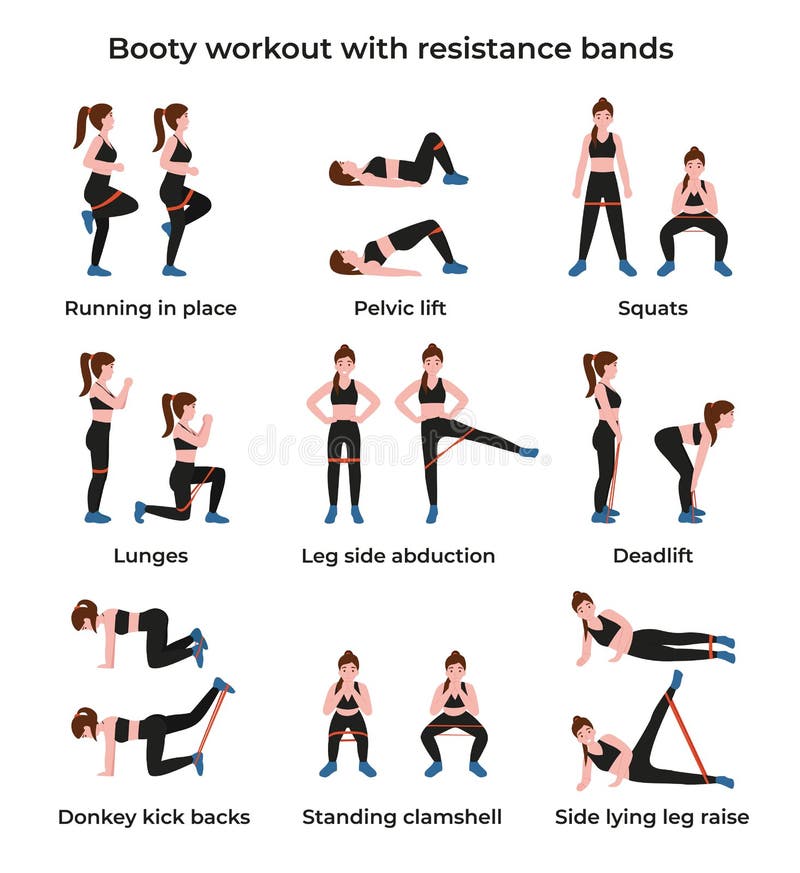
Credit: www.dreamstime.com
Sample Standing Glute Workout Routine
Ready to try a complete standing glute workout? Here’s a routine you can follow 2–3 times per week. All you need is a resistance band and a chair.
Warm-up (5 minutes):
- March in place: 1 minute
- Hip circles: 30 seconds per direction
- Bodyweight squats: 1 minute
- Standing side leg swings: 1 minute
Main workout:
- Standing Glute Kickbacks (band optional) – 15 reps per leg
- Standing Lateral Leg Raises – 15 reps per leg
- Curtsy Lunges – 12 reps per leg
- Reverse Lunge with Knee Drive – 12 reps per leg
- Standing Fire Hydrant (band optional) – 15 reps per leg
- Banded Squat with Side Step – 12 steps each side
- Single-Leg Deadlift (dumbbell optional) – 10 reps per leg
How to perform:
- Do one set of each exercise back-to-back (circuit style).
- Rest 60 seconds after each round.
- Repeat the circuit 2–4 times, based on your fitness level.
Cool down (3 minutes):
- Standing hamstring stretch: 30 seconds per leg
- Standing quad stretch: 30 seconds per leg
- Glute stretch: Cross ankle over knee, sit back slightly, hold 30 seconds per side
Tips:
- If an exercise feels too easy, add a band or dumbbell.
- If you struggle with balance, hold onto a chair or wall.
- Focus on feeling the glutes, not just moving your leg.
Progression And How To Get Results
Many give up on glute training because they don’t see results fast enough. Here’s how to keep improving:
Increase Resistance
As you get stronger, use a heavier band, add ankle weights, or hold dumbbells. Your muscles need new challenges to grow.
Add More Sets Or Reps
If you’re already using extra resistance, try adding an extra set or increasing reps slowly.
Change The Tempo
Slow down each repetition. Pause at the top of the movement to increase tension.
Try New Variations
Switch up exercises every few weeks. For example, swap curtsy lunges for reverse lunges, or try standing hip circles.
Don’t Forget Recovery
Glutes are big muscles and need rest. Train them 2–3 times per week, not daily. Overtraining can slow your progress.
Non-obvious insight: Many people “feel” their hamstrings or lower back more than their glutes during standing exercises. This usually means you’re not engaging your glutes enough. Before each set, squeeze your glutes and keep your core tight. This primes the right muscles to work.

Credit: www.youtube.com
Common Mistakes And How To Fix Them
Standing glute exercises look simple, but small errors can reduce their effectiveness or even cause discomfort.
Using Momentum
Swinging the leg or “kicking” fast uses momentum, not muscle. Move slowly and pause at the top of each rep.
Poor Posture
Leaning forward or arching your back takes the work away from your glutes. Stand tall, keep your abs tight, and don’t let your pelvis tilt.
Not Going Through Full Range
Many stop the movement too soon. For example, in lateral raises, lift your leg as high as you can without tilting your body.
Ignoring The Mind-muscle Connection
If you don’t “feel” your glutes working, slow down and squeeze at the top. Imagine pushing the floor away with each rep.
Neglecting Warm-up
Cold muscles are less responsive and more prone to strain. Always warm up with light cardio and dynamic stretches.
Pro tip: Record yourself or use a mirror to check your form. Small adjustments can make a big difference.
How To Add Standing Glute Workouts To Your Routine
Standing glute exercises fit into almost any workout schedule. Here’s how:
- Beginner: 2 times per week, 20–25 minutes per session
- Intermediate: 3 times per week, 30–40 minutes per session
- Advanced: Add resistance, increase sets, or use as a “finisher” after leg day
You can do them as a standalone workout, add a few moves to your leg day, or perform a set between upper body exercises for active recovery.
Standing glute workouts are also great for home, travel, or busy days when you want a quick, effective session without changing clothes or lying on the floor.
Real-world Results And Success Stories
Standing glute workouts are not just for fitness models or athletes. People of all ages and backgrounds have seen real benefits.
- Office workers: Adding a few sets of standing glute kickbacks and side leg raises during the day helps reduce back pain and improve posture.
- Seniors: Standing glute training improves hip stability, making it easier to walk, climb stairs, and avoid falls.
- Athletes: Many sports coaches use standing glute exercises to boost sprinting, jumping, and overall leg power.
A fitness coach shared that her clients who switched to standing glute routines saw better glute activation and less knee pain, compared to traditional squats and lunges.
Non-obvious insight: Many people ignore the gluteus medius. Weakness here leads to “flat” hips and higher risk of injury. Include at least one lateral movement (like standing lateral leg raise) in every session.
Safety Tips And Who Should Be Cautious
Standing glute workouts are generally safe, but keep these in mind:
- Joint issues: If you have hip or knee pain, start with bodyweight only and avoid deep lunges.
- Balance problems: Hold onto a support or do double-leg moves like banded squats.
- Pregnancy: Most standing exercises are safe, but avoid high-impact or single-leg moves if you feel unstable.
Always listen to your body. Mild muscle fatigue is good, but sharp pain is not.
If you have a serious injury or health condition, ask a professional before starting a new workout.

Credit: us.humankinetics.com
Advanced Variations For More Challenge
Once you master the basics, try these advanced standing glute moves:
- Single-leg squat to box: Balances on one leg, squat to touch a box or chair, then stand up.
- Standing glute circle: Lift your leg back and draw small circles in the air.
- Banded monster walk: Squat low and walk forward/backward with a band around your legs.
- Cable standing hip rotation: At the gym, use a cable to rotate your hip outward or inward.
You can also combine moves—do a curtsy lunge, then add a lateral leg raise before standing up.
Nutrition For Glute Growth And Fat Loss
Building visible, strong glutes isn’t just about exercise. Nutrition plays a key role.
Protein
Your glutes need protein to grow. Aim for 0. 7–1 gram of protein per pound of bodyweight daily, spread over meals.
Healthy Fats
Don’t fear fat. Foods like avocado, nuts, and olive oil support hormone health, which is important for muscle growth.
Carbohydrates
Carbs fuel your workouts. Choose whole grains, fruits, and vegetables to keep energy up.
Hydration
Drink water before, during, and after your workouts. Dehydration reduces performance and slows recovery.
If your goal is to reduce body fat and reveal muscle, eat in a small calorie deficit, but don’t cut calories too low—your glutes need energy to grow.
Pro tip: Keep a food journal for a week to spot nutrition gaps.
Tracking Progress And Staying Motivated
Results take time, but tracking helps you stay motivated.
Take Photos
Glute changes are often slow and subtle. Take photos from the side and back every few weeks.
Measure
Use a soft tape to measure around the fullest part of your hips/glutes. Track changes monthly.
Log Workouts
Write down exercises, sets, reps, and resistance. Look for improvements over time.
Celebrate Non-scale Wins
Better posture, stronger balance, and less pain are all signs of progress—even if the scale doesn’t move.
How To Stretch And Recover Your Glutes
Recovery is just as important as training. Tight glutes can lead to lower back pain and reduced performance.
Top standing glute stretches:
- Figure 4 stretch: Cross ankle over opposite knee, sit back slightly, hold.
- Standing quad/glute stretch: Pull foot to buttock, keep knees together, lean forward.
- Hip flexor stretch: Step one leg back, bend front knee, squeeze glute of back leg.
Hold each stretch for 20–30 seconds after your workout.
Frequently Asked Questions
How Often Should I Do Standing Glute Workouts?
Most people see good results training glutes 2–3 times per week. Allow at least one rest day between sessions for recovery.
Can Standing Glute Exercises Grow My Glutes As Much As Squats Or Hip Thrusts?
Yes, especially if you use enough resistance and progress over time. Standing exercises activate all parts of the glute, and with focus, can be as effective as traditional lifts.
What If I Don’t Feel My Glutes Working During Standing Exercises?
Try reducing momentum, slowing down each rep, and squeezing your glutes hard at the top. You may also need to adjust your posture or use lighter resistance until your form is perfect.
Do I Need Equipment For A Good Standing Glute Workout?
No. Bodyweight is enough for beginners. However, adding resistance bands, dumbbells, or ankle weights makes the workout more challenging and effective over time.
Where Can I Find More Information On Glute Training?
Check out the Wikipedia page on gluteus maximus for deeper muscle anatomy and function.
Standing glute workouts offer a flexible, powerful way to build a strong lower body—no mat, no floor work, and no excuses. Start today, stay consistent, and your glutes will thank you.
