

Stairmaster Glute Workout: Sculpt Stronger, Rounder Glutes Fast
Stairmaster Glute Workout: Build Stronger, Shapelier Glutes
Walking into the gym, you may notice the Stairmaster often gets overlooked. Many people head straight for the treadmill or the weights. But if your goal is strong, defined glutes, the Stairmaster can be your secret weapon. This machine offers much more than a simple cardio session—it gives your glutes the challenge they need to grow.
Whether you're aiming to lift, tighten, or tone your backside, a focused Stairmaster glute workout can make a real difference. Let's explore how this machine targets your glutes, the best workout routines, and tips to maximize your results.
Why The Stairmaster Is Powerful For Glutes
The Stairmaster mimics climbing stairs, a movement that naturally recruits your glute muscles. Every step you take forces your glutes to contract, especially when you push through your heel. Unlike flat walking or running, the vertical movement challenges your lower body in a unique way.
Here’s how the Stairmaster stands out:
- Constant resistance: Your glutes work against gravity with every step.
- Multiple muscles: It targets the gluteus maximus, medius, and minimus, plus your hamstrings and quads.
- Versatile intensity: You can adjust speed and duration to suit your fitness level.
Many people underestimate the impact of small changes in posture and step style. For example, a slight lean forward or pressing through the heel can boost glute engagement dramatically—something beginners often miss.
Glute Muscles: Quick Anatomy And Function
Understanding which muscles you’re working helps you target them better. Your glutes are made up of three main parts:
- Gluteus maximus: The largest muscle, responsible for the round shape of your butt and powerful hip extension.
- Gluteus medius: Sits on the outer side, shapes your hips, and stabilizes during movement.
- Gluteus minimus: The smallest, helps with hip stability and rotation.
When you climb stairs, especially with mindful technique, all three work together. They help you stand upright, power up each step, and control your descent.

Credit: www.sekompos.com
Stairmaster Vs Other Cardio Machines For Glutes
Is the Stairmaster truly better for glutes than the treadmill, elliptical, or bike? Let’s compare.
| Machine | Glute Activation | Main Focus | Calories Burned (avg/hour) |
|---|---|---|---|
| Stairmaster | High | Glutes, hamstrings, quads | 400-600 |
| Treadmill (flat) | Low | Quads, calves | 450-650 |
| Treadmill (incline) | Medium | Glutes, hamstrings | 500-700 |
| Elliptical | Medium | Quads, glutes | 350-550 |
| Stationary Bike | Low | Quads | 350-500 |
As you can see, Stairmaster offers high glute activation, even compared to incline treadmill walking. It burns plenty of calories, too, making it efficient for both muscle and fat loss.
Benefits Of A Stairmaster Glute Workout
There’s more to gain than just a nice shape. Regular Stairmaster glute sessions deliver:
- Stronger glutes: Improved athletic performance, better posture, and injury prevention.
- Toned lower body: Visible tightening and lifting of your butt and thighs.
- Calorie burn: Supports fat loss while building muscle.
- Core engagement: Your abs and lower back stabilize every step.
A less obvious benefit: stronger glutes can ease lower back pain. Weak glutes often force your back to do extra work, leading to discomfort. By building up your glutes, you support your whole body.
How To Use The Stairmaster For Maximum Glute Activation
Just climbing isn’t enough—you need the right form and strategy.
- Posture matters: Stand tall, lean forward slightly at your hips (not your back), and keep your chest open.
- Focus on your heel: Push down with your heel as you step. This activates your glute max instead of relying on your quads.
- Don’t rely on the rails: Lightly touch for balance if needed, but avoid pulling yourself up with your arms.
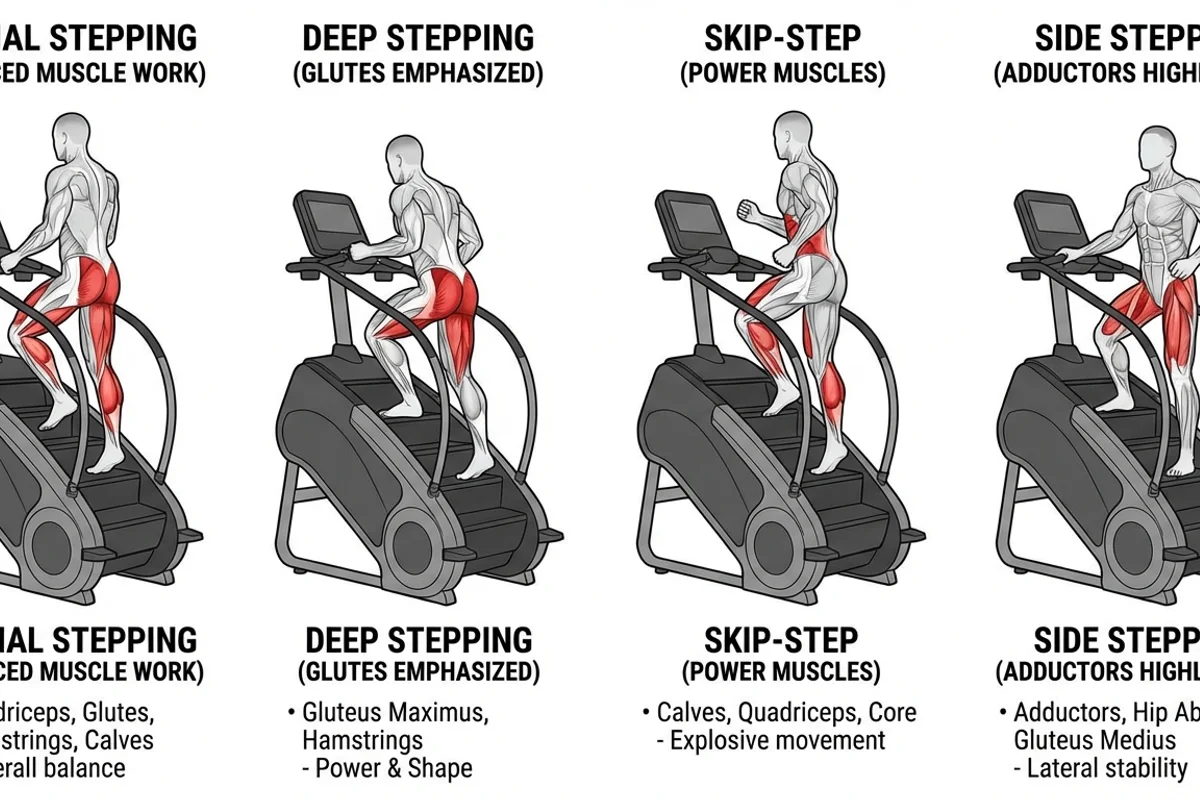
- Deep steps: Step your whole foot onto each stair, not just your toes.
- Slow, controlled movement: Rushing limits muscle engagement. Slow steps work your glutes better than fast ones.
A common mistake: people grip the rails and lean back, which reduces glute activation and shifts the work to your arms and lower back.
The Best Stairmaster Glute Workout Routine
Ready for a workout that really targets your glutes? Here’s a sample routine to get you started. Adjust speed and duration to your level.
Warm-up (5 Minutes)
- Start slow (Level 3–5)
- Focus on full, even steps
- Get your heart rate up and muscles warm
Glute-focused Intervals (20–30 Minutes)
Alternate between the following moves:
- Regular Climb (2 minutes)
- Step at a moderate pace
- Focus on pushing through your heels
- Side Steps (1 minute each side)
- Turn sideways, cross one leg over the other
- Targets glute medius and minimus
- Double Steps (2 minutes)
- Skip every other step
- Use your glutes to power up
- Kickbacks (1 minute each side)
- As you step, extend your leg behind you
- Squeeze your glute at the top
- Slow, Deep Steps (2 minutes)
- Slow down, focus on large, deep steps
- Maximize muscle tension
Repeat this circuit 2–3 times based on fitness.
Cool Down (5 Minutes)
- Return to a slow, steady climb
- Relax shoulders, focus on breathing
Sample Workout Table
Here’s a quick look at a 30-minute glute-focused session:
| Time | Move | Notes |
|---|---|---|
| 0–5 min | Warm-Up | Slow, steady pace |
| 5–7 min | Regular Climb | Focus on heels |
| 7–9 min | Side Steps (right) | Engage glute medius |
| 9–11 min | Side Steps (left) | Engage glute medius |
| 11–13 min | Double Steps | Deep glute activation |
| 13–15 min | Kickbacks (right) | Isolate glute max |
| 15–17 min | Kickbacks (left) | Isolate glute max |
| 17–19 min | Slow, Deep Steps | Max tension |
| 19–29 min | Repeat moves | 2nd round |
| 29–34 min | Cool Down | Slow, steady pace |
How Often Should You Do A Stairmaster Glute Workout?
For most people, 2–3 sessions per week is ideal. This allows your glutes to recover and grow. If you’re also doing heavy leg or glute strength work, space your sessions to avoid overtraining.
A common beginner mistake is daily Stairmaster sessions. Muscles need rest to build, so quality matters more than quantity. Pay attention to soreness and energy levels.
Progression: How To Keep Challenging Your Glutes
Your body adapts quickly. To keep seeing results, you must gradually make your workouts harder—this is called progressive overload.
Ways to progress:
- Increase duration: Add 2–5 minutes every week.
- Boost intensity: Raise the Stairmaster level or speed.
- Add more complex moves: Try longer side steps, higher kickbacks, or add light ankle weights (if safe).
- Shorten rest periods: Keep your muscles working longer.
A tip many miss: record your sessions in a notebook or app. Tracking progress helps you see improvements and motivates you to keep going.
Combining The Stairmaster With Strength Training
While the Stairmaster is great, adding strength exercises gives even better results. Resistance training builds muscle size and shape, while cardio (like the Stairmaster) burns fat and improves endurance.
Consider these strength moves on non-Stairmaster days:
- Barbell hip thrusts
- Bulgarian split squats
- Deadlifts
- Cable kickbacks
- Glute bridges
Pairing both methods delivers faster, more balanced glute development.
Sample Weekly Schedule For Glute Growth
Here’s how you could structure your week:
| Day | Workout |
|---|---|
| Monday | Stairmaster Glute Workout |
| Tuesday | Glute Strength Training |
| Wednesday | Rest or light cardio |
| Thursday | Stairmaster Glute Workout |
| Friday | Glute Strength Training |
| Saturday | Rest or yoga |
| Sunday | Optional Stairmaster or walk |
This routine allows for both cardio and muscle-building, with enough rest to recover.
Nutrition Tips To Maximize Glute Growth
Exercise alone isn’t enough. To build muscle, your body needs the right fuel. Here’s how to support your glute gains:
- Eat enough protein: Aim for at least 0.7 grams per pound of body weight.
- Don’t fear healthy carbs: They fuel your workouts and recovery.
- Stay hydrated: Muscles work best when you’re well-hydrated.
- Balance your calories: If your goal is muscle growth, eat slightly more calories than you burn.
Skipping meals or cutting calories too hard can stall progress, even if you train hard.
Mistakes To Avoid With Stairmaster Glute Training
Even with the best intentions, some habits can slow your progress or cause injury. Watch out for these pitfalls:
- Leaning back or slouching: This shifts work to your lower back and reduces glute activation.
- Holding the rails tightly: Makes the workout easier but less effective.
- Using only your toes: This mostly works your quads, not your glutes.
- Going too fast: Quality matters more than speed.
- Not varying the workout: Repeating the same routine leads to plateaus.
A less obvious mistake: ignoring muscle soreness or pain. If you feel sharp pain, stop and rest. Soreness that lasts more than a few days may mean you need more recovery.
Glute Activation Tips For Faster Results
Sometimes, glutes are “sleepy” from too much sitting or poor activation. To wake them up, try these before your Stairmaster session:
- Bodyweight glute bridges: 2 sets of 15 reps
- Banded lateral walks: 2 sets of 10 steps each way
- Standing hip abductions: 2 sets of 12 reps per side
These exercises “prime” your glutes, so they work harder during the main workout.
Who Should Try A Stairmaster Glute Workout?
Almost anyone can benefit from this workout, but it’s especially helpful for:
- People with desk jobs: Sitting weakens glutes over time. The Stairmaster helps reactivate them.
- Athletes: Strong glutes improve speed, jumping, and injury resistance.
- Those wanting a shapelier lower body: Tones and lifts the butt, hips, and thighs.
- People rehabbing from injury: With doctor approval, controlled stair climbing can rebuild strength.
If you have knee or hip issues, talk with a physical therapist before starting. Modifications may be needed.
Stairmaster Glute Workout For Beginners
If you’re new to the Stairmaster, start slow. Here’s a simple plan:
- Warm up: 3 minutes, easy pace
- Regular climb: 2 minutes, focus on form
- Rest (step off or slow down): 1 minute
- Side steps: 1 minute each side (hold rails for balance)
- Rest: 1 minute
- Slow deep steps: 2 minutes
- Cool down: 3 minutes, easy pace
Total: about 15–17 minutes. As you get stronger, add more time and intensity.
Intermediate And Advanced Stairmaster Glute Workouts
For more challenge, try these ideas:
- Weighted vest: Adds resistance (start light).
- Longer intervals: 3–5 minutes per move.
- Less rest: Only 30 seconds between sets.
- Complex moves: High-knee steps, crossover steps, or squat steps (step up, squat down on the stair).
Change your routine every few weeks to keep your muscles guessing.
Credit: www.bibliotecaoscura.com
Tracking Progress And Staying Motivated
Seeing results can take time, especially for muscle growth. Track your progress to stay motivated:
- Take progress photos every 2–4 weeks.
- Write down your workout stats: Time, level, moves completed.
- Measure your hips, waist, and thighs monthly.
- Celebrate small wins: More stamina, better form, or less soreness.
Remember, progress isn’t just about looks. Stronger glutes mean better movement, less pain, and more confidence.
Common Questions And Myths About Stairmaster Glute Workouts
Let’s clear up some confusion:
- Myth: Stairmaster makes your legs bulky.
- Reality: Building large muscles requires heavy weights, lots of food, and years of training. The Stairmaster tones and shapes, not bulks.
- Myth: You need to do hours to see results.
- Reality: Consistent, focused 20–30 minute sessions are enough.
- Myth: All cardio is the same for glutes.
- Reality: Stair climbing activates glutes more than most cardio machines.
- Myth: You should only feel it in your glutes.
- Reality: Your quads, hamstrings, and calves will also work—this is normal.
Safety Tips For Stairmaster Glute Training
Stair climbing is safe for most people, but keep these tips in mind:
- Wear supportive shoes: Good grip prevents slips.
- Start slow: Increase speed and duration gradually.
- Stay hydrated: Bring water, especially for longer sessions.
- Pay attention to your body: Sharp pain means stop.
- Cool down and stretch: Prevents tightness and soreness.
If you feel dizzy or unwell, step off safely and rest.
Making The Most Of Your Stairmaster Glute Workout
Here are two advanced tips that many beginners miss:
- Mind-muscle connection: Focus your mind on your glutes as you move. Studies show this boosts muscle activation and results.
- Vary your foot position: Try stepping with toes slightly out or in. This can change which part of your glutes work harder, leading to better overall development.

Credit: pneudirect.it
Should You Use Resistance Bands On The Stairmaster?
Some people add mini-bands just above the knees during their Stairmaster workout. This increases glute activation, especially for the glute medius and minimus. However, it also raises the difficulty and can affect balance. Only try this if you’re experienced and comfortable on the machine.
The Role Of Genetics In Glute Growth
Glute shape and size are partly genetic. Some people build muscle faster or have naturally rounder glutes. However, everyone can improve their glute strength and appearance with the right training and nutrition. Don’t compare your journey to others—focus on your personal progress.
Real-life Results: What To Expect
People who stick with a Stairmaster glute workout see:
- Firmer, higher glutes
- Slimmer thighs and hips
- Better athletic performance
- Increased confidence in jeans, dresses, and swimsuits
Results are visible in about 4–8 weeks with consistent effort. Your clothes may fit better and you’ll feel stronger during daily activities.
Stairmaster Glute Workout For Fat Loss
If your goal is fat loss, combine the workout with a slight calorie deficit. This means eating a bit less than you burn, without starving yourself. The Stairmaster burns fat from all over your body, not just your glutes. Over time, as you lose fat and build muscle, your glutes will become more defined.
For more on the science of fat loss, check out this Wikipedia guide.
Frequently Asked Questions
How Long Does It Take To See Results From A Stairmaster Glute Workout?
Most people notice firmer, more toned glutes within 4 to 8 weeks of consistent training. Visible changes depend on your starting point, diet, and genetics. Take regular photos and measurements to track progress.
Is The Stairmaster Safe For People With Knee Problems?
Stair climbing can be hard on the knees if done incorrectly or with existing injuries. Start slow, use proper form, and avoid skipping steps or going too fast. If pain occurs, stop and consult a physical therapist.
Can The Stairmaster Replace Squats And Other Glute Exercises?
The Stairmaster is excellent for endurance and shaping, but it’s not a complete substitute for strength training. For best results, combine it with squats, hip thrusts, and other glute exercises.
How Can I Target My Glutes More And My Quads Less On The Stairmaster?
Focus on pushing through your heels, taking deeper steps, and leaning forward slightly at the hips. Avoid using the rails for support and keep your movement slow and controlled.
What Should I Eat After A Stairmaster Glute Workout?
Eat a meal with protein (like chicken, eggs, or tofu) and healthy carbs (like rice, potatoes, or fruit) within two hours. This helps muscles recover and grow.
A strong, shapely lower body is within your reach. With the right approach, the Stairmaster can be a fun and effective way to build your glutes, improve your fitness, and feel more confident every day. Stay consistent, challenge yourself, and enjoy the journey.
