

Outer Glute Workout: Sculpt Stronger Hips and Glutes Fast
Outer Glute Workout: Build Strong, Shapely Hips
The outer glutes are often overlooked in many fitness routines, but training them can make a big difference in your lower body strength, shape, and stability. If you want rounder hips, better balance, and improved athletic performance, focusing on your outer glute muscles is key. These muscles—mainly the gluteus medius and gluteus minimus—help move your legs sideways, keep your pelvis steady, and give you a curvier look. Many beginners miss how important these muscles are for preventing injuries and boosting overall leg power.
In this guide, you’ll learn everything you need to know about effective outer glute workouts. We’ll cover the science, best exercises, clear instructions, training tips, and even mistakes to avoid. Whether you train at home or in the gym, this article will help you shape stronger, more toned hips and legs.
Understanding The Outer Glute Muscles
The gluteus medius sits on the outside of your hips, just above the gluteus maximus. The gluteus minimus lies underneath the medius. Both are responsible for moving your leg to the side (abduction), stabilizing your hip, and supporting your pelvis when you walk or run. Weak outer glutes can cause knee pain, lower back issues, or poor balance.
Key Functions
- Hip abduction: Moves your leg outward away from your body.
- Pelvic stability: Keeps your pelvis level, especially when you stand on one leg.
- Rotational control: Helps turn your leg inward and outward.
Why Outer Glutes Matter
Most people focus on their gluteus maximus (the largest glute muscle), but neglecting the outer glutes can limit progress. Strong outer glutes:
- Improve posture: They help keep your body aligned.
- Reduce injury risk: They protect your knees and lower back.
- Boost athletic performance: They help with running, jumping, and changing direction.
- Enhance shape: They give your hips a rounder, fuller look.
Many beginners don’t realize that weak outer glutes can slow down progress in squats, lunges, and even core exercises.
Benefits Of Outer Glute Training
Targeting your outer glutes has several advantages, both functional and aesthetic.
Enhanced Hip Shape
Building outer glutes creates a curvier hip profile. This is often desired in sports, dance, and fitness modeling. You’ll notice a more rounded look at the sides of your hips.
Injury Prevention
Strong outer glutes stabilize your pelvis and knees. Research shows that weak gluteus medius muscles are linked to knee pain and lower back injuries. For example, runners with weak outer glutes often experience IT band syndrome, a common overuse injury.
Improved Athletic Ability
Outer glute strength improves performance in many sports. Athletes who play soccer, basketball, or tennis need strong hip abductors to move quickly and change direction. This muscle group also helps you jump higher and sprint faster.
Better Everyday Movement
Even simple actions like walking, climbing stairs, or standing from a chair use your outer glutes. Strengthening them makes daily tasks easier and safer.
How To Activate The Outer Glutes
Before you start your workout, it’s important to activate your outer glutes. Many people rely too much on their quads or hamstrings, which can limit glute engagement.
Activation Techniques
- Dynamic warm-ups: Side-lying leg raises, clamshells, or lateral band walks.
- Mind-muscle connection: Focus on feeling the muscle work during each rep.
- Controlled movements: Use slow, steady motions to isolate the outer glutes.
Sample Activation Warm-up
- Lateral band walks: 2 sets of 20 steps each direction.
- Clamshells: 2 sets of 15 reps per side.
- Standing hip abduction: 2 sets of 12 reps per leg.
This quick routine wakes up your outer glutes and prepares them for harder exercises.
Best Outer Glute Exercises
A strong outer glute workout includes both bodyweight and resistance exercises. Here are some of the most effective moves:
1. Side-lying Hip Abduction
Lie on your side with legs straight. Lift your top leg upward, keeping it in line with your body. Pause, then lower slowly.
- Muscles targeted: Gluteus medius and minimus
- Sets/Reps: 3 sets of 15–20 reps
2. Clamshell
Lie on your side with knees bent. Keep feet together and open your knees apart like a clamshell.
- Tip: Use a resistance band above your knees for extra challenge.
- Sets/Reps: 3 sets of 15–20 reps
3. Lateral Band Walk
Place a loop band around your legs just above your knees. Stand with feet hip-width apart, knees slightly bent. Step sideways, keeping tension on the band.
- Common mistake: Letting knees cave inward. Keep them aligned with your toes.
- Sets/Reps: 3 sets of 20 steps each direction
4. Curtsy Lunge
Stand tall. Step one leg behind and across your body, bending both knees. Return to start.
- Targets: Gluteus medius, minimus, maximus, quads
- Sets/Reps: 3 sets of 12–15 reps per leg
5. Single-leg Glute Bridge
Lie on your back, knees bent. Lift one leg off the floor and push hips up, squeezing your glutes.
- Advanced tip: Pause at the top for 2–3 seconds.
- Sets/Reps: 3 sets of 12–15 reps per leg
6. Standing Hip Abduction
Stand tall, hold onto a chair or wall for balance. Lift one leg straight out to the side, then lower.
- Try slow reps: Hold for a second at the top.
- Sets/Reps: 3 sets of 15–20 reps per leg
7. Bulgarian Split Squat With Side Lift
Start in a split squat position, back foot elevated. As you rise, lift your front leg out to the side.
- Targets: Gluteus medius, minimus, maximus, quads
- Sets/Reps: 3 sets of 10–12 reps per leg
8. Cable Hip Abduction
Use a cable machine with an ankle strap. Stand sideways and lift your leg outwards.
- Tip: Start with light weight to focus on form.
- Sets/Reps: 3 sets of 12–15 reps per leg
9. Side Step-up
Stand next to a bench or step. Step sideways onto it, lifting your body and squeezing your outer glutes.
- Variation: Hold dumbbells for extra resistance.
- Sets/Reps: 3 sets of 12–15 reps per side
10. Fire Hydrant
On all fours, lift your knee out to the side, keeping it bent.
- Common mistake: Arching your back. Keep core tight.
- Sets/Reps: 3 sets of 15–20 reps per leg
Sample Outer Glute Workout Routine
A well-structured workout combines several exercises and includes proper rest and intensity. Here’s a sample routine for beginners and intermediates:
Beginner Routine
- Lateral band walk: 3 sets x 20 steps
- Clamshell: 3 sets x 15 reps per side
- Standing hip abduction: 3 sets x 15 reps per leg
- Side-lying hip abduction: 3 sets x 15 reps per leg
Rest: 45–60 seconds between sets
Intermediate Routine
- Curtsy lunge: 3 sets x 12 reps per leg
- Bulgarian split squat with side lift: 3 sets x 10 reps per leg
- Fire hydrant: 3 sets x 15 reps per leg
- Single-leg glute bridge: 3 sets x 12 reps per leg
Rest: 60–90 seconds between sets
Advanced Routine
- Cable hip abduction: 4 sets x 15 reps per leg
- Side step-up with dumbbells: 4 sets x 12 reps per side
- Lateral band walk: 4 sets x 20 steps
- Clamshell with heavy band: 4 sets x 15 reps per side
Rest: 90 seconds between sets
Comparing Outer Glute Exercises
Some exercises work your outer glutes better than others. Here’s a comparison of muscle activation based on research:
| Exercise | Outer Glute Activation (EMG %) | Difficulty Level |
|---|---|---|
| Side-Lying Hip Abduction | High | Beginner |
| Lateral Band Walk | Very High | Intermediate |
| Curtsy Lunge | Moderate | Intermediate |
| Fire Hydrant | High | Beginner |
| Cable Hip Abduction | Very High | Advanced |
Non-obvious insight: Lateral band walks and cable hip abduction often activate the outer glutes more than popular squats and lunges.
How Often Should You Train Outer Glutes?
For best results, aim to train your outer glutes 2–3 times per week. This gives your muscles enough stimulus while allowing recovery. Overtraining can cause soreness and reduce progress, especially for beginners.
Weekly Training Plan Example
- Monday: Outer glute workout
- Wednesday: Full leg workout (including outer glute exercises)
- Friday: Outer glute workout
Tip: Rest at least one day between outer glute sessions. If you feel tired or sore, add another rest day.
Common Mistakes In Outer Glute Workouts
Many people make errors that limit their progress or cause injury. Here are the most frequent mistakes and how to fix them:
1. Using Wrong Form
- Letting knees cave inward: This reduces glute activation and strains your knees.
- Arching your back: Keep your core tight during exercises.
- Moving too fast: Use slow, controlled reps.
2. Skipping Activation
Not warming up the outer glutes means your quads or hamstrings may take over. Always do activation drills before your main workout.
3. Ignoring Mind-muscle Connection
Focus on feeling your outer glutes working. This improves results and helps you avoid relying on other muscles.
4. Neglecting Progressive Overload
Progressive overload is increasing resistance, reps, or sets over time. Without it, your muscles won’t grow or get stronger. Use bands, weights, or tougher exercises as you improve.
5. Overtraining
Too many sessions or too little rest can cause fatigue and injury. Stick to 2–3 workouts per week and listen to your body.
Equipment For Outer Glute Training
You can train your outer glutes with minimal equipment. Here’s what helps:
- Resistance bands: Great for lateral band walks, clamshells, and hip abductions.
- Dumbbells: Useful for step-ups or split squats.
- Cable machine: Excellent for hip abduction with adjustable resistance.
- Bench or step: Needed for side step-ups and Bulgarian split squats.
A simple band is enough for most home workouts. If you train at the gym, you can add cable machines and heavier weights for more challenge.
Outer Glute Workout For Home And Gym
Many people worry they need fancy equipment to train their outer glutes. Here’s a comparison of home and gym routines:
| Exercise | Home | Gym |
|---|---|---|
| Lateral Band Walk | Resistance Band | Resistance Band |
| Clamshell | Bodyweight/Band | Bodyweight/Band |
| Standing Hip Abduction | Bodyweight | Cable Machine |
| Single-Leg Glute Bridge | Bodyweight | Dumbbell/Plate |
| Side Step-Up | Chair/Step | Bench/Dumbbell |
Insight: Home workouts can be just as effective as gym routines if you use resistance bands and focus on proper form.
Progression: How To Make Outer Glute Workouts Harder
As you get stronger, your muscles need new challenges. Here’s how to progress:
- Increase resistance: Use heavier bands or weights.
- Add reps or sets: Gradually add more repetitions or sets each week.
- Use harder variations: Try advanced moves like Bulgarian split squats or cable hip abductions.
- Slow down reps: Pause at the top and lower slowly to increase muscle tension.
- Combine exercises: Superset two moves for more intensity.
Practical tip: Track your workouts in a notebook or app. Write down your sets, reps, and resistance. Increase one factor each week for steady progress.
Stretching And Mobility For Outer Glutes
Tightness in the outer glutes can limit your range of motion and lead to discomfort. Stretch after your workout to improve mobility and reduce soreness.
Effective Stretches
- Seated figure-four stretch: Sit, cross one ankle over your opposite knee, lean forward.
- Standing IT band stretch: Stand, cross one leg behind the other, lean sideways.
- Pigeon pose: From yoga, stretches the hip and glute muscles.
Hold each stretch for 20–30 seconds and repeat 2–3 times.
Insight: Stretching after workouts helps muscle recovery and prevents tightness that can affect your movement.
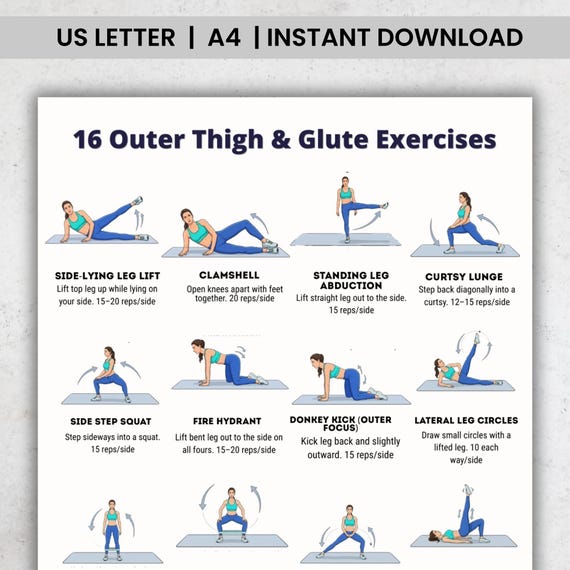
Credit: www.etsy.com
Nutrition For Outer Glute Growth
Building muscle needs the right food. If you want stronger, rounder glutes, pay attention to your diet.
Key Nutrients
- Protein: Helps repair and build muscle. Aim for 1.2–1.7 grams per kg of body weight daily.
- Carbohydrates: Provide energy for workouts. Choose whole grains, fruits, and vegetables.
- Healthy fats: Support hormone production and muscle growth. Include avocados, nuts, olive oil.
Tip: Eat a balanced meal within two hours after your workout. Include protein (chicken, fish, tofu), carbs (rice, potatoes), and vegetables.
Tracking Progress And Results
Seeing changes takes time. Track your progress to stay motivated and adjust your routine.
How To Measure Progress
- Photos: Take front and side photos every 4 weeks.
- Measurements: Use a tape to measure your hip circumference.
- Strength tests: Record how many reps you can do or the resistance you use.
- Mobility: Track your range of motion in hip abduction.
Insight: Beginners often miss small improvements in strength or shape. Keeping a log helps you notice gains that are not visible right away.
Who Should Train Outer Glutes?
Outer glute training is helpful for everyone, not just athletes or bodybuilders.
Groups Who Benefit Most
- Athletes: Improve speed, agility, and prevent injuries.
- Older adults: Increase balance and reduce fall risk.
- Office workers: Counteract sitting posture, which weakens glutes.
- Fitness beginners: Build a strong foundation for other lower body workouts.
Outer Glute Workout For Different Goals
The best routine depends on your goal. Here’s a quick guide:
| Goal | Recommended Exercises | Frequency |
|---|---|---|
| Muscle growth | Bulgarian split squat, cable hip abduction, step-up | 3x/week |
| Shape and tone | Clamshell, lateral band walk, fire hydrant | 2–3x/week |
| Injury prevention | Standing hip abduction, side-lying hip abduction | 2x/week |
| Athletic performance | Curtsy lunge, cable hip abduction, step-up | 3x/week |
Tip: Adjust sets, reps, and resistance based on your fitness level and desired outcome.

Credit: www.youtube.com
Science Behind Outer Glute Training
Studies show that targeted glute exercises activate the outer glutes more than traditional squats or deadlifts. One research found that lateral band walks increased gluteus medius activation by over 50% compared to basic squats. Proper outer glute training also improves hip stability and reduces injury risk in runners and athletes.
For more information, see NCBI, a reliable source for fitness research.
Frequently Asked Questions
How Long Does It Take To See Results From Outer Glute Workouts?
Most people notice changes in hip shape and strength within 4–8 weeks if they train consistently. Visible results depend on your starting fitness level, workout intensity, and diet.
Can I Train My Outer Glutes Every Day?
It’s best to train outer glutes 2–3 times per week. Daily training can lead to soreness and slow progress. Muscles need time to recover and grow.
What Is The Best Exercise For Outer Glutes?
Lateral band walks, cable hip abductions, and clamshells are excellent for activating the outer glutes. Choose exercises that you can do with good form and gradually increase resistance.
Are Outer Glute Workouts Effective For Shaping Hips?
Yes, targeted outer glute exercises help build rounder, fuller hips. Combining resistance training with proper nutrition improves both shape and strength.
Can I Do Outer Glute Workouts At Home?
Absolutely. Many effective exercises need only a resistance band or your bodyweight. Home routines can be just as effective as gym workouts if you focus on form and progressive overload.
Strengthening your outer glutes brings many benefits, from better hip shape to improved balance and lower injury risk. Whether you train at home or in the gym, use a mix of exercises, focus on form, and keep progressing. With patience and effort, you’ll build strong, shapely hips and a healthier body.

Credit: www.plattar.com
