

No Equipment Glute Workout: Sculpt Your Booty Anywhere
No Equipment Glute Workout: Build Strong Glutes Anywhere
Strong glutes help you move better, prevent injuries, and look fit. But many people think you need a gym or weights to train your glutes. The truth is, you can develop powerful glute muscles with no equipment at all. Whether you’re at home, traveling, or just don’t have access to a gym, this guide will show you how to target your glutes effectively and safely.
You will learn proven exercises, workout plans, and smart training tips—all using bodyweight only. Along the way, you’ll see how glute training boosts performance, supports healthy posture, and makes everyday movement easier. This article is your complete, practical resource for no equipment glute workouts.
Why Glute Strength Matters
The glute muscles—gluteus maximus, gluteus medius, and gluteus minimus—are the largest muscles in your body. They control hip movement, stabilize your pelvis, and support your lower back.
Strong glutes benefit you in many ways:
- Improve athletic performance (running, jumping, lifting)
- Reduce risk of knee, hip, and back injuries
- Enhance balance and stability
- Support healthy posture
- Make daily tasks easier (walking, climbing stairs, carrying objects)
Weak glutes can cause lower back pain, poor movement patterns, and even knee problems. That’s why building glute strength should be a priority for everyone—no matter your fitness level.
How Glutes Work Without Equipment
You might wonder: Can bodyweight exercises really build strong glutes? Absolutely. Your glutes respond to resistance, tension, and movement patterns. You can create all of these without weights by using gravity, leverage, and smart exercise choices.
Bodyweight glute training uses:
- Single-leg movements (more demand on each glute)
- High reps for endurance and muscle activation
- Slow, controlled tempo for increased tension
- Isometric holds to challenge stability
No equipment means you can train anywhere, anytime. The key is to focus on technique, muscle activation, and progressive overload (making exercises harder over time).
Key Bodyweight Glute Exercises
Let’s break down the most effective no-equipment glute exercises. These moves recruit all parts of the glute muscles and are suitable for beginners and advanced levels.
1. Glute Bridge
Lie on your back, knees bent, feet flat. Push through your heels to lift hips, squeeze glutes at the top, then lower down.
Tips:
- Keep core tight
- Don’t arch lower back
- Hold the top position for 1–2 seconds
2. Single-leg Glute Bridge
Similar to the glute bridge, but raise one leg straight while lifting hips. This increases glute activation and challenges stability.
Tips:
- Switch legs each set
- Don’t let hips tilt
- Focus on pushing through heel
3. Bulgarian Split Squat
Stand with one foot behind you on a chair or bench. Lower front knee, keeping torso upright, then push up.
Tips:
- Front knee stays above ankle
- Lean forward slightly for more glute activation
- Use slow tempo
4. Step-up
Find a sturdy step or chair. Step up, pushing through heel, then step down.
Tips:
- Drive through the glute, not the quad
- Alternate legs each set
5. Hip Thrust
Place upper back on a couch or bench. Feet flat, knees bent. Push hips up, squeeze glutes, lower back down.
Tips:
- Keep chin tucked
- Don’t overextend back
6. Squat
Stand feet shoulder-width apart. Lower hips back and down, then stand up.
Tips:
- Keep knees tracking over toes
- Push hips back for glute focus
7. Single-leg Squat (pistol Squat)
Balance on one leg, lower down, then push up. It’s advanced—use a chair for support if needed.
Tips:
- Go as low as comfortable
- Keep chest up
8. Reverse Lunge
Step one leg back, lower knee, push up.
Tips:
- Focus on glute of front leg
- Keep torso upright
9. Donkey Kick
On all fours, kick one leg up and back, squeeze glute. Alternate sides.
Tips:
- Keep knee bent
- Don’t arch back
10. Fire Hydrant
On all fours, lift one knee out to side, squeeze glute.
Tips:
- Don’t rotate hips
- Keep movement controlled
11. Frog Pump
Lie on back, soles of feet together, knees apart. Push hips up, squeeze glutes, lower down.
Tips:
- Use quick reps
- Focus on glute squeeze
12. Curtsy Lunge
Step one leg behind and across, lower into lunge, push up.
Tips:
- Keep front knee stable
- Feel stretch in glute
13. Side-lying Hip Abduction
Lie on side, lift top leg up and down.
Tips:
- Keep toes pointed forward
- Don’t swing leg
14. Wall Sit
Slide down wall, knees bent 90°, hold position.
Tips:
- Push through heels
- Squeeze glutes during hold
15. Glute Bridge March
Start in glute bridge, lift one knee, lower, alternate.
Tips:
- Keep hips level
- Don’t let hips drop
Sample No Equipment Glute Workout Plans
You can mix these exercises into workouts that fit your goals and schedule. Here are two sample routines: one for beginners, one for advanced.
Beginner Glute Workout (20–30 Minutes)
- Glute Bridge – 3 sets x 15 reps
- Reverse Lunge – 3 sets x 10 reps per leg
- Donkey Kick – 3 sets x 12 reps per leg
- Side-Lying Hip Abduction – 2 sets x 15 reps per leg
- Wall Sit – 2 sets x 30 seconds
Rest 30–60 seconds between sets.
Advanced Glute Workout (30–40 Minutes)
- Single-Leg Glute Bridge – 3 sets x 12 reps per leg
- Bulgarian Split Squat – 3 sets x 10 reps per leg
- Hip Thrust – 3 sets x 15 reps
- Frog Pump – 3 sets x 20 reps
- Pistol Squat – 2 sets x 6 reps per leg
- Curtsy Lunge – 2 sets x 12 reps per leg
Rest 45–90 seconds between sets.
Progression: How To Keep Challenging Your Glutes
Your body adapts to training. To keep seeing results, you need to make the exercises harder over time. Here’s how to progress with no equipment:
- Increase reps and sets: Gradually do more repetitions or add extra sets.
- Slow down tempo: Move slowly, especially during the lowering phase.
- Add isometric holds: Pause at the hardest point (top or bottom) for 2–5 seconds.
- Use single-leg variations: These demand more from each glute.
- Combine exercises: For example, do a glute bridge followed by a frog pump.
- Shorten rest periods: Less rest means more challenge.
You can track your progress by writing down reps, sets, and exercise variations each week.
Comparison: Bodyweight Vs Weighted Glute Training
Many people wonder if bodyweight workouts can match weighted workouts for glute development. Let’s compare the two:
| Factor | Bodyweight Training | Weighted Training |
|---|---|---|
| Accessibility | Train anywhere | Need gym/equipment |
| Safety | Lower injury risk | Higher injury risk |
| Progression | Reps, tempo, single-leg | Add weight easily |
| Muscle Activation | High, with technique | Very high |
| Strength Gains | Moderate | High |
| Hypertrophy (Muscle Size) | Good for beginners | Better for advanced |
Bodyweight glute training is effective for beginners, people without access to weights, or those wanting to train safely. Weighted training offers faster muscle growth, but bodyweight still builds strong, functional glutes.
Glute Anatomy: Understanding Muscle Activation
Knowing which exercises target which glute muscles helps you get the most from your workouts. Here’s a simple breakdown:
| Glute Muscle | Main Function | Best Exercise |
|---|---|---|
| Gluteus Maximus | Hip extension, power | Hip thrust, glute bridge |
| Gluteus Medius | Hip abduction, stability | Side-lying hip abduction, fire hydrant |
| Gluteus Minimus | Hip internal rotation | Curtsy lunge, fire hydrant |
By mixing hip extension, abduction, and rotation exercises, you work all parts of the glutes for strength and shape.
Common Mistakes In No Equipment Glute Workouts
Even with simple bodyweight moves, mistakes can stop your progress or cause pain. Here are frequent errors and how to avoid them:
- Not feeling the glutes: If you only feel quads or hamstrings, adjust your form. Push through heels, squeeze glutes at the top, and keep core tight.
- Letting knees cave in: During squats and lunges, knees should track over toes. If they cave in, glute activation drops and injury risk rises.
- Arching the lower back: Keep spine neutral. Don’t overextend during bridges or thrusts.
- Rushing reps: Fast, sloppy reps reduce tension. Slow down and control movement.
- Skipping single-leg work: Single-leg exercises demand more from each glute and fix imbalances.
- Ignoring progression: If you don’t increase reps or difficulty, your results plateau.
Many beginners miss the importance of muscle activation. Before each workout, try glute activation drills—like squeezing your glutes for 10 seconds, or doing 10 slow bridges.
Glute Activation: The Secret To Better Results
Before your main workout, spend 5–7 minutes warming up your glutes. This increases blood flow, helps you feel the muscles, and improves performance.
Activation drills:
- Glute bridge (10 reps, squeeze at top)
- Fire hydrant (10 reps per side)
- Donkey kick (10 reps per side)
- Side-lying hip abduction (10 reps per side)
Focus on squeezing the glute, not just moving your leg.
Glute Training For Different Goals
Your approach may change depending on your goal—strength, size, athletic performance, or injury prevention. Here’s how to adapt your no equipment glute workout.
For Strength
- Use lower reps (8–12)
- Add single-leg moves
- Increase sets (4–5 sets per exercise)
- Use isometric holds
For Muscle Size (hypertrophy)
- Use moderate reps (12–20)
- Slow tempo, full range of motion
- Combine exercises (supersets)
For Endurance
- High reps (20–30)
- Short rest (20–30 seconds)
- Circuit-style (move between exercises)
For Athletic Performance
- Focus on explosive moves (jump squats, power lunges)
- Use quick, powerful reps
- Mix in balance and agility drills
For Injury Prevention
- Prioritize glute medius/minimus exercises
- Use slow, controlled reps
- Add stability drills (single-leg balance)

Credit: www.asheborolawfirm.com
Sample Weekly Glute Workout Schedule
You can train glutes 2–4 times per week, depending on your recovery and goals. Here’s a sample weekly schedule:
Day 1: Glute activation + beginner workout
Day 2: Rest or light cardio
Day 3: Glute activation + advanced workout
Day 4: Rest
Day 5: Glute activation + endurance workout
Day 6: Rest
Day 7: Optional mobility/stretching
Listen to your body. If you feel sore, take extra rest. Recovery is key for muscle growth.
Practical Tips For Better Glute Training
Getting results from no equipment glute workouts comes down to smart training. Here are practical tips most beginners overlook:
- Quality over quantity: 10 perfect reps are better than 30 sloppy ones.
- Mind-muscle connection: Focus on feeling the glute contract in every rep.
- Use mirrors or record yourself: Checking your form helps spot mistakes.
- Breathe properly: Exhale during exertion, inhale during lowering phase.
- Add variety: Change up exercises every 2–4 weeks to keep muscles challenged.
- Stretch after workouts: Glute and hip stretches improve flexibility and recovery.
One non-obvious insight: For many people, hip mobility limits glute activation. Spend time stretching your hips and lower back to improve your range of motion.
Nutrition And Glute Growth
Building glutes isn’t just about exercise—your nutrition matters too. To support muscle growth and recovery:
- Eat enough protein (about 0.7–1 gram per pound of bodyweight)
- Include healthy fats (avocado, nuts, olive oil)
- Get complex carbs for energy (sweet potatoes, oats, brown rice)
- Stay hydrated
Protein helps repair and build muscle, while carbs fuel your workouts. If you want to improve your diet for glute training, consider tracking your food intake for a week.
Glute Training For Men Vs Women
Both men and women can benefit from bodyweight glute workouts. The main differences come from genetics and training goals.
| Factor | Men | Women |
|---|---|---|
| Muscle Growth | Faster, more visible | Slower, more shape |
| Fat Distribution | Less fat around glutes | More fat around hips, glutes |
| Training Focus | Strength/power | Shape/tone |
| Exercise Selection | Similar | Similar |
Both should use single-leg moves, hip thrusts, and lunges for best results. Women may want higher reps for endurance, while men may focus on lower reps for strength.
Glute Mobility And Flexibility
Strong glutes need to be flexible and mobile to function well. Stiff hips can limit your range of motion and reduce glute activation.
Simple stretches:
- Figure-4 stretch: Sit, cross ankle over knee, lean forward
- Hip flexor stretch: Kneel, push hips forward
- Pigeon pose: On floor, one knee bent, other leg behind
Hold each stretch for 20–30 seconds after workouts. This keeps your glutes healthy and helps prevent injuries.
Tracking Progress: How To Measure Results
Measuring your progress helps you stay motivated and see what’s working. Here are ways to track glute training results:
- Take photos every 2–4 weeks: Look for changes in shape, size, and tone
- Record reps and sets: Write down your workouts to see improvement
- Measure hip and glute circumference: Use a tape measure around widest part
- Notice strength gains: Are daily tasks easier? Can you do more reps?
Many beginners miss that bodyweight progress can be slow but steady. Don’t expect overnight changes—consistency leads to results.

Credit: samarthyaclasses.com
Glute Training For Different Ages
No equipment glute workouts are safe and effective for almost any age. Here’s how to adjust for youth, adults, and older adults:
- Youth (under 18): Focus on balance, coordination, and basic movement patterns. Keep workouts fun and short.
- Adults: Use all exercise variations, increase reps and sets gradually.
- Older adults: Prioritize slow, controlled movements, avoid high-impact exercises, include hip mobility and balance drills.
If you have medical conditions or injuries, consult a professional before starting any new workout.
Glute Training For Runners And Athletes
Athletes and runners need strong glutes for speed, power, and injury prevention. Bodyweight glute exercises can improve performance by:
- Increasing hip drive (for sprinting)
- Improving balance and stability
- Reducing risk of hamstring and knee injuries
Include single-leg glute bridges, Bulgarian split squats, and hip thrusts in your routine. For runners, focus on high reps and endurance moves.
For more on glute anatomy and function, see Wikipedia.
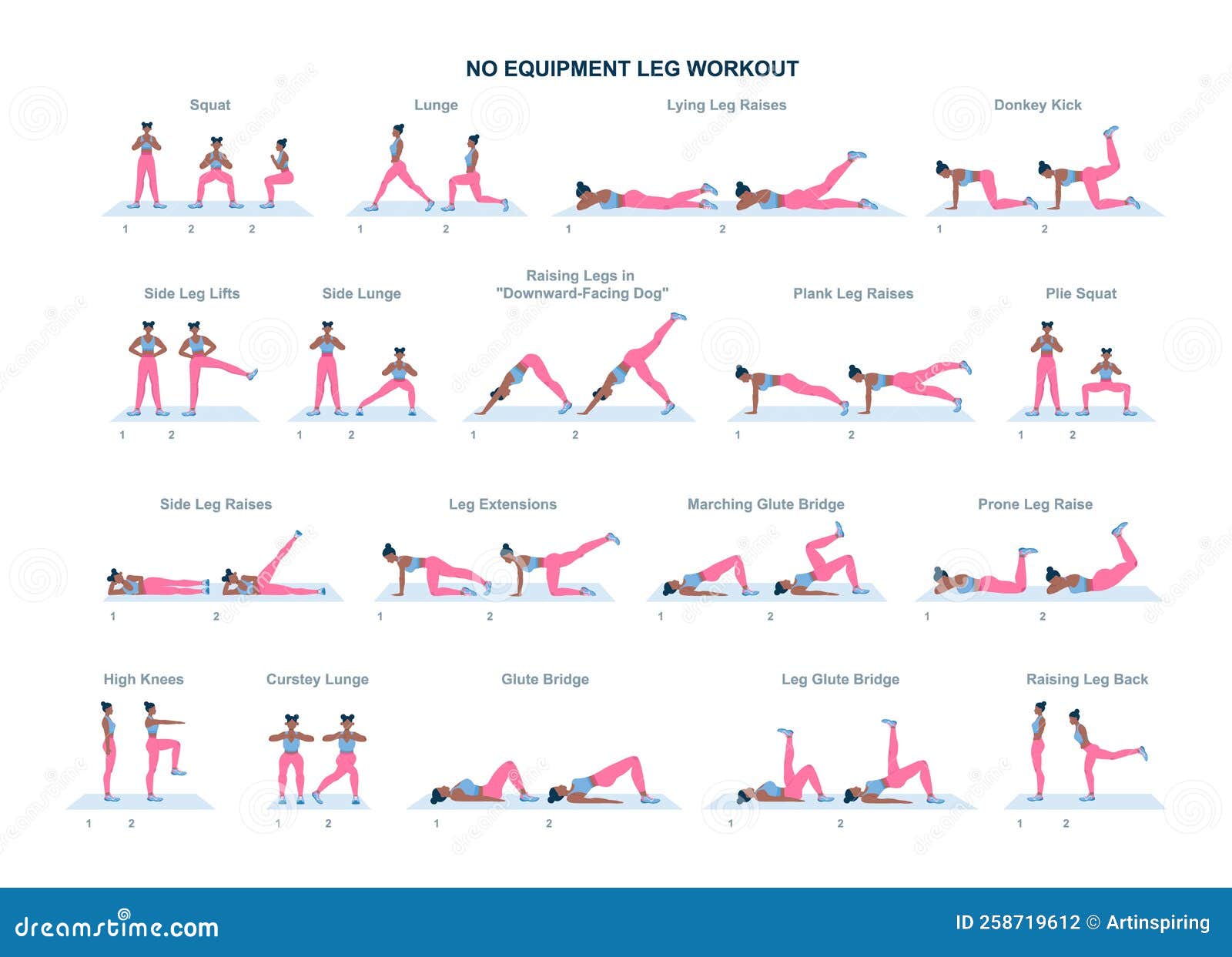
Credit: www.dreamstime.com
Frequently Asked Questions
How Often Should I Do No Equipment Glute Workouts?
You can train glutes 2–4 times per week. Beginners may start with 2–3 sessions. Listen to your body—if you feel sore, take rest. Recovery is as important as training.
How Long Does It Take To See Glute Growth?
Most people notice changes in 4–8 weeks with consistent workouts. Results depend on your starting point, nutrition, and workout intensity. Photos and measurements help track progress.
Can I Do Glute Workouts Every Day?
Daily glute workouts are possible if you vary intensity and volume. For best results, allow at least one rest day between tough sessions. Overtraining can lead to injury or slow progress.
What If I Don’t Feel My Glutes Working?
Focus on form, slow down reps, and use activation drills before your workout. Push through heels, squeeze at the top, and keep core tight. Avoid exercises that shift tension to quads or back.
Are No Equipment Glute Workouts Enough For Muscle Growth?
For beginners and those without access to weights, bodyweight glute workouts can build muscle and strength. Advanced trainees may see slower progress, but single-leg moves and higher reps make bodyweight training effective.
Strong glutes improve movement, support your body, and boost confidence. You don’t need a gym or equipment—just commitment, smart exercises, and proper progression. Whether you’re starting out or looking to level up, this guide gives you everything you need for effective, safe, and flexible glute training.
