

Leg Glute Workout at Home: Sculpt Stronger Legs Fast
Leg Glute Workout At Home
Strong legs and glutes are more than just a fitness trend. They support your daily movement, protect your joints, and improve your athletic performance. Many people believe you need a gym or fancy equipment to build these muscles. But the truth is, you can create an effective leg glute workout at home with minimal space and no expensive machines.
If you want to shape, strengthen, or tone your lower body, this guide gives you everything you need to get started—and succeed—right where you live.
Why Train Legs And Glutes At Home?
Training your legs and glutes is not just about looks. These large muscles are the foundation of your body. When strong, they help you walk, run, jump, and lift things with ease. Weak legs and glutes can lead to poor posture, back pain, and higher injury risk, especially as you age.
Working out at home makes it easy to stay consistent. There’s no travel time, no waiting for machines, and you can fit exercise into your schedule—even if you only have 20 minutes. For people who feel shy at the gym, home workouts remove that stress.
Recent studies also show that home workouts can be just as effective as gym routines if you use good form and push yourself. The key is to choose the right exercises and progress over time.
Anatomy: Understanding Your Leg And Glute Muscles
Knowing which muscles you are training helps you target them better. The main muscles in your legs and glutes include:
- Quadriceps: Front of your thighs, used for straightening your knees.
- Hamstrings: Back of your thighs, help bend your knees and move your hips.
- Gluteus Maximus, Medius, and Minimus: Your “butt” muscles, control hip movement and keep your pelvis stable.
- Adductors: Inner thigh muscles, bring your legs together.
- Calves (Gastrocnemius and Soleus): Lower leg muscles, help point your foot and support walking.
A good workout should hit all these areas for balance and better results.
Benefits Of Leg Glute Workouts At Home
Building your legs and glutes at home offers several unique benefits:
- Improved Strength: Strong legs and glutes help you climb stairs, carry groceries, and play sports.
- Better Posture: Glutes stabilize your hips and spine, reducing back pain.
- Boosted Metabolism: Large muscles burn more calories, even at rest.
- Injury Prevention: Strengthening these areas protects your knees and lower back.
- No Gym Needed: Save time and money, avoid crowded spaces.
- Easy Adaptation: Adjust workouts for your level, from beginner to advanced.
Many people overlook single-leg training, which is key for balance and reducing injury risk. At home, you can focus on these moves without distractions.
Essential Equipment For Home Leg Glute Workouts
You don’t need a full gym to see results. Most exercises use just your body weight. However, a few simple tools can make your workouts more challenging:
- Resistance Bands: Great for glute activation and adding intensity.
- Dumbbells or Water Bottles: For extra resistance.
- Chair or Step: Useful for step-ups or Bulgarian split squats.
- Yoga Mat: For comfort and safety.
If you don’t have these, get creative—use a backpack with books, or do exercises on a carpet. Consistency matters more than equipment.
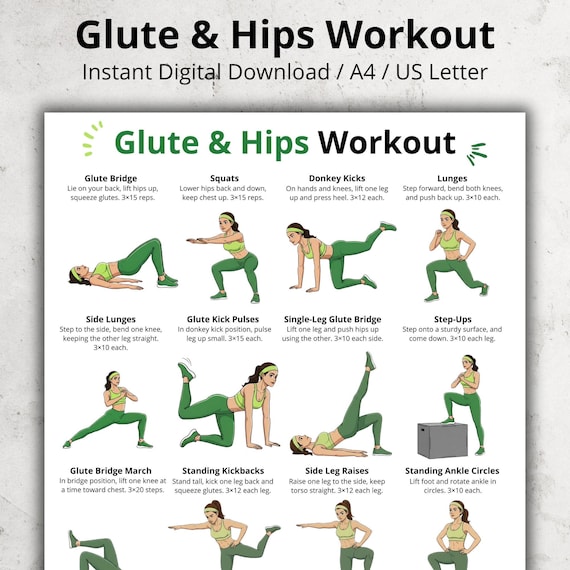
Credit: www.etsy.com
Key Principles: How To Structure Your Leg Glute Workout
To build muscle and see real changes, structure is important. Here’s what you need to know:
- Warm Up First: Always spend 5-10 minutes warming up. This increases blood flow and reduces injury risk. Try jumping jacks, bodyweight squats, or light jogging in place.
- Compound Movements: Choose exercises that work multiple muscles at once (like squats, lunges, glute bridges).
- Progressive Overload: Increase difficulty over time by adding reps, sets, or resistance.
- Proper Form: Focus on quality, not just quantity. Bad form can cause injury and slow progress.
- Rest and Recovery: Muscles need time to repair and grow. Train legs/glutes 2-3 times per week, with rest in between.
Here’s a simple example schedule:
| Day | Workout Focus |
|---|---|
| Monday | Leg & Glute Workout |
| Wednesday | Upper Body/Core |
| Friday | Leg & Glute Workout |
Top Home Leg Glute Exercises
Not all exercises are equal. Here are some of the most effective lower body moves you can do at home, with variations for all levels.
1. Bodyweight Squat
This classic move works your quads, glutes, and core.
- Stand with feet hip-width apart.
- Push hips back, bend knees, and lower your body as if sitting in a chair.
- Keep chest up, knees out, and heels on the ground.
- Go as low as you can, then push back up.
Tip: Pause at the bottom for 2-3 seconds to increase intensity.
2. Glute Bridge
Great for targeting the glutes and hamstrings.
- Lie on your back, knees bent, feet flat on the floor.
- Push through your heels, lift hips as high as possible.
- Squeeze glutes at the top, then lower slowly.
Variation: Single-leg glute bridge for extra challenge.
3. Reverse Lunge
Works quads, glutes, and balance.
- Stand tall, step one foot back.
- Lower your back knee toward the floor.
- Push through front heel to return to standing.
Mistake to avoid: Letting your front knee push forward too much.
4. Bulgarian Split Squat
Targets glutes and quads, also improves balance.
- Stand a few feet in front of a chair.
- Place one foot on the chair behind you.
- Lower your back knee toward the ground.
- Push through front heel to rise.
Beginner tip: Hold onto a wall for balance at first.
5. Step-up
Simple but effective for legs and glutes.
- Find a sturdy chair or bench.
- Step up with one foot, drive through your heel.
- Bring the other foot up, then step down.
Tip: Go slowly to focus on muscle control.
6. Side-lying Hip Abduction
Works the glute medius for hip stability.
- Lie on your side, legs straight.
- Lift top leg up and back slightly.
- Lower with control.
Add a resistance band for more challenge.
7. Curtsy Lunge
Adds a twist to hit glutes and inner thighs.
- Stand tall, step one foot behind and across the other.
- Lower your back knee toward the floor.
- Push through the front heel to stand.
8. Donkey Kicks
Targets glutes, especially the upper part.
- Start on all fours.
- Keep knee bent, lift one leg up and back.
- Squeeze glute at the top.
Do not arch your lower back.
9. Wall Sit
An isometric move for quads and glutes.
- Lean against a wall, slide down until knees are at 90 degrees.
- Hold for as long as possible.
Try to increase your hold time weekly.
10. Calf Raise
Strengthens calves and supports ankle stability.
- Stand with feet flat.
- Rise onto tiptoes, hold, then lower slowly.
Use a step for a bigger range of motion.
Sample Leg Glute Workouts For Every Level
You can build a routine by mixing and matching the above exercises. Here are sample workouts for three levels:
Beginner Home Leg Glute Workout
- Bodyweight Squat: 3 sets of 12 reps
- Glute Bridge: 3 sets of 15 reps
- Reverse Lunge: 3 sets of 10 reps per leg
- Wall Sit: 3 sets of 30 seconds
Rest: 45-60 seconds between sets.
Intermediate Home Leg Glute Workout
- Bulgarian Split Squat: 3 sets of 10 reps per leg
- Single-Leg Glute Bridge: 3 sets of 12 reps per leg
- Curtsy Lunge: 3 sets of 12 reps per leg
- Side-Lying Hip Abduction: 3 sets of 15 reps per leg
- Calf Raise: 3 sets of 20 reps
Rest: 30-45 seconds between sets.
Advanced Home Leg Glute Workout
- Jump Squat: 4 sets of 12 reps
- Bulgarian Split Squat (weighted): 4 sets of 12 reps per leg
- Single-Leg Deadlift (use dumbbells or backpack): 4 sets of 12 reps per leg
- Donkey Kick (with band): 4 sets of 15 reps per leg
- Wall Sit (with weight): 4 sets of 45-60 seconds
Rest: 30 seconds between sets.
Progression: How To Keep Improving
Many beginners stop seeing results after a few weeks. This is often because they do not make their workouts harder over time. Here’s how you can keep progressing at home:
- Increase Reps or Sets: Add more repetitions or an extra set as you get stronger.
- Slow Down the Tempo: Make each rep take longer, especially on the way down.
- Add Resistance: Use bands, dumbbells, or even a heavy backpack.
- Try Harder Variations: Move from two-leg to single-leg exercises.
- Shorten Rest Periods: Less rest means more challenge for your muscles.
Hidden insight: Tracking your workouts in a notebook or app helps you see progress and stay motivated. Many people skip this, but it makes a big difference.
Common Mistakes In Home Leg Glute Workouts
Avoid these mistakes to get better results and reduce injury risk:
- Skipping Warm-Ups: Cold muscles are more likely to get hurt.
- Rushing Through Reps: Fast, sloppy movements do less for your muscles.
- Ignoring Single-Leg Moves: These build balance and fix muscle weaknesses.
- Not Using Full Range of Motion: Go as deep as you safely can in each move.
- Neglecting Glute Activation: Glutes can be “sleepy.” Try band walks or glute bridges before your main workout.
Many people also forget to stretch after training, which can lead to tight hips and sore lower back.
How Nutrition Supports Your Leg Glute Gains
Exercise is only half the story. To build muscle, you need the right nutrition:
- Protein: Essential for muscle repair and growth. Aim for 1.2-2.0 grams per kg of body weight.
- Carbohydrates: Fuel your workouts and help with recovery.
- Healthy Fats: Support hormones and joint health.
- Water: Stay hydrated for better performance.
If you’re looking to build muscle, eat a slight calorie surplus. For fat loss, keep a small calorie deficit but don’t cut protein.
| Goal | Protein (g/kg) | Carbs (g/kg) | Fats (g/kg) |
|---|---|---|---|
| Build Muscle | 1.6-2.0 | 3-6 | 0.8-1.0 |
| Fat Loss | 1.6-2.0 | 2-4 | 0.8-1.0 |
When To Add Weights Or Resistance Bands
Bodyweight exercises work well, but eventually your muscles need more challenge. That’s when you add:
- Resistance Bands: Cheap, portable, and great for targeting glutes.
- Dumbbells/Kettlebells: Use what you have at home, even filled water bottles or bags.
- Backpacks: Fill with books for weighted squats or lunges.
Non-obvious insight: Resistance bands are especially good for activating the side glutes (glute medius). Many people miss this, but it helps shape your hips and improves stability.
Combining Cardio With Leg Glute Training
You can add cardio to your leg glute workouts for more calorie burn and heart health. Here’s how:
- Superset Moves: Do squats, then immediately do high knees or jumping jacks.
- Add Circuits: Rotate 3-5 exercises with little rest.
- Try HIIT: Short, intense bursts (like 20 seconds squat jumps, 10 seconds rest).
Caution: Don’t do intense cardio before your main strength workout. It can make your legs too tired for good form.
How To Avoid Plateaus
Plateaus are common when your body adapts and progress slows. To break through:
- Change Exercises: Swap squats for lunges, or bridges for hip thrusts.
- Adjust Sets and Reps: Try more sets with fewer reps, or vice versa.
- Increase Intensity: Add pauses, pulses, or shorten rest times.
- Set Short-Term Goals: Like holding a wall sit 10 seconds longer.
Tracking your workouts and making small changes every 2-4 weeks keeps you moving forward.
Recovery: Stretching And Mobility After Leg Glute Workouts
Recovery is as important as the workout itself. After training, spend 5-10 minutes stretching:
- Standing Quad Stretch: Hold one foot behind you, stretch the front of your thigh.
- Seated Hamstring Stretch: Reach for your toes.
- Figure-Four Stretch: Lie down, cross one ankle over the opposite knee, pull in.
- Calf Stretch: Lean against a wall, press heel down.
Foam rolling or massage can also help reduce soreness.
Tip: Many beginners skip recovery. Over time, this can lead to pain and stiff muscles, slowing your progress.
Tracking Progress And Staying Motivated
Sticking with a home workout can be tough. Here are ways to stay on track:
- Write Down Your Workouts: Use a notebook or app.
- Take Progress Photos: Every 2-4 weeks, same lighting, same pose.
- Set Small Goals: Like adding 5 more reps, or holding a move longer.
- Celebrate Wins: Notice when you feel stronger or your clothes fit better.
Extra insight: Strength and muscle changes may not show on the scale right away. Measurements and photos show progress better.
Safety Tips For Home Leg Glute Workouts
Your home may not be as safe as a gym. Reduce injury risk by:
- Clearing Space: Move furniture, rugs, or objects out of your way.
- Using Proper Shoes: Stable, non-slip shoes protect your feet and knees.
- Listening to Your Body: Sharp pain means stop. Muscle “burn” is normal, but joint pain is not.
If you have knee, hip, or back injuries, check with a physical therapist before starting new exercises.

Credit: amkglobalgroup.com
Example Weekly Home Leg Glute Training Plan
Here’s a plan you can adjust to your needs. It mixes strength and cardio for best results.
| Day | Focus | Example Exercises |
|---|---|---|
| Monday | Strength | Squats, Glute Bridges, Lunges, Calf Raises |
| Wednesday | HIIT/Cardio | Jump Squats, High Knees, Burpees, Step-Ups |
| Friday | Strength | Bulgarian Split Squats, Donkey Kicks, Wall Sit, Side-Lying Hip Abduction |
| Saturday | Mobility/Stretch | Yoga, Foam Rolling, Static Stretches |
Adjust sets, reps, and rest based on your fitness level.
Real-life Examples: People Who Transformed Their Lower Body At Home
Many people have reshaped their legs and glutes without a gym. For example, a mother of two used bodyweight squats and lunges after her kids went to bed. In six months, she could run faster and had fewer backaches. Another person, working from home, did resistance band glute bridges and step-ups during lunch breaks.
He noticed better muscle tone and improved posture.
These stories show that consistency and good form are more important than equipment or gym access.

Credit: nilds.gov.ng
Resources For More Learning
If you want to go deeper, check out official resources like the ACE Exercise Library for detailed movement breakdowns and video guides.
Frequently Asked Questions
How Many Times Per Week Should I Do Leg Glute Workouts At Home?
For most people, 2-3 sessions per week is enough to build strength and muscle. This gives your muscles time to recover and grow. If you’re a beginner, start with two days and add a third as you get stronger.
Can I Really Build Muscle At Home Without Weights?
Yes, you can build muscle using bodyweight exercises and resistance bands. The key is to challenge your muscles with harder variations, more reps, or slower movements. Over time, adding bands or weights (like a backpack) helps you progress further.
How Long Does It Take To See Results From Leg Glute Workouts?
Visible results depend on your starting point, effort, and nutrition. Most people notice changes in strength and muscle tone within 4-8 weeks if they train regularly and eat well. Taking progress photos helps you spot improvements that the scale might not show.
What If I Have Knee Pain During Leg Exercises?
If you feel sharp knee pain, stop that exercise and check your form. Often, pain comes from letting your knees go too far forward or collapsing inward. Try gentler moves like glute bridges or wall sits. If pain continues, see a healthcare professional before continuing.
Do I Need To Do Cardio With My Leg Glute Workouts?
Cardio is not required to build muscle, but it helps with fat loss and heart health. You can combine short bursts of cardio (like jump squats or high knees) with your strength routine for more benefits. Just avoid tiring out your legs before your main strength work.
Building strong legs and glutes at home is possible, practical, and rewarding. With the right exercises, good form, and steady progress, you’ll notice real changes in how you look, move, and feel. Stick with it, track your progress, and adjust as you get stronger—you might be surprised how much you can achieve in your own space.
